
Edinburgh Marathon
Edinburgh's marathon is a point-to-point race that leaves the Scottish capital and runs east along the coast to Musselburgh. The 2027 edition is on 30 May.
By Global Marathon Routes editorial team · Last reviewed 27 October 2026
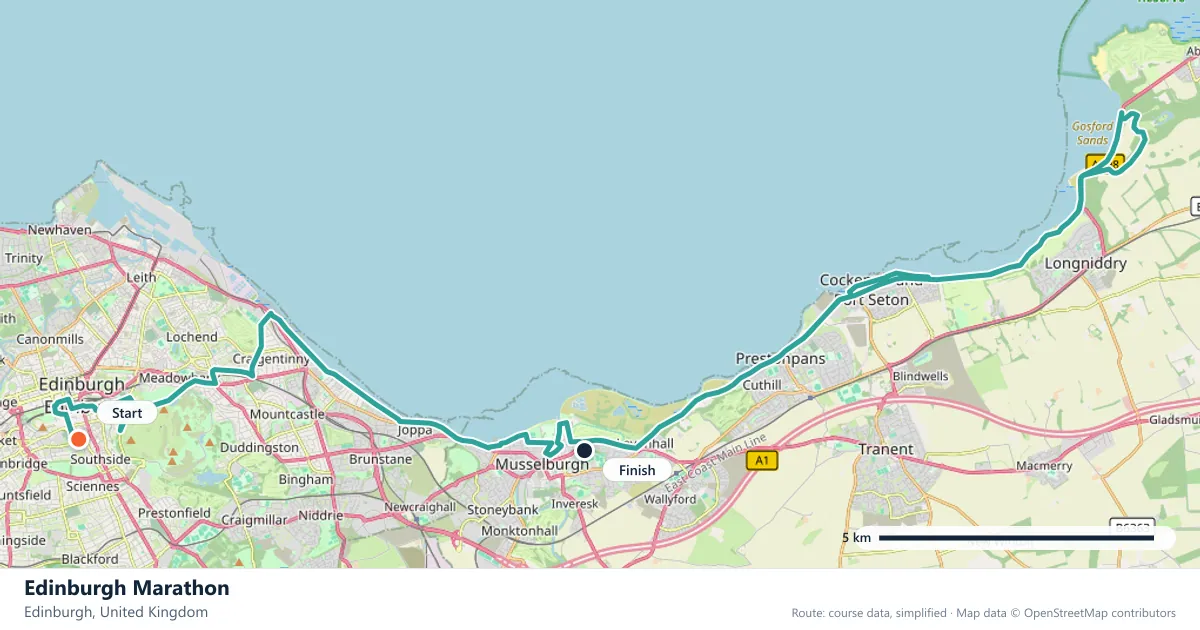
Where does the Edinburgh Marathon run?
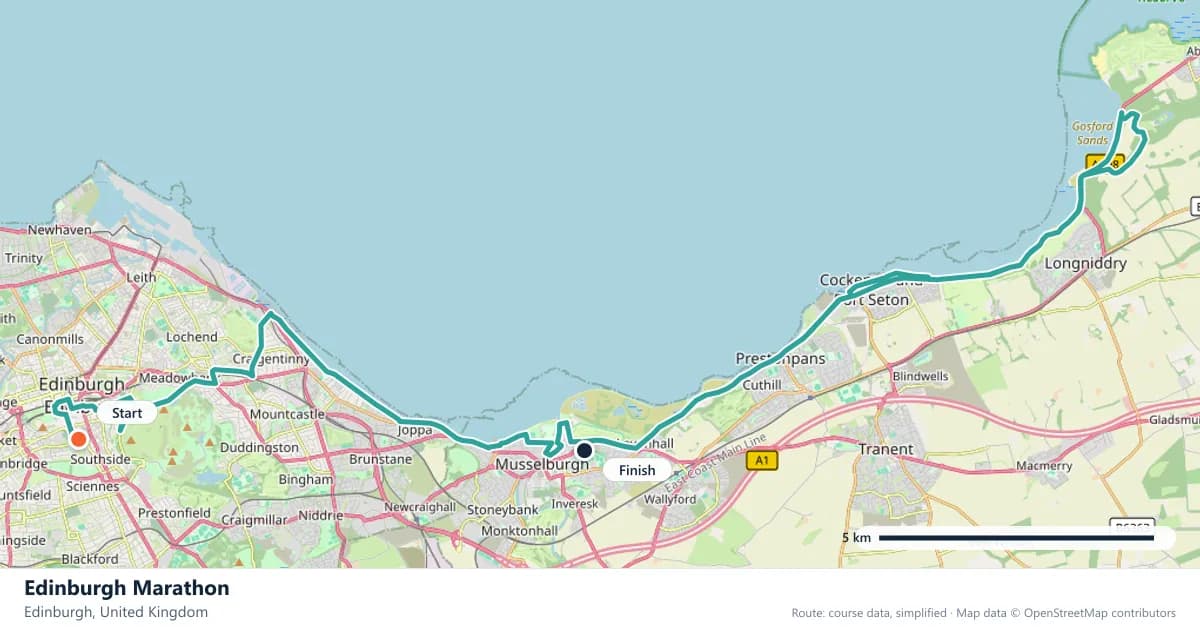
Interactive map
The trace follows the organizer's published course, simplified for the screen: the orange dot is the start, the dark dot the finish. Scroll to zoom, drag to pan.
What is the Edinburgh Marathon course like?
A point-to-point run from the city centre out along the coast towards Musselburgh, mostly flat and quick when the wind cooperates. One of the fastest spring courses in Britain.
- Next edition
- 30 May 2027
- Elevation gain
- 101 m
- Profile
- Undulating
- First run
- —
Course guide
Edinburgh's marathon is a point-to-point race that leaves the Scottish capital and runs east along the coast to Musselburgh. The 2027 edition is on 30 May. On paper the course is undulating, with about 101 metres of climbing; in practice it is mostly flat and can be very quick when the wind cooperates.
The route heads out of the city centre rather than looping back, so the race has a direction and a destination. The centre, the coast and the finish at Musselburgh are three different settings, and the day changes character as the city gives way to the water.
Edinburgh is one of the fastest spring courses in Britain, and the scene at the start reflects that: club runners chasing times and visitors using the race as a spring target.
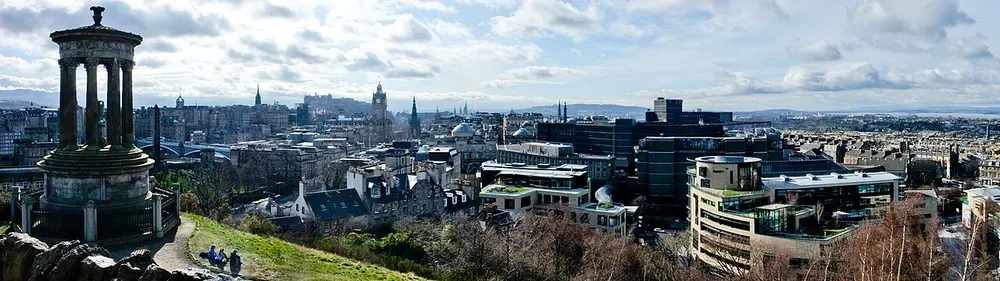
Edinburgh Skyline Panorama. Photo: Strevo / Wikimedia Commons, CC BY 2.0.
The course
The race starts in Edinburgh city centre and runs east along the coast towards Musselburgh. It is point to point, with no looping back, so the route keeps moving and the second half is more exposed. The 101 metres come as gentle undulation rather than a true hill.
The course is fast, but not automatic. The flat sections let you hold a rhythm; the small rises and the coastal wind interrupt it. The finish at Musselburgh is a separate place from the start, which shapes the whole day's logistics.
Out of the capital
Leaving the centre means passing from dense streets to the coastal edge of the city. The urban opening is the busiest part of the course; the coast is where it opens up. The skyline gives way to the coast, and the running changes with it: enclosed streets at the start, open road for the long haul east.
Edinburgh's skyline, the castle and Arthur's Seat behind you, gives the start a strong sense of place. The race is not a sightseeing loop, but the first miles run through a city with a distinctive silhouette.
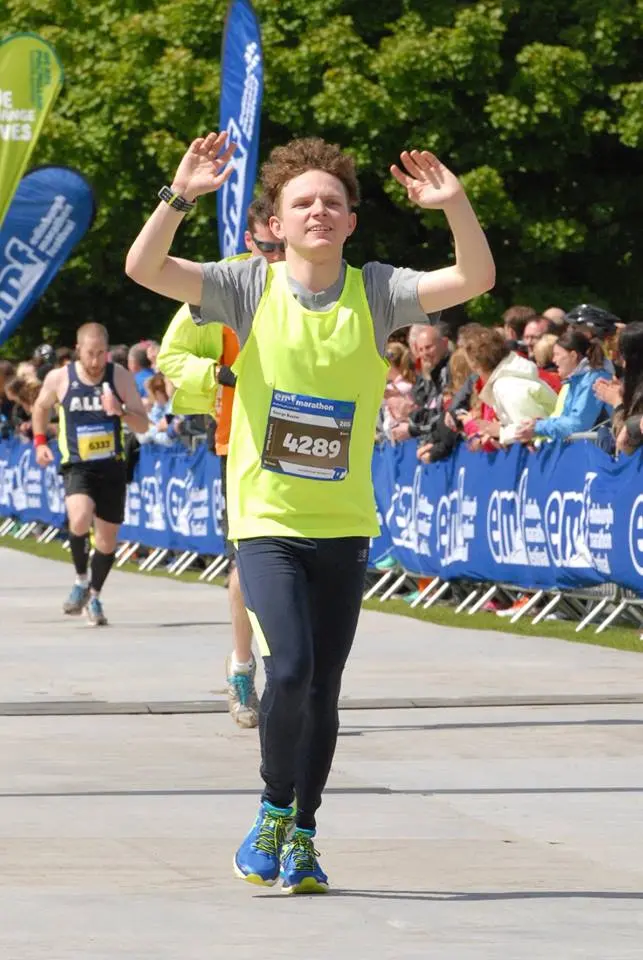
Edinburgh marathon runner. Photo: JJZG123458923 / Wikimedia Commons, CC BY-SA 4.0.
The wind on the coast
The coastal stretch is the race's wildcard. When the wind is behind the field, the course can be very quick; when it is not, the same flat kilometres demand patience and a lower gear. There is little shelter on the exposed sections, so use groups and do not fight the gusts.
The exposed sections are also where the field spreads out, so company can be harder to find just when you need it. Pacing by effort matters more than hitting exact splits. A headwind can cost minutes without any change in effort, and chasing the watch in those conditions is a mistake.
Getting back from Musselburgh
The finish is east of the city, in Musselburgh, and the start is in the centre. That separation is the main logistical fact of the race. Arrange your return before race day, with a meeting point and a plan for getting back to the city.
Allow more time than you think for the journey, and keep warm clothes with whoever is meeting you. The finish area is a different town, with its own streets and its own crowd. A point-to-point race is simple when the plan is made in advance and stressful when it is improvised at the finish.
A quick Scottish spring
The date is confirmed for 30 May 2027. Late May is a good time for a fast race in Scotland: the days are long, the city is busy, and the coast is at its most inviting.
Musselburgh sits at the mouth of the Esk, east of the city, and the finish there gives the race a seaside ending. The course's reputation rests on the 101 metres and the point-to-point shape. It is not a mountain race; it is a road race that rewards rhythm and punishes bad pacing.
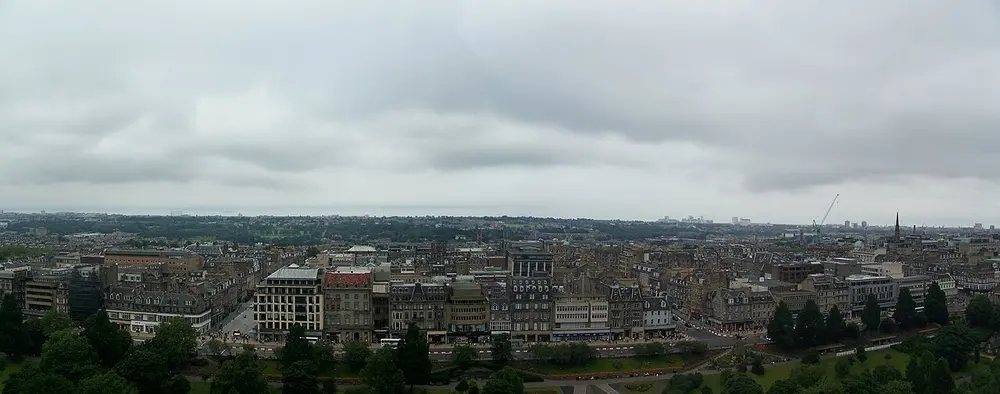
Edinburgh Skyline from the Castle. Photo: Carlesmari / Wikimedia Commons, CC BY 3.0.
Frequently asked questions
Answers to the questions runners ask before entering, drawn from this race's course guide and the directory's own data — the sources behind them are listed below.
When is the Edinburgh Marathon?
The next edition is on 30 May 2027. It is a late-spring race, and the date is confirmed rather than provisional.
Is the Edinburgh Marathon flat or hilly?
It is undulating, with about 101 metres of climbing, but the course is mostly flat and quick. The coastal section adds gentle rises and exposure to the wind rather than a true hill.
Is it good for a personal best?
Yes. The limited climbing and fast profile suit a personal-best attempt, provided the wind is not against you. The course is one of the quicker spring marathons in Britain.
Is it a good first marathon?
The course is manageable for a debut, with modest climbing and mostly flat roads. The point-to-point layout and the coastal wind add complexity, so plan the day carefully rather than treating it as a simple city loop.
Where is the Edinburgh Marathon run?
It runs from Edinburgh city centre out along the coast towards Musselburgh in Scotland. The finish is east of the city.
Is the course point-to-point?
Yes. The race starts in Edinburgh's city centre and finishes towards Musselburgh, so runners need to plan a return from the finish area.
More marathons in United Kingdom
More marathons in Europe
Sources for this page
What each source below is used for on this page, and where to check this race yourself.
- World Athletics — the label calendar and the road-race regulations. Used to check whether the race holds a World Athletics label, and its elite competition details.
- AIMS — the international course-measurement standard behind the 42.195 km distance, and the AIMS race calendar.
- The organizer's own publications — course maps, race handbooks and published results. The date, course character and climbing on this page are compiled from them and re-checked each season.
Where do these facts come from?
Dates, course type, climbing and time limits are compiled from the organizer's publications and re-checked each season; elevation is an estimate of total climbing rather than a survey figure. Always confirm race-day details with the organizer before making plans.
Last reviewed 27 October 2026