
Hannover Marathon
Hannover's marathon is built on a simple proposition: take almost all the climbing out of a city course and let the runners find a rhythm.
By Global Marathon Routes editorial team · Last reviewed 27 October 2026
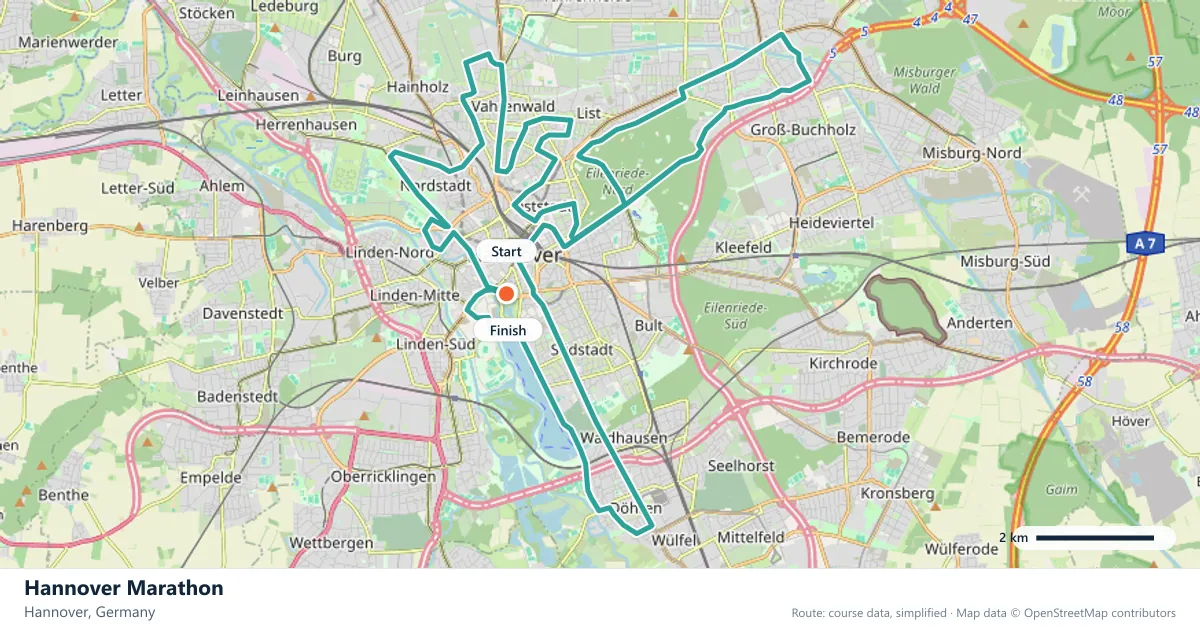
Where does the Hannover Marathon run?
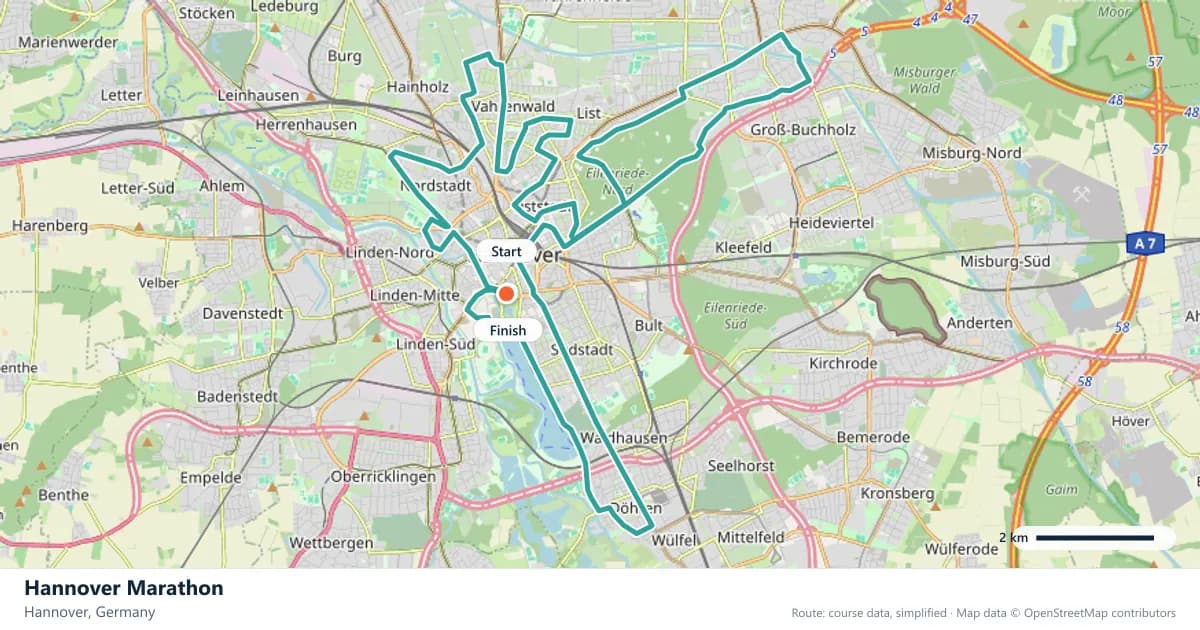
Interactive map
The trace follows the organizer's published course, simplified for the screen: the orange dot is the start, the dark dot the finish. Scroll to zoom, drag to pan.
What is the Hannover Marathon course like?
A pancake-flat spring course through Hannover, past the Maschsee and the Herrenhäuser Gardens. Almost no climbing at all, which is why it is a popular first marathon.
- Next edition
- 11 April 2027
- Elevation gain
- 43 m
- Profile
- Flat
- First run
- —
Course guide
Hannover's marathon is built on a simple proposition: take almost all the climbing out of a city course and let the runners find a rhythm. The route measures roughly 43 metres of ascent, the profile is flat, and the next edition falls on 11 April 2027. The race holds a World Athletics Label.
The course threads through Hannover past the Maschsee and the Herrenhäuser Gardens, two very different kinds of green space: one a lake at the centre of the city, the other a formal baroque garden on its edge. Together they give a quick race a scenic spine, and they help explain why the event has become a fixture for runners chasing a personal best or a first marathon.
There is no famous climb here, no decisive bridge or wall to break the race. The appeal is the opposite: kilometres that get out of your way. In a marathon landscape full of engineered challenges, that is an identity of its own.
The course
The marathon stays inside Hannover, and the route's character is set by the two open spaces it passes. The Maschsee supplies a long stretch of water and promenade; the Herrenhäuser Gardens supply hedges, avenues and a very different kind of calm. Between them, the city's streets fill in the rest of the 42.195 km.
With about 43 metres of gain, there is no sustained ascent and no hill that asks for a change of stride. The few rises are spread so thinly that the road feels level underfoot. That makes the course easy to read and hard to resist: the first half will feel comfortable almost regardless of pace, and the second half will expose whatever was borrowed from it.

2021-09-05 Hannover Germany Skyline (100). Photo: Klaaschwotzer / Wikimedia Commons, CC BY-SA 4.0.
Maschsee, Herrenhäuser and the green middle
The Maschsee is an artificial lake and one of Hannover's favourite places to run, row and walk. Its shoreline gives the marathon a long, open section where the field can spread out and the city feels further away than it is.
The Herrenhäuser Gardens are a formal counterpoint. The Great Garden is a baroque set piece of clipped hedges, parterres and straight avenues, and the long lime avenue of the Herrenhäuser Allee leads towards it from the city. On race day the gardens are a landmark rather than a puzzle: the route passes them, and their geometry is a useful reminder of how flat the surrounding ground really is.
Together the two places make a course that is green without being rural. You are never far from a street, a tram line or a crowd, but the middle of the race has enough parkland to keep the city at arm's length.
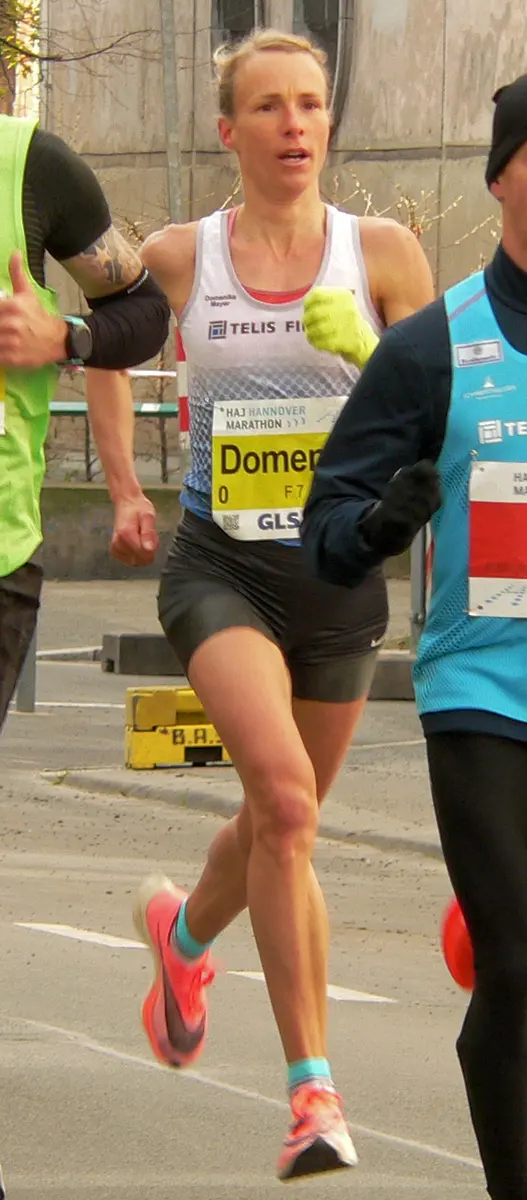
Hannover Marathon 2022 Domenika Mayer. Photo: Hannatoni / Wikimedia Commons, CC BY-SA 3.0.
Pacing a pancake-flat course
Flat courses are not automatically easy. With only about 43 metres of climbing, there is no descent where you can recover and no climb where you can reset; the same muscles do the same work from the first kilometre to the last. The pace you choose early is the pace you will have to live with.
The practical approach is to treat the first 10 km as a cap, not a target. Let the field move away if it wants to. Hannover's landmarks arrive in sequence, and each one is a chance to check posture and effort rather than a reason to surge. If you are chasing a personal best, the second half is where the time is made; if it is your first marathon, the second half is where the day is protected.
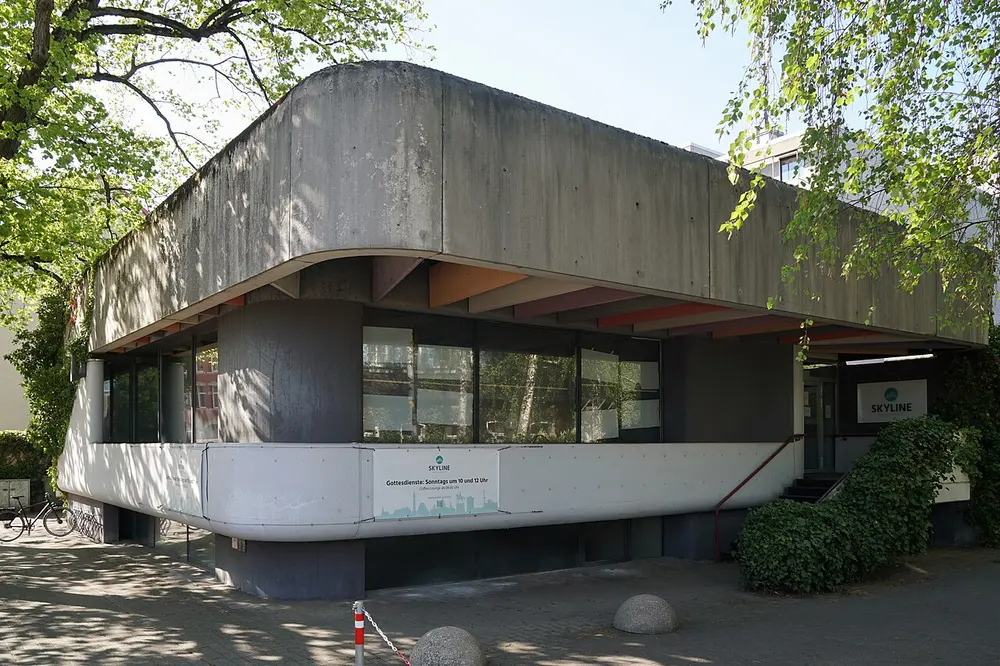
2020-04-22 163340 Hannover Kirche Alte Herrenhäuser Straße. Photo: Tim Rademacher / Wikimedia Commons, CC BY-SA 4.0.
Spring in Lower Saxony
An April date in northern Germany means most of the build happens through winter, and race morning can bring almost any version of spring. Plan layers that are easy to shed, and do not treat a mild forecast as a promise. The city itself is easy to move around, with the centre, the lake and the gardens all within reach of each other.
Hannover's centre was largely rebuilt after the Second World War, and the mix of old and new is part of its character: the New Town Hall, the Sprengel Museum and the shopping streets sit close together. A spring weekend gives you an excuse to walk the city after the race, which is a better recovery plan than sitting still.
Frequently asked questions
Answers to the questions runners ask before entering, drawn from this race's course guide and the directory's own data — the sources behind them are listed below.
When is the Hannover Marathon?
The next edition is on 11 April 2027. It is a spring race and holds a World Athletics Label.
Is the Hannover Marathon a flat course?
Yes. The route climbs about 43 metres in total, with no sustained ascent. The road feels level for long stretches, which is why the race is associated with even pacing and quick times.
Is Hannover a good first marathon?
Yes, and the flat profile is the main reason. With so little climbing, the distance is the challenge rather than the terrain, which makes it a sensible place to debut as long as you hold back in the opening kilometres.
Is it a good course for a personal best?
The low climbing and the level roads give a personal best a fair chance. The risk is not the course but the pacing: flat kilometres encourage an opening that feels easier than it is.
What does the course pass?
The route goes through Hannover past the Maschsee and the Herrenhäuser Gardens. Those two green spaces give the race most of its scenery, with the city streets connecting them.
How should I train for the flat profile?
Do not neglect hills entirely. Short, regular hill sessions keep the legs strong without changing the race-day demands, and long runs on level ground teach you the even effort the course rewards.
More marathons in Germany
More marathons in Europe
Sources for this page
What each source below is used for on this page, and where to check this race yourself.
- World Athletics — the label calendar and the road-race regulations. Used to check whether the race holds a World Athletics label, and its elite competition details.
- AIMS — the international course-measurement standard behind the 42.195 km distance, and the AIMS race calendar.
- The organizer's own publications — course maps, race handbooks and published results. The date, course character and climbing on this page are compiled from them and re-checked each season.
“A World Athletics Label denotes a full application of the Competition and Technical Rules in, at a minimum, the elite component of the competition. Labels also denote superior standards in event organisation, safety and runner experience, support from public authorities to the event and a financial commitment to anti-doping.”
Where do these facts come from?
Dates, course type, climbing and time limits are compiled from the organizer's publications and re-checked each season; elevation is an estimate of total climbing rather than a survey figure. Always confirm race-day details with the organizer before making plans.
Last reviewed 27 October 2026