
Frankfurt Marathon
Frankfurt's skyline is the only one in Germany that genuinely rivals a capital city's. The towers of the banking district rise above the Main, and the river gives the financial centre a waterfront…
By Global Marathon Routes editorial team · Last reviewed 27 October 2026
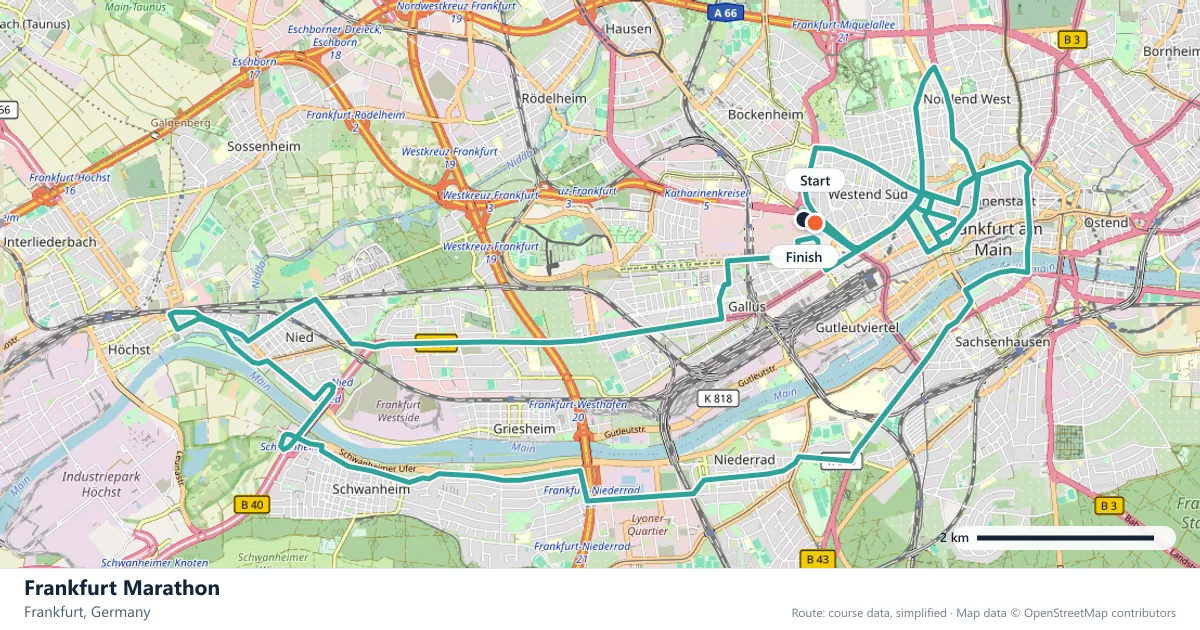
Where does the Frankfurt Marathon run?
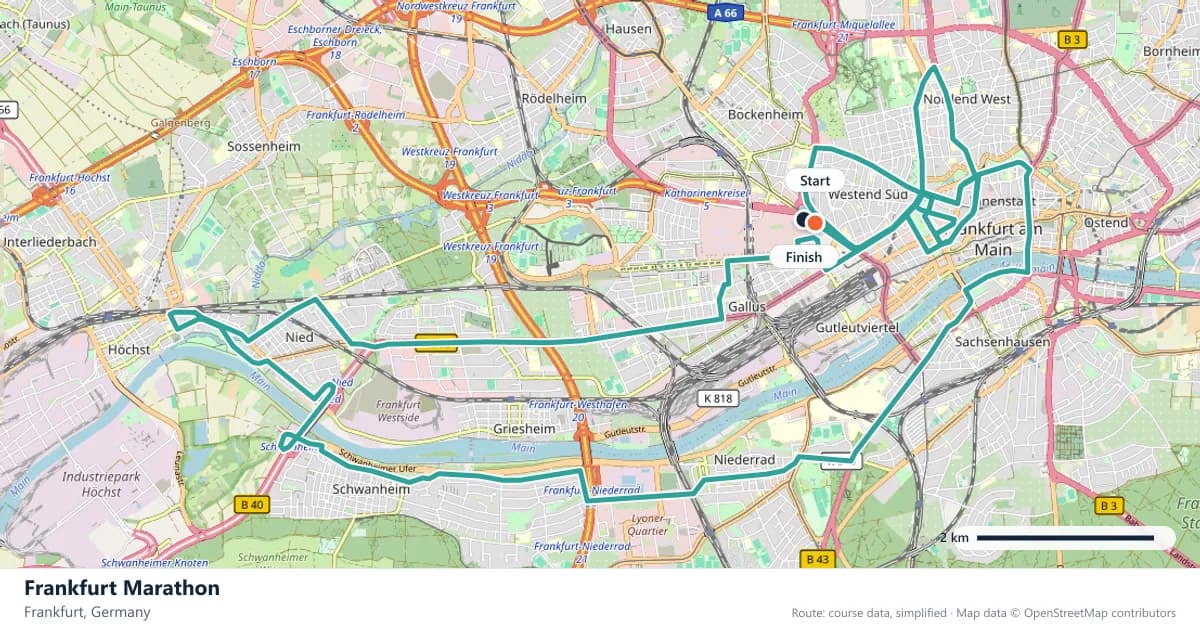
Interactive map
The trace follows the organizer's published course, simplified for the screen: the orange dot is the start, the dark dot the finish. Scroll to zoom, drag to pan.
What is the Frankfurt Marathon course like?
A fast autumn race through the banking district, along the Main and out to the exhibition halls. The flat course and late-October date have produced some of Europe's quickest times.
- Next edition
- October 2027 (expected)
- Elevation gain
- 95 m
- Profile
- Flat
- First run
- —
Course guide
Frankfurt's skyline is the only one in Germany that genuinely rivals a capital city's. The towers of the banking district rise above the Main, and the river gives the financial centre a waterfront that softens the glass and steel. The marathon runs through that landscape, following the Main and heading out to the exhibition halls. The next edition is expected in October 2027.
The course is flat and the late-October date has helped it produce some of Europe's quickest times; about 95 metres of climbing is spread across the route. It holds a World Athletics Elite Label. The combination of a fast route, a big-city atmosphere and a season-ending date makes it one of Germany's most established autumn races.
Frankfurt is not a pretty medieval city in the way that Prague or Dresden is. Its appeal is different: a modern, confident financial capital, a riverfront that has become a leisure space, and a marathon that uses the city's scale rather than its history.
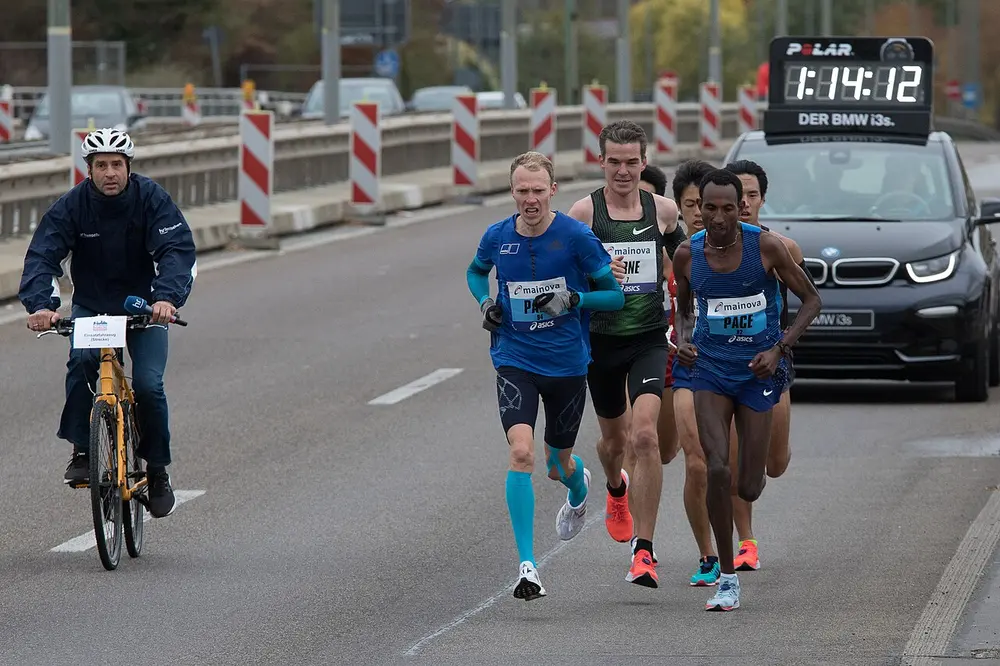
Frankfurt-Marathon-2018. Photo: JeLuF / Wikimedia Commons, CC BY-SA 4.0.
The course
The course works through the banking district, follows the Main and heads out to the exhibition halls. These are broad, recognisable parts of Frankfurt, and the route stays flat as it moves between them. The river provides the most open section, while the financial district supplies the skyline that defines the race.
With roughly 95 metres of climbing, Frankfurt is not the absolutely flattest marathon course, but there is no sustained ascent. The gentle changes of grade are spread across the route, and the wide roads let the field settle early. The course rewards runners who can hold an even effort through the city sections.
The skyline and the Main
The banking district is the image most people have of Frankfurt: a cluster of towers around the Main, with the river reflecting the glass. The marathon passes through it, and the scale of the buildings gives the race a very different feel from a course that threads through old streets.
The Main itself is the counterweight. Its banks have been developed into a long riverside park, with paths, trees and views back towards the skyline. The race follows that waterfront, and the contrast between the towers and the water is one of the best parts of the morning.
Out to the exhibition halls
The exhibition halls are another distinctive Frankfurt landmark. The Messe is one of the largest trade-fair complexes in Europe, and the course heads out to it before returning to the city. The area is broad and modern, with wide roads and a scale that matches the financial district.
For runners, the exhibition halls are a marker rather than a highlight. The section gives the course a longer, more varied shape and keeps it from becoming a simple river loop. The return to the centre brings the skyline back and sets up the final kilometres.
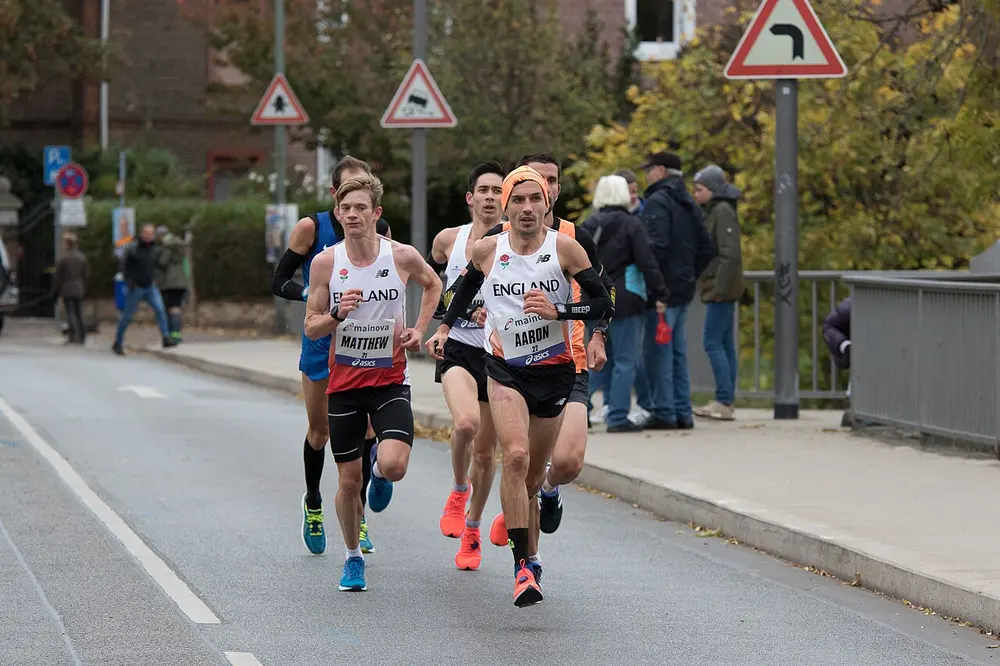
Frankfurt-Marathon-2018 (photo 2). Photo: JeLuF / Wikimedia Commons, CC BY-SA 4.0.
Why Frankfurt is fast
The course's speed comes from three things: a flat profile, wide roads and a late-October date that usually offers cooler racing conditions than the summer. The 95 metres of climbing are not nothing, but they are spread thinly enough that the route never forces a major change of effort.
The Elite Label reflects the depth of the field as well as the course. Frankfurt has become a place where fast times are expected, and that reputation attracts runners who are prepared to chase them. A personal best is never guaranteed, but the course gives you a fair chance.
A late-October weekend
Late October is the end of the German marathon season, and Frankfurt uses that position well. The race feels like a finale: the summer training is complete, the city is back in its autumn rhythm and the cooler weather suits distance running.
The central location and the riverside setting make race weekend easy to navigate. The banking district, the Main and the exhibition halls are connected by public transport, and supporters can find several viewpoints without long transfers. It is a big-city race with a straightforward course and a clear fast-time identity.
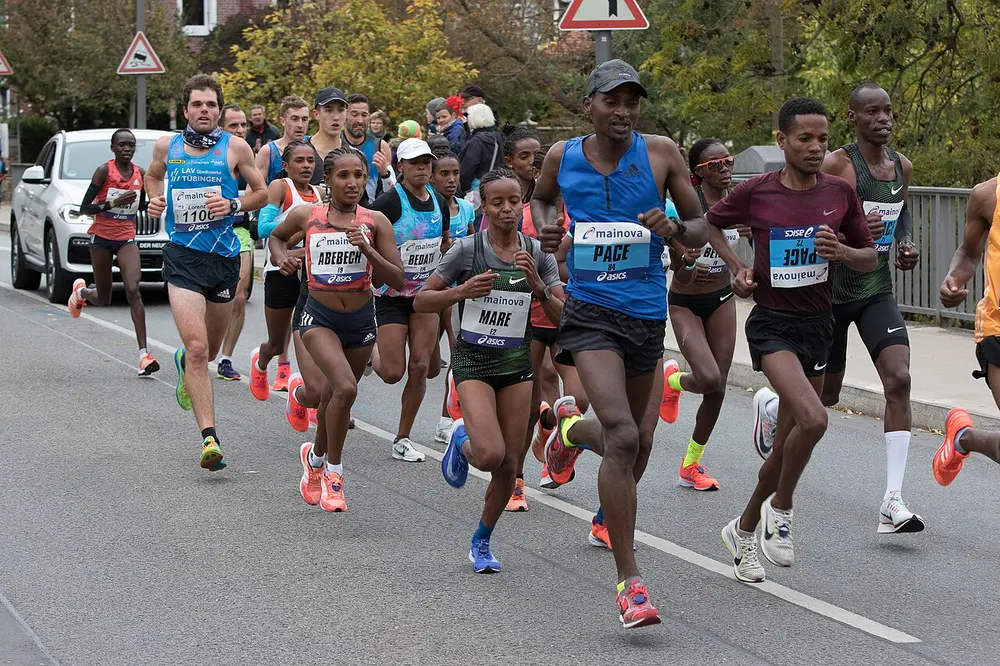
Frankfurt-Marathon-2018 (photo 3). Photo: JeLuF / Wikimedia Commons, CC BY-SA 4.0.
Frequently asked questions
Answers to the questions runners ask before entering, drawn from this race's course guide and the directory's own data — the sources behind them are listed below.
When is the Frankfurt Marathon?
The next edition is expected in October 2027. It is a late-October race in the financial capital.
Is the Frankfurt Marathon a flat course?
Yes, broadly. The course climbs about 95 metres, with no sustained ascent, so it is a flat marathon by any practical standard. There are gentle changes of grade, but nothing that requires hill-specific training.
Is Frankfurt good for a personal best?
The flat course and late-October date have produced very quick times, making it a strong personal-best candidate. A personal best still depends on pacing and conditions, but the route offers little resistance.
Is the Frankfurt Marathon suitable for a first marathon?
Yes. The limited climbing and straightforward city route make it manageable for a debut. The main risk is starting too quickly in a big-city atmosphere.
Does the Frankfurt Marathon hold a World Athletics label?
Yes, it holds a World Athletics Elite Label. The label reflects the race's place among Europe's established autumn marathons.
Where does the Frankfurt Marathon run?
It runs through the banking district, along the Main and out to the exhibition halls. The route stays within Frankfurt and returns to the city centre.
Why has the Frankfurt Marathon produced fast times?
The course is flat and the late-October date sits at the end of the autumn season, with about 95 metres of climbing spread across the route. That combination has produced quick times.
More marathons in Germany
More marathons in Europe
Sources for this page
What each source below is used for on this page, and where to check this race yourself.
- World Athletics — the label calendar and the road-race regulations. Used to check whether the race holds a World Athletics label, and its elite competition details.
- AIMS — the international course-measurement standard behind the 42.195 km distance, and the AIMS race calendar.
- The organizer's own publications — course maps, race handbooks and published results. The date, course character and climbing on this page are compiled from them and re-checked each season.
“A World Athletics Label denotes a full application of the Competition and Technical Rules in, at a minimum, the elite component of the competition. Labels also denote superior standards in event organisation, safety and runner experience, support from public authorities to the event and a financial commitment to anti-doping.”
Where do these facts come from?
Dates, course type, climbing and time limits are compiled from the organizer's publications and re-checked each season; elevation is an estimate of total climbing rather than a survey figure. Always confirm race-day details with the organizer before making plans.
Last reviewed 27 October 2026