
Hamburg Marathon
Hamburg's relationship with water is visible from the air: the Alster lakes sit in the middle of the city, the Elbe and its harbour run along the southern edge, and the two systems give the marathon…
By Global Marathon Routes editorial team · Last reviewed 27 October 2026
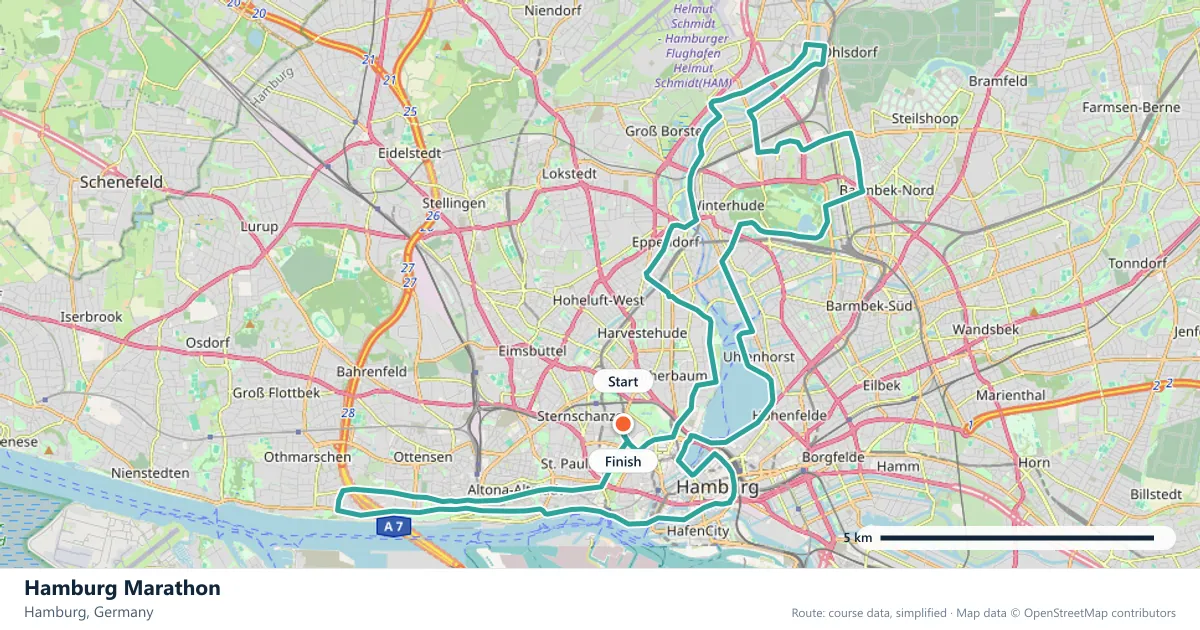
Where does the Hamburg Marathon run?
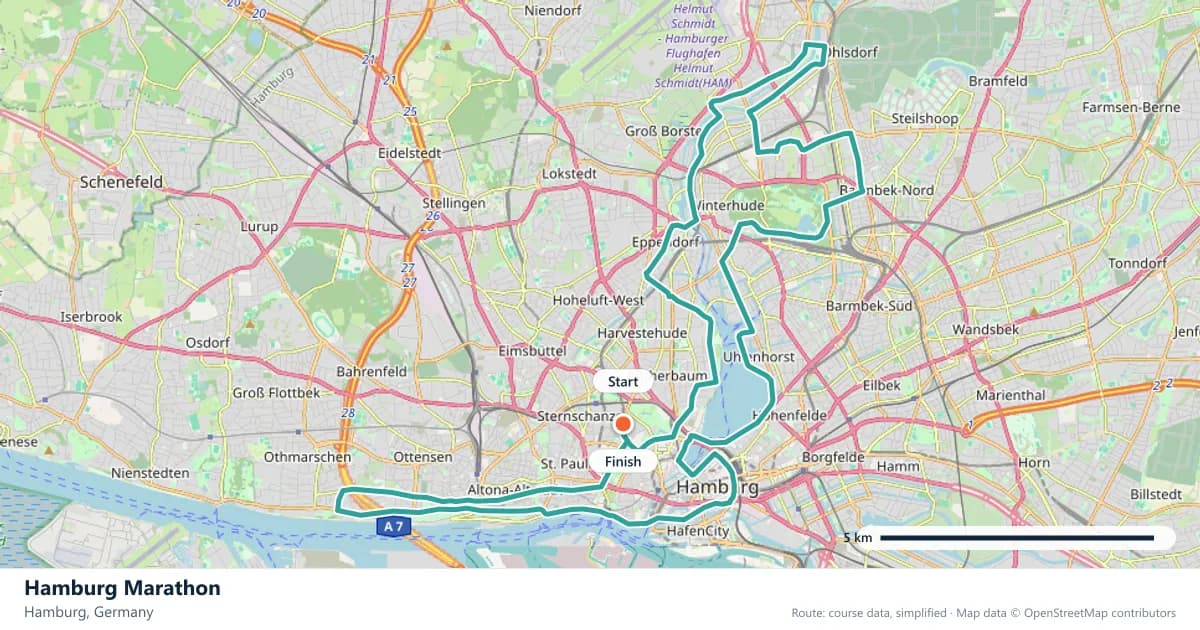
Interactive map
The trace follows the organizer's published course, simplified for the screen: the orange dot is the start, the dark dot the finish. Scroll to zoom, drag to pan.
What is the Hamburg Marathon course like?
Germany's biggest spring marathon, circling the Alster lakes and the harbour district on wide, quick roads. Flat enough for personal bests, with a big-city atmosphere.
- Next edition
- 25 April 2027
- Elevation gain
- 135 m
- Profile
- Undulating
- First run
- —
Course guide
Hamburg's relationship with water is visible from the air: the Alster lakes sit in the middle of the city, the Elbe and its harbour run along the southern edge, and the two systems give the marathon a natural route. The race circles the Alster, works through the harbour district and returns on wide, quick roads. The next edition is on 25 April 2027.
It is Germany's biggest spring marathon, and the field gives the day a big-city feel. The course is undulating on paper, with about 135 metres of climbing, but the rises are gentle and the roads are fast enough for personal bests. The combination of scale, speed and a spring date has made Hamburg a popular target.
The race is not a loop around a single park. It moves between the calm of the Alster, the industrial energy of the harbour and the commercial centre, and that variety is a large part of its appeal.
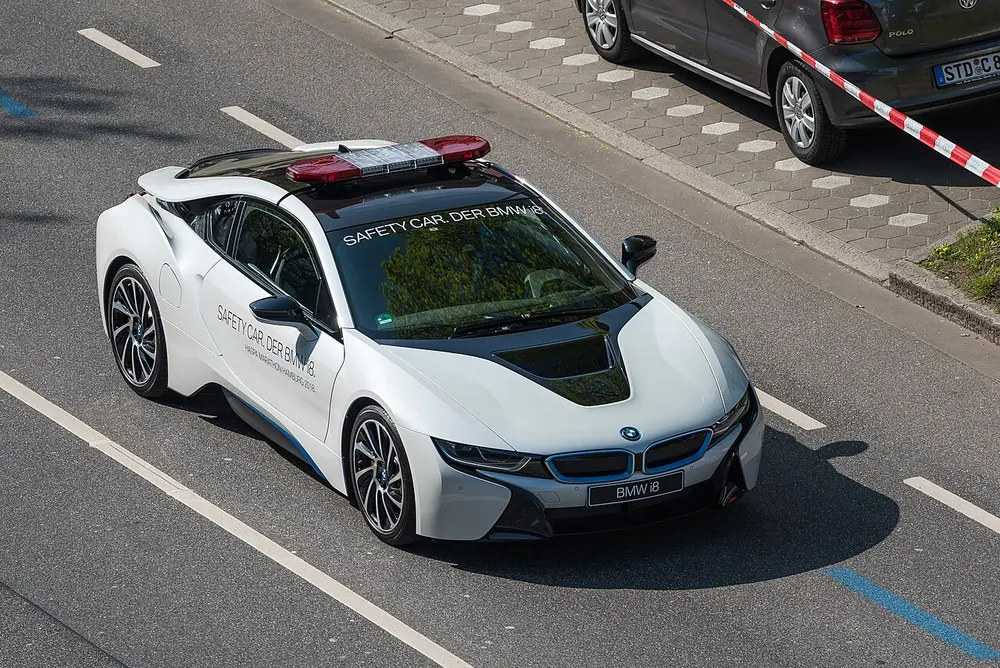
BMW i8 at Hamburg Marathon 2018. Photo: Sebastian Koppehel / Wikimedia Commons, CC BY 4.0.
The course
The route circles the Alster lakes and works through the harbour district. The lakes provide a calmer, greener section, while the harbour gives the race its maritime, industrial backdrop. The 135 metres of climbing come as gentle rolls rather than one hill, and the wide roads let the field spread out.
There is nothing on the course that needs a dedicated hill block, but the repeated small rises can wear down a runner who goes out too fast. The flat sections are genuinely quick, and the harbour and lake views keep the morning moving.
The Alster lakes
The Alster is Hamburg's inner sea. The river was dammed centuries ago to create the Binnenalster and the Außenalster, and the two lakes now form a green-blue heart in the middle of the city. The marathon circles them, and the lakeside roads give the race some of its calmest and most attractive kilometres.
The Alster also gives the course its shape. The lakes are large enough that the route can use their perimeter without repeating the same street, and the water provides a constant reference point. On a spring morning, with the trees coming into leaf, it is one of the best sections of any German city marathon.
The harbour district
The harbour is Hamburg's other defining landscape. The Elbe, the docks and the warehouse districts give the city its trading identity, and the marathon passes through the areas where that history is most visible. The scale is large: cranes, water, bridges and the wide river beyond.
The harbour section adds a different kind of energy to the race. After the calm of the Alster, the docks bring noise, open space and a sense of the city's working life. It is also where the course's gentle undulation becomes noticeable, as the route moves between the water and the streets.
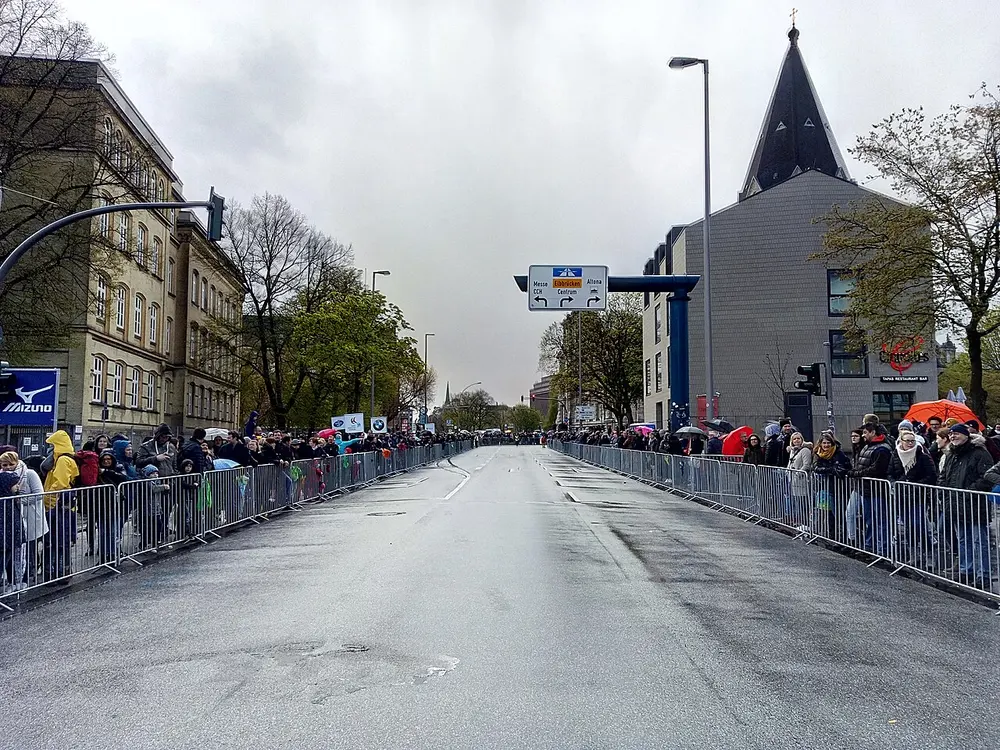
Hamburg-Marathon 2017. Photo: TheAmerikaner / Wikimedia Commons, CC BY-SA 4.0.
A big spring field
Germany's biggest spring marathon brings a large field, and that changes the character of the opening kilometres. The start is busy, the first few miles are crowded and the pace can be dictated by the runners around you rather than by your own plan. Allow for that instead of trying to run through it.
The size of the field is also an advantage. There is always someone to run with, the crowd support is spread across the course and the city takes the race seriously. For a first marathon, that atmosphere can be a lift; for a personal-best attempt, it is a distraction to manage.
Pacing an undulating 135 metres
The 135 metres of climbing are easy to dismiss because no single rise is significant. But the total is real, and the gentle rolls arrive often enough to accumulate. The right approach is to run by effort, let the climbs slow you slightly and use the flat lakeside and riverside sections to recover.
The wide roads make it tempting to chase a fast split, especially in the first half. Resist that. Hamburg is flat enough for a personal best, but it is not a course where you can bank time effortlessly. The runners who do well are the ones who keep something for the harbour and the final return to the city.

Anne-Mari Hyryläinen at Hamburg Marathon 2019. Photo: Sebastian Koppehel / Wikimedia Commons, CC BY 4.0.
Frequently asked questions
Answers to the questions runners ask before entering, drawn from this race's course guide and the directory's own data — the sources behind them are listed below.
When is the Hamburg Marathon?
The next edition is on 25 April 2027. It is Germany's biggest spring marathon.
Is the Hamburg Marathon flat or hilly?
It is undulating, with about 135 metres of climbing, but the rises are gentle. It is flat enough for personal bests, so it sits closer to flat than hilly.
Is Hamburg good for a personal best?
The wide roads, limited climbing and spring date make it a fair course for a fast time. A personal best still depends on pacing, especially in the crowded opening kilometres.
Is the Hamburg Marathon suitable for a first marathon?
Yes. The course is manageable and the big-city atmosphere is a lift, while the distance is still the main challenge. Start conservatively and do not get carried away by the size of the field.
Where does the Hamburg Marathon run?
It circles the Alster lakes and works through the harbour district, staying within the city. The route combines lakeside roads with the Elbe waterfront.
How big is the Hamburg Marathon?
It is Germany's biggest spring marathon. That size brings a large field, strong crowd support and a big-city atmosphere on race day.
More marathons in Germany
More marathons in Europe
Sources for this page
What each source below is used for on this page, and where to check this race yourself.
- World Athletics — the label calendar and the road-race regulations. Used to check whether the race holds a World Athletics label, and its elite competition details.
- AIMS — the international course-measurement standard behind the 42.195 km distance, and the AIMS race calendar.
- The organizer's own publications — course maps, race handbooks and published results. The date, course character and climbing on this page are compiled from them and re-checked each season.
Where do these facts come from?
Dates, course type, climbing and time limits are compiled from the organizer's publications and re-checked each season; elevation is an estimate of total climbing rather than a survey figure. Always confirm race-day details with the organizer before making plans.
Last reviewed 27 October 2026