
Verona Marathon
Verona is a Roman city with a medieval heart and a river running through it. The Arena, the amphitheatre that still dominates Piazza Bra, is the landmark most runners picture, and on 15 November 2026…
By Global Marathon Routes editorial team · Last reviewed 27 October 2026
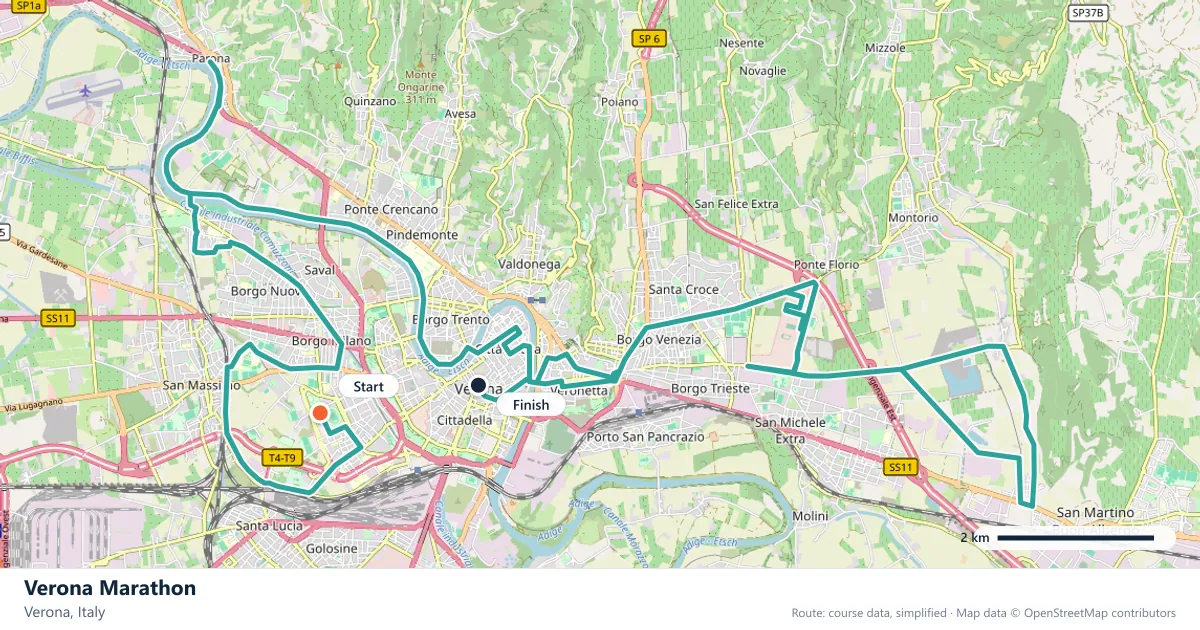
Where does the Verona Marathon run?
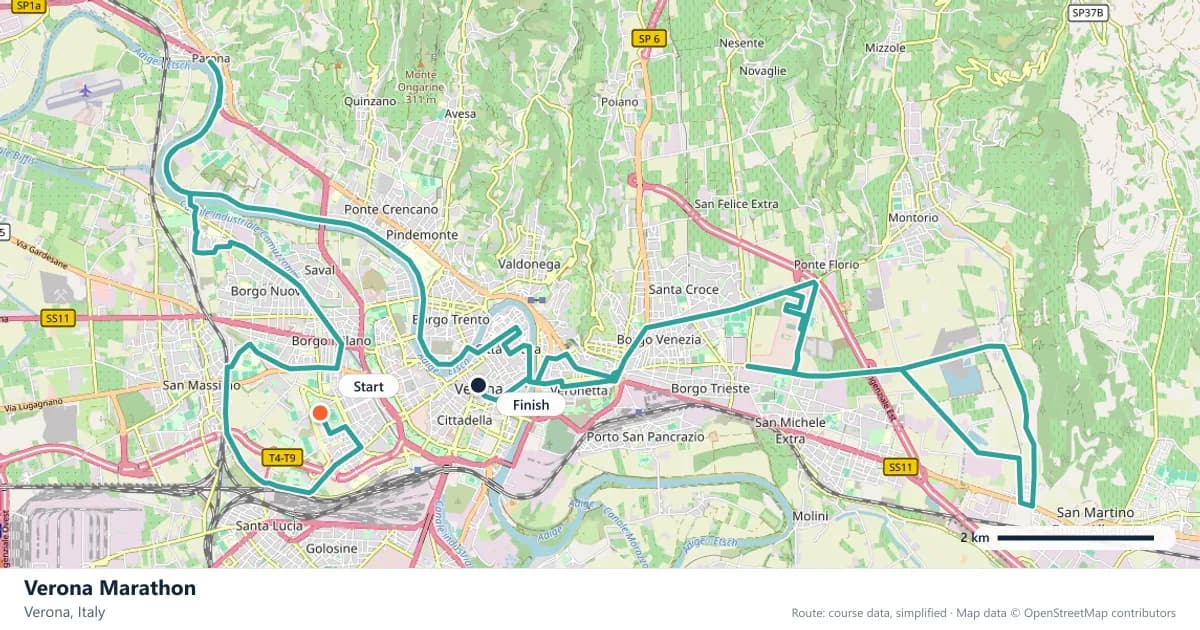
Interactive map
The trace follows the organizer's published course, simplified for the screen: the orange dot is the start, the dark dot the finish. Scroll to zoom, drag to pan.
What is the Verona Marathon course like?
A flat loop through the Roman city, past the Arena and along the Adige, with the Lessini hills always in view. November in the Veneto is usually crisp and quick.
- Next edition
- 15 November 2026
- Elevation gain
- 89 m
- Profile
- Flat
- First run
- —
Course guide
Verona is a Roman city with a medieval heart and a river running through it. The Arena, the amphitheatre that still dominates Piazza Bra, is the landmark most runners picture, and on 15 November 2026 the marathon loops through the city with the Arena and the Adige as its fixed points. The result is a course that feels historical without being technical: flat, quick and compact, with the Lessini hills always somewhere in view.
The profile is flat: about 89 metres of climbing across the full distance. That is not a course that punishes you with a climb, but it does not slow you down either. November in the Veneto is usually crisp, and the combination of level roads and cool air is why Verona can be a fast race when the morning cooperates.
It is also approachable for a first marathon: the loop stays within the city, the climbing is modest, and the setting gives the later kilometres a reason to keep moving. What it asks in return is patience, because there is little terrain to correct an overenthusiastic start.
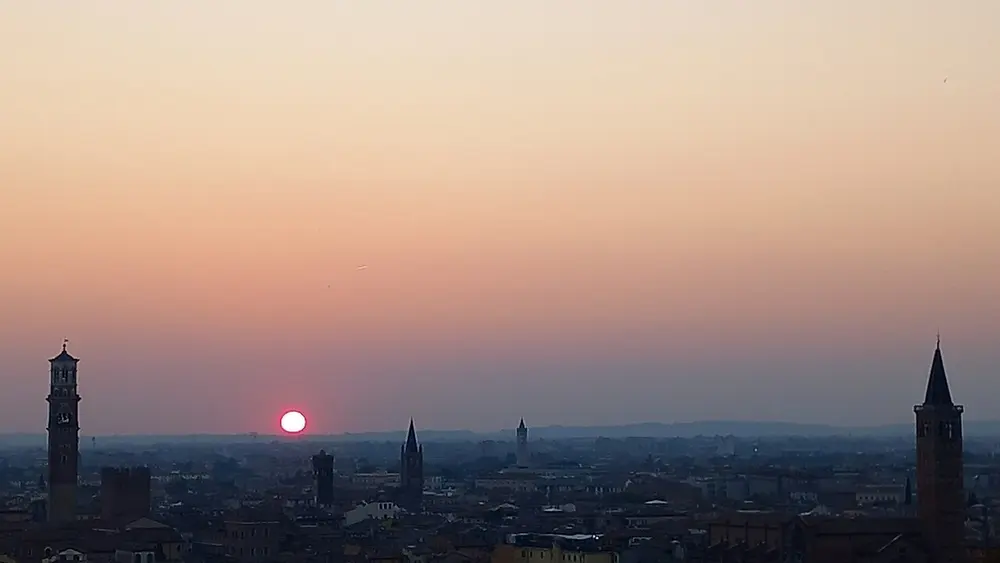
The Crimson Orb - Verona Horizon at Golden Hour. Photo: Eleneru / Wikimedia Commons, CC BY-SA 4.0.
The course
The route is a loop through Verona, passing the Arena and following the Adige for part of the race. The centre is dense with stone, squares and porticoes, so the course changes direction often. Those turns are not climbs, but they break the rhythm and make smooth running a skill in itself.
At 89 metres of climbing, the course is flat in any meaningful sense. There is no sustained ascent or decisive descent. The small rises that do exist are short enough to disappear under the rhythm of the field. Run by effort and let the flat kilometres accumulate.
The loop returns through streets you have already seen, which makes the final third easier to navigate. The crowds gather in the same places, so you get their lift twice.
The Arena and the city
The Arena is the best-known Roman monument in Verona and one of the best preserved amphitheatres in Italy. It gives the race a monumental anchor, and the course uses it as a backdrop rather than a stage: no climb to the amphitheatre, no technical section, just the pleasure of running past something older than the marathon itself.
Away from the Arena, the centre is a network of squares and lanes. Piazza delle Erbe and the castellated Ponte Scaligero are part of the city's identity, and the river frames the historic core. The marathon does not need to visit every landmark to benefit from them.
The Adige and the Lessini hills
The Adige gives the course its natural edge. The river bends around the old town, and the embankments open up views that most city marathons cannot offer. Running beside water tends to flatten the effort, which is welcome on a course where the profile is already level.
The Lessini hills sit to the north, visible from the city but never part of the route. They are scenery, not elevation. That distinction matters on race morning: the sight of a hill does not mean one is coming, and the marathon stays on the plain. Use the view as a distraction and keep your pace anchored to the road.
A November start
Verona in mid-November is usually cold enough to make hard running feel natural. The mornings are sharp, the light is low, and the city is quieter than in summer. For a marathon, that is close to ideal.
The trade-off is the wait before the start. A cold morning rewards a warm layer you can discard, gloves for the first kilometres and a bag-drop plan. Once the race is moving, the same conditions that felt uncomfortable at the start become an advantage.
The date sits late in the season. Runners who have raced since spring may arrive tired, while those who built specifically for November can use the cool weather. The race rewards a block that finishes fresh.
Why flat is not the same as easy
A flat course removes the obvious excuses. There is no hill to blame for a slow kilometre and no descent to recover on. The pace you choose in the first half is the pace you live with, and the last 10 kilometres reveal whether it was sensible.
That makes Verona a good race for runners who have learned to pace by effort. The course does not demand hill training or technical skill; it demands discipline. If you can keep the first 25 kilometres controlled, the flat final stretch is a gift. If you cannot, the same flatness offers nowhere to hide.
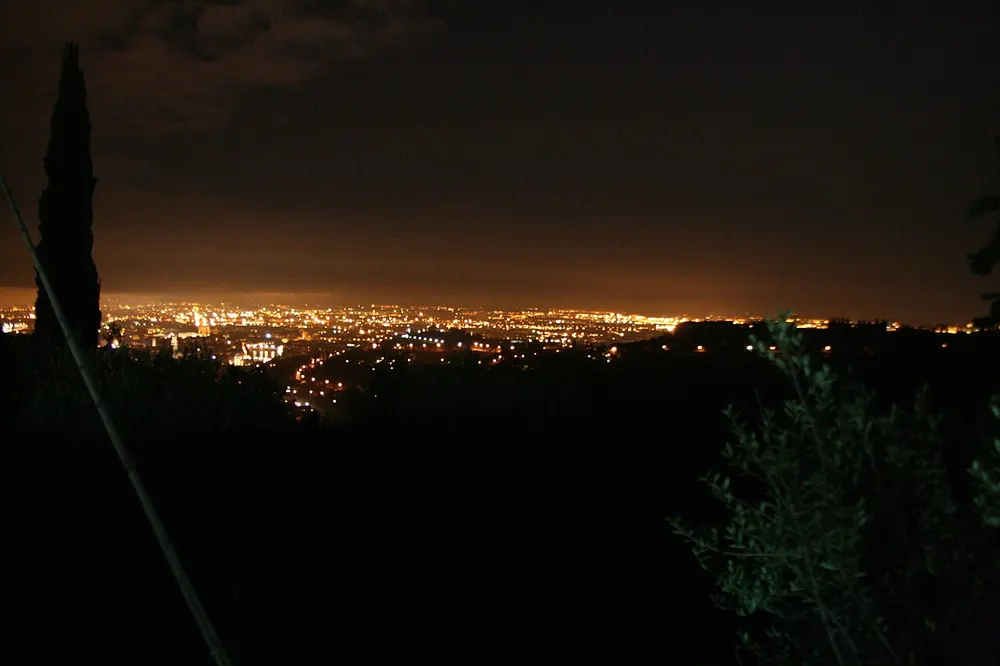
Notte a Verona. Photo: Marco Zanferrari from Doha, Qatar / Wikimedia Commons, CC BY-SA 2.0.
Planning the weekend
Verona is compact enough to walk across, which makes race weekend easy to manage. The historic centre is the natural base: the river and the main squares are within reach on foot. Book early, because November is not a quiet month for hotels.
The race is a single morning, leaving time to see the Arena and walk the riverbanks afterwards. Verona does not require a separate sightseeing plan; the course does much of the work.
Frequently asked questions
Answers to the questions runners ask before entering, drawn from this race's course guide and the directory's own data — the sources behind them are listed below.
When is the Verona Marathon in 2026?
The 2026 edition is scheduled for 15 November 2026. It is a late-autumn race in the Veneto.
Is the Verona Marathon flat or hilly?
The course climbs about 89 metres in total. The Lessini hills are visible from the city but the route does not climb them. It is a city loop rather than a hill race.
Is the Verona Marathon good for a personal best or a first marathon?
Yes, on both counts. The flat profile and usually crisp November air favour fast times, while the modest climbing and compact city route make it approachable for a first marathon.
Where is the Verona Marathon run?
It runs on a loop through Verona, passing the Arena and following the Adige, with the Lessini hills in view. The course stays within the city.
What is there to see on the course?
The Arena is the best-known landmark, and the Adige gives the route a riverside section. The Lessini hills provide the backdrop, while the centre's squares and stone streets supply the atmosphere.
What is the weather like in November?
Mid-November in Verona is usually crisp and quick, but cold before the start. Plan for a cold morning and layers rather than mild conditions.
More marathons in Italy
More marathons in Europe
Sources for this page
What each source below is used for on this page, and where to check this race yourself.
- World Athletics — the label calendar and the road-race regulations. Used to check whether the race holds a World Athletics label, and its elite competition details.
- AIMS — the international course-measurement standard behind the 42.195 km distance, and the AIMS race calendar.
- The organizer's own publications — course maps, race handbooks and published results. The date, course character and climbing on this page are compiled from them and re-checked each season.
Where do these facts come from?
Dates, course type, climbing and time limits are compiled from the organizer's publications and re-checked each season; elevation is an estimate of total climbing rather than a survey figure. Always confirm race-day details with the organizer before making plans.
Last reviewed 27 October 2026