
Rome Marathon
There are marathons that show you a city and marathons that run through one. Rome does both at once. The 2027 edition is scheduled for 14 March, and for most of the race the course has the Colosseum…
By Global Marathon Routes editorial team · Last reviewed 27 October 2026
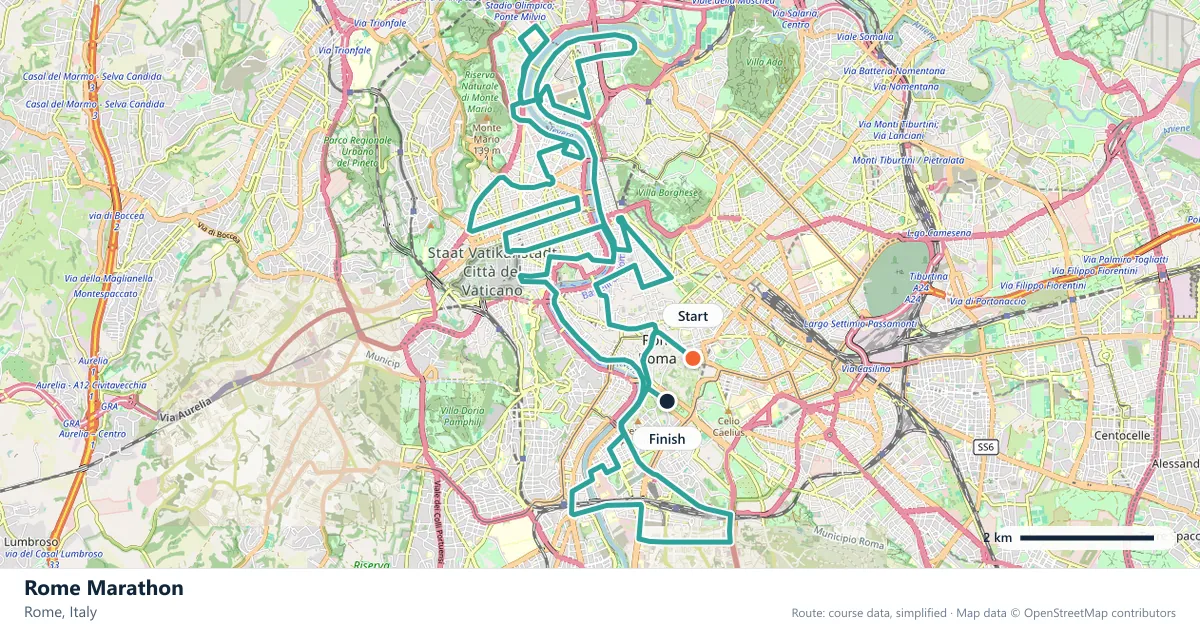
Where does the Rome Marathon run?
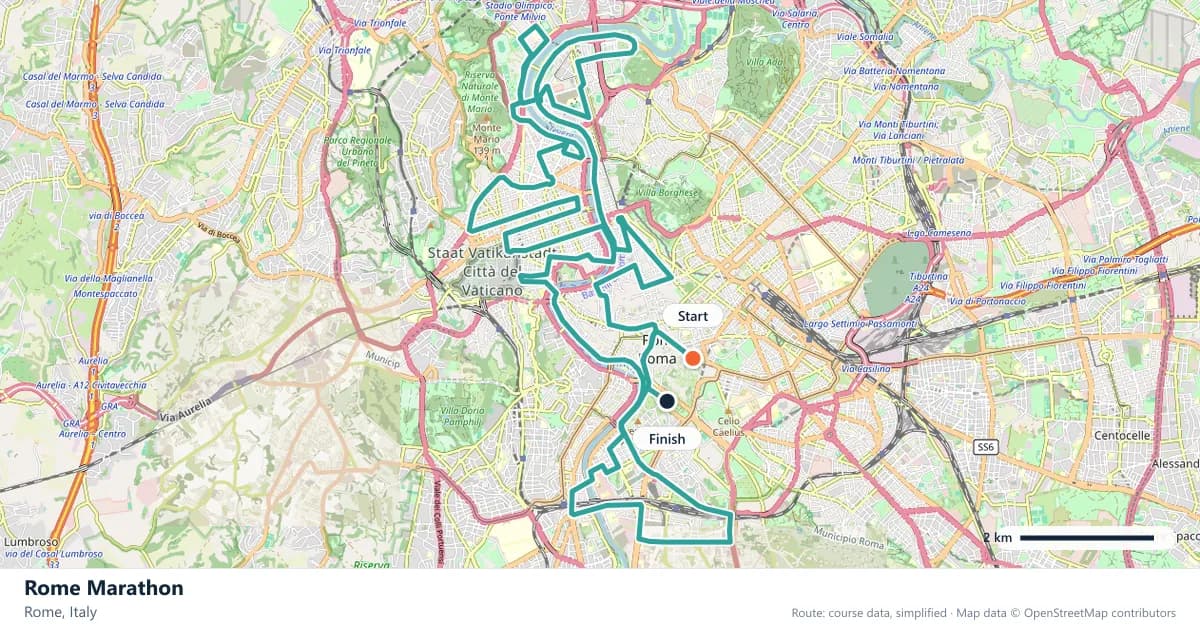
Interactive map
The trace follows the organizer's published course, simplified for the screen: the orange dot is the start, the dark dot the finish. Scroll to zoom, drag to pan.
What is the Rome Marathon course like?
Starts and finishes at the Colosseum, passing the Forum, the Vatican and the Spanish Steps on a course that is part tour, part race. Cobbles and a few long drags keep the times honest.
- Next edition
- 14 March 2027
- Elevation gain
- 190 m
- Profile
- Undulating
- First run
- —
Course guide
There are marathons that show you a city and marathons that run through one. Rome does both at once. The 2027 edition is scheduled for 14 March, and for most of the race the course has the Colosseum as its anchor: the start and finish sit beside it, and the route works outward through the historic centre before returning.
The race is undulating, with about 190 metres of climbing, and it holds a World Athletics Elite Label. That is not a combination that promises a careless personal best. The cobbles demand attention, the long drags accumulate, and the landmarks arrive at exactly the moments when you might prefer to be looking at your watch. But it is a first-marathon race in the fullest sense: a course with atmosphere, history and enough variety to carry a debutant through the difficult final third.
Rome in mid-March is a good moment to be in the city: the winter crowds have thinned and the days are lengthening. The morning air still has an edge to it, which is exactly what a marathon wants.
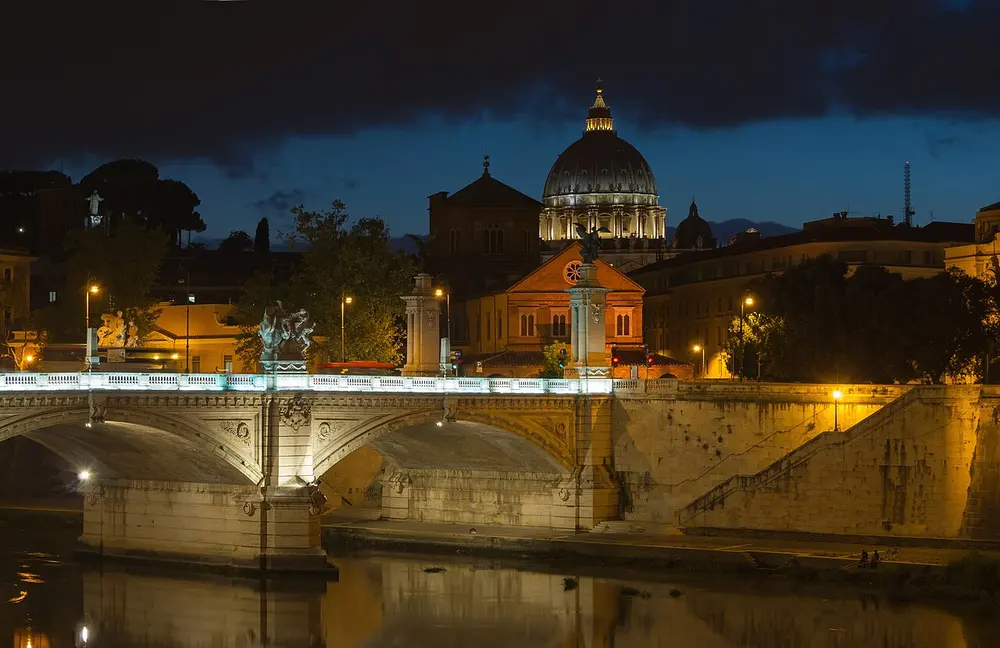
Ponte Vittorio Emanuele II San Pietro, Rome, Italy. Photo: Jebulon / Wikimedia Commons, CC BY-SA 3.0.
The course
The marathon is a single loop through the centre, traced from the Colosseum and back. The opening kilometres are busy and ceremonial, with the field still thick and the first landmarks close together. The Forum, the Vatican and the Spanish Steps are the route's set pieces, each pulling the race through a different layer of the city.
Between those sights the course is rarely level. The 190 metres of climbing are not concentrated in a single hill; they are spread through the route in long, shallow drags that change the rhythm without ever looking like a climb. That is the character of Roman running. You rarely feel the gradient in the moment, but by the last ten kilometres the accumulated work is real.
The surface matters too. Cobbles appear in sections, and they ask for a shorter, more relaxed stride than smooth asphalt. On tired legs they are the part of the course that punishes inattention. Treat them as a technical section rather than an inconvenience, and save your faster running for the smoother stretches.
Start and finish beside the Colosseum
The Colosseum is both the beginning and the end of the day, which makes the race unusually easy to visualise. You leave with the amphitheatre behind you and return to it with the finish line in front. The area is pedestrianised and served by the Colosseo Metro stop, so the main decision is how early to arrive.
Because the start and finish share the same area, race morning is simple: one journey in, one meeting point after. Expect the streets around the finish to be slow to leave, and arrange to meet away from the immediate finish area.
What the cobbles ask of you
Rome is a city built on layers, and the marathon surface reflects that. Smooth stretches alternate with stone setts, and the joins between them can catch a tired foot. The technique is simple: shorten the stride slightly, keep the hips tall, and do not try to make up time on the rough sections.
The long drags are the other quiet challenge. None of them is steep enough to justify walking, but together they turn a flat-looking first half into a patient one. Use the landmarks as rewards rather than pace markers. The Forum, the Vatican and the Spanish Steps will all draw a surge from the runners around you; let them go and keep your own effort steady.
A March weekend in the city
Mid-March is still early in the Roman spring. Mornings can be cool, and the shade between buildings feels colder than the open streets. That is helpful for a long race, provided you have a layer to discard before the start and somewhere to leave a bag. The afternoon is a different matter: once the sun is up, the stone squares hold the warmth.
Arrive on Saturday rather than the morning of the event. Walk the final approach to the Colosseum and get a feel for the scale of the start area. Rome rewards unhurried preparation, and the centre is at its most walkable before the Sunday closures.
The debut question
A first marathon is a fair fit, but not because the course is easy. It works because it gives a debutant reasons to keep going: something to see at every turn, a finish that is easy to picture, and a route that rewards restraint. The cobbles and the drags will expose a fast start, so the first half should feel almost too controlled.
Runners chasing a time should be more cautious. The elevation is modest, but the surface and the constant changes of direction make even pacing difficult. Rome is a race to enjoy first and measure second. That is not a weakness; it is the point of running a marathon through one of the most extraordinary city centres in Europe.
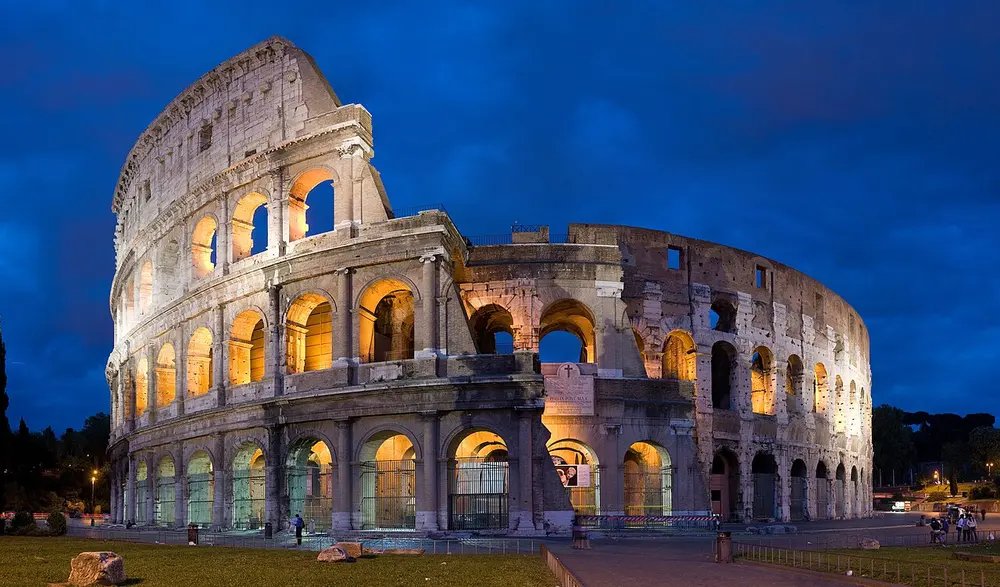
Colosseum in Rome, Italy - April 2007. Photo: Diliff / Wikimedia Commons, CC BY-SA 2.5.
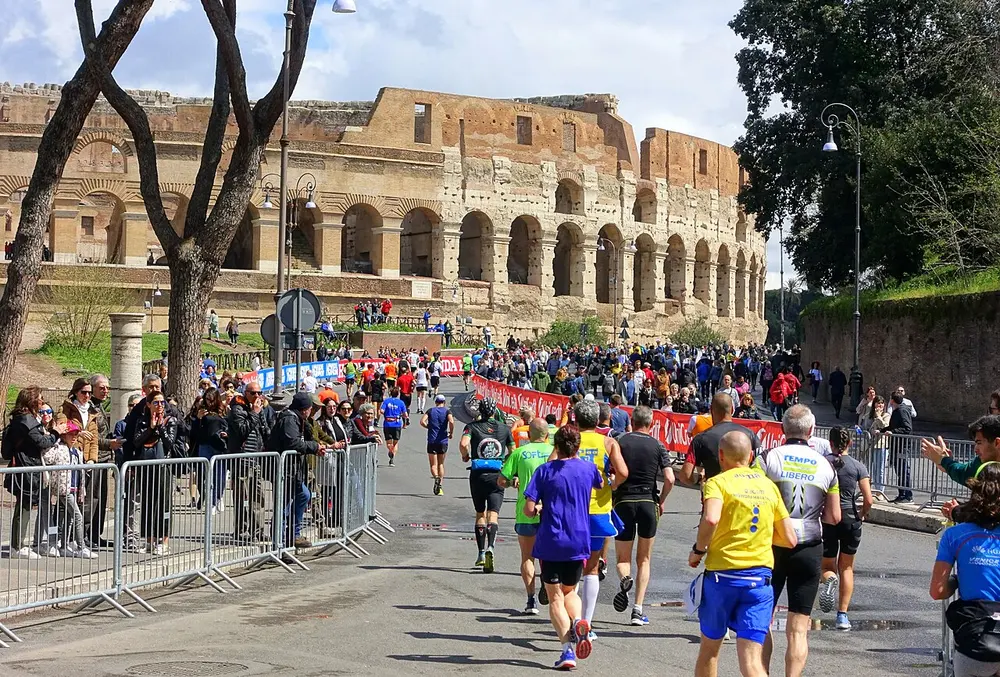
Maratona di Roma 2019 - Rome, Italy. Photo: Daderot / Wikimedia Commons, CC0.
Frequently asked questions
Answers to the questions runners ask before entering, drawn from this race's course guide and the directory's own data — the sources behind them are listed below.
When is the Rome Marathon in 2027?
The next edition is scheduled for 14 March 2027. It is a spring race, and the start and finish are beside the Colosseum.
Is the Rome Marathon flat or hilly?
It is undulating rather than hilly, with about 190 metres of climbing. The gain is spread through long drags rather than a single climb, and cobbled sections make parts of the course feel slower than the profile suggests.
Is Rome a good first marathon?
Yes. The course works for a debut, with a memorable route and a finish that is easy to visualise. The caveats are the cobbles and the long drags, which reward a conservative first half.
Where does the Rome Marathon start and finish?
Both the start and the finish are at the Colosseum. The route passes the Forum, the Vatican and the Spanish Steps on its way through the centre.
What landmarks does the course pass?
The Forum, the Vatican and the Spanish Steps are the best-known set pieces, with the Colosseum framing the start and finish. The route stays within the historic centre.
What is the surface like?
Parts of the course are cobbled. The setts ask for a shorter stride and a relaxed foot when the legs are tired.
More marathons in Italy
More marathons in Europe
Sources for this page
What each source below is used for on this page, and where to check this race yourself.
- World Athletics — the label calendar and the road-race regulations. Used to check whether the race holds a World Athletics label, and its elite competition details.
- AIMS — the international course-measurement standard behind the 42.195 km distance, and the AIMS race calendar.
- The organizer's own publications — course maps, race handbooks and published results. The date, course character and climbing on this page are compiled from them and re-checked each season.
“A World Athletics Label denotes a full application of the Competition and Technical Rules in, at a minimum, the elite component of the competition. Labels also denote superior standards in event organisation, safety and runner experience, support from public authorities to the event and a financial commitment to anti-doping.”
Where do these facts come from?
Dates, course type, climbing and time limits are compiled from the organizer's publications and re-checked each season; elevation is an estimate of total climbing rather than a survey figure. Always confirm race-day details with the organizer before making plans.
Last reviewed 27 October 2026