
Venice Marathon
The Venice Marathon does not begin in Venice. It begins at Stra, a small town on the Brenta inland from Venice, and it finishes on the mainland at Mestre, at the edge of the lagoon.
By Global Marathon Routes editorial team · Last reviewed 27 October 2026
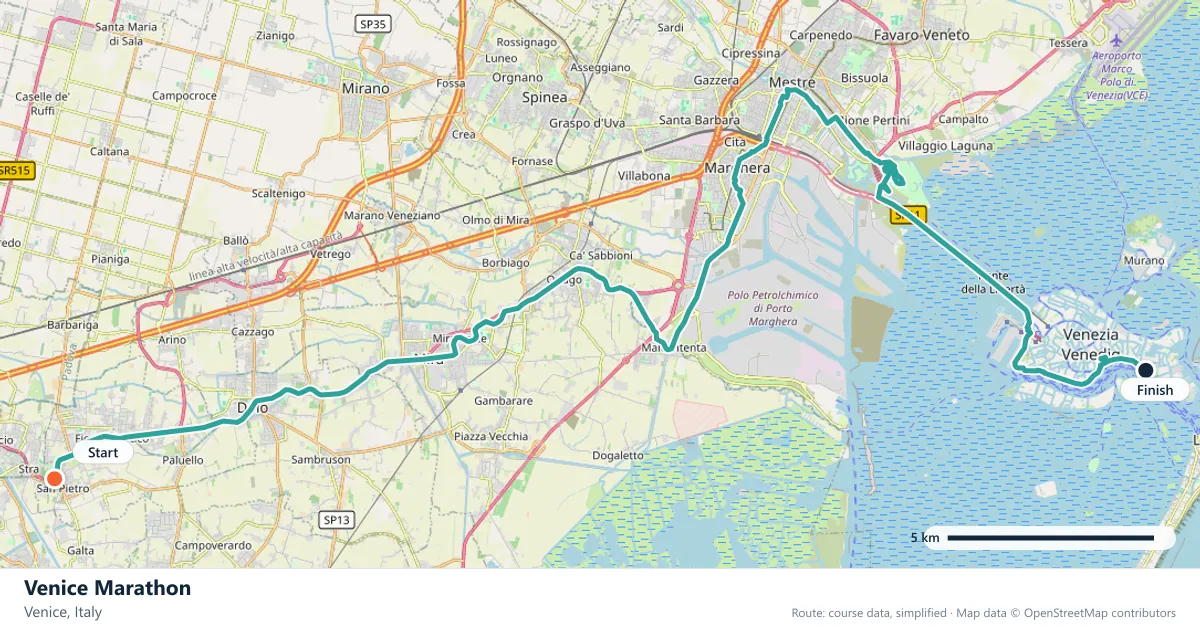
Where does the Venice Marathon run?
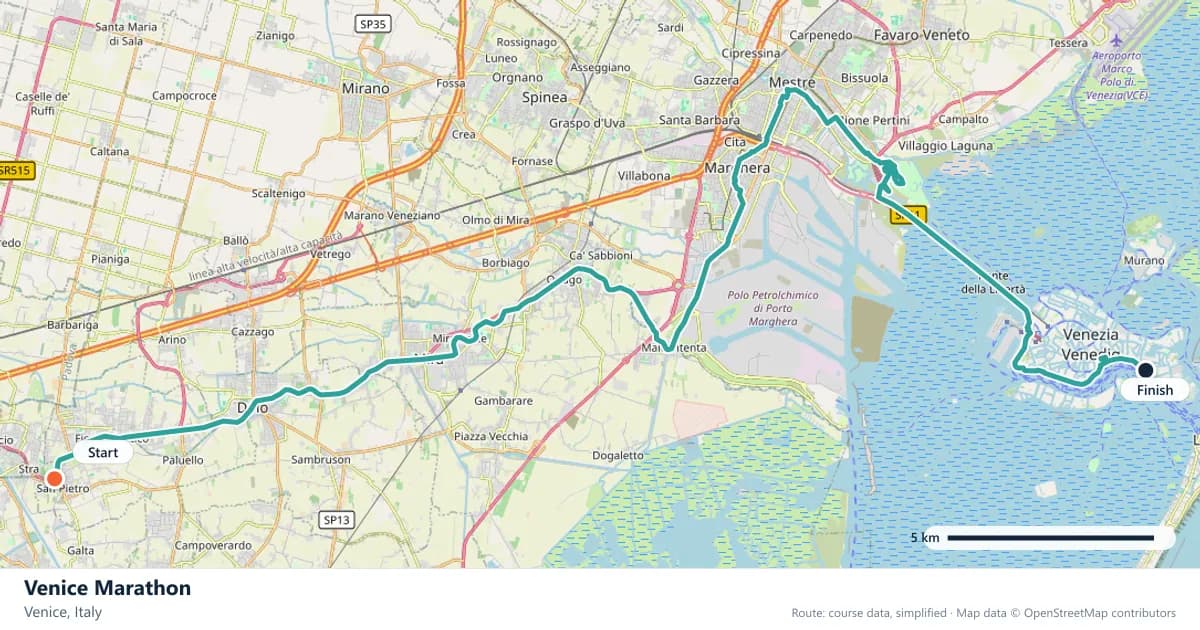
Interactive map
The trace follows the organizer's published course, simplified for the screen: the orange dot is the start, the dark dot the finish. Scroll to zoom, drag to pan.
What is the Venice Marathon course like?
A point-to-point from Stra along the Brenta to the edge of Venice, finishing on the mainland at Mestre. Dead flat, and the last kilometres run beside the lagoon.
- Next edition
- October 2027 (expected)
- Elevation gain
- 49 m
- Profile
- Flat
- First run
- —
Course guide
The Venice Marathon does not begin in Venice. It begins at Stra, a small town on the Brenta inland from Venice, and it finishes on the mainland at Mestre, at the edge of the lagoon. Between those two points the course runs west to east across the flat Veneto plain, following the river corridor and then the last stretch beside the water.
The 2026 edition is scheduled for 25 October. It is dead flat, with only about 49 metres of climbing, and it holds a World Athletics Label. The profile explains why runners come, and the label reflects a serious event.
The geography is what makes the race distinctive. A point-to-point marathon from a river town to the mainland edge of Venice is not a loop around a historic centre; it is a linear journey across villas, water and flat fields, ending with the lagoon in view.
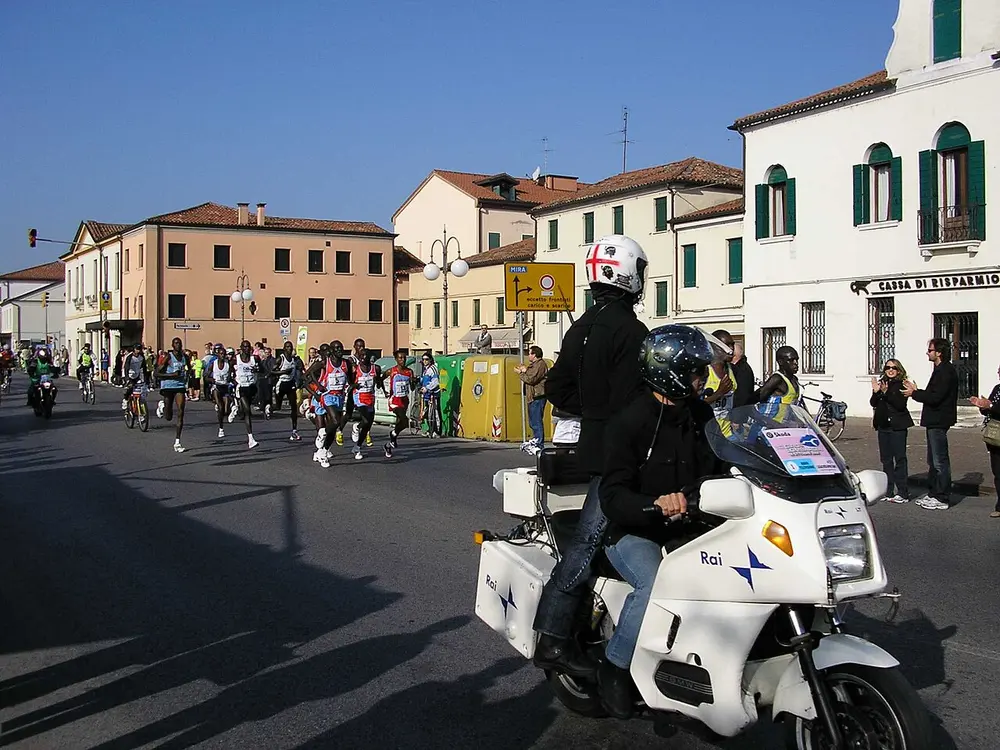
Venice Marathon. Photo: Dariozo at Italian Wikipedia / Wikimedia Commons, CC BY-SA 3.0.
The course
The route leaves Stra and follows the Brenta towards the coast, then turns across the flat land at the edge of the lagoon for the finish at Mestre. It is a linear course rather than a loop, so the scenery changes gradually rather than repeating: river town, open plain, lagoon edge.
With 49 metres of climbing, there is almost nothing on the course that forces a change of pace. The challenge is the opposite of a hill race. The flat kilometres invite a faster rhythm than you planned, and the even surface makes it easy to switch off. The runners who do well are the ones who can hold a precise effort without any terrain to remind them.
The final kilometres run beside the lagoon, which gives the race a finish unlike an inland city marathon. The water is there, the horizon opens, and the finish at Mestre is close. It is a good place to be tired, provided you have not spent the first 35 kilometres racing the flat.
Along the Brenta
The Brenta is the backbone of the first half. This is the Riviera del Brenta, the corridor of villas and gardens that Venetian families built along the river, and the course uses the water as its organising line. Stra itself is known for one of the grandest of those villas, and the river remains a presence as the route heads east.
River running has its own rhythm. The path is level, the view is soft, and the towns arrive in quick succession. That can be a pleasure or a trap. The early river miles should feel almost too easy; if they feel like racing, the pace is too hot. Use the water and the villas as a distraction, not as a signal to push.
Point-to-point logistics
A linear course means two places to plan for. The start at Stra and the finish at Mestre are not interchangeable, and the journey to the start needs the most thought. Point-to-point races often provide transport from the finish to the start, but check the final instructions rather than assuming.
The upside is that the finish is on the mainland, which makes leaving simpler than it would be from the historic island. Mestre has road and rail connections, and the mainland edge is easier to navigate with tired legs than the alleys and bridges of Venice itself. The weekend can still be spent in the city; the race does not require you to cross the lagoon at the end.
A flat course with no free speed
There is a particular discipline to a 49-metre marathon. You cannot blame a climb for a slow kilometre, and you cannot use a descent to recover. The only variable is your own pacing, and the flat course will expose every early surge.
The practical approach is to fix an effort that feels almost conservative for the first 25 kilometres, then let the pace settle naturally. Check your splits at regular intervals rather than relying on feel, because the absence of hills removes the body's usual feedback. On a course this flat, patience is the technical skill.
October at the lagoon
Late October in the Veneto is a transitional moment. The summer crowds have gone, the light is lower, and the air can feel cool or mild depending on the year. That makes it a good date for a marathon, but it also means the weather can vary, so prepare for a range rather than a single forecast.
The lagoon finish adds one more consideration: wind. Beside open water, even a modest breeze is noticeable, and the final kilometres are exposed. Save a little energy for that stretch and stay relaxed if the air moves.
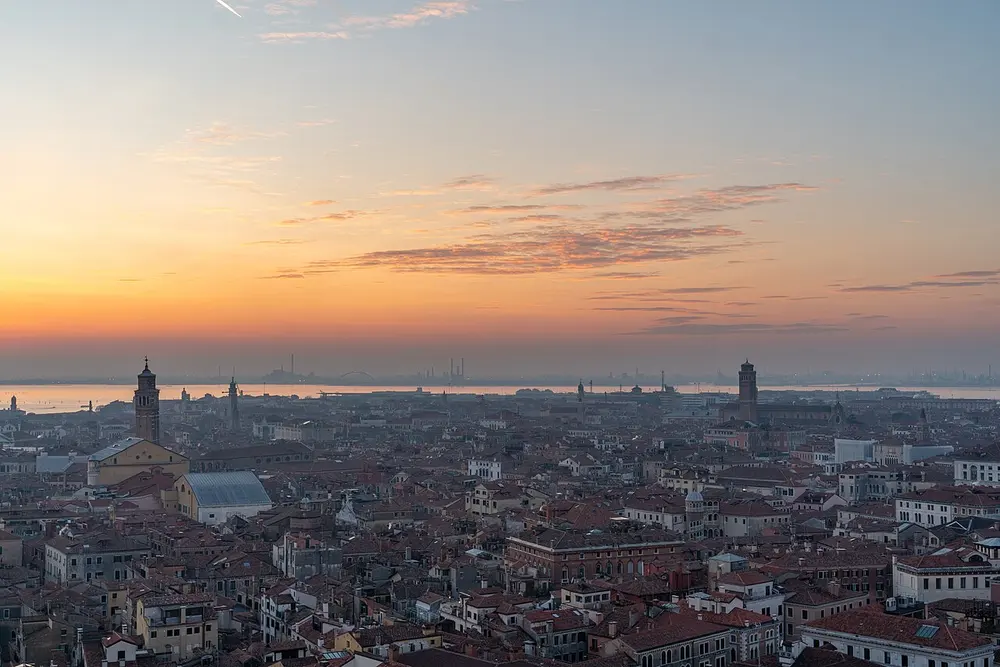
Hazy aerial panorama of Venice rooftops toward the lagoon at sunset (2023). Photo: Paul Colin Hennig firstdorsal.eu / Wikimedia Commons, CC BY-SA 4.0.
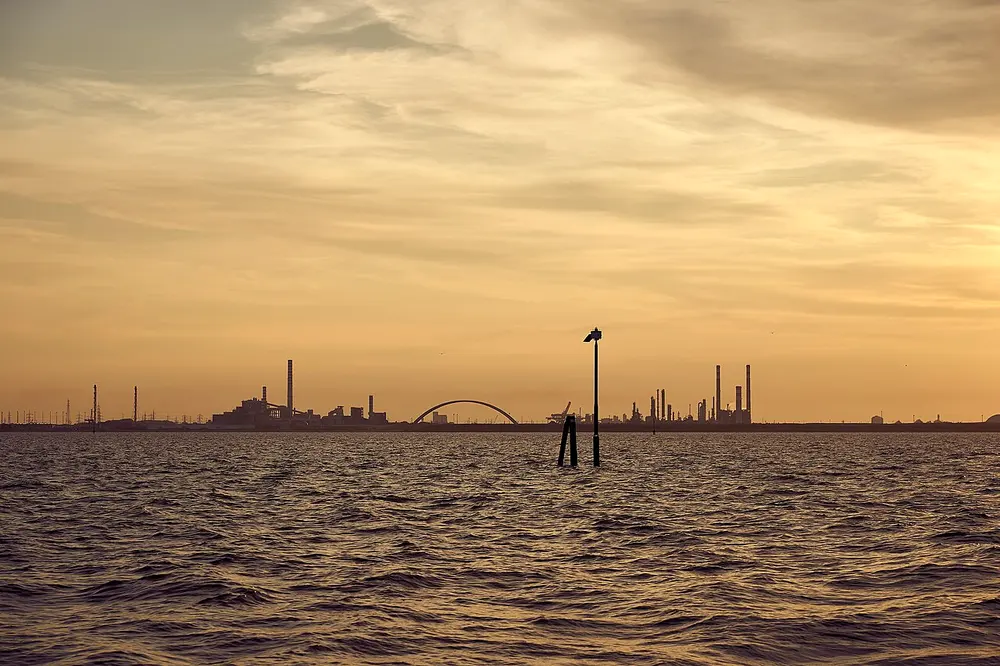
The industrial skyline of Venice 25-07-19 1. Photo: Øyvind Holmstad / Wikimedia Commons, CC BY-SA 4.0.
Frequently asked questions
Answers to the questions runners ask before entering, drawn from this race's course guide and the directory's own data — the sources behind them are listed below.
When is the Venice Marathon in 2026?
The next edition is expected in October 2027. It is an autumn race, held in the Veneto at the end of the season.
Is the Venice Marathon flat?
Yes. It climbs only about 49 metres over the full distance, which makes it one of the flattest marathon courses in Italy. There is no sustained ascent and almost nothing that forces a change of rhythm.
Is the Venice Marathon good for a personal best?
Yes. The course is suited to fast times: the profile is dead flat, the route is linear, and the label reflects a serious racing event. The main risk is starting too quickly on the flat, so even pacing matters more than terrain.
Where does the Venice Marathon start and finish?
It starts at Stra on the Brenta and finishes on the mainland at Mestre, at the edge of Venice. The last kilometres run beside the lagoon.
Does the Venice Marathon finish in Venice?
The finish is at Mestre, on the mainland at the edge of Venice, rather than in the historic island city. The lagoon is beside the closing kilometres, but the race itself stays on the mainland.
What is the course like?
It is a point-to-point route from Stra along the Brenta towards the coast, crossing the flat land at the edge of the lagoon before the finish at Mestre. The landscape shifts from river town to open plain to lagoon edge.
More marathons in Italy
More marathons in Europe
Sources for this page
What each source below is used for on this page, and where to check this race yourself.
- World Athletics — the label calendar and the road-race regulations. Used to check whether the race holds a World Athletics label, and its elite competition details.
- AIMS — the international course-measurement standard behind the 42.195 km distance, and the AIMS race calendar.
- The organizer's own publications — course maps, race handbooks and published results. The date, course character and climbing on this page are compiled from them and re-checked each season.
“A World Athletics Label denotes a full application of the Competition and Technical Rules in, at a minimum, the elite component of the competition. Labels also denote superior standards in event organisation, safety and runner experience, support from public authorities to the event and a financial commitment to anti-doping.”
Where do these facts come from?
Dates, course type, climbing and time limits are compiled from the organizer's publications and re-checked each season; elevation is an estimate of total climbing rather than a survey figure. Always confirm race-day details with the organizer before making plans.
Last reviewed 27 October 2026