
Turin Marathon
Turin is a city designed for walking under cover. Its centre is threaded with arcades, and on a cold morning they do more than look elegant: they keep the wind off and give the streets a sheltered,…
By Global Marathon Routes editorial team · Last reviewed 27 October 2026
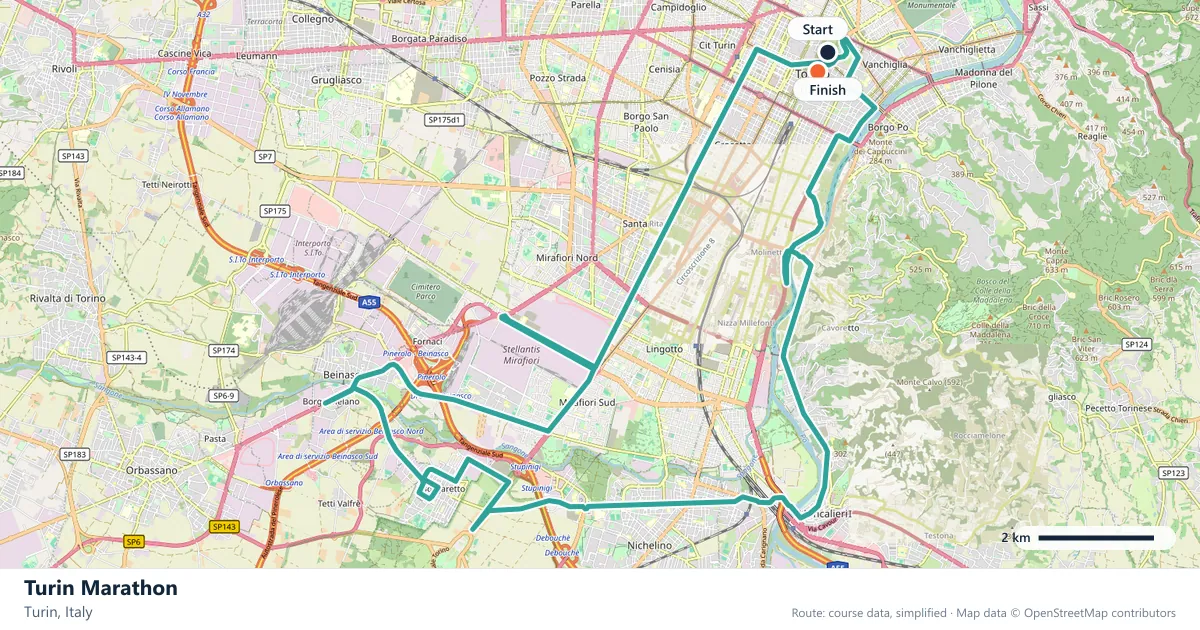
Where does the Turin Marathon run?
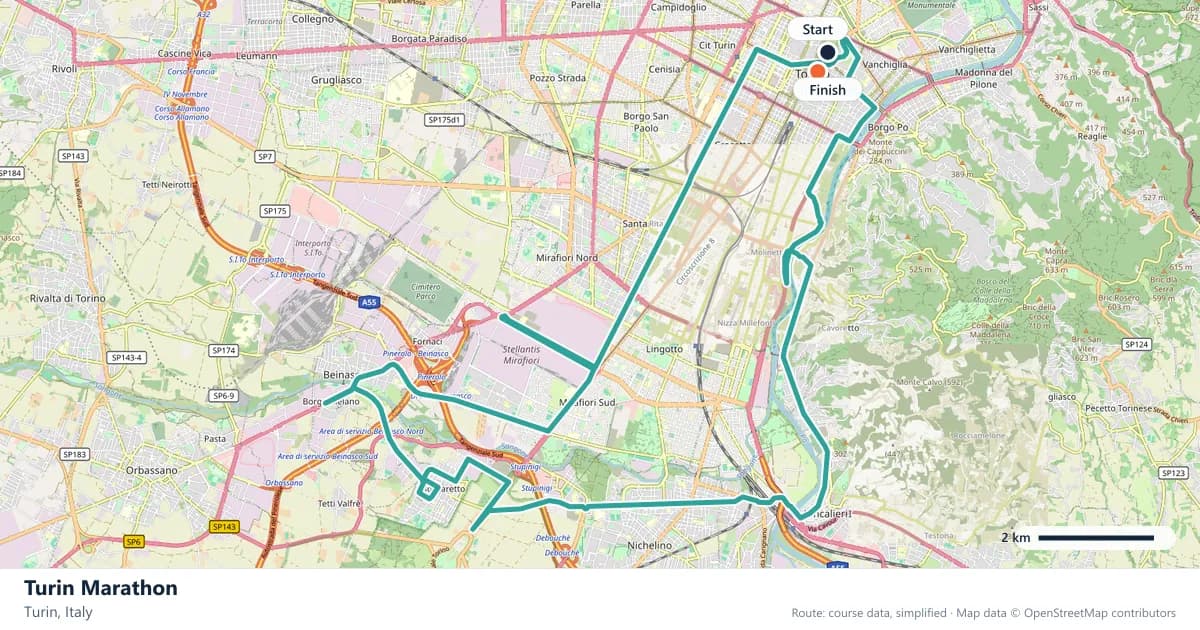
Interactive map
The trace follows the organizer's published course, simplified for the screen: the orange dot is the start, the dark dot the finish. Scroll to zoom, drag to pan.
What is the Turin Marathon course like?
A late-autumn race through Turin's arcaded streets and along the Po, with the Alps as a backdrop when the air is clear. Gently rolling and usually cold enough to race hard.
- Next edition
- 29 November 2026
- Elevation gain
- 110 m
- Profile
- Undulating
- First run
- —
Course guide
Turin is a city designed for walking under cover. Its centre is threaded with arcades, and on a cold morning they do more than look elegant: they keep the wind off and give the streets a sheltered, continuous rhythm. The marathon uses that city as its stage, on 29 November 2026, following the arcaded centre and a stretch of the Po before returning through the streets.
The course is gently rolling rather than flat; the total climb is about 110 metres. That is a low total, but it is not zero, and the changes of gradient come often enough to make a single fixed pace difficult to hold. What makes Turin interesting for a late-season race is the combination: the profile is quick, the air is usually cold enough to race hard, and the Alps appear on the horizon when the air is clear.
The course has something for a personal-best attempt and for a debut, though the two need different things from it. Fast runners get a course without a significant ascent and a date that favours hard efforts. Debutants get a city-centre route with plenty to look at and a modest total climb.
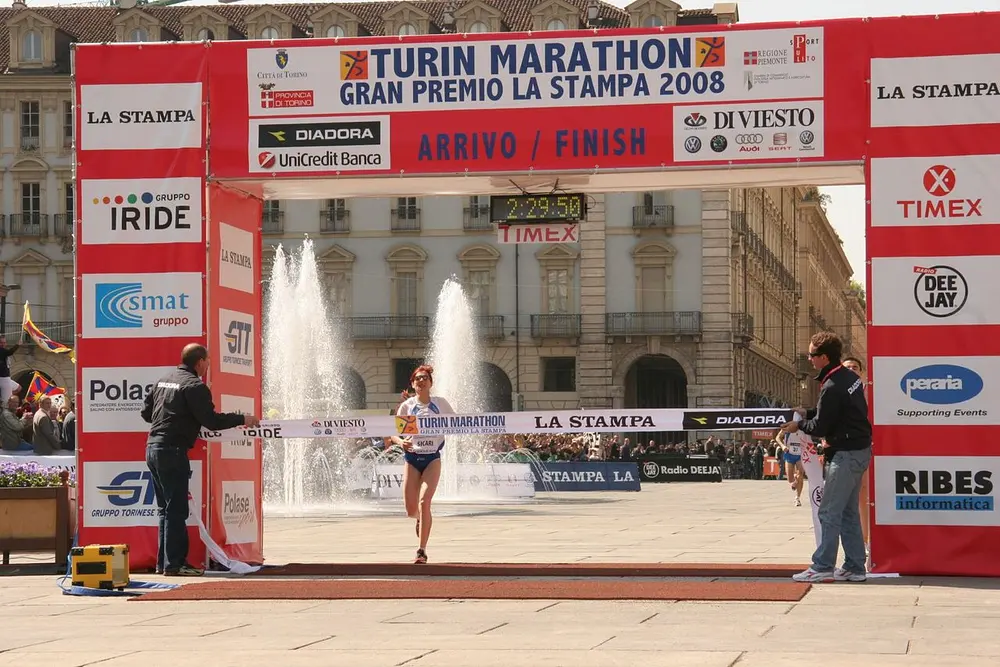
Vincenza Sicari - 2008 Turin Marathon finish. Photo: Sport Communities from Italia / Wikimedia Commons, CC BY-SA 2.0.
The course
The route works through the arcaded streets of the centre and then follows the Po for part of the race. The river section opens the course up: after the enclosure of the colonnades, the sky widens, the water appears, and the running feels less urban for a while. Then the streets close in again and the final part of the race returns to the city.
The 110 metres of climbing are spread across the distance in short rises rather than saved for one obvious hill. That is the sort of profile that can flatter you early and catch you late. The first ten kilometres may feel almost level; the cumulative effect of the small changes is what matters by 30 kilometres.
There is no section steep enough to force a walk, and no descent long enough to buy back time. Turin rewards even effort more than heroic surges, so pace by feel and check your splits.
Under the arcades
The arcades are the city's signature, and they give the early race a particular atmosphere: long colonnades, shopfronts, and a ceiling low enough to make the street feel like a corridor. They also break the wind, which is welcome in late November. The downside is that the field can feel compressed in the narrower stretches, especially while it is still dense.
Use the opening kilometres to establish rhythm, not position. The arcades reward a relaxed stride and a good line through the corners; once the route reaches the river, there is more space to settle.
Along the Po
The Po is the quiet centrepiece of the route. Turin's relationship with the river is one of the city's pleasures: the embankments, the bridges, the hills beyond. In clear November weather the Alps sit behind it all.
That is precisely where discipline matters. A beautiful stretch and a flat riverside path invite faster running. Resist it. The return into the city still has to be paid for, and the short rises that felt harmless earlier will feel different on the way home.
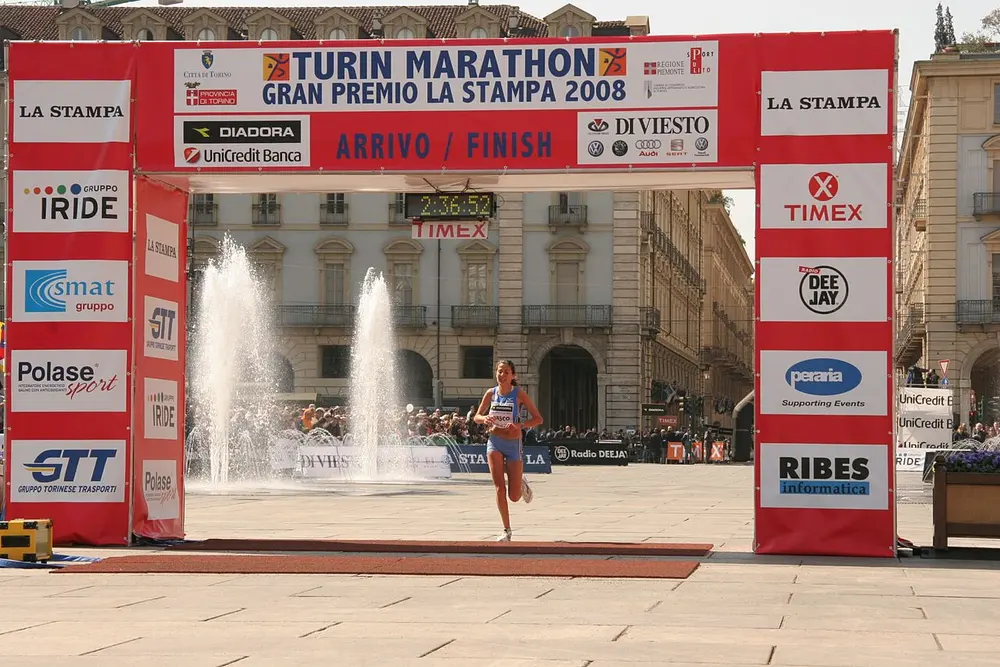
Arrivo DescoTurin Marathon 2008 01. Photo: Sport Communities from Italia / Wikimedia Commons, CC BY-SA 2.0.
Racing into winter
A 29 November date sits at the end of the racing year. Cold air makes hard efforts feel more sustainable. The disadvantage is that training has to survive the autumn.
The practical answer is to build the long runs around the light rather than fight it. By late November the days are short, so the key sessions move indoors or into the weekend middle of the day. Arrive on race morning prepared for a cold wait: a warm layer to discard, gloves, and a plan for what happens between the start pen and the first kilometre.
Turin is a good place to spend the weekend. The centre is compact, and the Egyptian Museum and the Mole Antonelliana give you reasons to walk rather than sit.
The debut and the time
For a first marathon, the course is approachable: the total climbing is modest, the route is urban, and there is no remote section where a bad patch becomes a logistical problem. The main risk is the late start to the season. A debutant who arrives under-trained because autumn was busy will suffer regardless of the profile.
For a personal best, Turin has no sustained climb, usually cool air, and enough flat running to settle into a rhythm. The short rises are the only obstacle, and even effort manages them.
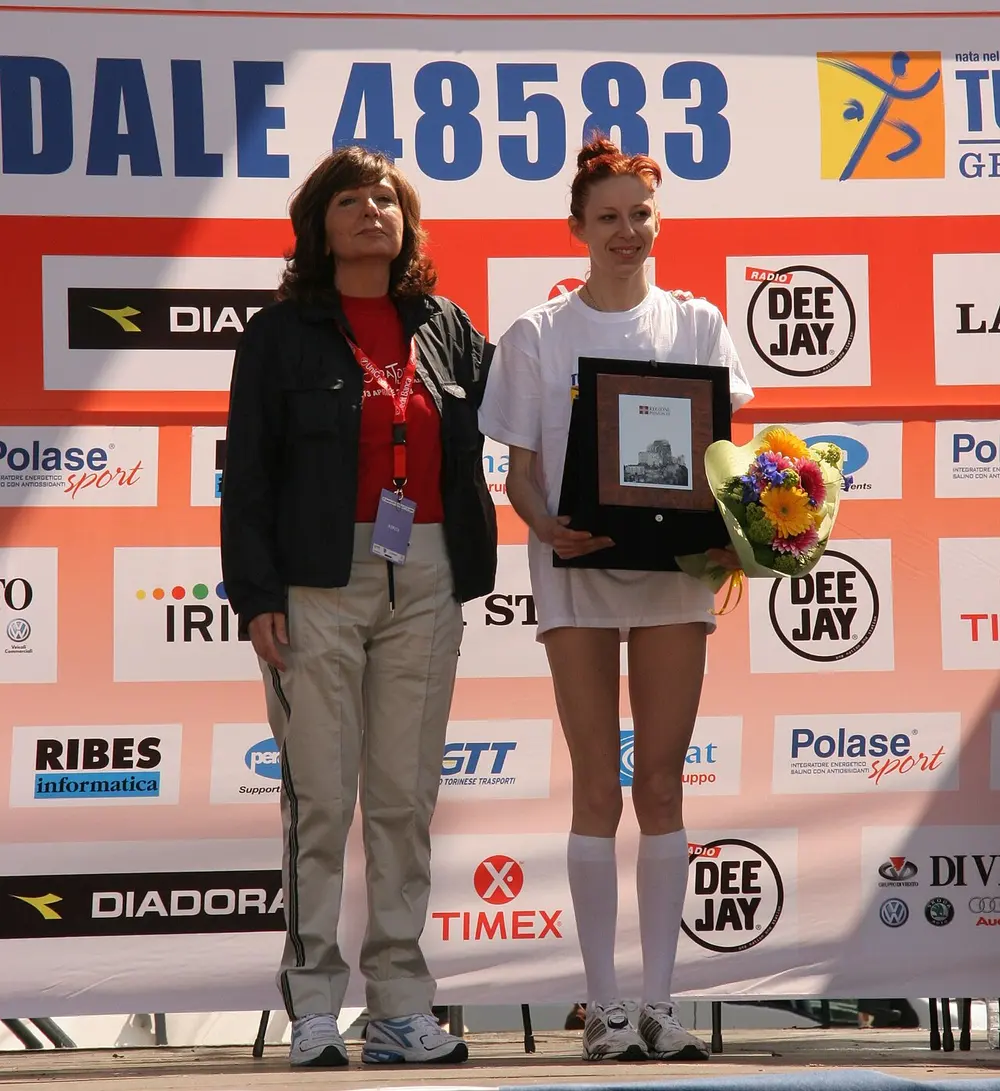
Vincenza Sicari - 2008 Turin Marathon podium. Photo: Sport Communities from Italia / Wikimedia Commons, CC BY-SA 2.0.
Frequently asked questions
Answers to the questions runners ask before entering, drawn from this race's course guide and the directory's own data — the sources behind them are listed below.
When is the Turin Marathon in 2026?
The 2026 edition is scheduled for 29 November 2026. It is a late-autumn race, held at the end of the Italian running season.
Is the Turin Marathon flat or hilly?
It is undulating, with about 110 metres of climbing. The course is gently rolling rather than hilly, with short rises and no sustained ascent. That is enough to break the rhythm without turning the race into a hill marathon.
Is the Turin Marathon good for a personal best or a first marathon?
Yes, for both goals. The low total climbing and usually cold racing weather favour fast times, while the city-centre route and modest profile are approachable for a first marathon. The late-November date means your autumn training needs to be consistent.
Where is the Turin Marathon run?
It runs through Turin's arcaded streets and along the Po, with the Alps visible as a backdrop when the air is clear. The route stays within the city.
What is the weather usually like?
Late November is usually cold enough to race hard. Plan for a cold start, gloves and a warm layer to discard, rather than expecting mild spring conditions.
What should I know about the course profile?
The 110 metres of gain are spread in short rises across the route. There is no single climb to prepare for, but the changes are frequent enough that a fixed pace can be hard to hold. Run by effort and check your splits.
More marathons in Italy
More marathons in Europe
Sources for this page
What each source below is used for on this page, and where to check this race yourself.
- World Athletics — the label calendar and the road-race regulations. Used to check whether the race holds a World Athletics label, and its elite competition details.
- AIMS — the international course-measurement standard behind the 42.195 km distance, and the AIMS race calendar.
- The organizer's own publications — course maps, race handbooks and published results. The date, course character and climbing on this page are compiled from them and re-checked each season.
Where do these facts come from?
Dates, course type, climbing and time limits are compiled from the organizer's publications and re-checked each season; elevation is an estimate of total climbing rather than a survey figure. Always confirm race-day details with the organizer before making plans.
Last reviewed 27 October 2026