
Munich Marathon
The Alps are visible from Munich on a clear day, and they are the first thing many visitors notice. The marathon is not in them.
By Global Marathon Routes editorial team · Last reviewed 27 October 2026
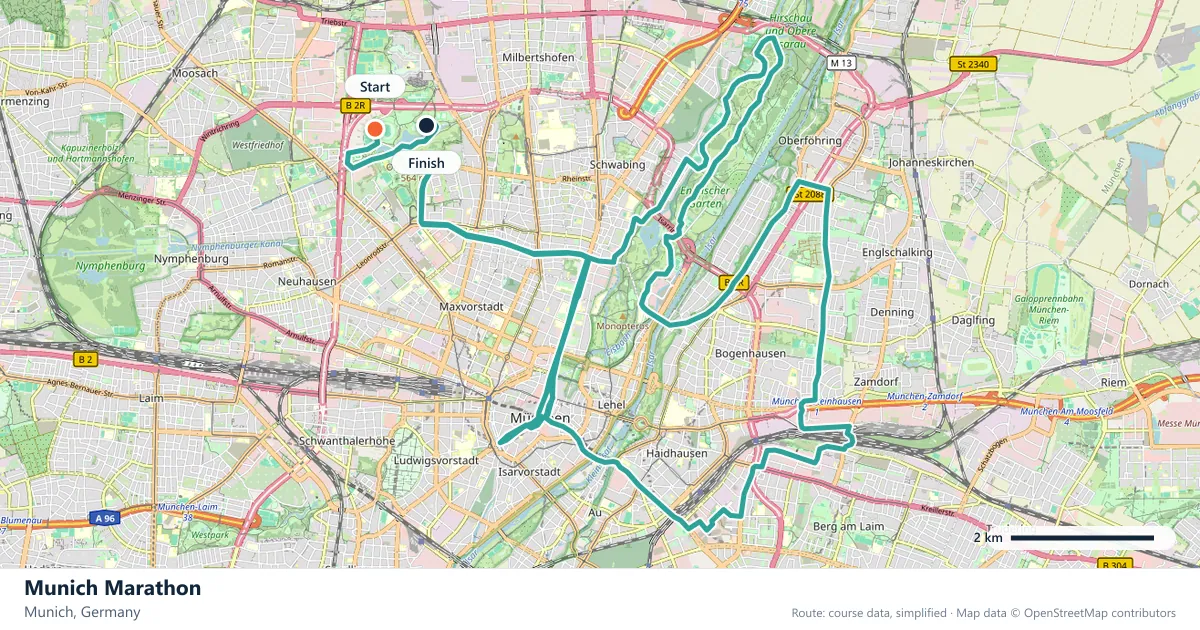
Where does the Munich Marathon run?
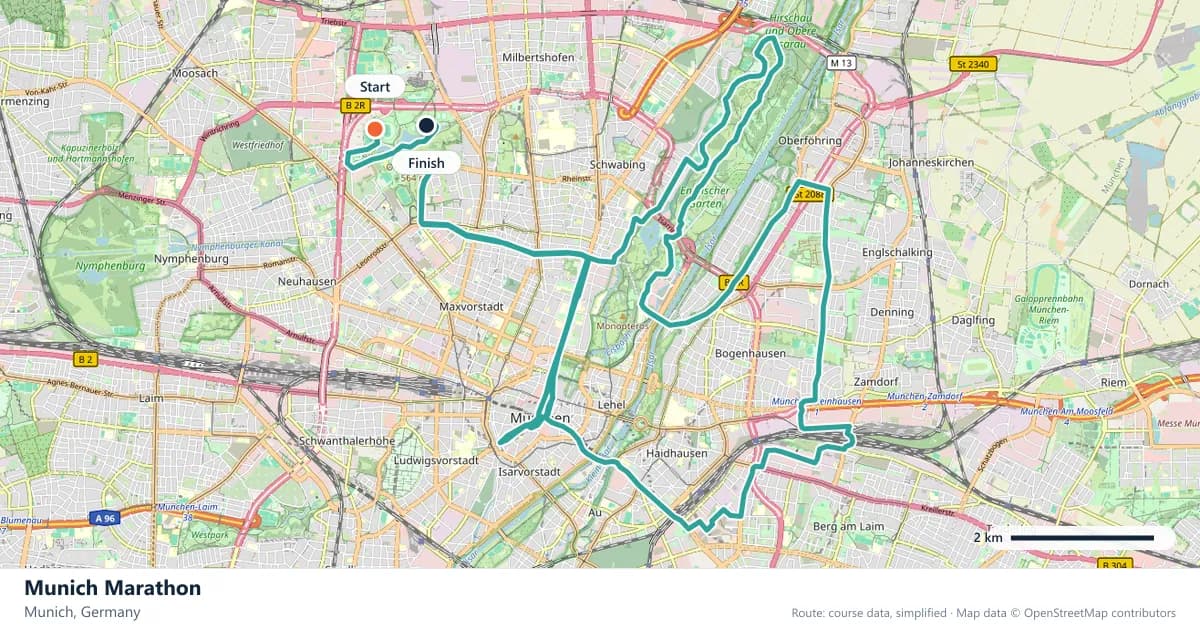
Interactive map
The trace follows the organizer's published course, simplified for the screen: the orange dot is the start, the dark dot the finish. Scroll to zoom, drag to pan.
What is the Munich Marathon course like?
Runs through the Bavarian capital from the Olympic Park towards the old town and back, on a course that is flatter than the Alps on the horizon suggest.
- Next edition
- October 2027 (expected)
- Elevation gain
- 90 m
- Profile
- Flat
- First run
- —
Course guide
The Alps are visible from Munich on a clear day, and they are the first thing many visitors notice. The marathon is not in them. The course stays in the city, climbing about 90 metres between the Olympic Park and the old town, and the 2026 edition was held on 11 October.
That gap between backdrop and route is the defining fact of the Munich Marathon. The city sits on a gravel plain north of the mountains, and the race uses the flat ground to make a course that is quicker than the horizon suggests. It is a race for personal bests and for first marathons, and the out-and-back shape keeps the day legible.
Munich's running identity is tied to the Olympic Park, built for the 1972 Games, and the course uses it as the anchor. From there the route heads towards the old town and returns, so the second half retraces ground you have already covered.
The course
The route leaves the Olympic Park and heads towards the old town, then comes back along the same broad corridor. There is no sustained climb anywhere on the 42.195 km, and the 90 metres of gain are spread so thinly that the road rarely feels like it is rising at all.
That makes the course quick, but it also makes it mentally repetitive. The second half revisits streets and landmarks you have already passed, and the familiarity can make the final 10 km feel longer than the profile deserves. Breaking the race into sections, with the turnaround as the halfway marker, is more useful here than waiting for the finish line to arrive.
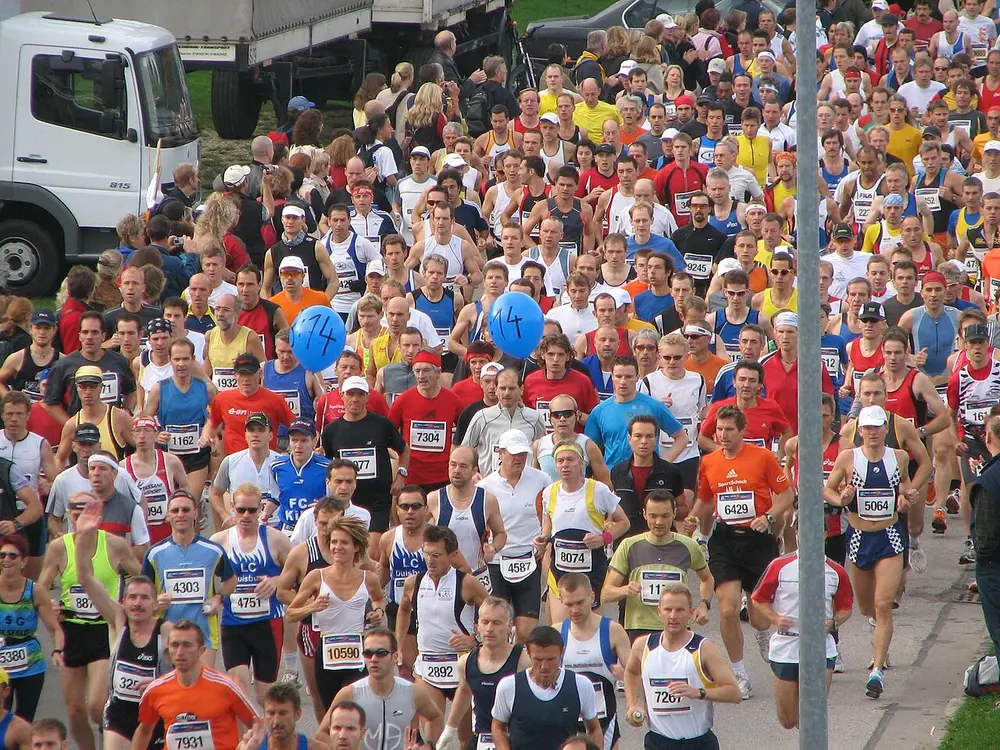
Marathon-Munich-2005-10-09-10. Photo: Thomas Netsch / Wikimedia Commons, Public domain.
Olympic Park to the old town
The Olympic Park is more than a stadium. It is a landscape of lawns, paths and water, with the tent-like roof of the stadium and the tall Olympic tower visible from across the park. The race begins in that open, modern setting, which is about as far from the postcard image of Munich as the city gets.
The old town is the other pole: narrow streets, the Frauenkirche's twin towers, the Marienplatz and the market stalls around the Viktualienmarkt. The approach to the historic centre gives the race its urban texture.
Between the two ends, the route uses Munich's broad streets and the green spaces that make the city such a comfortable place to run.
Why the Alps are a backdrop, not a warning
Runners arriving from the mountains may expect a course to match, but Munich's marathon is a plain-city race. The 90 metres of climbing are modest, and there is no pass, no long drag and no summit. The Alps are a view, not a warning.
That does not mean the course is easy. Flat kilometres remove the natural breaks that hills provide, and the out-and-back format removes novelty in the second half. The race is decided by pace and patience rather than by gradient.
If you train in a hilly city, do not assume Munich will feel effortless. The lack of climbing means the legs never change their working pattern, and the same muscles carry the load all day. A few long runs on flat ground are good preparation for that.
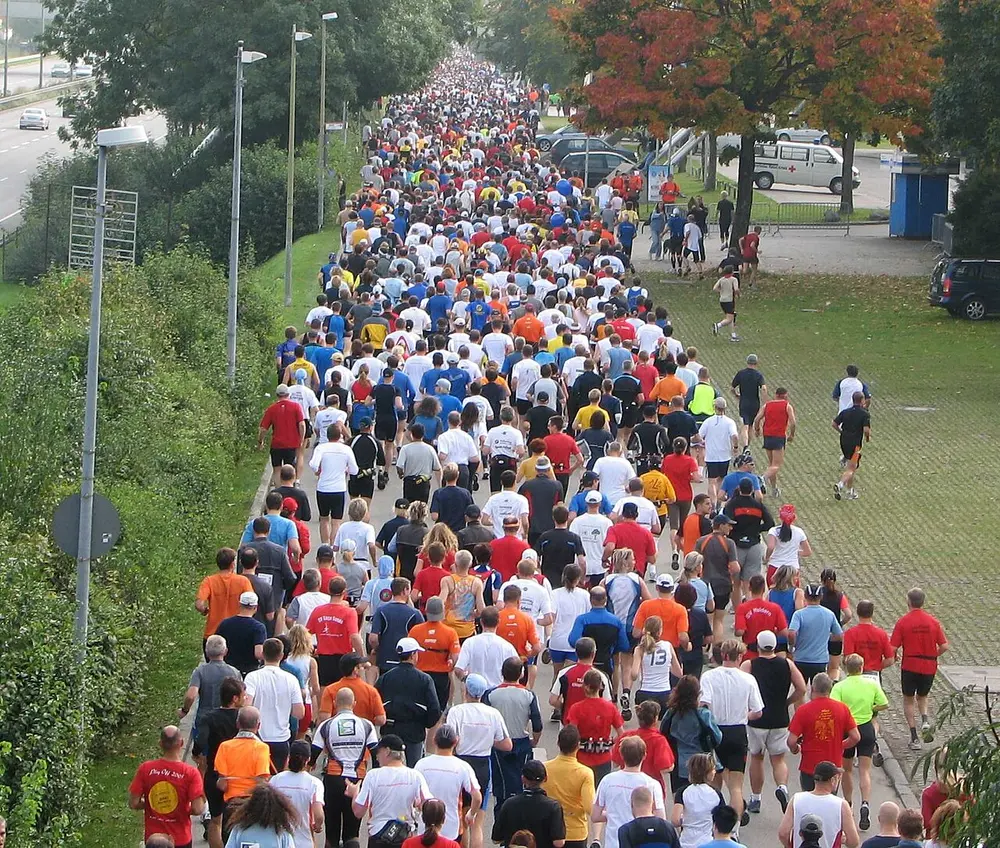
Marathon-Munich-2005-10-09-10 (photo 2). Photo: Thomas Netsch / Wikimedia Commons, Public domain.
Autumn in the Isar city
An October race means the main training block lands in late summer, and race day sits at the point where Munich's beer gardens are winding down and the city is settling into autumn. The Isar, the English Garden and the wide boulevards give the city a relaxed feel that suits a distance race.
The date is also a reminder that the Munich marathon is a one-day event in a city with a crowded calendar. Book accommodation early if the race coincides with a busy weekend, and leave time to walk through the old town after the race. The city is compact enough to explore on foot, which is the best recovery there is.
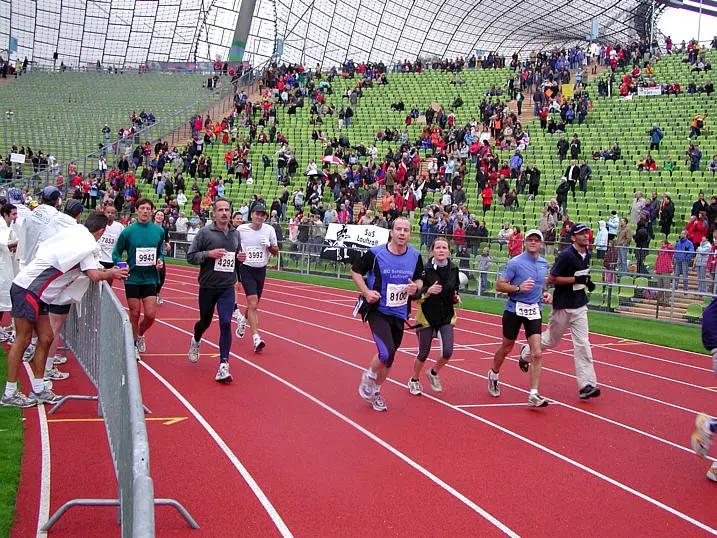
Muenchen marathon 2004 zieleinlauf. Photo: Thomas Schmidtkonz / Wikimedia Commons, CC BY-SA 3.0.
Frequently asked questions
Answers to the questions runners ask before entering, drawn from this race's course guide and the directory's own data — the sources behind them are listed below.
When is the Munich Marathon?
The edition covered here was held on 11 October 2026. The race is an October fixture in the Bavarian capital, and the organiser sets the date for each edition.
Is the Munich Marathon flat?
Yes. The course climbs about 90 metres in total and has no sustained ascent. Despite the Alps on the horizon, the route itself is flat.
Is Munich good for a first marathon or a personal best?
The flat profile and the autumn date give a personal-best attempt and a debut a fair chance. A first marathon benefits from the lack of climbing, while a personal-best attempt benefits from the even rhythm the course allows. The main risk is starting too quickly on the flat opening kilometres.
Where does the Munich Marathon take place?
It runs through Munich from the Olympic Park towards the old town and back. The route stays within the Bavarian capital, with the Olympic Park and the old town as its two poles.
What is the shape of the course?
It is an out-and-back route. The race heads from the Olympic Park towards the old town and then returns, which makes the second half familiar.
How should I handle the return leg?
Expect the second half to feel less exciting than the first. Use the turnaround as a reset, break the return into short blocks, and keep your effort even when the streets start to look the same.
More marathons in Germany
More marathons in Europe
Sources for this page
What each source below is used for on this page, and where to check this race yourself.
- World Athletics — the label calendar and the road-race regulations. Used to check whether the race holds a World Athletics label, and its elite competition details.
- AIMS — the international course-measurement standard behind the 42.195 km distance, and the AIMS race calendar.
- The organizer's own publications — course maps, race handbooks and published results. The date, course character and climbing on this page are compiled from them and re-checked each season.
Where do these facts come from?
Dates, course type, climbing and time limits are compiled from the organizer's publications and re-checked each season; elevation is an estimate of total climbing rather than a survey figure. Always confirm race-day details with the organizer before making plans.
Last reviewed 27 October 2026