
Madrid Marathon
Madrid is Spain's original popular marathon: MAPOMA first took thousands of runners through the city in 1978, starting in El Retiro, and the race has grown into one of the country's biggest running…
By Global Marathon Routes editorial team · Last reviewed 27 October 2026
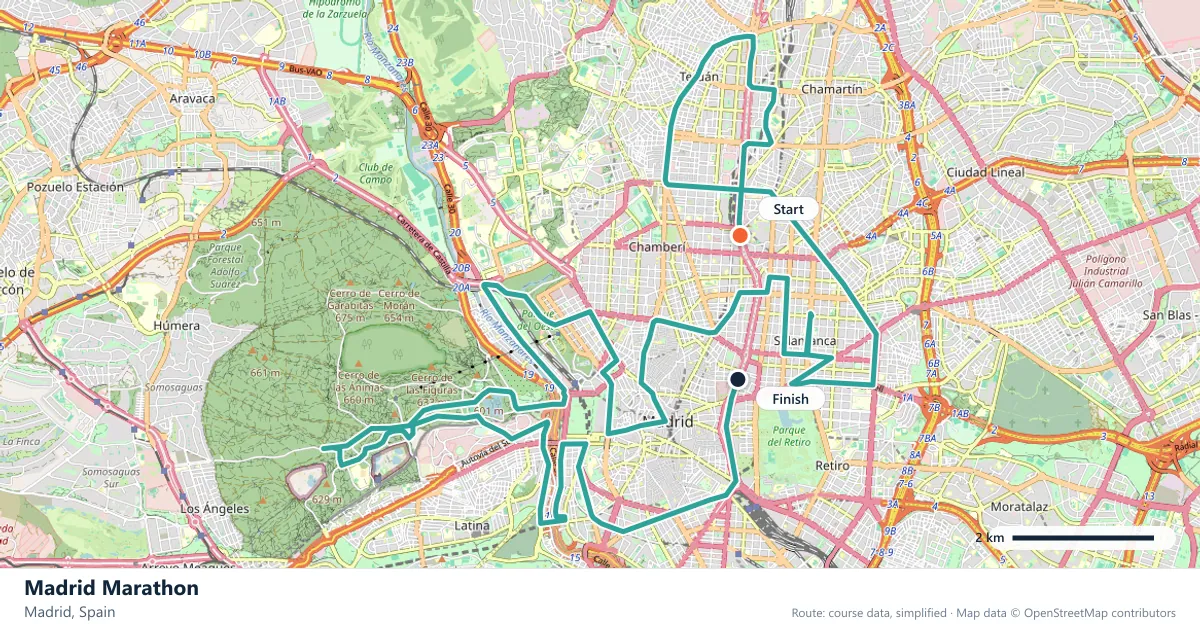
Where does the Madrid Marathon run?
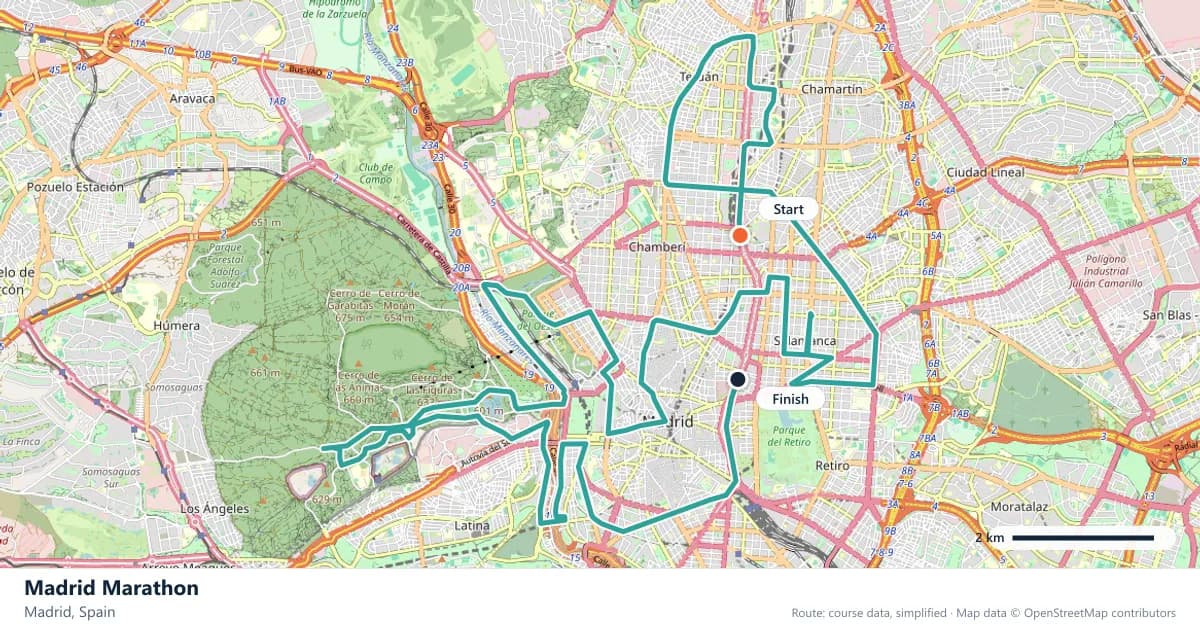
Interactive map
The trace follows the organizer's published course, simplified for the screen: the orange dot is the start, the dark dot the finish. Scroll to zoom, drag to pan.
What is the Madrid Marathon course like?
A demanding course through central Madrid, climbing towards the Retiro and the northern avenues before the long run home past the Prado. Nearly 400 metres of gain on a spring day that can already feel warm.
- Next edition
- 25 April 2027
- Elevation gain
- 410 m
- Profile
- Hilly
- First run
- —
Course guide
Madrid is Spain's original popular marathon: MAPOMA first took thousands of runners through the city in 1978, starting in El Retiro, and the race has grown into one of the country's biggest running festivals. The 2027 edition is the 49th, held on Sunday 25 April, with 47,000 runners across the marathon and half marathon. About 17,000 of those places are for the full 42.195 km.
This is not a flat capital-city course. Madrid sits at roughly 650 metres above sea level, the marathon climbs about 410 metres in total, and the second half is the harder one. The route is completely urban and fully closed to traffic, but the combination of altitude, repeated climbs and a spring day that can warm up quickly makes it a far more demanding race than its city-centre setting suggests.
That is the appeal. Madrid is a race for runners who want a major-city atmosphere without a flat, processional loop. The landmarks come at you in sequence — the Castellana, the Royal Palace, the Retiro, the Puerta del Sol — and the finish on the Paseo de Recoletos rewards patience more than raw speed.
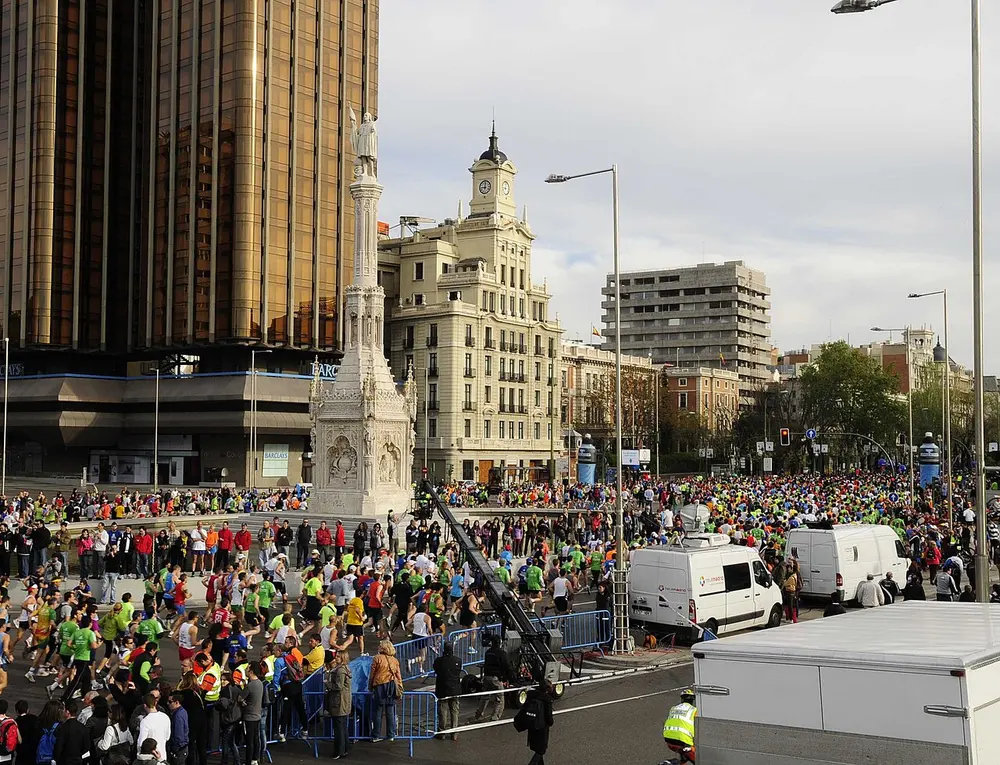
Maratón de Madrid 2016. Photo: Diario de Madrid / Wikimedia Commons, CC BY 4.0.
The course
The race starts on the Paseo de la Castellana, beside the Plaza de San Juan de la Cruz, and finishes on the Paseo de Recoletos between the Plaza de Cibeles and the Plaza de Colón. Between those two points the course is a single urban loop through the centre, certified by the RFEA and World Athletics and closed to traffic for the morning.
The profile is often described as downhill towards halfway, with the real work saved for the return. The second half brings a series of false flats and longer climbs, including the Calle Segovia ramp, the climb up Calle Princesa and the drag from Atocha back towards Recoletos. None of these is a mountain pass, but they arrive when the legs are tired, and the finish itself is on a gradual rise.
The landmarks are the other half of the story. The route passes the Royal Palace, the Retiro and the Puerta del Sol, and the final kilometres run through the formal heart of the city. It is a course that keeps giving you something to look at, even when the climbing has stopped feeling generous.
| Race fact | Detail |
|---|---|
| Date | Sunday 25 April 2027 |
| Start | Paseo de la Castellana, beside Plaza de San Juan de la Cruz |
| Finish | Paseo de Recoletos, between Cibeles and Colón |
| Field | About 47,000 across marathon and half; about 17,000 marathoners |
| Elevation | About 410 m of climbing |
| Altitude | Around 650 m above sea level |
| Label | World Athletics Label |
| Course | Single urban loop, fully closed to traffic |
| Part of the race | What to expect |
|---|---|
| Start | Wide Castellana boulevard and a crowded opening |
| First half | The easier half: city-centre streets and a net descent towards halfway |
| Second half | False flats, the Calle Segovia ramp and the Calle Princesa climb |
| Final 10K | The drag from Atocha towards Recoletos and a gradual uphill finish |
| Finish | Paseo de Recoletos, between Cibeles and Colón |
Start, finish and cut-offs
The start is on the Paseo de la Castellana next to the Plaza de San Juan de la Cruz. The finish is on the Paseo de Recoletos, between the Plaza de Cibeles and the Plaza de Colón. The wheelchair and handbike race starts at 8:30; the first mass wave time was still listed as to be confirmed when the 2027 regulations were published, so check the final instructions before race morning.
The regulations publish maximum passage times at every kilometre rather than a single headline limit. The key points are:
| Distance | Maximum time |
|---|---|
| 5 km | 11:00 |
| 10 km | 11:45 |
| Half marathon | 13:24:52 |
| 30 km | 14:45 |
| 40 km | 16:15 |
| 42.195 km | 16:34:45 |
The early checkpoints matter because the course closes on a rolling schedule. If you are aiming for a time near the back of the field, know the 5 km and 10 km times before you start, not after you have already lost the buffer.
Aid stations and fuelling
The official refreshment points are at 5, 10.5, 16, 20, 25, 29, 32, 35.8, 38 and 40 kilometres, plus the finish. The marathon Fuel Bag includes two gels and a bar, and there is an additional 226ERS gel point at kilometre 30. Water and the usual race-day support are available along the route; the exact product list can change, so check the final participant instructions.
The Fuel Bag is collected with your bib at the Feria del Corredor, not on the course. Practise with 226ERS before race day if you plan to use the on-course gels; a hilly marathon at altitude is not the place to try a new flavour.
Records and the Madrid story
Madrid's records reflect how much harder the course is than the flat European majors. The men's course record is 2:08:18, set by Reuben Kerio in 2019. The women's record is 2:24:37, set by Siranesh Yirga in 2022. Those are strong times on a course with 410 metres of climbing and a finish that rises towards Recoletos.
| Record | Time | Athlete | Year |
|---|---|---|---|
| Men's course record | 2:08:18 | Reuben Kerio | 2019 |
| Women's course record | 2:24:37 | Siranesh Yirga | 2022 |
The first edition in 1978 was a different kind of event: thousands of runners started in El Retiro, the organisation was improvised, and only about 3,000 finished. MAPOMA grew from that race into the organiser behind the modern Rock 'n' Roll Running Series Madrid. The 2027 event has only two distances, the marathon and the half marathon; the 10K is not on the programme.
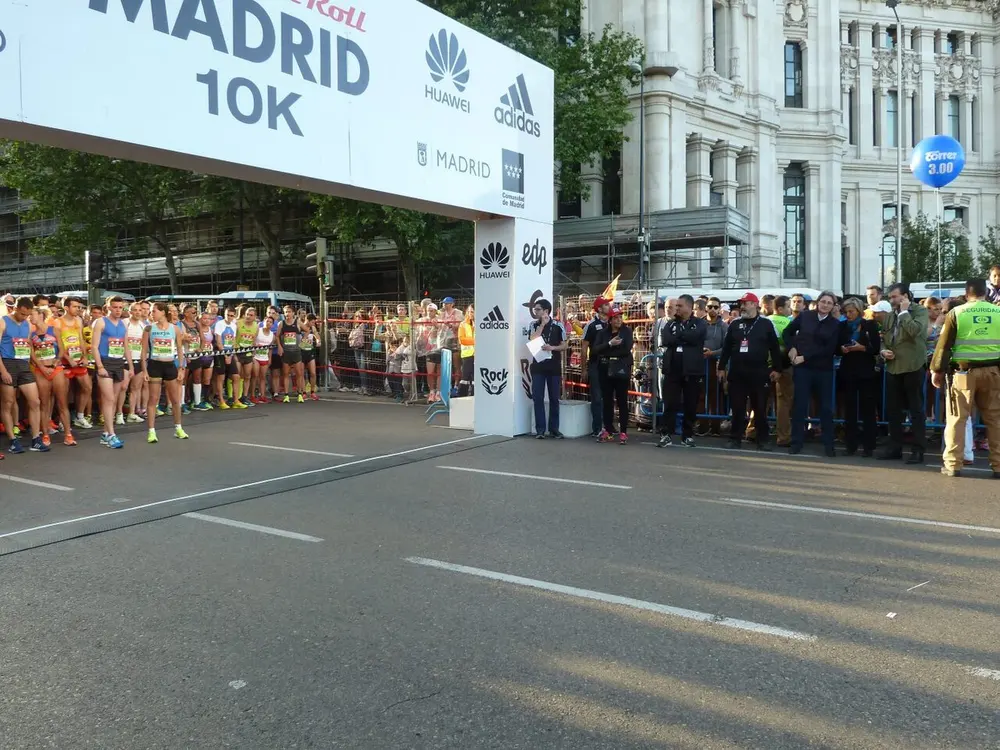
El Maratón de Madrid cumple 40 años con 37.000 participantes (02). Photo: Diario de Madrid / Wikimedia Commons, CC BY 4.0.
Registration and race weekend
The 2027 entry process is tiered. Participants from the 2026 edition had a loyalty window from 6 to 10 May 2026; people on the 2026 waitlist had a preferential window from 11 to 13 May; general registration opened on 14 May 2026 at 10:00 and continues until the field is full. Once places sell out, the organiser opens a waitlist for bibs released by cancellations.
If you want a personalised bib and a start corral based on your qualifying time, enter before 18 March 2027. Entries after that date are not guaranteed a personalised bib or the corral that matches the time you submit.
Bib collection is at the Feria del Corredor at IFEMA on 23 and 24 April. There is no race-day pickup. Bring the registration QR code and a photo ID; the organiser does not release bibs without them. The start and finish are both in the city centre, so the Metro and walking are the simplest way to move around on race morning.
Late April in Madrid can be cool at the start and warm by midday. Plan for a range rather than a single temperature, and remember that the altitude makes the same pace feel harder than it would at sea level.
What to watch for
- The second half. The first half can feel deceptively manageable. The Calle Segovia ramp, the Calle Princesa climb and the drag to Recoletos are where the race is decided.
- Altitude. Madrid is around 650 metres above sea level. It is not a mountain race, but the thin air adds to the effort on every climb.
- Spring warmth. A cool start can turn into a warm afternoon. Carry fluids early and do not overdress for the first hour.
- The finish rise. The line on Recoletos is not flat. Leave something for the final kilometre rather than emptying everything at Atocha.
- The cut-off table. The per-kilometre maximum times are strict. If you are aiming to finish near the back of the field, know the 5 km and 10 km cut-offs.
Frequently asked questions
Answers to the questions runners ask before entering, drawn from this race's course guide and the directory's own data — the sources behind them are listed below.
When is the Madrid Marathon in 2027?
The 49th edition is on Sunday 25 April 2027. The event has two distances, the marathon and the half marathon; the 10K is not part of the 2027 programme.
Is the Madrid Marathon a hilly course?
Yes. The marathon climbs about 410 metres, with the hardest work in the second half, including the Calle Segovia ramp and the climb up Calle Princesa. The finish on Paseo de Recoletos is also on a gradual rise. It is not a flat personal-best course.
Where does the Madrid Marathon start and finish?
The start is on the Paseo de la Castellana beside the Plaza de San Juan de la Cruz. The finish is on the Paseo de Recoletos between the Plaza de Cibeles and the Plaza de Colón.
What are the cut-off times at the Madrid Marathon?
The regulations publish maximum times at every kilometre. The key points are 5 km at 11:00, 10 km at 11:45, halfway at 13:24:52, 30 km at 14:45, 40 km at 16:15 and the finish at 16:34:45. The first mass start time is confirmed closer to race day; the wheelchair and handbike race starts at 8:30.
What aid stations are on the Madrid Marathon course?
Refreshment points are at 5, 10.5, 16, 20, 25, 29, 32, 35.8, 38 and 40 kilometres, plus the finish. The marathon Fuel Bag contains two gels and a bar, and there is an extra 226ERS gel point at kilometre 30.
How do you enter the Madrid Marathon?
The 2027 entry process has a loyalty window, a preferential window for the 2026 waitlist and then general registration from 14 May 2026 until the field fills. Enter before 18 March 2027 if you want a personalised bib and a start corral based on your time. Bibs are collected at IFEMA on 23 and 24 April; there is no race-day pickup.
Is Madrid a good first marathon or personal-best race?
It is not the obvious choice for either. The climbing, the altitude and the possibility of a warm spring day make it a demanding first marathon, and the course records are much slower than the flat majors. It suits runners who want a big-city race with a real course and are prepared to pace by effort.
What are the highlights of the Madrid Marathon course?
The route passes the Royal Palace, the Retiro and the Puerta del Sol, starts on the Castellana and finishes on the Recoletos between Cibeles and Colón. The second half includes the Calle Segovia ramp, the Calle Princesa climb and the drag from Atocha to the finish.
More marathons in Spain
More marathons in Europe
Sources for this page
What each source below is used for on this page, and where to check this race yourself.
- World Athletics — the label calendar and the road-race regulations. Used to check whether the race holds a World Athletics label, and its elite competition details.
- AIMS — the international course-measurement standard behind the 42.195 km distance, and the AIMS race calendar.
- The organizer's own publications — course maps, race handbooks and published results. The date, course character and climbing on this page are compiled from them and re-checked each season.
“A World Athletics Label denotes a full application of the Competition and Technical Rules in, at a minimum, the elite component of the competition. Labels also denote superior standards in event organisation, safety and runner experience, support from public authorities to the event and a financial commitment to anti-doping.”
Where do these facts come from?
Dates, course type, climbing and time limits are compiled from the organizer's publications and re-checked each season; elevation is an estimate of total climbing rather than a survey figure. Always confirm race-day details with the organizer before making plans.
Last reviewed 27 October 2026