
Zurich Marathon
Zurich's marathon makes its case with restraint. There is no mountain pass, just a flat city course that skirts Lake Zurich, threads the old town and follows the Limmat.
By Global Marathon Routes editorial team · Last reviewed 27 October 2026
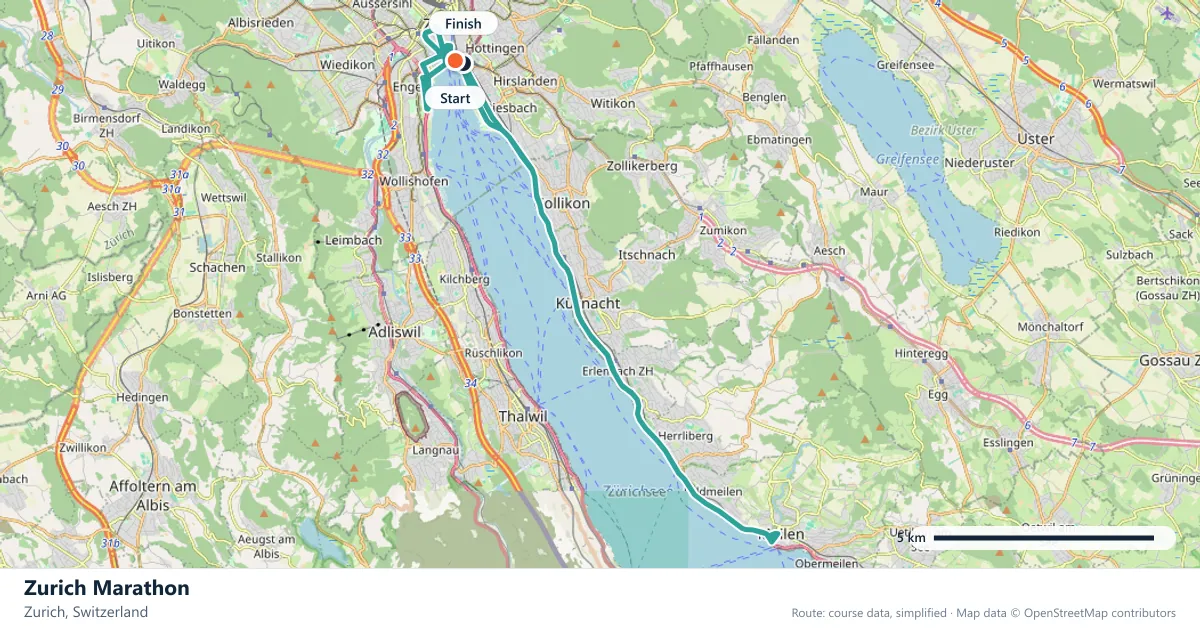
Where does the Zurich Marathon run?
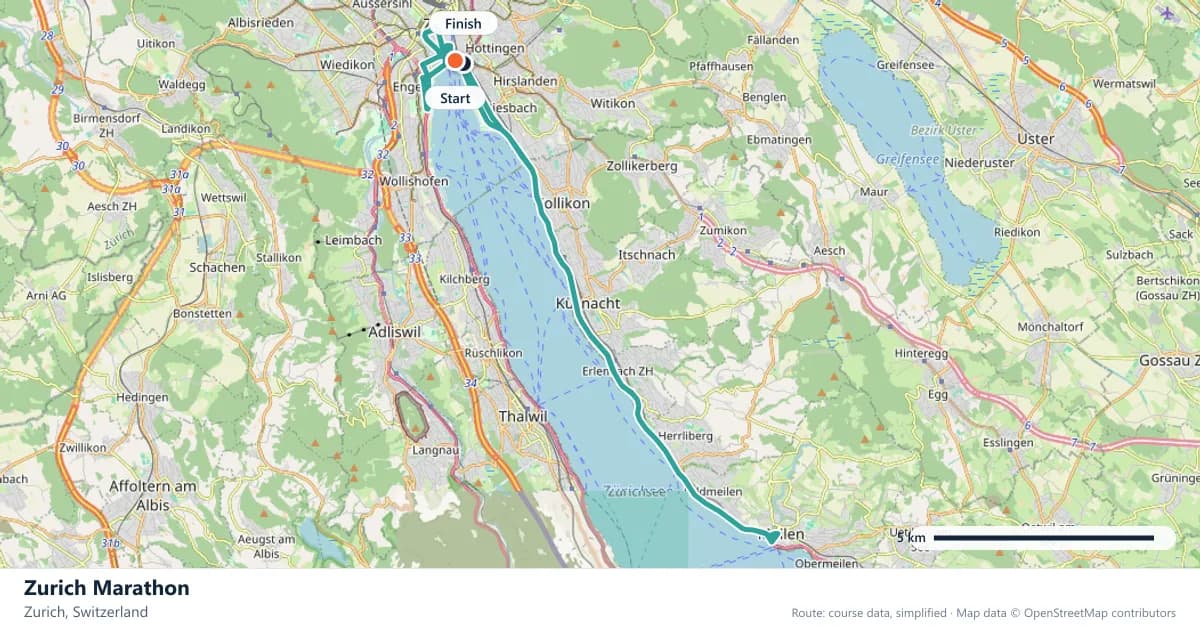
Interactive map
The trace follows the organizer's published course, simplified for the screen: the orange dot is the start, the dark dot the finish. Scroll to zoom, drag to pan.
What is the Zurich Marathon course like?
A flat city course around Lake Zurich, through the old town and along the Limmat. Run in spring, with wide roads and a famously quick field.
- Next edition
- April 2027 (expected)
- Elevation gain
- 63 m
- Profile
- Flat
- First run
- —
Course guide
Zurich's marathon makes its case with restraint. There is no mountain pass, just a flat city course that skirts Lake Zurich, threads the old town and follows the Limmat. The next edition is expected in April 2027, and the restraint is the point: a full marathon here climbs only about 63 metres, the roads are wide, and the field has a reputation for going quickly.
Switzerland's running imagination usually turns to the Alps, yet its largest city stages a race that is almost entirely level. The route stays inside Zurich, moving between the open water of the lake and the narrower streets of the historic centre. The scenery changes; the gradient hardly does.
That makes it attractive for a personal best and manageable for a first marathon, though not trivial: flat roads still punish an ambitious opening.
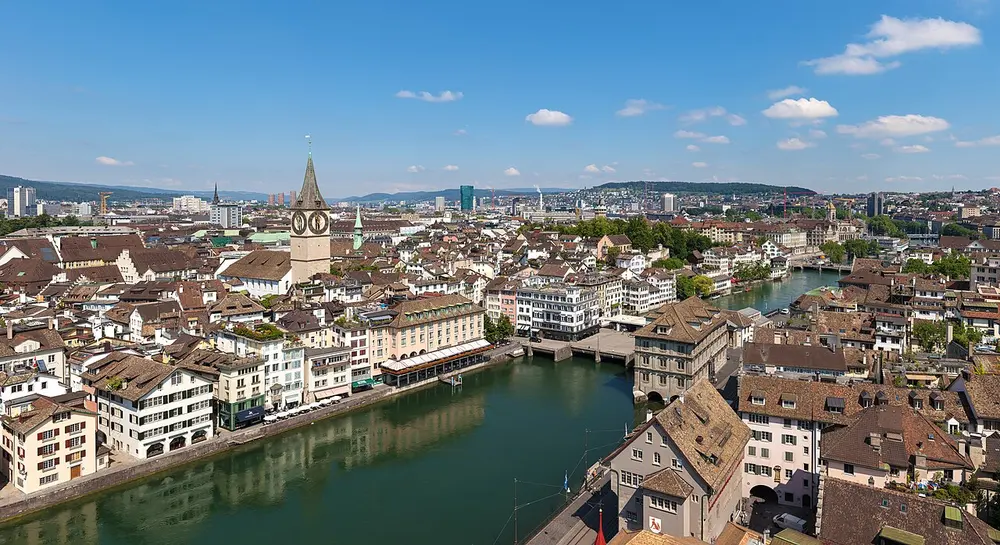
Altstadt Zürich 2015. Photo: Thomas Wolf , www.foto-tw.de / Wikimedia Commons, CC BY-SA 3.0 de.
The course
The race is a city course built around water. It runs around Lake Zurich, through the old town and along the Limmat, the river that drains the lake and divides the medieval centre. The lakeside stretches are wide and open; the old town is tighter, with corners, buildings close to the road and spectators at the barriers. The profile is flat: the total gain is about 63 metres, and no climb demands a change of stride.
The character comes from the alternation: the lakefront feels spacious, the old town enclosed, and the river gives the route a spine. Runners expecting a monotonous city loop will find more variety than the elevation suggests.
The old town and the water
The old town on the Limmat is the part of Zurich most visitors picture: the Grossmünster and Fraumünster towers, the Lindenhof square above the river, the narrow lanes of the Niederdorf. The race passes through this layer of the city, so the middle of the marathon runs through streets with centuries of history around them.
Water frames the rest. Lake Zurich opens to the south, with hills rising on both sides, and the Limmat carries the lake's clear water through the centre. The transitions between quays and lanes are quick; in a marathon, they are where the race changes rhythm.
What the flat profile hides
Sixty-three metres is close enough to zero that the climbing will not decide the race; the decisions are yours. How hard to run the first ten kilometres, whether to use the wide roads to pass, how much to save for the old-town turns. A level course makes a fast pace feel sustainable for longer than it really is, and the field reinforces the illusion.
Pace by effort and let the kilometres come. The old town is a natural reset, and the final stretch along the water rewards patience. A flat marathon is not an easy marathon; the course gives you nothing to blame.
An April start in a city of hills
Zurich is built on slopes. The Zürichberg rises behind the city to the east, the Uetliberg to the west, and the lake stretches south towards the Alps. The marathon deliberately stays on the level ground between them. April puts the race at the start of the season, when the city is shaking off winter and the lakefront is coming back to life.
The date is still expected rather than confirmed, which matters if you are booking travel: wait for the organiser's exact date before committing to flights or a hotel.
At the Zurich Airport. Switzerland. Photo: Ввласенко / Wikimedia Commons, CC BY-SA 3.0.
Around the race
Zurich is compact. Trams run through the centre, the main station sits at the top of Bahnhofstrasse, and the airport is a short train ride away. The old town, the lakefront and the financial district are neighbours, so race weekend is easy to combine with a few days of walking.
The Dolder Grand, on the wooded hill above the lake, is a reminder that Zurich's grand side looks down on the course. The race stays below, on the water and in the streets. Walk the old town the day before if you can; the corners feel different at race pace.
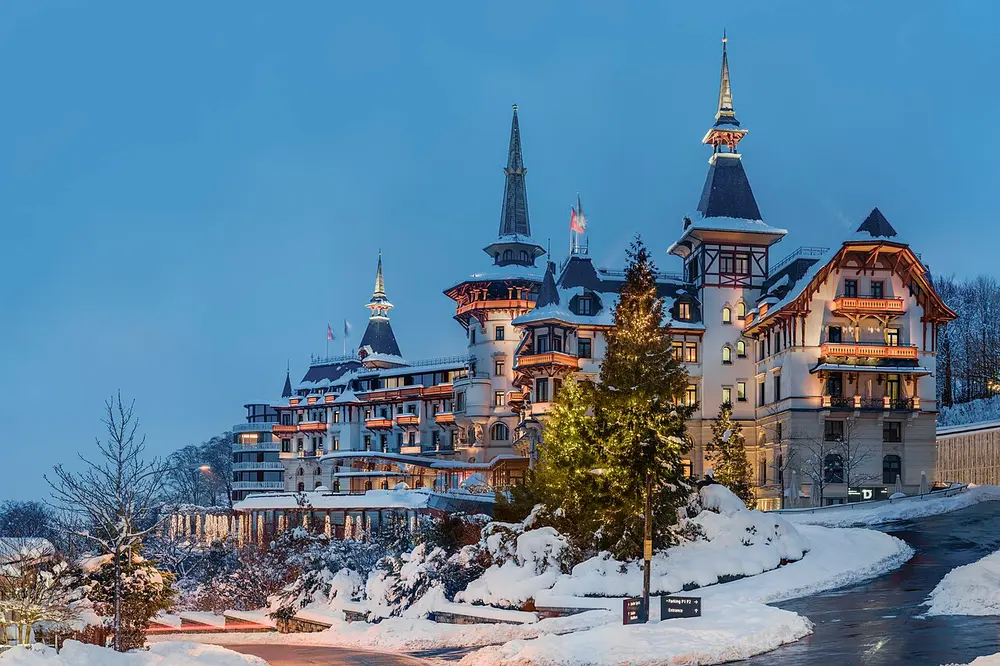
CH.ZH.Zurich Hotel The-Dolder-Grand 3x2-R 15K. Photo: NOTE: This image is a panorama consisting of multiple frames that were merged or stitched in software. As a result, this image necessarily underwent some form of digital manipulation. These manipulations may include blending, blurring, cloning, and color and perspective adjustments. As a result of these adjustments, the image content may be slightly different from reality at the points where multiple images were combined. This manipulation is often required due to lens, perspective, and parallax distortions. / Wikimedia Commons, CC BY-SA 4.0.
Frequently asked questions
Answers to the questions runners ask before entering, drawn from this race's course guide and the directory's own data — the sources behind them are listed below.
When is the Zurich Marathon?
The next edition is expected in April 2027. The month is known, but the exact race day is still provisional; the organiser confirms it closer to the event.
Is the course flat?
Yes. The full marathon climbs about 63 metres, with no sustained ascent. The route around the lake and through the old town is level enough that the effort stays remarkably even from start to finish.
Is Zurich good for a personal best?
The flat profile, wide roads and quick field give it a fair claim as a fast course. A personal best still depends on pacing and conditions, but the route does not fight you.
Is it a good first marathon?
The course is manageable for a debut: 63 metres of climbing, wide roads and an easy city to navigate. The risk is going out too quickly because it feels easy.
Where is the race run?
Entirely within Zurich: around the lake, through the old town and along the Limmat. The race alternates between open water and historic streets.
How should I pace the Zurich Marathon?
Start conservatively. The flat kilometres feel easier than they are, and the old-town corners are a natural place to reset before the run along the water.
More marathons in Switzerland
More marathons in Europe
Sources for this page
What each source below is used for on this page, and where to check this race yourself.
- World Athletics — the label calendar and the road-race regulations. Used to check whether the race holds a World Athletics label, and its elite competition details.
- AIMS — the international course-measurement standard behind the 42.195 km distance, and the AIMS race calendar.
- The organizer's own publications — course maps, race handbooks and published results. The date, course character and climbing on this page are compiled from them and re-checked each season.
Where do these facts come from?
Dates, course type, climbing and time limits are compiled from the organizer's publications and re-checked each season; elevation is an estimate of total climbing rather than a survey figure. Always confirm race-day details with the organizer before making plans.
Last reviewed 27 October 2026