
Jungfrau Marathon
The Jungfrau Marathon is not a road race with a hill in it. It starts in Interlaken and climbs close to 2,000 metres to the foot of the Eiger, finishing 2,000 metres above the start.
By Global Marathon Routes editorial team · Last reviewed 27 October 2026
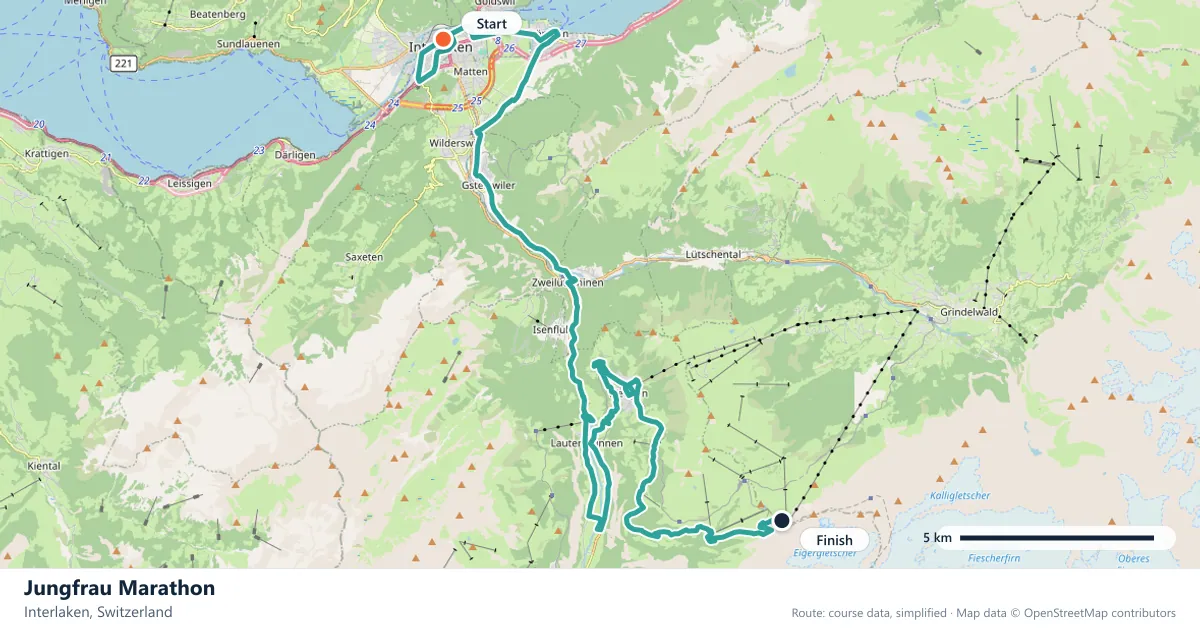
Where does the Jungfrau Marathon run?
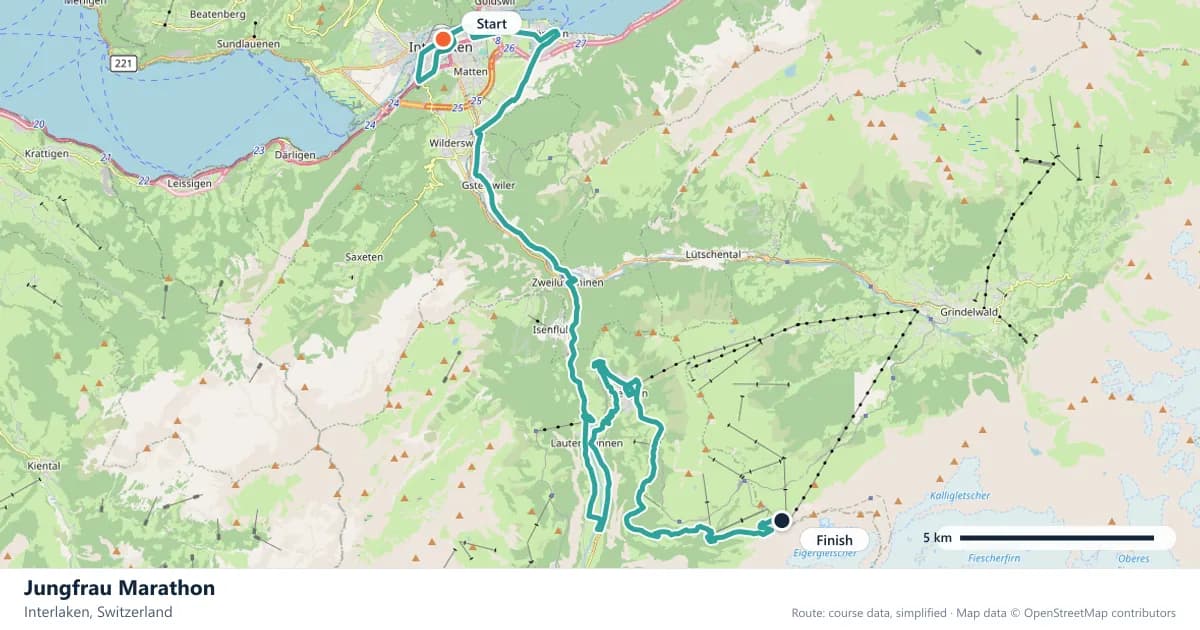
Interactive map
The trace follows the organizer's published course, simplified for the screen: the orange dot is the start, the dark dot the finish. Scroll to zoom, drag to pan.
What is the Jungfrau Marathon course like?
A mountain marathon from Interlaken to the foot of the Eiger, climbing close to 2,000 metres over 42 km. Walking the steepest kilometres is normal; the finish is 2,000 metres above the start.
- Next edition
- 11 September 2027
- Elevation gain
- 1999 m
- Profile
- Hilly
- First run
- —
Course guide
The Jungfrau Marathon is not a road race with a hill in it. It starts in Interlaken and climbs close to 2,000 metres to the foot of the Eiger, finishing 2,000 metres above the start. The next edition is on Saturday 11 September 2027.
The climb is the race. The gradient shapes every kilometre, from the opening miles in the valley to the final approach below the Eiger, and it makes the marathon a different kind of test from a flat city course. Pacing is measured in effort and altitude, not in splits alone.
Walking the steepest kilometres is normal. Runners who expect to run every step often find the upper section humbling, while those who plan to walk the steepest ramps arrive at the finish in better shape. The race is a mountain day, and the mountain sets the terms.
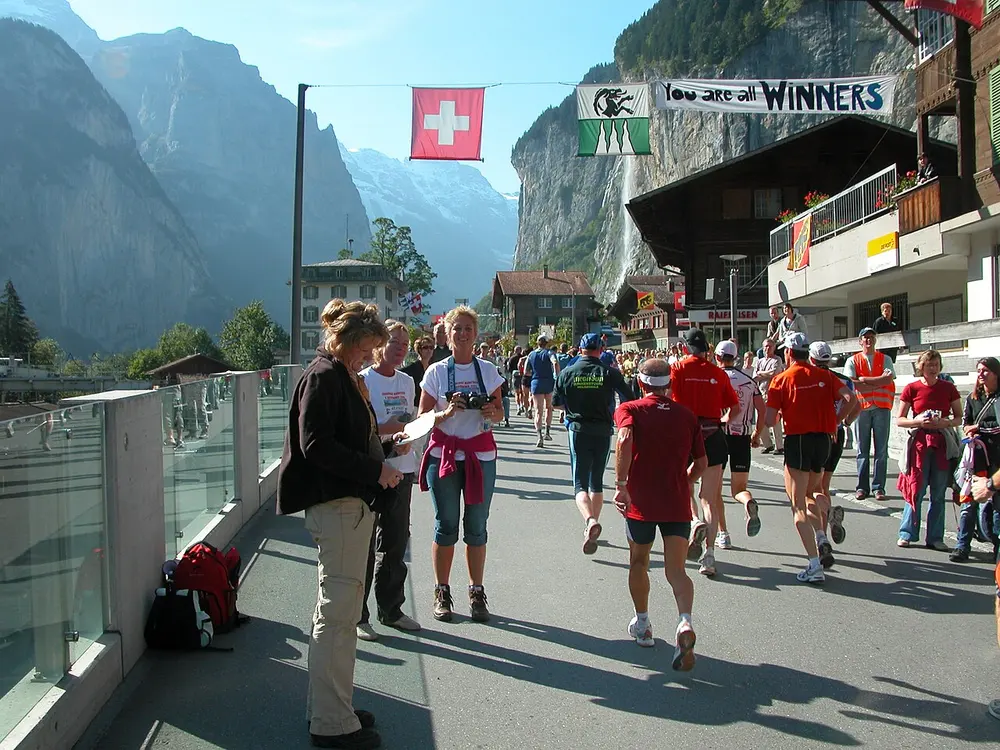
Jungfrau-Marathon 2006 004. Photo: Simon Mannweiler / Wikimedia Commons, CC BY-SA 4.0.
The course
The route begins in Interlaken, the town that sits between Lake Thun and Lake Brienz, and climbs towards the foot of the Eiger. The early kilometres are the gentlest, with the valley floor giving runners a chance to settle before the gradient begins to bite.
As the course rises, the character changes. The roads become narrower and steeper, the views open up, and the race becomes a continuous climb rather than a series of hills. The 1,999 metres of climbing are not evenly spread, but the direction is always the same: up.
The finish is 2,000 metres above the start, which means the last kilometres are run high on the mountain. The air is thinner, the weather can be different from the valley, and the finish is a true arrival rather than a turn into a stadium.
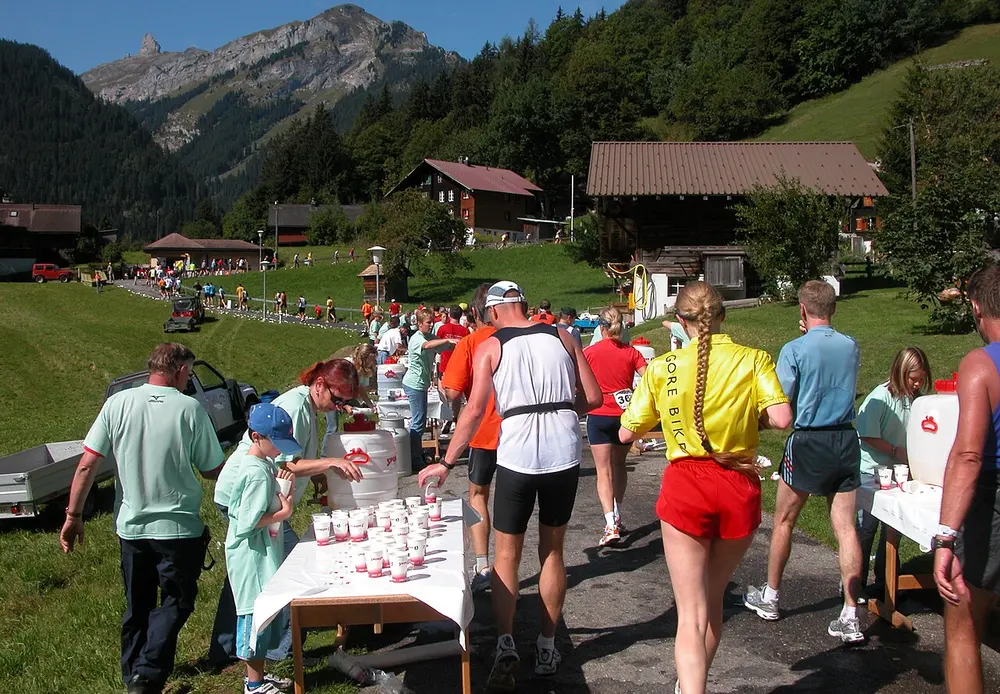
Jungfrau-Marathon 2006 008. Photo: Simon Mannweiler / Wikimedia Commons, CC BY-SA 4.0.
The climb to the Eiger
The Eiger is one of the most recognisable mountains in the Alps, and the race finishes at its foot rather than on its summit. That is a mercy. The climb is still close to 2,000 metres, and the upper section is steep enough that walking is a sensible part of the plan.
Interlaken's position between Lake Thun and Lake Brienz gives the start a sense of departure: the lakes are behind you, the Eiger is ahead, and the valley narrows as the race climbs.
The lower slopes are where the race can be lost. Runners who feel strong in the valley often push too hard before the real climbing begins, and the effort returns with interest higher on the mountain. Starting easier than feels necessary is the most common piece of advice, and it is the right one.
The upper section is where the race becomes memorable. The views open towards the surrounding peaks, the air cools, and the finish at the foot of the Eiger comes into view. It is a slow, spectacular way to finish a marathon.
Walking the steep kilometres
Walking is not a failure in the Jungfrau Marathon; it is part of the event. The steepest sections are routinely walked by runners across the field, and the race's culture accepts it in a way that a city marathon would not.
A run-walk strategy works well here. Walking the steepest ramps preserves the legs for the runnable sections and keeps the effort under control. Runners who try to run everything often end up walking anyway, but with less energy and more frustration.
The important thing is to decide before race day. If walking is part of the plan, it is easier to execute without feeling defeated. The mountain does not care whether you run or walk; it only cares whether you keep moving.
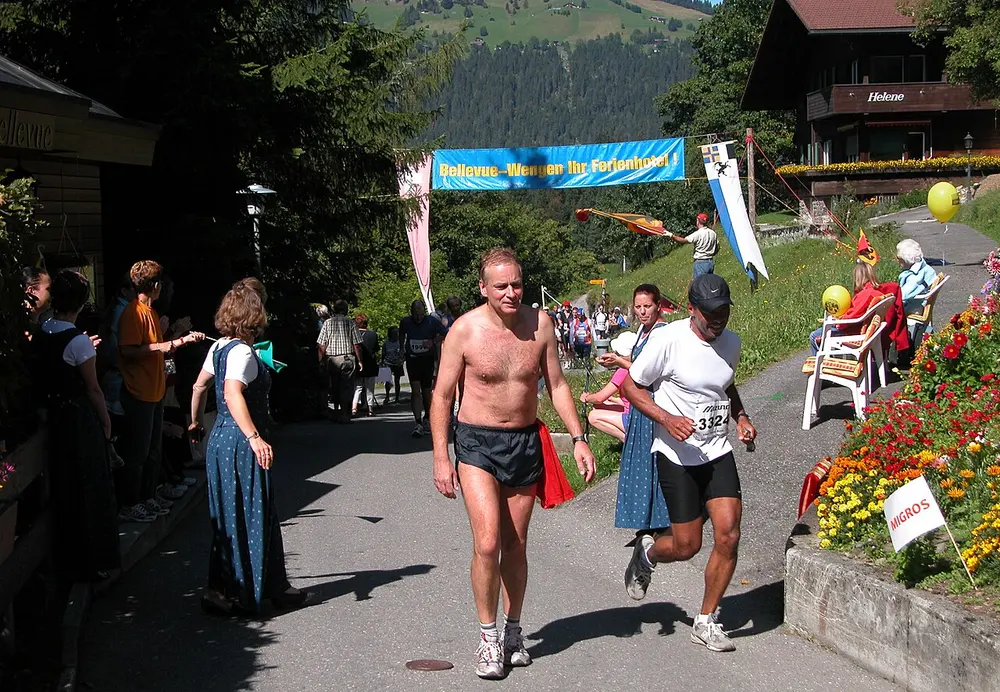
Jungfrau-Marathon 2006 009. Photo: Simon Mannweiler / Wikimedia Commons, CC BY-SA 4.0.
A mountain first marathon
The race is open to first-time marathoners, and the walking culture makes it less intimidating than the elevation suggests. The distance is still 42 kilometres, but the pace is dictated by the mountain, and the finish is a personal achievement rather than a time trial.
That does not mean it is easy. A first marathon here requires dedicated hill training, a realistic plan for walking and a respect for the altitude. Runners who arrive fit and patient will have a better day than those who arrive hoping the gradient will be gentler than expected.
The reward is a debut unlike any other. Most first marathons finish in a city street or a stadium; this one finishes below the Eiger, with the valley far below and the mountains all around.
Frequently asked questions
Answers to the questions runners ask before entering, drawn from this race's course guide and the directory's own data — the sources behind them are listed below.
When is the Jungfrau Marathon?
The next edition is on Saturday 11 September 2027. It is an autumn mountain race from Interlaken to the foot of the Eiger.
Is the Jungfrau Marathon hilly?
Yes. It climbs close to 2,000 metres over 42 kilometres, finishing 2,000 metres above the start. The ascent, not the distance alone, is the defining challenge.
Can you run a first marathon at the Jungfrau?
Yes, with preparation. The race is open to first-time marathoners and walking the steepest sections is normal, but a debut here needs dedicated hill training and a patient pacing plan.
Where is the Jungfrau Marathon run?
It is run from Interlaken to the foot of the Eiger in Switzerland. The finish is 2,000 metres above the start.
How much of the race is walked?
Walking the steepest kilometres is normal. The exact proportion depends on the runner, but the climb is severe enough that walking is an accepted part of the day.
What is the finish like?
The finish is at the foot of the Eiger, 2,000 metres above Interlaken. The last kilometres are high on the mountain, with thinner air and a very different climate from the valley.
More marathons in Switzerland
More marathons in Europe
Sources for this page
What each source below is used for on this page, and where to check this race yourself.
- World Athletics — the label calendar and the road-race regulations. Used to check whether the race holds a World Athletics label, and its elite competition details.
- AIMS — the international course-measurement standard behind the 42.195 km distance, and the AIMS race calendar.
- The organizer's own publications — course maps, race handbooks and published results. The date, course character and climbing on this page are compiled from them and re-checked each season.
Where do these facts come from?
Dates, course type, climbing and time limits are compiled from the organizer's publications and re-checked each season; elevation is an estimate of total climbing rather than a survey figure. Always confirm race-day details with the organizer before making plans.
Last reviewed 27 October 2026