
Pune Marathon
Pune's marathon has a rare convenience for a city race: it starts and finishes in the centre. The race is on 6 December 2026, and the route runs along the wide Deccan avenues on rolling ground with…
By Global Marathon Routes editorial team · Last reviewed 27 October 2026
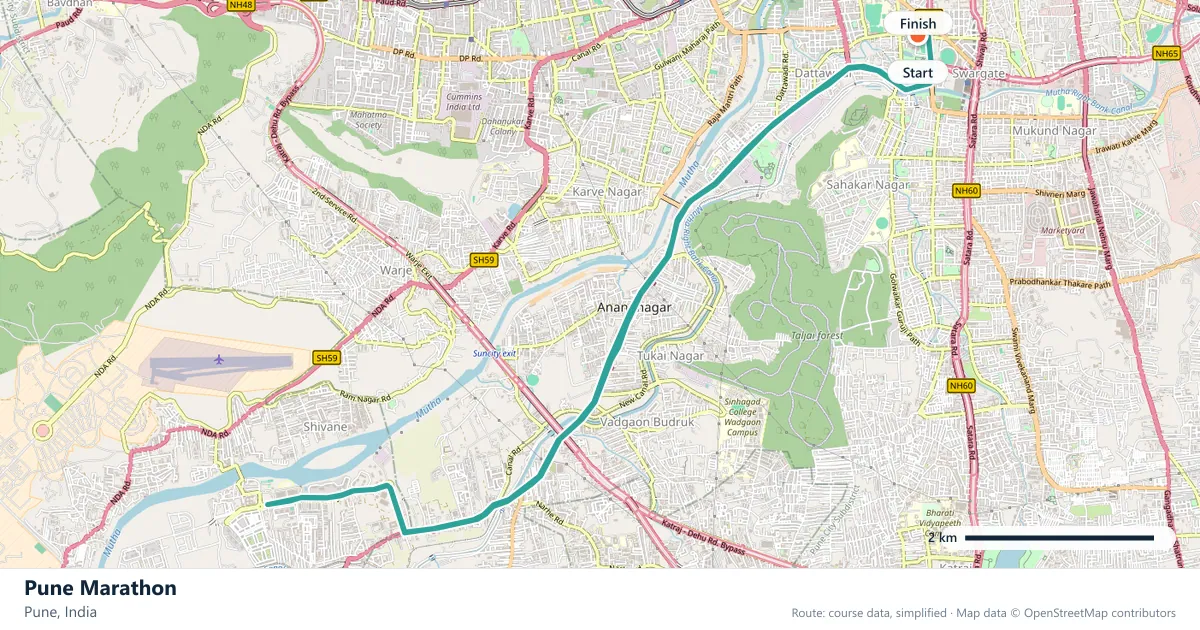
Where does the Pune Marathon run?
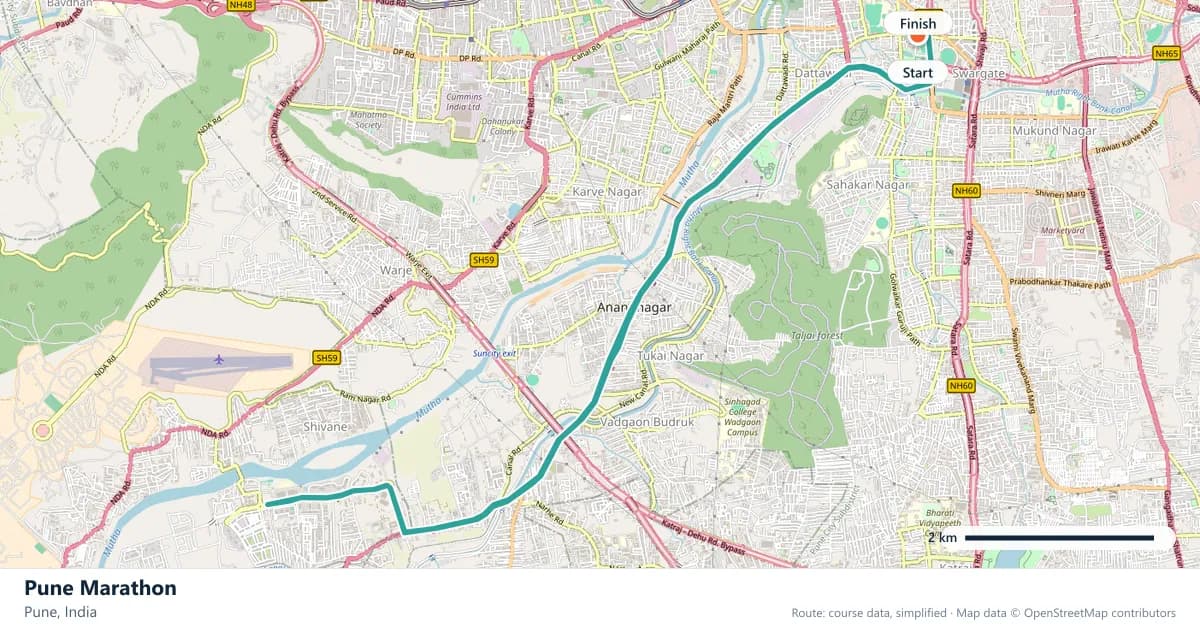
Interactive map
The trace follows the organizer's published course, simplified for the screen: the orange dot is the start, the dark dot the finish. Scroll to zoom, drag to pan.
What is the Pune Marathon course like?
A December marathon through Pune's wide Deccan avenues, starting and finishing in the city centre. Rolling ground and cool winter-morning conditions.
- Next edition
- 06 December 2026
- Elevation gain
- 102 m
- Profile
- Undulating
- First run
- —
Course guide
Pune's marathon has a rare convenience for a city race: it starts and finishes in the centre. The race is on 6 December 2026, and the route runs along the wide Deccan avenues on rolling ground with about 102 metres of climbing. Winter mornings here are cool, and the race is a natural first-marathon choice.
That is not an accident of geography. A central start and finish removes the point-to-point logistics that complicate many debuts, and the broad avenues give the field room to settle. The course still rolls, but the overall shape is welcoming rather than intimidating.
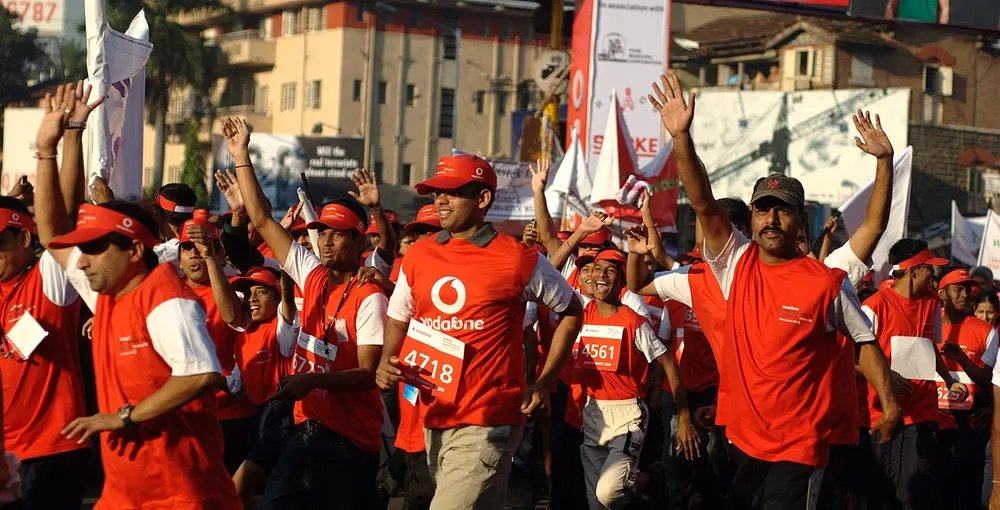
2008 Pune Marathon runners. Photo: Kushal Das from Pune, India / Wikimedia Commons, CC BY 2.0.
The course
The route runs through Pune's wide Deccan avenues, starting and finishing in the city centre. That makes logistics simpler than a point-to-point race: you can stay in one part of the city and return to the same area at the end. The course is a city marathon in the traditional sense, with the urban fabric as the scenery.
The ground rolls, climbing about 102 metres across 42.195 kilometres. The rises are short and the avenues are broad, so it never feels like a hill race. It does ask for steady effort, so plan clothing and fluids for a cool winter morning.
A city-centre start and finish
Starting and finishing in the same part of Pune is a practical gift. Runners can walk to the start, leave a bag nearby and meet friends at the finish without navigating a cross-city transfer. For a first marathon, that simplicity is worth more than it sounds.
The centre also gives the race its atmosphere. The start is busy, the finish is busy, and the streets in between are lined with the city's everyday life. It is not a grand waterfront course; it is a working city marathon, and that is part of its character.
The Deccan rollers
Pune sits on the Deccan plateau, and the course uses the wide roads that cross it. The climbing is modest — about 102 metres in total — but the ground is rarely truly flat. Short rises and dips repeat through the route, and they are easy to ignore individually and hard to ignore in aggregate.
The right approach is to run by effort rather than by pace on every rise. Keep the climbs controlled, use the descents to recover and let the wide avenues carry the rhythm. On a rolling course, the runners who look after their legs early are the ones still moving well at the end.
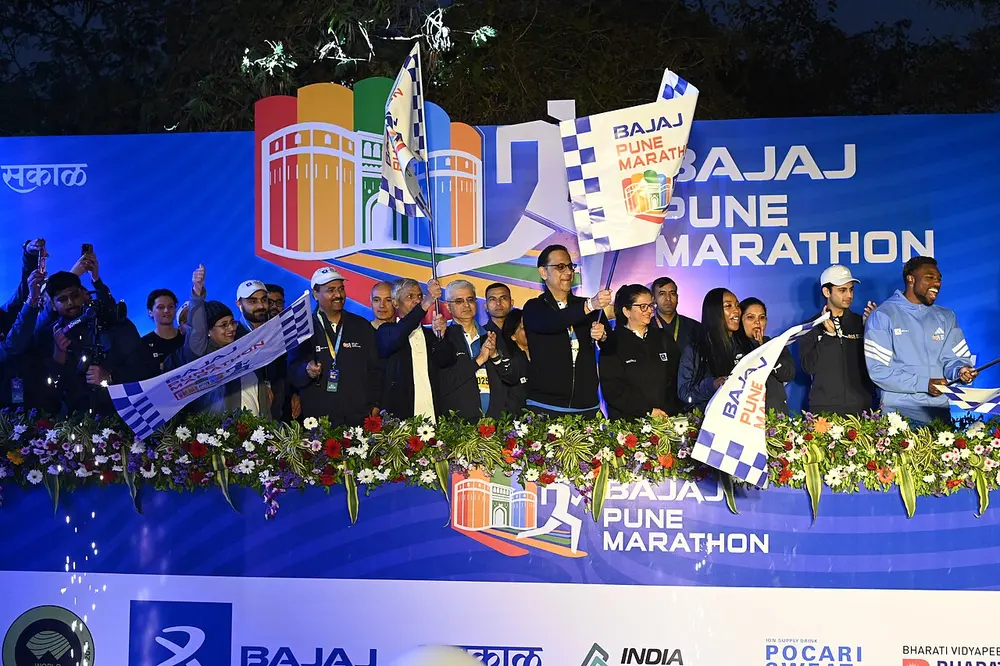
Bajaj Pune Marathon in 2025. Photo: Anndyz / Wikimedia Commons, CC0.
A December debut
Pune's December date and central logistics make the race a good setting for a first marathon. The cool winter morning is kinder than the Indian summer, the course is not severe and the finish is in the same place as the start. Those are exactly the conditions a debutante wants.
The caution is the rolling ground and the need to pace sensibly on it. A first marathon should be paced conservatively, with a target based on effort rather than a hoped-for time. The goal in Pune is a controlled first finish, not a fast one.
The city behind the race
Pune is a large, modern city with a strong academic and cultural identity, and the marathon uses its main avenues rather than a scenic loop. The route is urban and practical, with the city going about its business around the race. That gives the event a local feel that a tourist-course marathon often lacks.
Runners who want a sense of how the city moves will enjoy it. The wide roads, the winter light and the central start and finish make the day feel straightforward. It is a marathon to settle into rather than to be overwhelmed by.
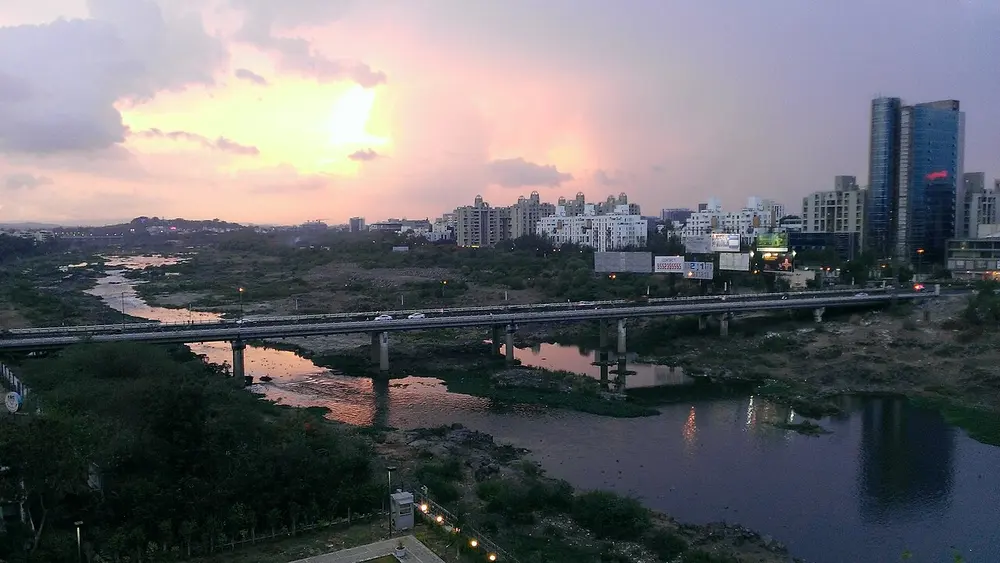
Aga Khan Bridge in Pune. Photo: Mack Male from Edmonton, AB, Canada / Wikimedia Commons, CC BY-SA 2.0.
Frequently asked questions
Answers to the questions runners ask before entering, drawn from this race's course guide and the directory's own data — the sources behind them are listed below.
When is the Pune Marathon?
The race is on 6 December 2026. It is a December race, held in cool winter-morning conditions.
Is the Pune Marathon flat or hilly?
It is undulating, with about 102 metres of climbing over 42.195 kilometres. The rises are short and the avenues are wide, so it is not hilly, but it is not flat either.
Where does the race start and finish?
The race starts and finishes in the city centre, which makes it easier to reach and leaves you in a familiar area at the end. The route runs along Pune's wide Deccan avenues.
Is Pune a good first marathon?
The central logistics, moderate climbing and cool December morning make it a sensible debut. The rolling ground still demands patient pacing, so a conservative plan is essential.
Can I run a personal best in Pune?
The rolling ground is the main reason to keep expectations modest. Pune is better chosen for a controlled first finish than for a fast time.
What is the course atmosphere like?
It is a working city marathon rather than a scenic tour. The start and finish are busy, the avenues are wide and the race feels embedded in Pune's everyday life.
More marathons in India
More marathons in Asia
Sources for this page
What each source below is used for on this page, and where to check this race yourself.
- World Athletics — the label calendar and the road-race regulations. Used to check whether the race holds a World Athletics label, and its elite competition details.
- AIMS — the international course-measurement standard behind the 42.195 km distance, and the AIMS race calendar.
- The organizer's own publications — course maps, race handbooks and published results. The date, course character and climbing on this page are compiled from them and re-checked each season.
Where do these facts come from?
Dates, course type, climbing and time limits are compiled from the organizer's publications and re-checked each season; elevation is an estimate of total climbing rather than a survey figure. Always confirm race-day details with the organizer before making plans.
Last reviewed 27 October 2026