
Pretoria Marathon
Pretoria is one of South Africa's three capitals, a city of government buildings, avenues and hills set on the high veld.
By Global Marathon Routes editorial team · Last reviewed 27 October 2026
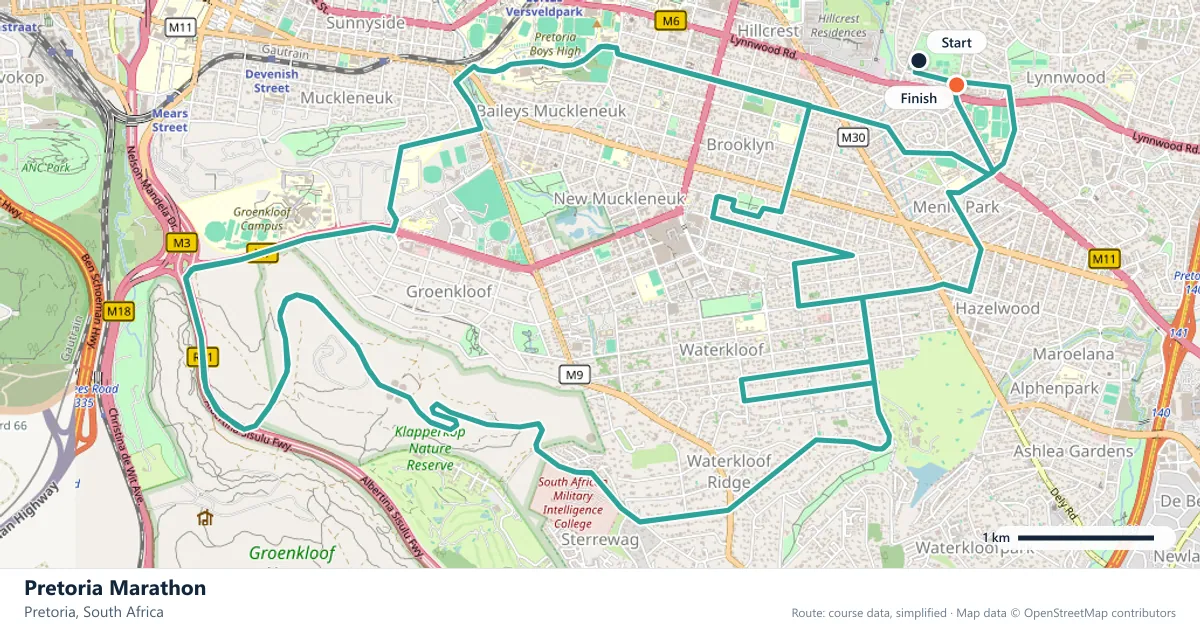
Where does the Pretoria Marathon run?
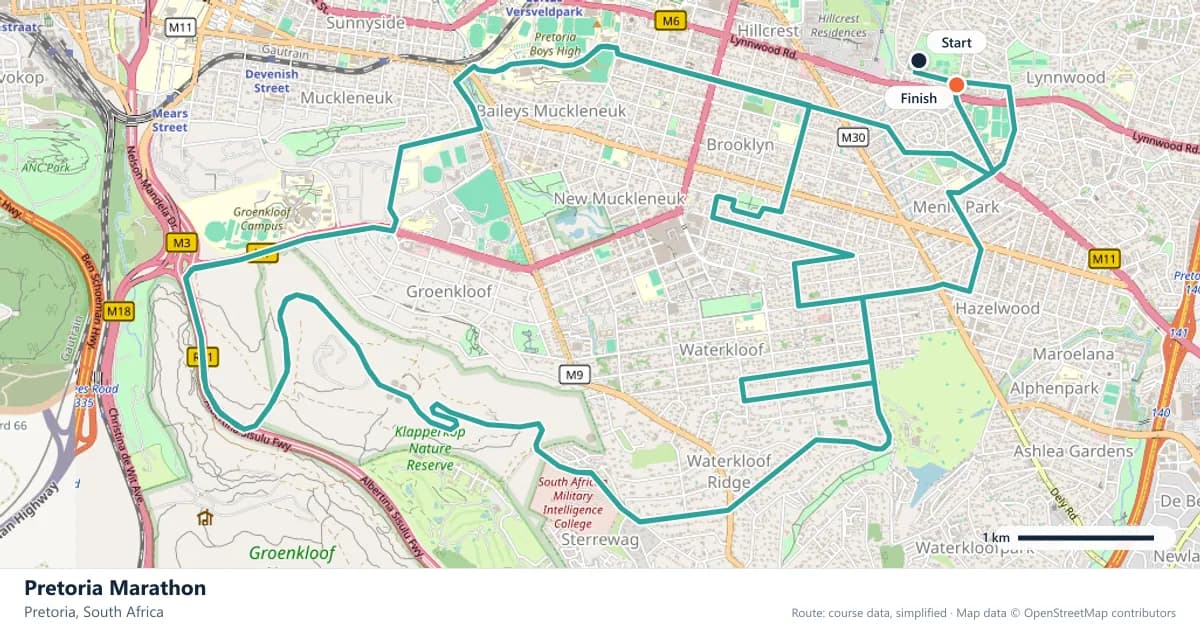
Interactive map
The trace follows the organizer's published course, simplified for the screen: the orange dot is the start, the dark dot the finish. Scroll to zoom, drag to pan.
What is the Pretoria Marathon course like?
A high-veld marathon in the South African capital with more than 600 metres of climbing in the hills above the city. Warm February conditions and a demanding profile.
- Next edition
- February 2027 (expected)
- Elevation gain
- 656 m
- Profile
- Hilly
- First run
- —
Course guide
Pretoria is one of South Africa's three capitals, a city of government buildings, avenues and hills set on the high veld. The marathon uses those hills, and the result is a race with more than 600 m of climbing, a warm February date and a course that never lets the legs settle for long.
The date is February 2027 (expected). The profile is hilly, with 656 m of gain, and the climbing is spread through the hills above the city rather than saved for a single pass. For a capital-city marathon, that is an unusual amount of ascent, and it changes the way the race has to be run.
It can be a first marathon for a runner prepared for the hills and the warmth, but Pretoria offers a high-veld course with a real profile, not an easy introduction.

Old Reserve Bank and Mutual Building in Pretoria, South Africa. Photo: Fritz Joubert / Wikimedia Commons, CC BY-SA 4.0.
The course
The route works through the hills above Pretoria, which means the city's high-veld setting is the defining feature of the race. There is no coast or waterfront to flatten the grade; the course goes up and down, and the climbing accumulates over the full 42.195 km.
At 656 m, the ascent is more than a city marathon usually asks for. The rises are spread through the route rather than concentrated in a single climb, so the challenge is cumulative. Some are short and steep, others longer and gentler, and the descents are not always long enough to recover.
The course uses city streets and the roads that climb into the hills, so the surroundings shift between urban Pretoria and the higher ground above it. The finish returns the race to the city, with the high veld as the backdrop throughout.
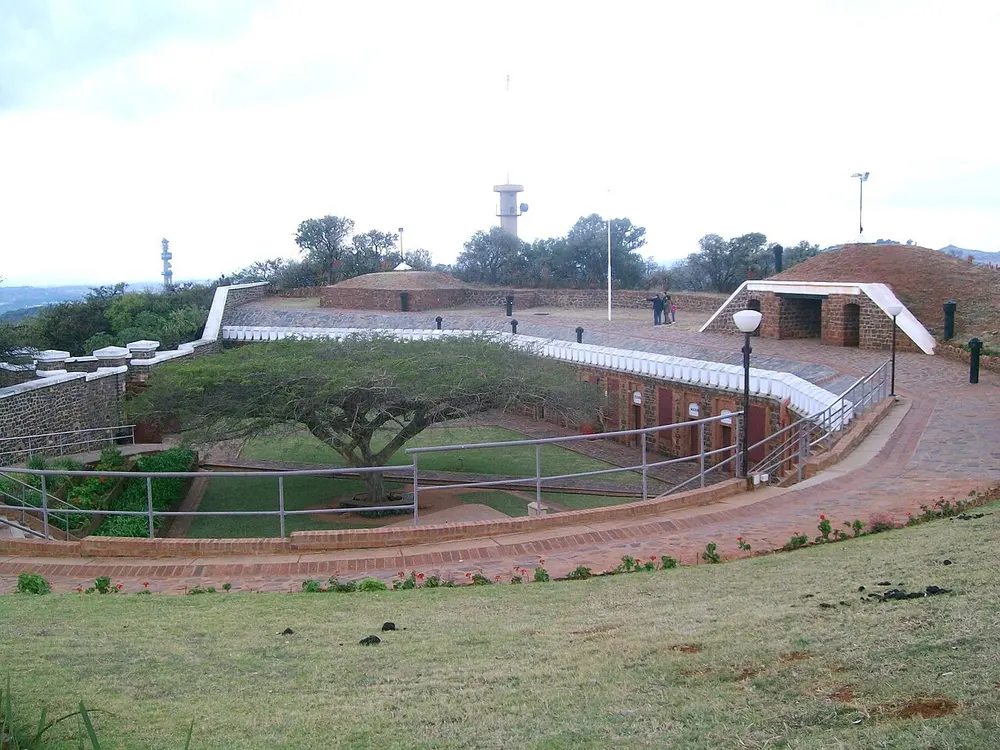
Fort Schanskop, Groenkloof, Pretoria, Gauteng. 01. Photo: A3alb / Wikimedia Commons, CC BY-SA 3.0.
High-veld hills
The high veld is a plateau, not a mountain range, but Pretoria is built on its undulations and the marathon uses them. The hills above the city are not alpine; they are the kind of rolling ground that makes a road race hard without making it spectacular. The effort comes in instalments.
That suits runners who have trained on similar terrain. A steady diet of rolling runs and hill repeats will prepare the legs for the repeated climbs, and it will also prepare the mind for a course that never offers a long flat respite. Runners who train only on flat ground will find the 656 m harder than the number suggests.
The high veld also brings altitude: Pretoria sits high enough that the air is thinner than at the coast, which makes the climbing feel harder than a sea-level race with the same profile.
More than 600 metres
The 656 m of climbing is the headline fact of the course. It is not a single mountain pass; it is the accumulation of every rise, every drag and every false flat over 42.195 km. That makes the race a test of endurance rather than a test of one climb.
The best way to handle it is to run by effort and let the pace vary with the grade. Trying to hold a constant speed uphill is the quickest way to empty the legs before the second half. On the descents, the temptation is to make up time, but the accumulated fatigue of the climbs usually makes that a false economy.
The course also rewards a conservative start. The first few kilometres may feel easy, especially if they are downhill, but the hills are waiting. A runner who banks time early will often spend the later climbs repaying it.
February warmth
February is a warm month in Pretoria, and the race is run in the middle of the southern African summer. The heat adds to the cost of every climb, and it makes hydration a central part of the race plan rather than a secondary concern.
The warmth is not the only weather variable. Summer on the high veld can bring afternoon storms, though a morning marathon avoids the worst of them. Runners should still prepare for a range of conditions and check the forecast in the days before the race.
The combination of heat and hills is what makes Pretoria demanding. Neither factor is extreme, but together they raise the effort of the full distance.
What to prepare for
The race is expected in February 2027, so the exact date should be confirmed before booking travel. The race is a capital-city event, with the logistics that implies, and the hills above the city are the main course characteristic to prepare for.
Training should include regular hill work and some heat exposure if possible. The 656 m of climbing and the February warmth are not things to meet for the first time on race day. A runner who has practised on rolling ground will be more comfortable and more able to pace the second half.
The race is also a good introduction to South African marathon culture. The capital's streets and the high-veld landscape give the day a character that a flat city race cannot match.
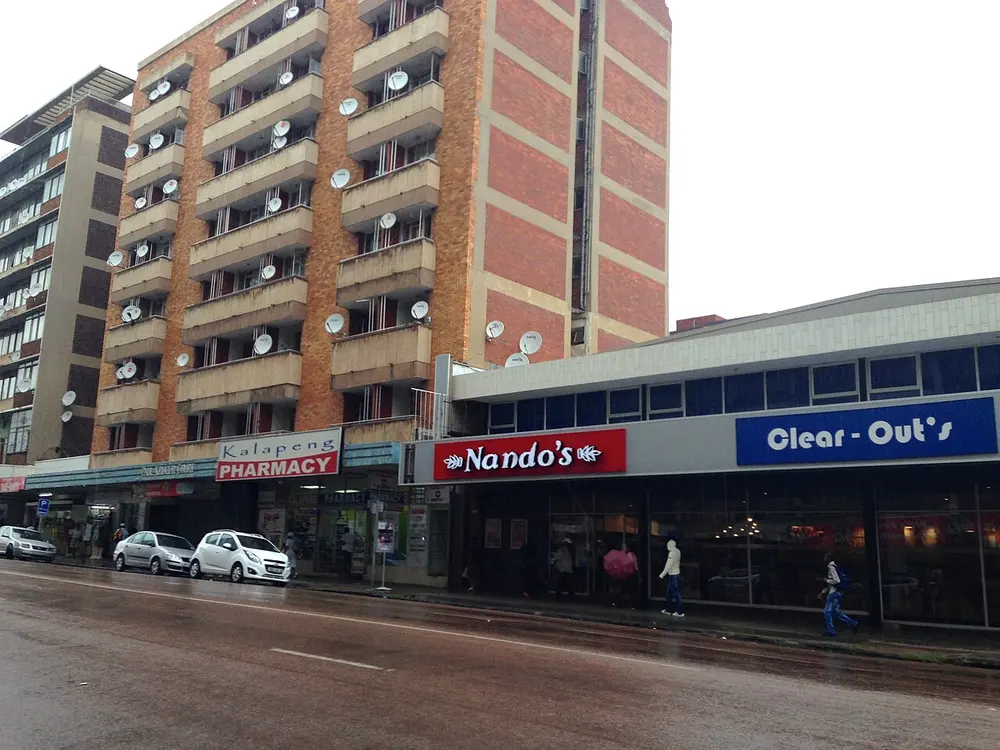
Pretoria, Gauteng, South Africa. Photo: Adamina / Wikimedia Commons, CC BY 2.0.
Frequently asked questions
Answers to the questions runners ask before entering, drawn from this race's course guide and the directory's own data — the sources behind them are listed below.
When is the Pretoria Marathon in 2027?
The 2027 edition is expected in February. The exact date is not yet confirmed, so check the organiser's calendar before booking.
Is the Pretoria Marathon a flat course?
No. The course climbs about 656 m, using the hills above the city. The rises are spread through the route rather than concentrated in one climb, so the challenge is cumulative.
Is the Pretoria Marathon a good first marathon?
It can be, if the first-timer has prepared for hills and warm conditions. The distance is standard and the city setting is straightforward, but the 656 m of climbing makes it more demanding than a flat race.
Is the Pretoria Marathon a personal-best course?
The climbing and the February warmth both work against fast times. The course is better suited to a strength test than a time trial.
Where does the Pretoria Marathon run?
It runs in Pretoria, South Africa, using city streets and the hills above the city on the high veld. The course accumulates more than 600 m of climbing over the marathon.
More marathons in South Africa
More marathons in Africa
Sources for this page
What each source below is used for on this page, and where to check this race yourself.
- World Athletics — the label calendar and the road-race regulations. Used to check whether the race holds a World Athletics label, and its elite competition details.
- AIMS — the international course-measurement standard behind the 42.195 km distance, and the AIMS race calendar.
- The organizer's own publications — course maps, race handbooks and published results. The date, course character and climbing on this page are compiled from them and re-checked each season.
Where do these facts come from?
Dates, course type, climbing and time limits are compiled from the organizer's publications and re-checked each season; elevation is an estimate of total climbing rather than a survey figure. Always confirm race-day details with the organizer before making plans.
Last reviewed 27 October 2026