
Casablanca Marathon
The Hassan II mosque is the image most runners carry home from Casablanca: a vast stone prayer hall set on the Atlantic edge, with the sea breaking against its base.
By Global Marathon Routes editorial team · Last reviewed 27 October 2026
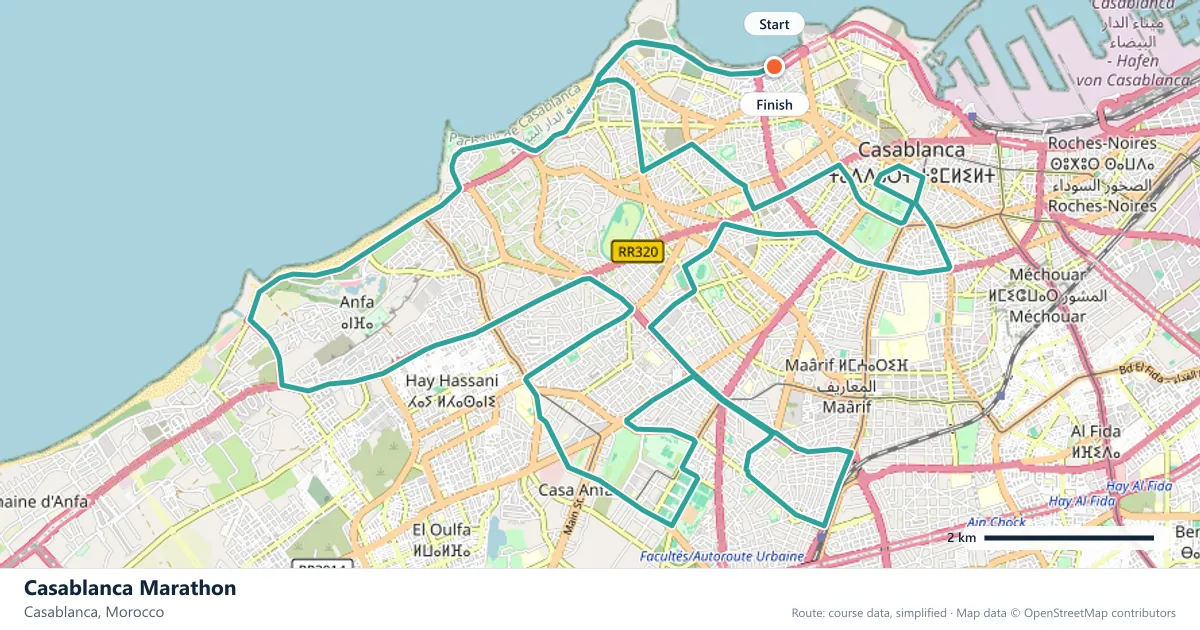
Where does the Casablanca Marathon run?
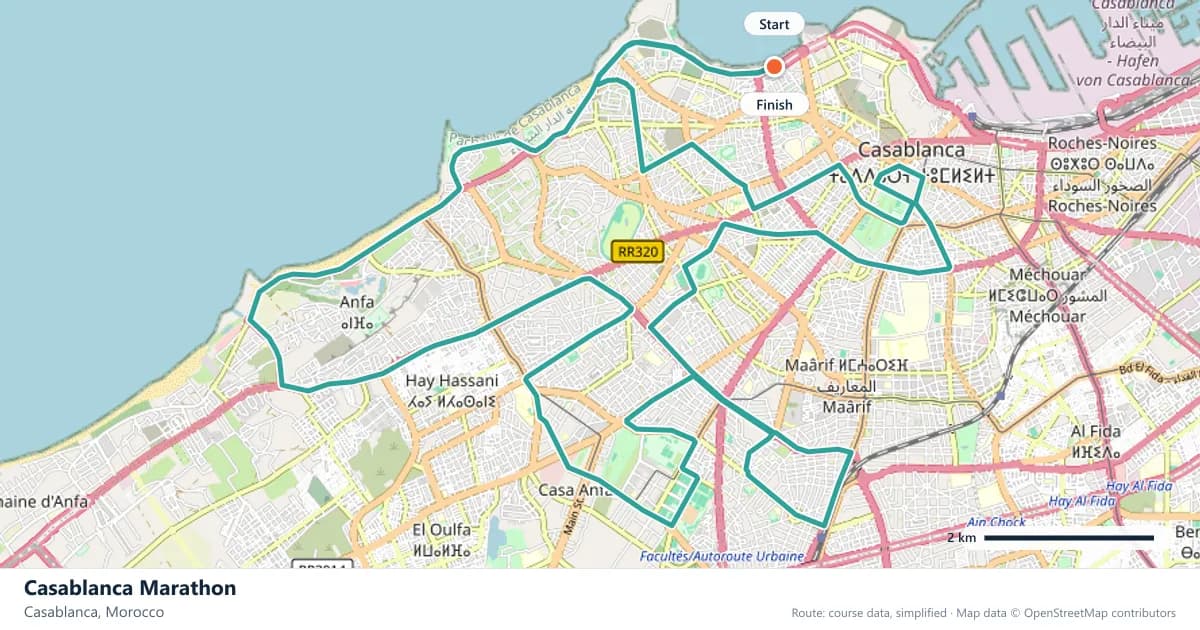
Interactive map
The trace follows the organizer's published course, simplified for the screen: the orange dot is the start, the dark dot the finish. Scroll to zoom, drag to pan.
What is the Casablanca Marathon course like?
A city marathon on the Atlantic coast of Morocco, past the Hassan II mosque and along the corniche. Rolling, mild in October and quick on the seaward stretches.
- Next edition
- October 2027 (expected)
- Elevation gain
- 174 m
- Profile
- Undulating
- First run
- —
Course guide
The Hassan II mosque is the image most runners carry home from Casablanca: a vast stone prayer hall set on the Atlantic edge, with the sea breaking against its base. The marathon passes it, then follows the corniche, and for long stretches the race is organised around the water rather than the city behind it.
The next edition is expected in October 2027. The course is undulating, with about 174 m of climbing, but the seaward sections are quick and the October weather is usually mild. That combination gives Casablanca a rare double character: it is fast enough to chase a time and gentle enough to be a first marathon.
The catch is that the fast miles are not the whole race. Once the route turns inland, the ground rolls, and the pace has to be managed with the same care as on a hillier course. Casablanca rewards runners who enjoy the waterfront without spending everything on it.
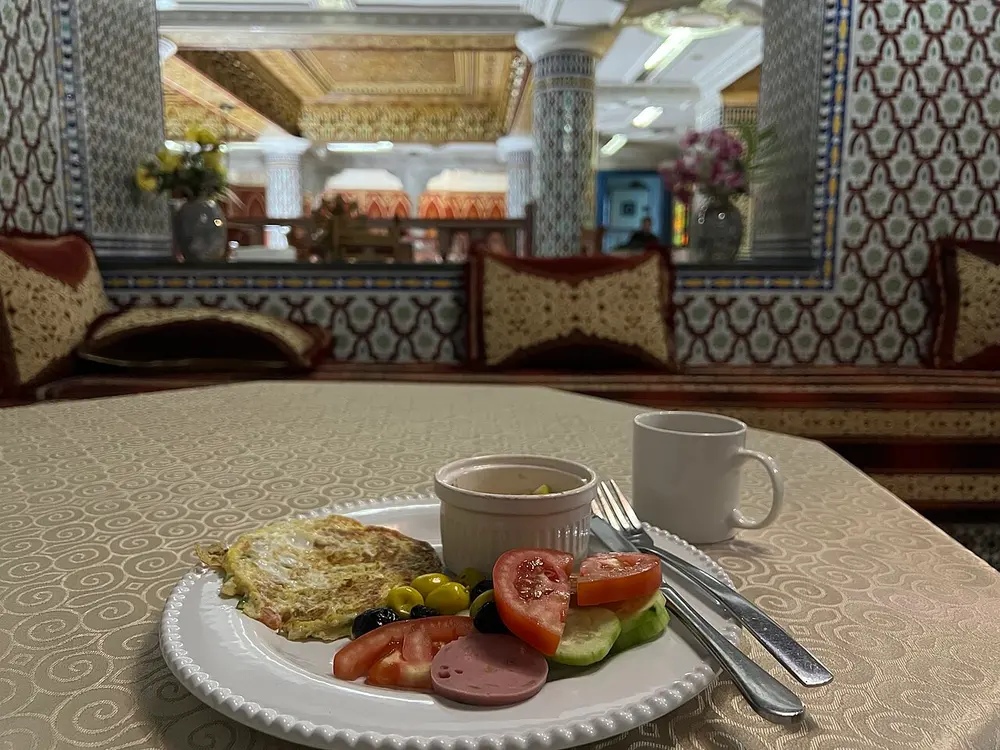
Casablanca, Morocco November 2023 - Breakfast. Photo: Sharon Hahn Darlin / Wikimedia Commons, CC BY 2.0.
The course
The route takes in the Hassan II mosque and the corniche, the two features that define Casablanca's relationship with the Atlantic. The waterfront stretches are the fastest part of the day: long, open and mostly level, with the sea providing a horizon and the city standing behind it.
Inland, the course changes. The climbs are not long, but they are repeated, and about 174 m of gain accumulates across the marathon. The transitions between the fast coastal miles and the rolling streets are where the race is shaped. A runner who banks too much on the corniche will feel the inland sections as a debt.
The course stays within the city and its coastal suburbs, so the surroundings remain urban throughout. There is no wilderness or park section to break the race up. Instead, the marathon moves between the formal waterfront, the streets behind it and the everyday city that most visitors see only from a taxi.
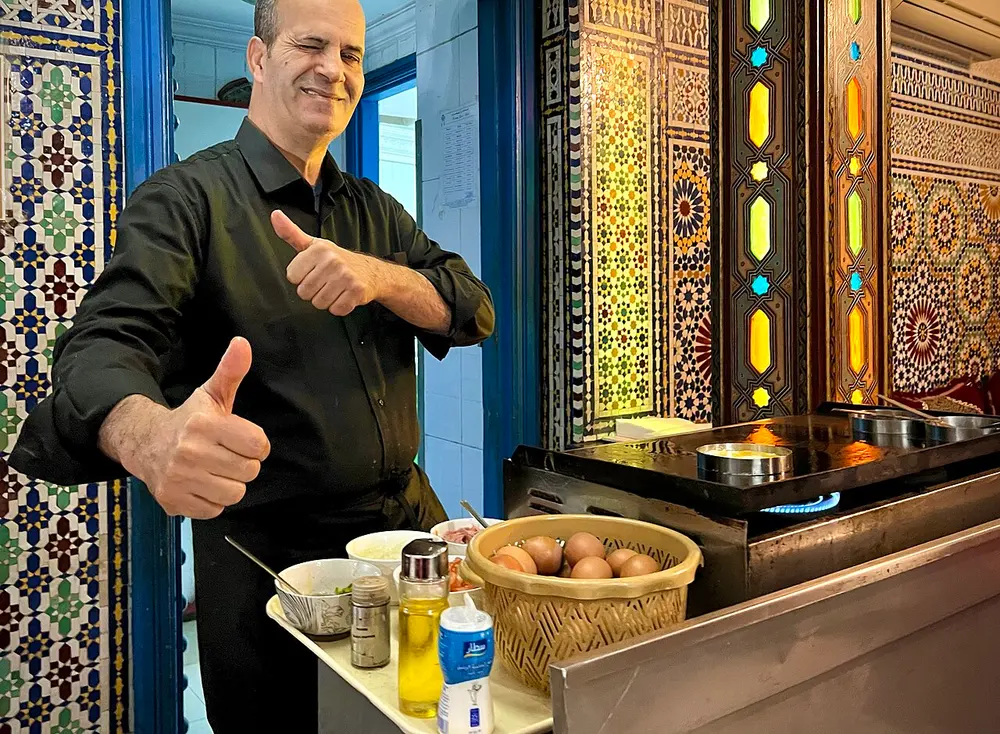
Casablanca, Morocco November 2023 - Breakfast Chef Thumbs Up. Photo: Sharon Hahn Darlin / Wikimedia Commons, CC BY 2.0.
The mosque and the corniche
The Hassan II mosque is one of the largest in the world, and its position on the shore makes it a landmark for the whole city. For runners, it serves as a fixed point in a city that otherwise spreads along the coast without a single dominating skyline.
The corniche is the other anchor. This is Casablanca's seaside promenade, and the marathon uses it to open the race to the ocean. The early kilometres here can feel effortless: flat ground, sea air and a broad view combine to make the pace seem easier than it is. That is the trap of the course, and it is a pleasant trap to fall into.
The waterfront is also where the race feels most like an event rather than a commute, with the mosque as a backdrop and the Atlantic giving the morning a scale that inland streets cannot match.
Where the inland rolls
Away from the sea, the course is more ordinary and more demanding. The streets behind the corniche rise and fall in short, frequent grades, and the city's traffic-free morning reveals a dense mix of residential blocks, shops and civic buildings. None of the climbs is memorable on its own; together they explain the 174 m total.
This is where even pacing matters. The waterfront invites a quicker rhythm, but the inland sections punish anyone who arrives with empty legs. The best approach is to treat the corniche as a place to settle rather than to race, and to save something for the repeated rises after the turn.
The inland miles also remove the sea breeze in places, which makes the air feel warmer and stiller. Casablanca in October is usually mild, but the difference between the open coast and the sheltered streets is one more reason to keep effort under control.
An October morning by the Atlantic
October is a kind month for a marathon on this coast. The summer heat has gone, the city is back to its working rhythm, and the Atlantic keeps the morning from becoming oppressive. The race does not depend on a cool dawn in the way that a midsummer event would; it depends on the runner not mistaking pleasant weather for free speed.
Mild conditions are also what make the race approachable for a first marathon. There is no extreme heat to manage and no mountain pass to survive, just a long, rolling city course with a fast start. The distance is still the distance, and the second half still has to be earned.
For anyone chasing a personal best, the seaward miles are the opportunity. For anyone running a first marathon, they are the temptation. Both groups are better off letting the corniche come to them and treating the inland climbs as the real test.
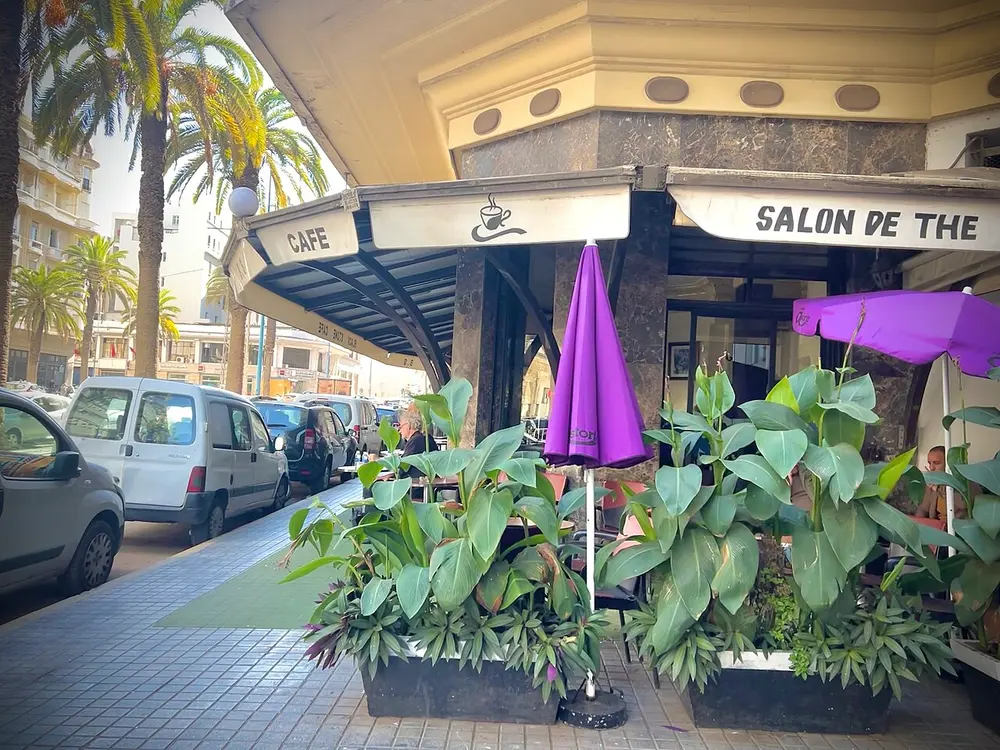
Casablanca, Morocco November 2023 - Cafe. Photo: Sharon Hahn Darlin / Wikimedia Commons, CC BY 2.0.
Frequently asked questions
Answers to the questions runners ask before entering, drawn from this race's course guide and the directory's own data — the sources behind them are listed below.
When is the Casablanca Marathon in 2026?
The 2026 edition is set for 25 October.
Is the Casablanca Marathon a flat course?
Not entirely. The course is undulating, with about 174 m of climbing. The corniche sections are fast and mostly level, while the inland streets roll in short, repeated rises.
Is the Casablanca Marathon good for a personal best?
The race is suited to fast times. The mild October weather and the quick seaward stretches give runners a fair chance, provided the inland climbs are paced rather than attacked.
Is the Casablanca Marathon a good first marathon?
Yes. The course is not severe, the weather is usually mild, and the waterfront gives the first half a generous rhythm. A first-timer should still start conservatively and save energy for the rolling middle.
Where does the Casablanca Marathon run?
It runs through Casablanca, past the Hassan II mosque and along the Atlantic corniche, then through the streets behind the waterfront. The route stays within the city for the full distance.
What should I watch for on the Casablanca course?
The fast corniche miles are the main temptation. The inland section adds repeated changes of grade, and the pace set beside the sea has to be sustainable after the route turns away from it.
More marathons in Morocco
More marathons in Africa
Sources for this page
What each source below is used for on this page, and where to check this race yourself.
- World Athletics — the label calendar and the road-race regulations. Used to check whether the race holds a World Athletics label, and its elite competition details.
- AIMS — the international course-measurement standard behind the 42.195 km distance, and the AIMS race calendar.
- The organizer's own publications — course maps, race handbooks and published results. The date, course character and climbing on this page are compiled from them and re-checked each season.
Where do these facts come from?
Dates, course type, climbing and time limits are compiled from the organizer's publications and re-checked each season; elevation is an estimate of total climbing rather than a survey figure. Always confirm race-day details with the organizer before making plans.
Last reviewed 27 October 2026