
Nairobi Marathon
Nairobi asks a question that few marathons ask: what happens to your pace when the air is thinner than you are used to?
By Global Marathon Routes editorial team · Last reviewed 27 October 2026
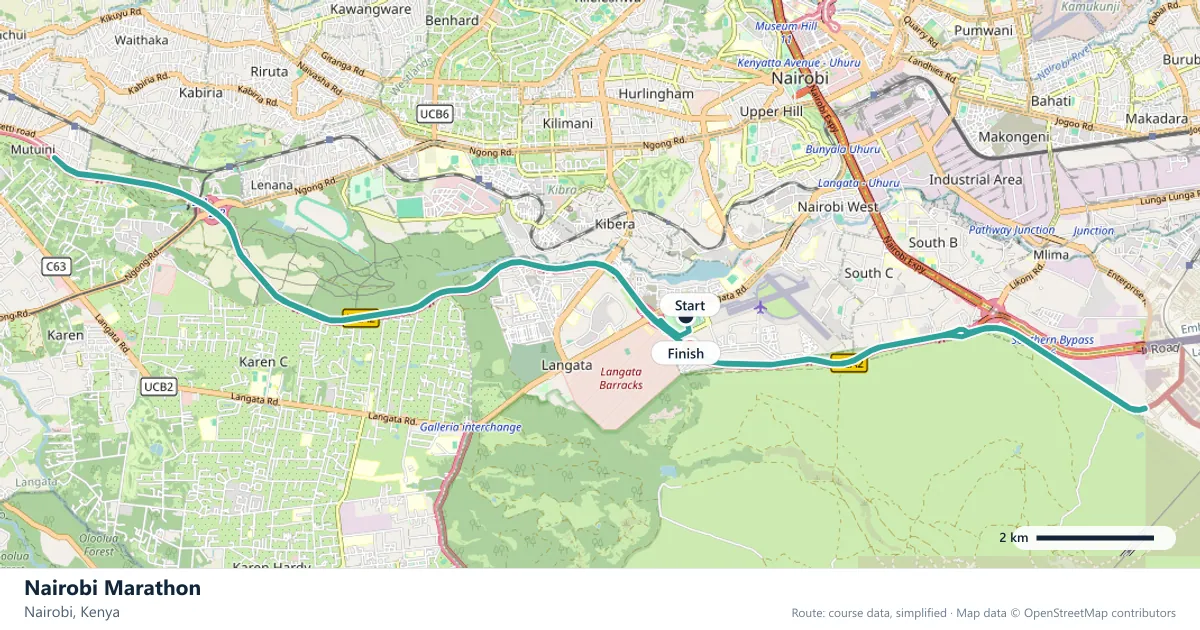
Where does the Nairobi Marathon run?
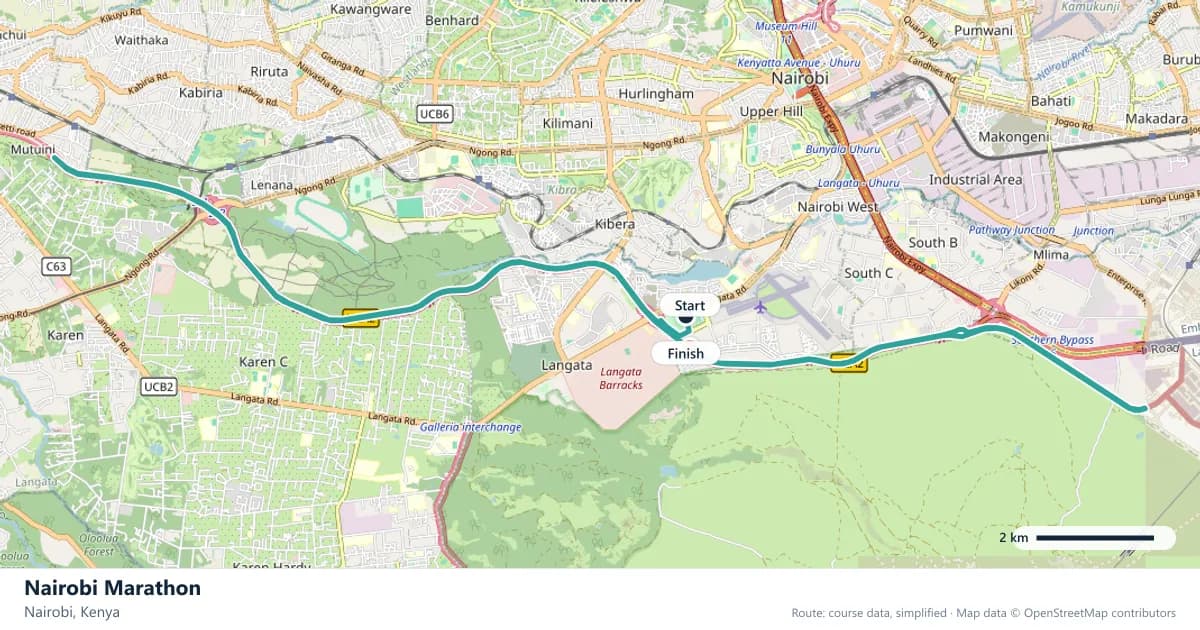
Interactive map
The trace follows the organizer's published course, simplified for the screen: the orange dot is the start, the dark dot the finish. Scroll to zoom, drag to pan.
What is the Nairobi Marathon course like?
Run in the Kenyan capital at 1,700 metres of altitude, out through the city's suburbs and along the Ngong road. The home of distance running, with a field that reflects it.
- Next edition
- October 2027 (expected)
- Elevation gain
- 290 m
- Profile
- Hilly
- First run
- —
Course guide
Nairobi asks a question that few marathons ask: what happens to your pace when the air is thinner than you are used to? The race is held at roughly 1,700 m in the Kenyan capital, and the altitude is not a detail to be managed at the edges. It is the first thing the course tells you, from the opening kilometre onwards.
The route leaves the centre and works out through the suburbs along the Ngong road, climbing about 290 m across the marathon. That total would make for a hilly city race at sea level. At 1,700 m, every rise costs more, and the descent does not always give the effort back. The next edition is expected in October 2027, and the event holds a World Athletics Label.
Nairobi is also the home of distance running, and the field reflects it. The depth around you is a reminder of where the sport lives, and the course and the company together make a day that is honest about pace.
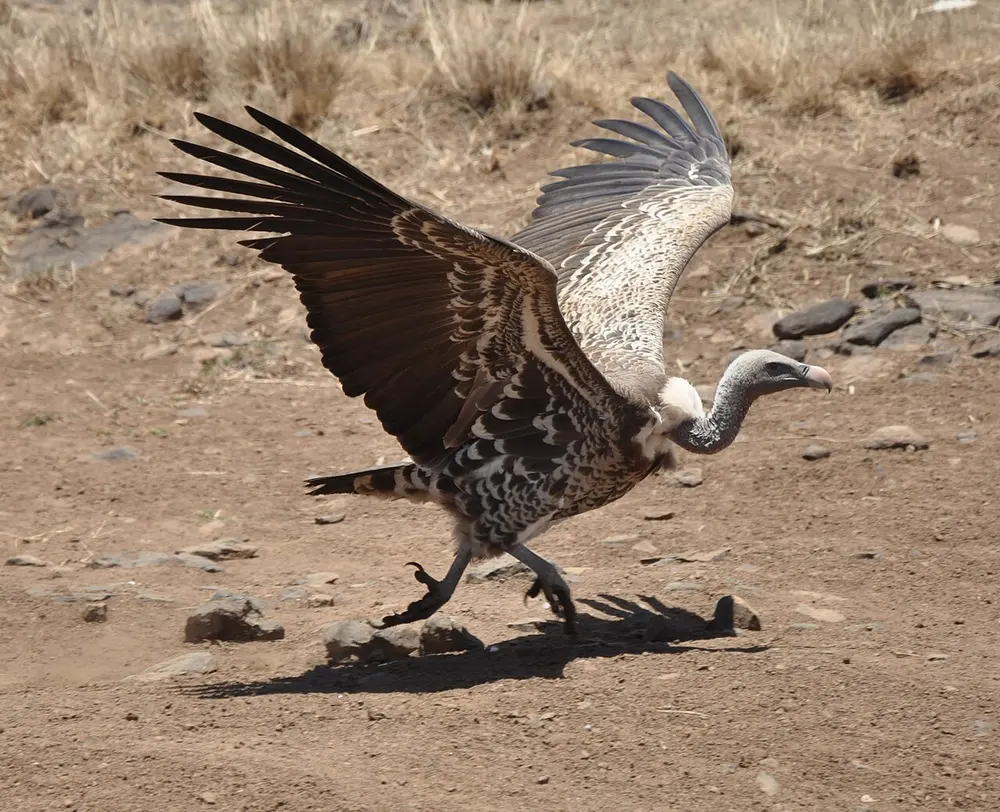
Gyps rueppellii -Nairobi National Park, Kenya-8-4c. Photo: Gyps_rueppellii_-Nairobi_National_Park,_Kenya-8.jpg : Jorge Láscar from Bogotá, Colombia derivative work: Snowmanradio ( talk ) / Wikimedia Commons, CC BY-SA 2.0.
The course
The marathon starts in the city and heads out through Nairobi's suburbs. The Ngong road is the spine of the route, and a substantial part of the race is spent on or beside it. This is a working city course rather than a park loop: junctions, commercial stretches and residential roads follow one another, and the character changes with the neighbourhoods.
The climbing totals about 290 m. It is spread through the race rather than gathered into one pass, which makes the course feel continuously rolling rather than dramatically steep. Runners who have trained on hills will recognise the rhythm.
The course does not offer a long, sheltered flat section in which to reset. The Ngong road rolls, the suburbs rise and fall, and the city keeps presenting small changes of grade. At altitude, those changes are the race.

Aéroport Nairobi Kenya. Photo: Cactus0625 / Wikimedia Commons, CC BY-SA 4.0.
The 1,700-metre factor
At 1,700 m, the air holds less oxygen than at sea level. The effect is not a wall; it is a tax. A pace that feels comfortable in training at lower ground requires more effort here, and the effort climbs faster as the race goes on. Runners who arrive with a target time based on sea-level races usually find the first 10 km reassuring and the last 10 km confusing.
The practical consequence is to pace by effort from the start and to revise expectations downwards before the gun. There is no point in spending the first half trying to prove the altitude wrong. The body adapts as much as it can, but it does not adapt on demand.
The altitude also changes how the hills feel: each rise arrives with less oxygen and a higher breathing rate, which makes Nairobi a serious race despite a modest elevation figure.
Ngong Road and the suburbs
The Ngong road is more than a route marker. It carries the race away from the centre and into the parts of Nairobi where the city lives its daily life: roadside business, matatus, schools, churches and the steady flow of pedestrians. The marathon turns the road into a running corridor for a morning, and the result feels less like a staged event than a city briefly changing its habits.
The suburbs along the way are not uniform. Some sections are open, some are built up, and the road itself bends and rises often enough to keep the field honest. Runners who know Nairobi will recognise the sequence; visitors get a compressed tour of how the capital spreads west.
A field shaped by the city
Nairobi's running culture is visible in the depth of the field. The race attracts local runners who treat a marathon as a serious competition, not a novelty, and the pace around you may be faster than at a comparable city race elsewhere. That is an advantage if you use it well and a trap if you let it pull you off your plan.
The atmosphere is also different from a major-city marathon built around tourism. It feels more like a serious sporting occasion than a festival, and for a visitor that is part of the appeal: a marathon in a place where running is a working part of the national identity.
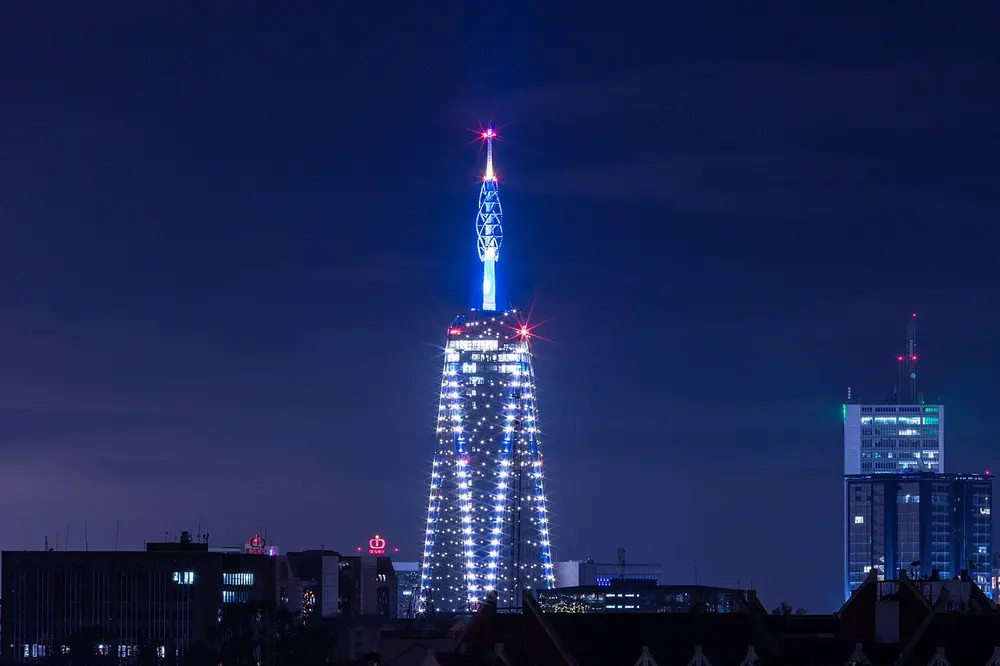
Britam Tower Nairobi Kenya Night. Photo: Antony Trivet / Wikimedia Commons, CC BY-SA 4.0.
What it asks of you
Nairobi is not a course that rewards a fast first half. The altitude, the rolling road and the depth of the field all push in the same direction: start conservatively, let the effort settle, and accept that the clock may be slower than the legs feel capable of.
Hill training helps, but the more useful preparation is time at altitude if you can get it. Arriving a few days early is better than arriving the night before, though neither guarantees an easy race. The body's response to thin air varies, and the marathon is long enough for that variation to show.
The closing kilometres are where the course collects. The suburbs keep rolling, the air stays thin, and the finish is still several turns away.
Frequently asked questions
Answers to the questions runners ask before entering, drawn from this race's course guide and the directory's own data — the sources behind them are listed below.
When is the Nairobi Marathon in 2026?
The 2026 edition is set for 25 October.
Is the Nairobi Marathon a flat course?
No. The route climbs about 290 m, with repeated rises rather than a single long ascent. The Ngong road section is continuously rolling, so there is no sustained flat stretch to settle into.
How much does the altitude affect the race?
The race is held at roughly 1,700 m, so the air holds less oxygen than at sea level. The same pace costs more effort, especially on the climbs, and the effect accumulates over the second half. Pace by effort rather than by a sea-level target.
Where does the Nairobi Marathon run?
It starts in the city and heads out through the suburbs along the Ngong road before returning to the capital. The route stays on city roads and passes through several different neighbourhoods.
Is the Nairobi Marathon a good personal-best race?
The altitude and the rolling course both work against fast times. The course does not offer the easy, flat kilometres that usually produce one.
More marathons in Africa
Sources for this page
What each source below is used for on this page, and where to check this race yourself.
- World Athletics — the label calendar and the road-race regulations. Used to check whether the race holds a World Athletics label, and its elite competition details.
- AIMS — the international course-measurement standard behind the 42.195 km distance, and the AIMS race calendar.
- The organizer's own publications — course maps, race handbooks and published results. The date, course character and climbing on this page are compiled from them and re-checked each season.
“A World Athletics Label denotes a full application of the Competition and Technical Rules in, at a minimum, the elite component of the competition. Labels also denote superior standards in event organisation, safety and runner experience, support from public authorities to the event and a financial commitment to anti-doping.”
Where do these facts come from?
Dates, course type, climbing and time limits are compiled from the organizer's publications and re-checked each season; elevation is an estimate of total climbing rather than a survey figure. Always confirm race-day details with the organizer before making plans.
Last reviewed 27 October 2026