
Johannesburg Marathon
Johannesburg sits at around 1,700 m, and the marathon makes you feel every metre of it. The city is South Africa's largest, a sprawl of business districts, suburbs and mine workings on the high veld,…
By Global Marathon Routes editorial team · Last reviewed 27 October 2026
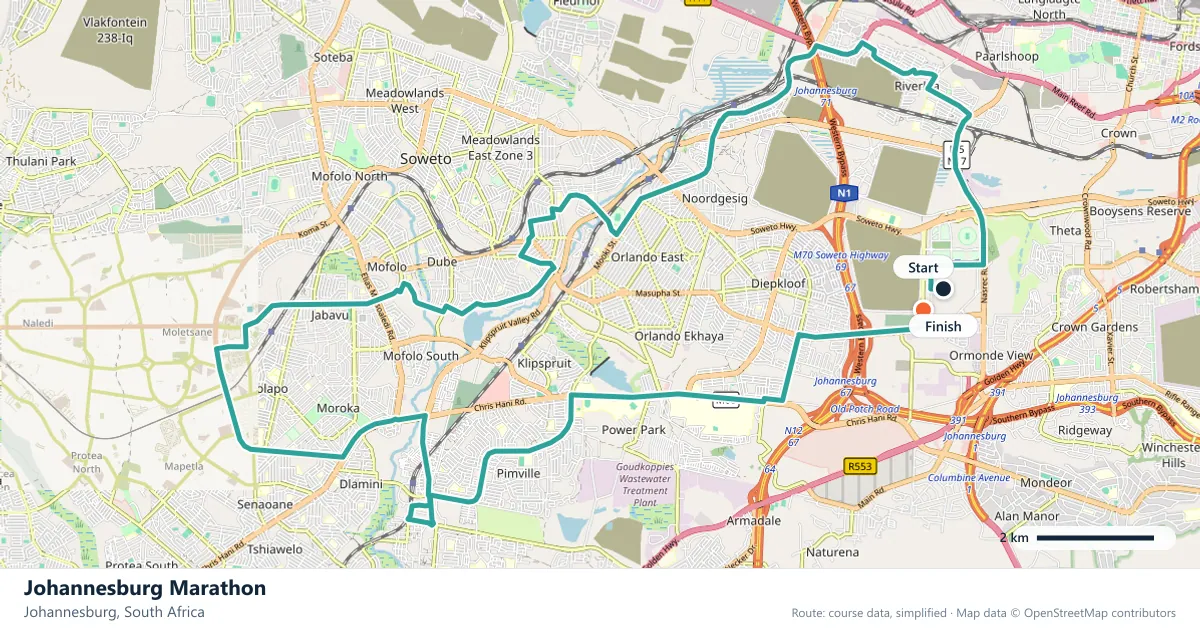
Where does the Johannesburg Marathon run?
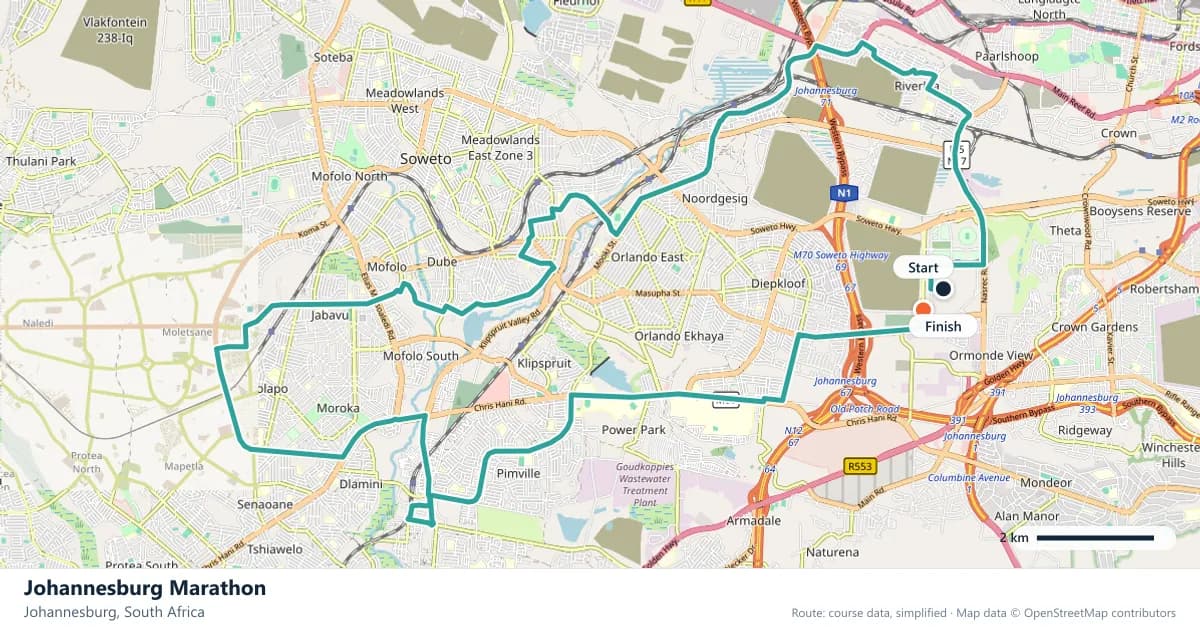
Interactive map
The trace follows the organizer's published course, simplified for the screen: the orange dot is the start, the dark dot the finish. Scroll to zoom, drag to pan.
What is the Johannesburg Marathon course like?
A high-altitude city marathon at 1,700 metres in South Africa's largest city, with close to 500 metres of climbing. Altitude and hills together make it a serious test.
- Next edition
- 29 November 2026
- Elevation gain
- 483 m
- Profile
- Hilly
- First run
- —
Course guide
Johannesburg sits at around 1,700 m, and the marathon makes you feel every metre of it. The city is South Africa's largest, a sprawl of business districts, suburbs and mine workings on the high veld, and the race uses its roads for a day that is less a tour than a test. Altitude and hills are the two facts that shape it.
The 2026 edition is set for 29 November 2026. The course climbs about 483 m, close to 500 m, and the total is spread across the marathon rather than concentrated in one climb. Add the thin air and the result is a race that punishes ambition more sharply than a sea-level city marathon of the same distance.
Johannesburg is a race for runners who want a serious course in a serious city, with no coastal scenery to soften the day.
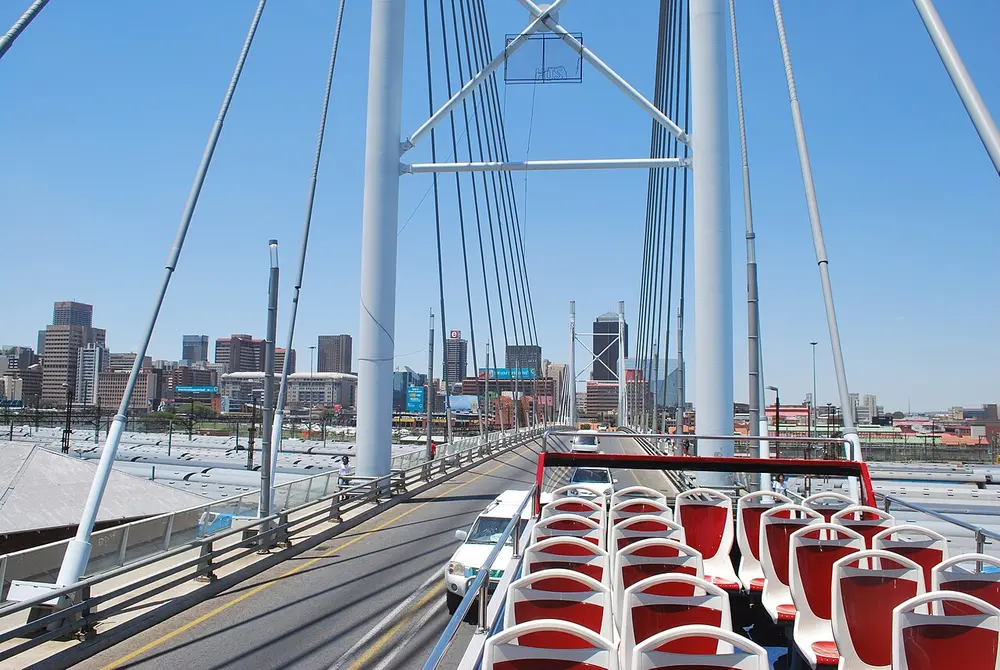
Johannesburg-bridge. Photo: 123web / Wikimedia Commons, CC0.
The course
The marathon uses city streets, starting in Johannesburg and working through the urban landscape rather than following a scenic loop. The route rises and falls continuously, with the biggest efforts coming in repeated sections rather than a single sustained pass.
About 483 m of climbing is a lot for a city marathon. It is not a mountain race, but it is hilly enough that the legs never get a long flat hour. The climbs are often short and steep enough to change the rhythm, and the descents that follow are not always long enough to recover. The course keeps asking for effort in small instalments.
Because the race is at altitude, the profile is only half the story. The same rise costs more here than at sea level, and the cost compounds over the second half.
Altitude before anything else
At 1,700 m, the air holds less oxygen than at sea level. The effect is subtle at first and obvious later. The opening kilometres may feel normal, especially in the excitement of the start, but the body is working harder than the pace suggests. By the time the hills begin to accumulate, the altitude is already part of the effort.
The practical response is to start slower than a sea-level target and to pace by feel. Runners who arrive from lower ground should give themselves a few days to adjust if possible, though no amount of adjustment makes the air as rich as it would be on the coast.
The altitude also changes how the race is won and lost. A pace that feels comfortable may still be accumulating an oxygen debt that becomes clear after 25 km.
Almost 500 metres of climbing
The climbing is the second half of the problem. Nearly 500 m of ascent over 42.195 km means the course is never truly flat, and the rises arrive often enough to prevent the legs from settling into a long rhythm. Some are short and sharp; others are longer drags that look harmless until you are on them.
The climbing is spread through the route, so there is no single summit to aim for. That makes it harder to prepare mentally. On a mountain race, you know where the pass is. In Johannesburg, the course keeps producing smaller tests, and each one takes a little more out of the legs.
The descents are not a free ride either. They arrive when the legs are tired, and the surface and camber of city streets demand attention. Runners who hammer the downhills early will feel the consequences on the next rise.
A November day on the high veld
November is late spring in Johannesburg, and the high veld can produce a range of conditions on the same day. The morning may start cool before the sun strengthens, and the city's altitude means the air can feel sharp in the shade and warm in the open. Runners should prepare for a spread rather than a single forecast.
The weather is not the main story, though. The course is. A November date gives the race a spring setting, with the city's gardens and street trees at their greenest, but the marathon is decided by how the runner handles the altitude and the climbing, not by the scenery.
The high veld also brings a sense of space that a coastal city lacks. The horizon is wide, the sky is large, and the city spreads out beneath it. On a hard course, that openness can be both motivating and exposed.
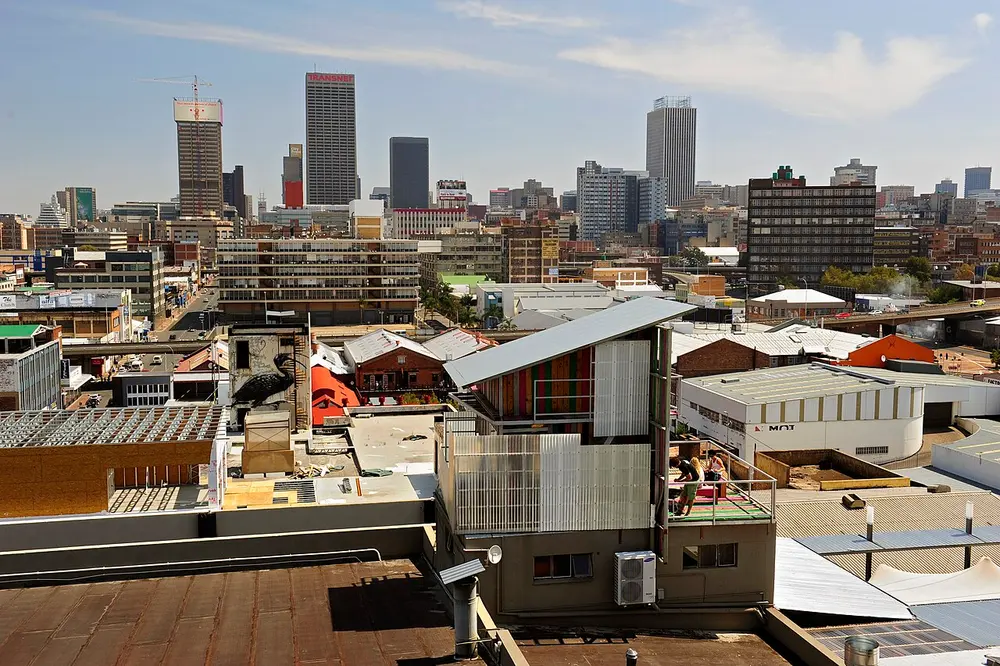
Johannesburg, Gauteng, South Africa. Photo: South African Tourism / Wikimedia Commons, CC BY 2.0.
What it punishes
Johannesburg punishes a fast first half. The altitude makes the early pace feel easier than it is, and the climbing keeps the effort high even when the road looks flat. A runner who tries to bank time in the first 20 km will usually spend the last 20 km negotiating.
It also punishes poor fuelling. The combination of altitude, climbing and a long morning makes energy demand high, and the race is not the place to experiment with a new plan. Runners should practise their intake on similar terrain before race day.
What it rewards is patience and preparation. A training block with regular hill work and, if possible, some time at altitude will make the day more manageable. Johannesburg is not a race to squeeze into a busy season; it is one to build towards.

Johannesburg, South Africa (Unsplash VZC8TgRYKVU). Photo: Celestine Ngulube sgjd / Wikimedia Commons, CC0.
Frequently asked questions
Answers to the questions runners ask before entering, drawn from this race's course guide and the directory's own data — the sources behind them are listed below.
When is the Johannesburg Marathon in 2026?
The 2026 edition is set for 29 November.
Is the Johannesburg Marathon a flat course?
No. The course climbs about 483 m, and it is run at roughly 1,700 m above sea level. The combination of hills and altitude makes it one of the more demanding city marathons on the calendar.
How much does altitude affect the Johannesburg Marathon?
The race is held at around 1,700 m, so the air contains less oxygen than at sea level. The same pace costs more effort, especially on the climbs, and the effect accumulates over the second half.
Is the Johannesburg Marathon a good personal-best race?
The altitude and the climbing both work against fast times. The course does not offer the flat, oxygen-rich kilometres that usually produce one.
Is the Johannesburg Marathon a good first marathon?
It is a demanding introduction. The distance is standard, but the altitude and the hills make it harder than a flat city race. A first-timer would need a solid training base and a conservative plan.
More marathons in South Africa
More marathons in Africa
Sources for this page
What each source below is used for on this page, and where to check this race yourself.
- World Athletics — the label calendar and the road-race regulations. Used to check whether the race holds a World Athletics label, and its elite competition details.
- AIMS — the international course-measurement standard behind the 42.195 km distance, and the AIMS race calendar.
- The organizer's own publications — course maps, race handbooks and published results. The date, course character and climbing on this page are compiled from them and re-checked each season.
Where do these facts come from?
Dates, course type, climbing and time limits are compiled from the organizer's publications and re-checked each season; elevation is an estimate of total climbing rather than a survey figure. Always confirm race-day details with the organizer before making plans.
Last reviewed 27 October 2026