
Lagos City Marathon
Lagos does not do small. The city marathon is the biggest race of its kind in Africa, with around 100,000 runners taking part across the weekend's events, and the marathon itself threads through a…
By Global Marathon Routes editorial team · Last reviewed 27 October 2026
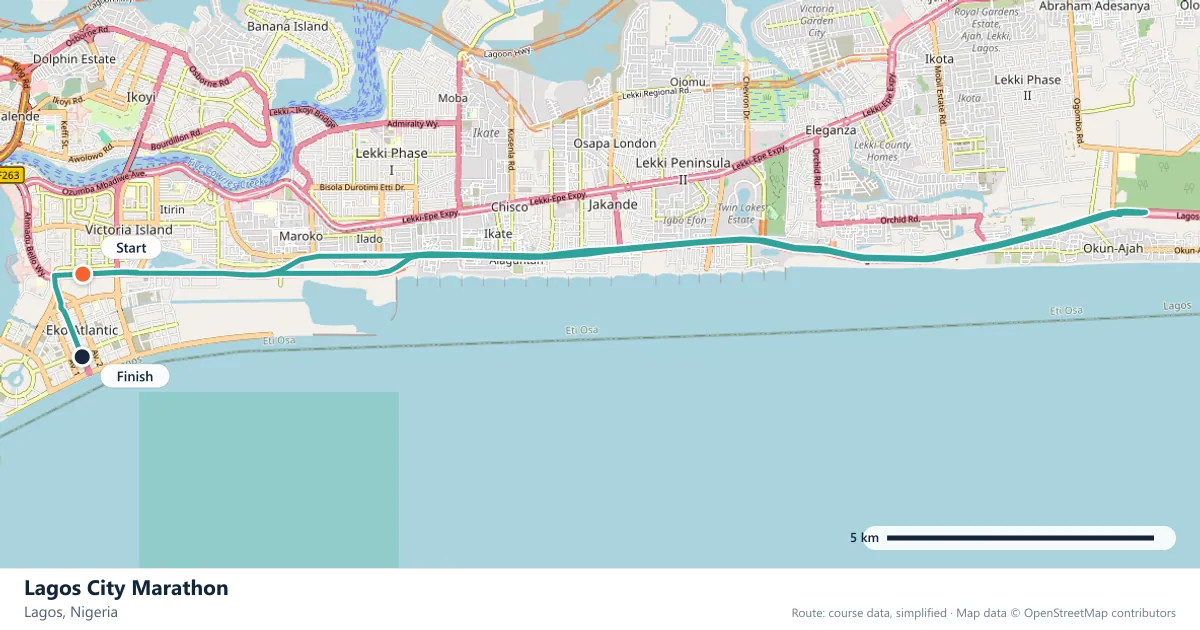
Where does the Lagos City Marathon run?
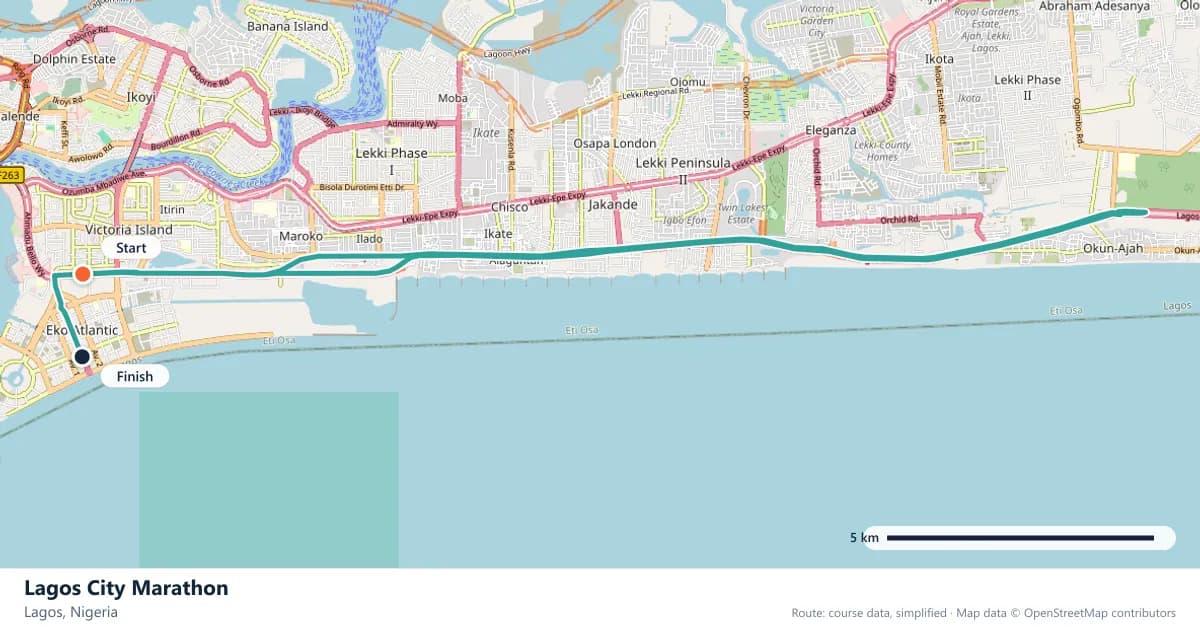
Interactive map
The trace follows the organizer's published course, simplified for the screen: the orange dot is the start, the dark dot the finish. Scroll to zoom, drag to pan.
What is the Lagos City Marathon course like?
Africa's biggest city marathon, run over the Lekki-Ikoyi bridge and along Lagos's island roads. Flat, hot and enormous, with 100,000 runners across the weekend's races.
- Next edition
- February 2027 (expected)
- Elevation gain
- 44 m
- Profile
- Flat
- First run
- —
Course guide
Lagos does not do small. The city marathon is the biggest race of its kind in Africa, with around 100,000 runners taking part across the weekend's events, and the marathon itself threads through a metropolis that never entirely stops moving. The scale is part of the experience, but so is the course: flat, hot and built around a crossing of the Lekki-Ikoyi bridge.
The date is February 2027 (expected). The exact weekend is not yet confirmed, so travel should be planned around the published calendar rather than an assumed date. What is certain is the shape of the race: about 44 m of climbing over 42.195 km, island roads on low-lying ground, and heat that makes the flatness a mixed blessing.
The event holds a World Athletics Gold Label, and it belongs to a city that treats the marathon as a civic occasion rather than a niche sporting fixture. For a runner, it means a course where the climate, not the terrain, sets the limit.
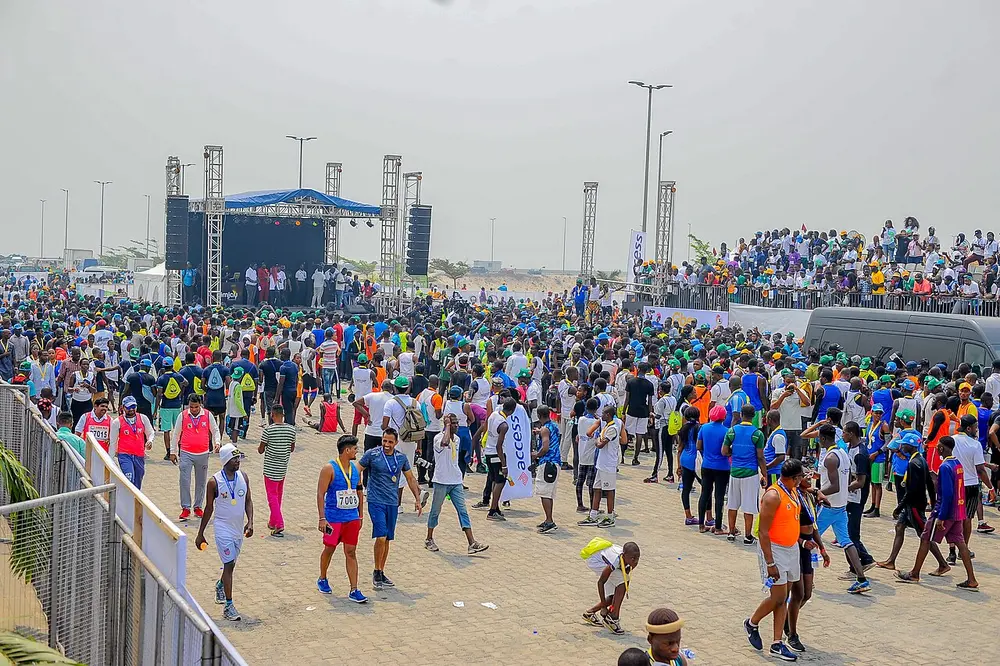
Closing gala at the Lagos Marathon 2020 11 07 17 646000. Photo: Kaizenify / Wikimedia Commons, CC BY-SA 4.0.
The course
The marathon crosses the Lekki-Ikoyi bridge and follows Lagos's island roads, with the lagoon and the city's waterfront as a constant presence. The route is flat in the way that matters for pacing: there is almost nothing to climb, so the legs can settle into a rhythm and stay there. The bridge provides the one dramatic moment, a long crossing that opens the race to the water.
With about 44 m of gain over the full distance, the course is one of the flattest on the African calendar. That sounds like an invitation to fast running, and in cooler conditions it would be. In Lagos, the flatness mainly means there is no hill to force a change of rhythm when the heat begins to bite. The pace has to be managed deliberately because the course will not manage it for you.
The island roads are wide and exposed in places, with little shade and long views across the water. The finish comes after the field has crossed back into the dense heart of Lagos.

Davido performing at the Lagos city Marathon gala 2020 10 26 58 519000. Photo: Kaizenify / Wikimedia Commons, CC BY-SA 4.0.
Across the Lekki-Ikoyi bridge
The Lekki-Ikoyi bridge is the signature of the race. It spans the lagoon between two of Lagos's island districts, and crossing it gives the marathon a moment of openness that the rest of the route cannot match. The water is on both sides, the city skyline sits in the distance, and for a few minutes the race feels like a crossing rather than a circuit.
The bridge also affects the running. It is exposed to the sun and the wind, and its approaches add small changes of grade that are easy to miss in the opening excitement. Runners who treat the crossing as a photo opportunity and a chance to reset rhythm usually benefit; those who race it may pay later.
Because the bridge is a bottleneck in the imagination as well as on the map, it tends to define how people remember the course.
Heat on the island roads
The heat is the first thing to accept about Lagos, and it changes how the flat course should be run. A pace that feels comfortable in the first hour can become unsustainable by 30 km, and there is no hill to explain the slowdown.
Drinking early is essential, and so is resisting the urge to chase the pace of runners around you. The field is enormous, and the early kilometres are crowded with people running at every conceivable speed. Finding your own effort level in that crowd is a skill, and it matters more here than on a smaller course.
The island roads offer little shelter. Long stretches are open to the sky, and the combination of sun, humidity and flat ground can make the race feel monotonous as well as hard.
The scale of the weekend
Around 100,000 runners take part across the weekend's races, which makes the Lagos City Marathon less a single event than a citywide festival. The marathon is the centrepiece, but the programme brings together a much larger field, and the logistics reflect that. Registration, bib collection and race-morning movement all need more time than at a smaller race.
The upside is atmosphere. Lagos turns out for the race, and the crowds along the route give the marathon an energy that a quiet city course cannot generate.
The downside is that the day can feel overwhelming. The marathon is the point, but the city around it is not a backdrop.
Where the race bites
- The heat. It is the defining condition, and no amount of flat road makes it easier. Pace by effort and start conservatively.
- The bridge. The Lekki-Ikoyi crossing is the highlight and a place to hold rhythm, not to surge.
- The crowd. With a field this large, the early kilometres are congested. Give yourself room and avoid weaving.
- The exposure. Island roads offer little shade. Use every chance to drink and protect yourself from the sun.
- The weekend. The event is much bigger than the marathon alone. Plan arrival, bib collection and race morning with extra time.
Frequently asked questions
Answers to the questions runners ask before entering, drawn from this race's course guide and the directory's own data — the sources behind them are listed below.
When is the Lagos City Marathon in 2027?
The 2027 edition is expected in February. The exact date is not yet confirmed, so check the organiser's calendar before booking travel.
Is the Lagos City Marathon a flat course?
Yes. The marathon climbs only about 44 m, with no sustained ascent. The route crosses the Lekki-Ikoyi bridge and follows island roads on low-lying ground.
Is the Lagos City Marathon good for a personal best?
The flat profile would normally favour fast times, but the heat is a serious constraint. Runners should plan around effort and hydration rather than a target split.
How big is the Lagos City Marathon?
Around 100,000 runners take part across the weekend's races, making it Africa's biggest city marathon. The marathon is the centrepiece, but the programme is much larger than the 42.195 km alone.
Where does the Lagos City Marathon run?
It crosses the Lekki-Ikoyi bridge and follows Lagos's island roads, staying within the city for the full distance. The route is flat and exposed, with the lagoon alongside for much of the way.
More marathons in Africa
Sources for this page
What each source below is used for on this page, and where to check this race yourself.
- World Athletics — the label calendar and the road-race regulations. Used to check whether the race holds a World Athletics label, and its elite competition details.
- AIMS — the international course-measurement standard behind the 42.195 km distance, and the AIMS race calendar.
- The organizer's own publications — course maps, race handbooks and published results. The date, course character and climbing on this page are compiled from them and re-checked each season.
“A World Athletics Label denotes a full application of the Competition and Technical Rules in, at a minimum, the elite component of the competition. Labels also denote superior standards in event organisation, safety and runner experience, support from public authorities to the event and a financial commitment to anti-doping.”
Where do these facts come from?
Dates, course type, climbing and time limits are compiled from the organizer's publications and re-checked each season; elevation is an estimate of total climbing rather than a survey figure. Always confirm race-day details with the organizer before making plans.
Last reviewed 27 October 2026