
Tunis Marathon
Tunis is a city where the ancient and the modern sit close together. The marathon starts in the medina, the walled heart of the old city, and heads towards Carthage, the ruins of the great rival of…
By Global Marathon Routes editorial team · Last reviewed 27 October 2026
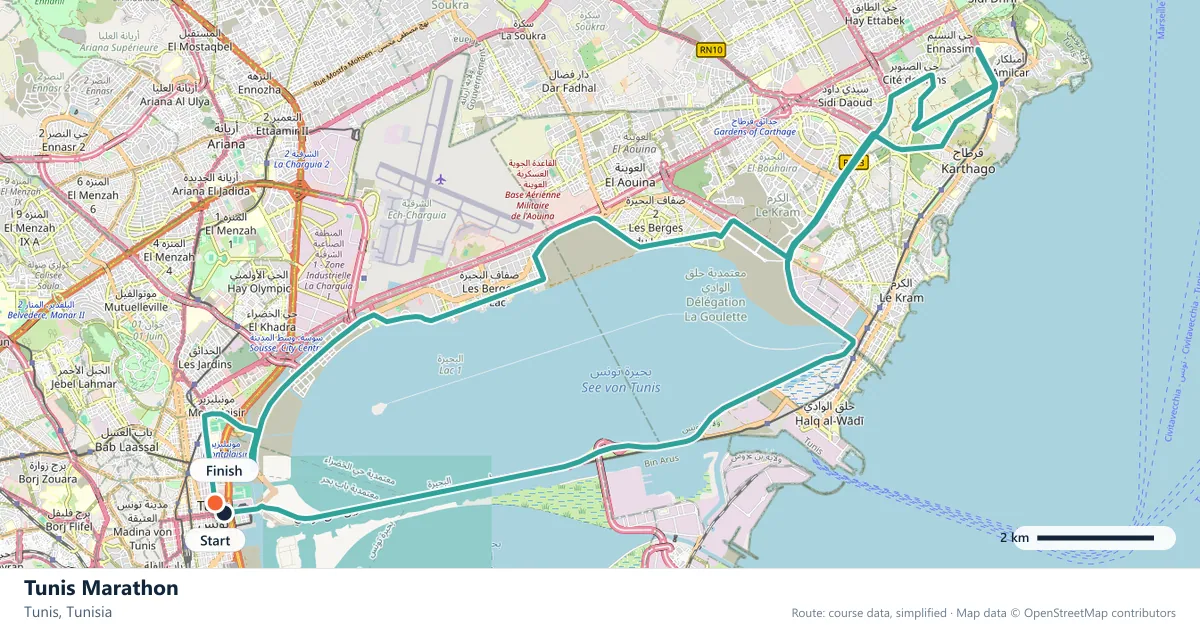
Where does the Tunis Marathon run?
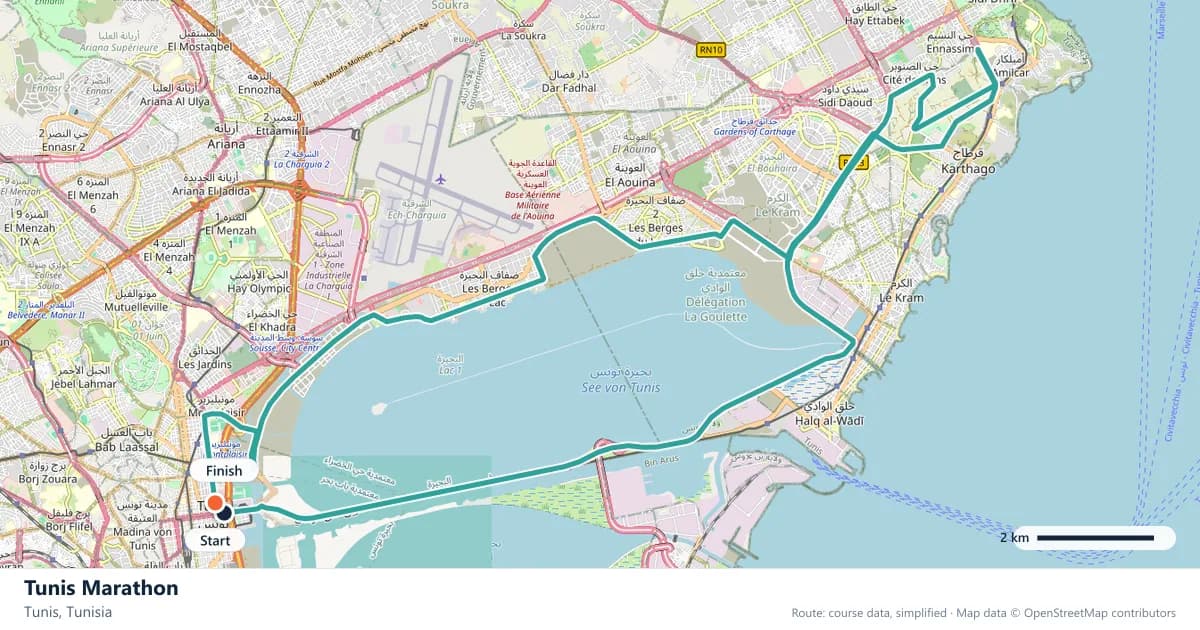
Interactive map
The trace follows the organizer's published course, simplified for the screen: the orange dot is the start, the dark dot the finish. Scroll to zoom, drag to pan.
What is the Tunis Marathon course like?
Runs through Tunis from the medina towards Carthage and the Mediterranean, on a course that is mostly flat. Mild December weather and a small, fast field.
- Next edition
- 06 December 2026
- Elevation gain
- 96 m
- Profile
- Flat
- First run
- —
Course guide
Tunis is a city where the ancient and the modern sit close together. The marathon starts in the medina, the walled heart of the old city, and heads towards Carthage, the ruins of the great rival of Rome, with the Mediterranean as the backdrop. For a race with only about 96 m of climbing, it covers an unusual amount of history.
The 2026 edition is set for 6 December 2026. December is mild in Tunis, and the course is mostly flat, which makes it one of the gentler races on the North African calendar. The event holds a World Athletics Label, and its small, fast field gives the race a different atmosphere from a mass-city marathon.
That combination makes Tunis a flat Mediterranean marathon with a historic route and enough speed to support a personal best, and it can also carry a first-timer.
Foreign Secretary of the United Kingdom David Lammy visits Tunis, Tunisia on 31 January 2025. Photo: Foreign, Commonwealth & Development Office / Wikimedia Commons, CC BY 2.0.
The course
The route starts in the historic medina and heads towards Carthage, with the Mediterranean as the backdrop for the later part of the race. It links the old city with the coast, so the surroundings change from dense historic streets to open water and ancient ruins.
The profile is flat by the standards of the region. About 96 m of climbing is spread so thinly that most runners will barely notice it, and the December weather is usually mild enough to allow a steady effort from start to finish. There is no sustained ascent anywhere on the route, and the changes of grade are small and infrequent.
The course stays on city roads and coastal stretches, with the sea becoming more prominent as the race progresses. The later part of the route is shaped by Carthage and the Mediterranean rather than by the density of the old city.
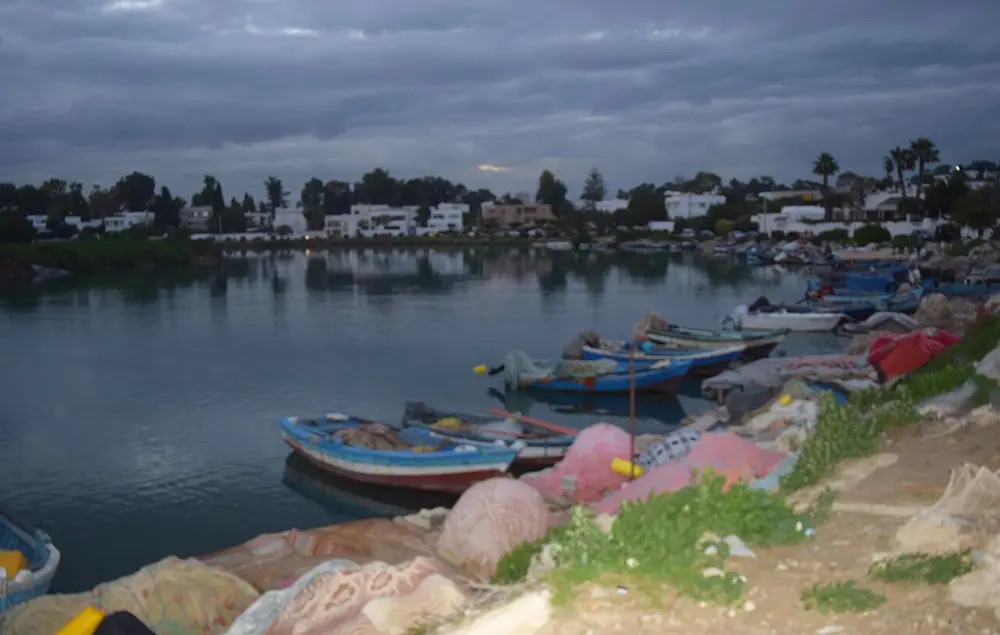
Carthage salambo tunis lac. Photo: Manel makdoly / Wikimedia Commons, CC BY-SA 4.0.
The medina
The medina is the historic heart of Tunis, a labyrinth of narrow streets, souks and mosques enclosed by old walls. The marathon uses it as a starting point, and the contrast with the modern city is immediate. Runners begin among buildings that have stood for centuries before heading out into the wider streets.
As a race start, the medina is atmospheric rather than practical. The streets are tight, the field has to funnel through them, and the first kilometres are more about finding space than finding pace. Runners should expect a controlled opening and use it to settle rather than to chase an early split.
The medina also sets the tone for the day. This is a race that moves through layers of history, from the old city to the ruins of Carthage, and the course is more than a line between two points. It is a journey through the city's past.
Carthage and the sea
Carthage is the other anchor of the route. The ancient city, now an archaeological site on the coast, gives the later part of the marathon a different scale and a different atmosphere. The sea is close, the ruins are visible, and the course opens up after the density of Tunis.
The coastal section is also the fastest part of the race. With the sea alongside and the ground mostly flat, the pace can settle into a rhythm, and the kilometres can pass quickly. The risk is that the openness invites a quicker pace than the day can support.
The Mediterranean is more than a backdrop. It cools the air slightly and gives the race a maritime character that inland African marathons lack. On a mild December morning, the combination of sea air and flat roads is close to ideal for running.
A small, fast field
Tunis is not a mass-participation marathon in the way that Lagos or London is. The field is small, the atmosphere is more concentrated, and the race has a reputation for speed. That suits runners who want room to run their own pace and a course that does not force them into a crowd.
A small field has disadvantages too. There is less company in the middle of the pack, and the rhythm of the race depends more on the individual runner. Runners who rely on a group to carry them through the middle miles may find the course quieter than expected.
The label status reflects the quality of the event rather than its size. Tunis is a race with international standards and a Mediterranean setting, and the small field is part of its character rather than a flaw.
The fast-course traps
- The fast opening. A flat course and mild weather can make the first 10 km feel effortless. Keep the pace under control.
- The small field. With fewer runners around, it is easier to run your own race, but also easier to drift off pace without company.
- The coastal stretch. The seaward section is the fastest part of the course, and the temptation is to use it to bank time. Hold back.
- The December mildness. The race is usually mild rather than hot, but hydration still matters over 42.195 km.
Frequently asked questions
Answers to the questions runners ask before entering, drawn from this race's course guide and the directory's own data — the sources behind them are listed below.
When is the Tunis Marathon in 2026?
The 2026 edition is set for 6 December.
Is the Tunis Marathon a flat course?
Yes. The course climbs only about 96 m over 42.195 km, with no sustained ascent. The route from the medina towards Carthage and the Mediterranean is one of the flattest in North Africa.
Is the Tunis Marathon good for a personal best?
The race is suited to fast times. The flat profile, mild December weather and small field all support an even pace, provided the training has been done.
Is the Tunis Marathon a good first marathon?
It can be. The gentle profile and mild conditions make it a forgiving introduction, though first-timers should still plan their pace and hydration rather than relying on the course.
Where does the Tunis Marathon run?
It starts in the medina and heads towards Carthage and the Mediterranean coast, linking the old city with the sea. The course stays within the Tunis area for the full distance.
What is the atmosphere like at the Tunis Marathon?
The field is small and fast, so the atmosphere is more concentrated than at a mass-city marathon. There is room to run your own pace, but less company in the middle of the pack.
More marathons in Africa
Sources for this page
What each source below is used for on this page, and where to check this race yourself.
- World Athletics — the label calendar and the road-race regulations. Used to check whether the race holds a World Athletics label, and its elite competition details.
- AIMS — the international course-measurement standard behind the 42.195 km distance, and the AIMS race calendar.
- The organizer's own publications — course maps, race handbooks and published results. The date, course character and climbing on this page are compiled from them and re-checked each season.
“A World Athletics Label denotes a full application of the Competition and Technical Rules in, at a minimum, the elite component of the competition. Labels also denote superior standards in event organisation, safety and runner experience, support from public authorities to the event and a financial commitment to anti-doping.”
Where do these facts come from?
Dates, course type, climbing and time limits are compiled from the organizer's publications and re-checked each season; elevation is an estimate of total climbing rather than a survey figure. Always confirm race-day details with the organizer before making plans.
Last reviewed 27 October 2026