
Marrakesh Marathon
A marathon in Marrakesh begins with a decision about where to look. The city itself is dense, warm-coloured and full of movement, but the race quickly points you out towards open roads and the Atlas…
By Global Marathon Routes editorial team · Last reviewed 27 October 2026
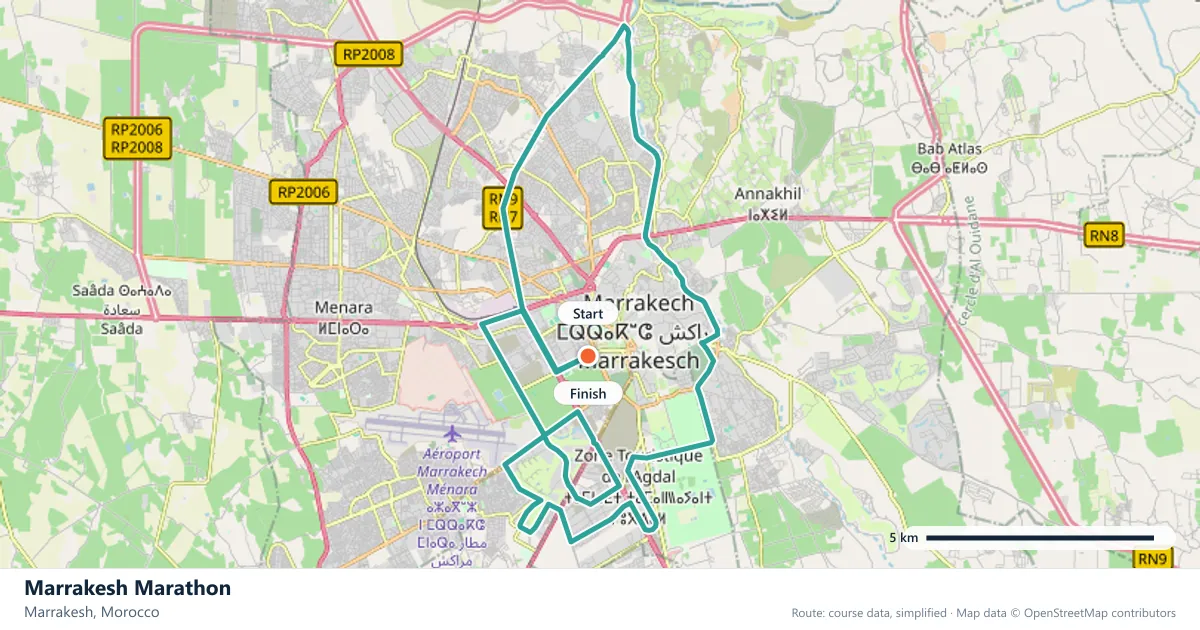
Where does the Marrakesh Marathon run?
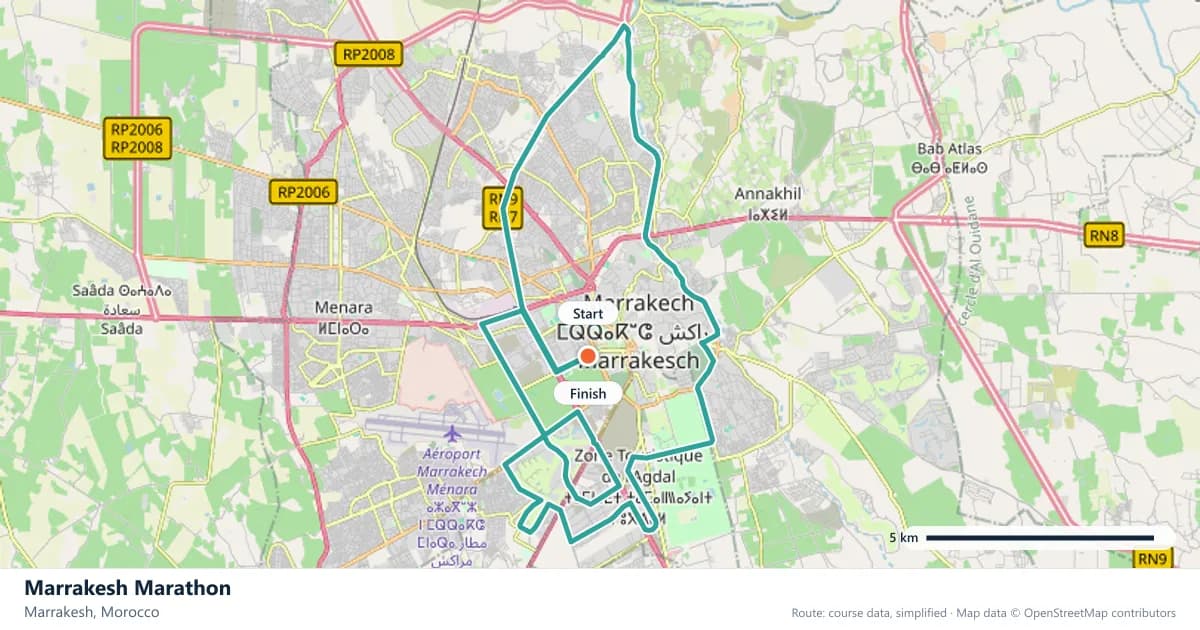
Interactive map
The trace follows the organizer's published course, simplified for the screen: the orange dot is the start, the dark dot the finish. Scroll to zoom, drag to pan.
What is the Marrakesh Marathon course like?
A January marathon out of Marrakesh towards the desert roads and the Atlas foothills, finishing near the city walls. Cool mornings, mild afternoons and plenty of flat racing.
- Next edition
- 31 January 2027
- Elevation gain
- 133 m
- Profile
- Undulating
- First run
- —
Course guide
A marathon in Marrakesh begins with a decision about where to look. The city itself is dense, warm-coloured and full of movement, but the race quickly points you out towards open roads and the Atlas foothills. By the time you return, the medina walls are waiting at the finish, and the city feels like a destination rather than a backdrop.
The 2027 edition is set for 31 January 2027. January is a good month for running here: mornings are cool, afternoons are mild, and the course mixes plenty of flat racing with about 133 m of gentle climbing. It is a route that can support a personal best and a route that can carry a first-timer, provided the pace respects the dry air.
The event holds a World Athletics Label, and the course is built around the contrast between the city and the open country beyond it.
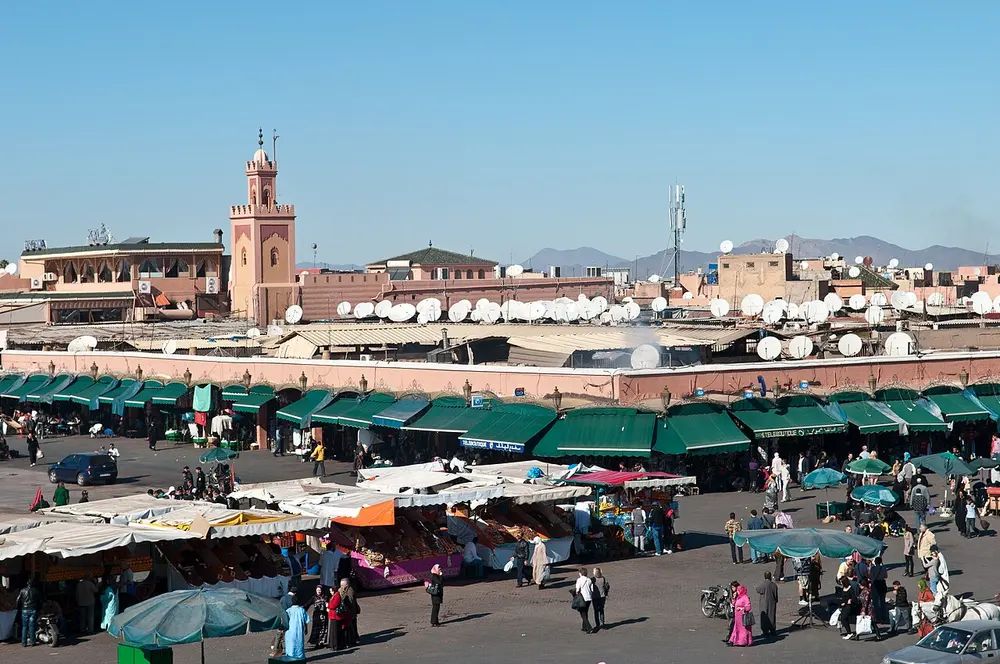
Djemaa El Fna in Marrakesh. Photo: Michal Osmenda from Brussels, Belgium / Wikimedia Commons, CC BY-SA 2.0.
The course
The race leaves the city and heads towards the desert roads and the approach to the Atlas foothills. The opening kilometres are urban, but the surroundings soon open up, and the marathon settles into a long stretch where the landscape does most of the talking. The finish brings runners back to the city walls, so the route has a clear shape: out into the open, then home.
The profile is undulating rather than severe. About 133 m of climbing is spread over 42.195 km, with long flat sections between the rises. The climbs arrive mostly as the course approaches the foothills, and they are gentle enough to run rather than walk, but they are also easy to underestimate after a fast opening.
The city walls are the defining finish. They frame the last part of the race and give the marathon an ending that is architectural rather than stadium-like.
Leaving the city behind
The first part of the race is still recognisably Marrakesh: streets, traffic-free for the morning, and the usual density of a historic city. Then the route opens. The desert roads beyond the city are wide and exposed, and the Atlas foothills provide the horizon. The transition is abrupt, and it changes the way the race feels.
Out here, the course is less about landmarks and more about rhythm. There are long flat stretches where the pace can settle, and the lack of constant turns makes it easier to hold a steady effort. The trade-off is that there is less to distract you when the legs begin to tire.
January light and the Atlas
January in Marrakesh is a month of clear light and cool starts. The first hour can feel almost cold, especially before the sun clears the horizon, and runners who have dressed for an afternoon race will notice the difference. By midday the city is mild rather than hot, which is close to ideal for a marathon.
The Atlas foothills are the visual anchor of the middle section. They are not climbed in any serious way; the course approaches them and uses their presence to give the route a direction. The rises that come with the approach are the main changes of grade, and they arrive when the legs have already spent time on the flat.
The dry air is the other January feature. It makes the cold feel sharper at the start and the warmth feel gentler later, but it also increases fluid loss without the obvious cue of heavy sweating. Runners should drink on a schedule rather than waiting for thirst.
The return to the walls
The finish near the city walls is the reward for the open-road section. The route comes back into Marrakesh, the scale shrinks, and the medina replaces the horizon. For a first-time visitor, the final kilometres are a reminder of why the race is worth the trip; for a returning runner, they are the point at which the day becomes a marathon rather than a tour.
The closing stretch also asks for patience. The flat miles have encouraged a steady rhythm, but the return to the city brings turns and small changes of grade that can break it. Runners who have saved something for the walls will finish strongly; those who spent the open road will be hanging on.
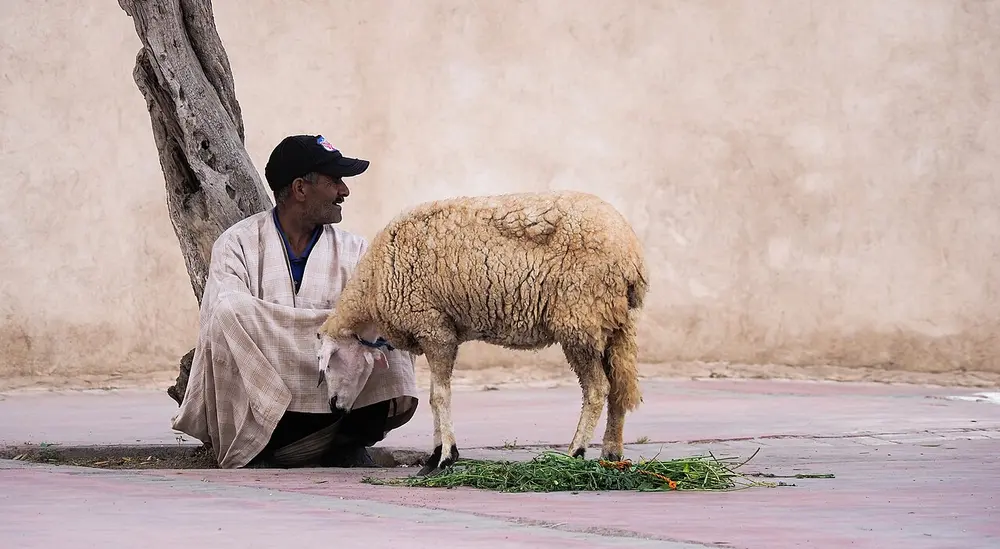
Arabian shepherd selling sheep in Ramadan month (street of Marrakesh). Photo: Petar Milošević / Wikimedia Commons, CC BY-SA 4.0.
What the course asks
Marrakesh is not a hard course in the way that a mountain marathon is hard. Its demands are subtler: a cool start that invites a fast first half, long flat stretches that make the pace feel easier than it is, and a dry climate that takes fluid without much warning. The 133 m of climbing is real but rarely decisive.
The result is a race that rewards discipline more than strength. A runner who holds back for the first 20 km and then uses the flat sections will have a good day. A runner who races the opening hour will meet the foothills already in debt.
The finish by the walls also makes the race feel complete in a way that a loop through anonymous suburbs does not.
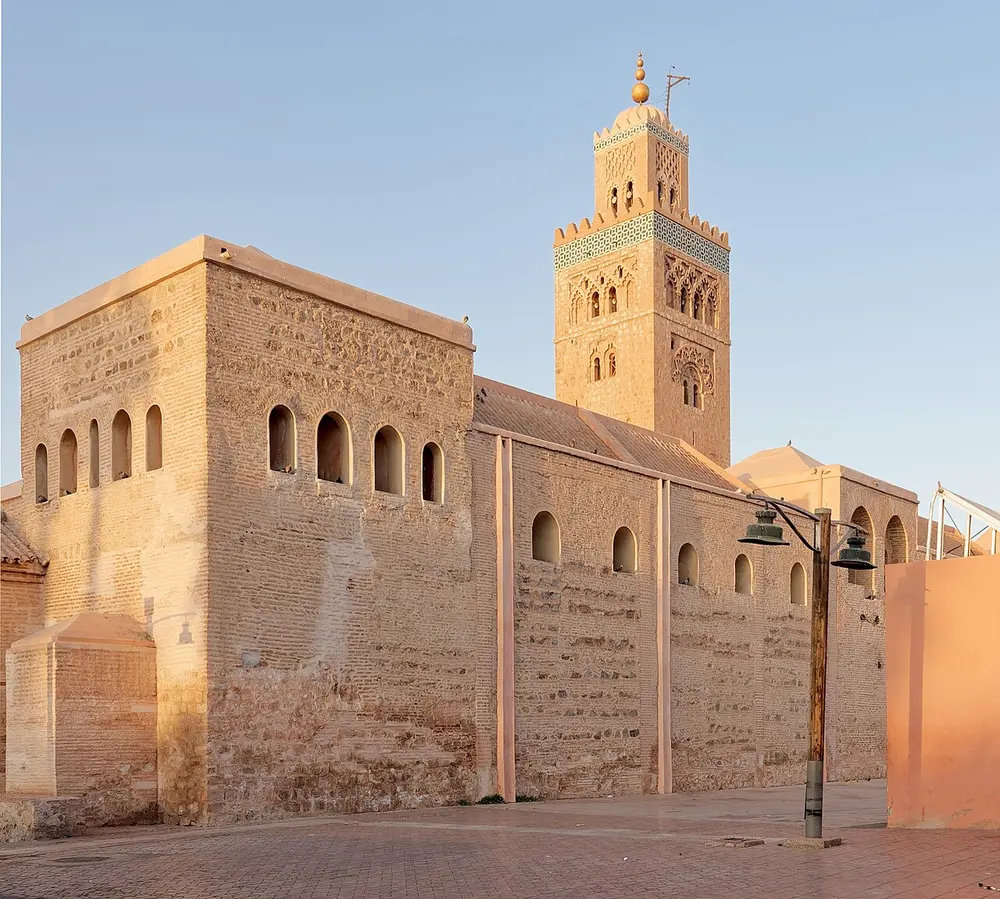
Kutubiyya Mosque, Marrakesh, Morocco, 20250124 1834 7027. Photo: Jakub Hałun / Wikimedia Commons, CC BY 4.0.
Frequently asked questions
Answers to the questions runners ask before entering, drawn from this race's course guide and the directory's own data — the sources behind them are listed below.
When is the Marrakesh Marathon in 2027?
The 2027 edition is set for 31 January.
Is the Marrakesh Marathon a flat course?
Mostly. It is undulating, with about 133 m of climbing, and there are long flat stretches between the rises. The main changes of grade come as the route approaches the Atlas foothills.
Is the Marrakesh Marathon good for a personal best?
The course can support a fast time. The flat sections, mild January weather and gentle profile all help, though the dry air and the temperature swing need to be managed.
Is the Marrakesh Marathon a good first marathon?
It can be. The course is not severe, the weather is generally kind and the finish near the walls gives the day a memorable shape. A first-timer should still respect the dry conditions and not race the opening flat miles.
Where does the Marrakesh Marathon run?
It leaves the city towards the desert roads and the Atlas foothills, then returns to finish near the city walls. The route is a mix of urban streets, open road and foothill approach.
More marathons in Morocco
More marathons in Africa
Sources for this page
What each source below is used for on this page, and where to check this race yourself.
- World Athletics — the label calendar and the road-race regulations. Used to check whether the race holds a World Athletics label, and its elite competition details.
- AIMS — the international course-measurement standard behind the 42.195 km distance, and the AIMS race calendar.
- The organizer's own publications — course maps, race handbooks and published results. The date, course character and climbing on this page are compiled from them and re-checked each season.
“A World Athletics Label denotes a full application of the Competition and Technical Rules in, at a minimum, the elite component of the competition. Labels also denote superior standards in event organisation, safety and runner experience, support from public authorities to the event and a financial commitment to anti-doping.”
Where do these facts come from?
Dates, course type, climbing and time limits are compiled from the organizer's publications and re-checked each season; elevation is an estimate of total climbing rather than a survey figure. Always confirm race-day details with the organizer before making plans.
Last reviewed 27 October 2026