
Cape Town Marathon
Table Mountain is not a backdrop in Cape Town so much as a presence. It sits above the city bowl, shapes the streets that run beneath it, and follows the marathon out along the Atlantic seaboard.
By Global Marathon Routes editorial team · Last reviewed 27 October 2026
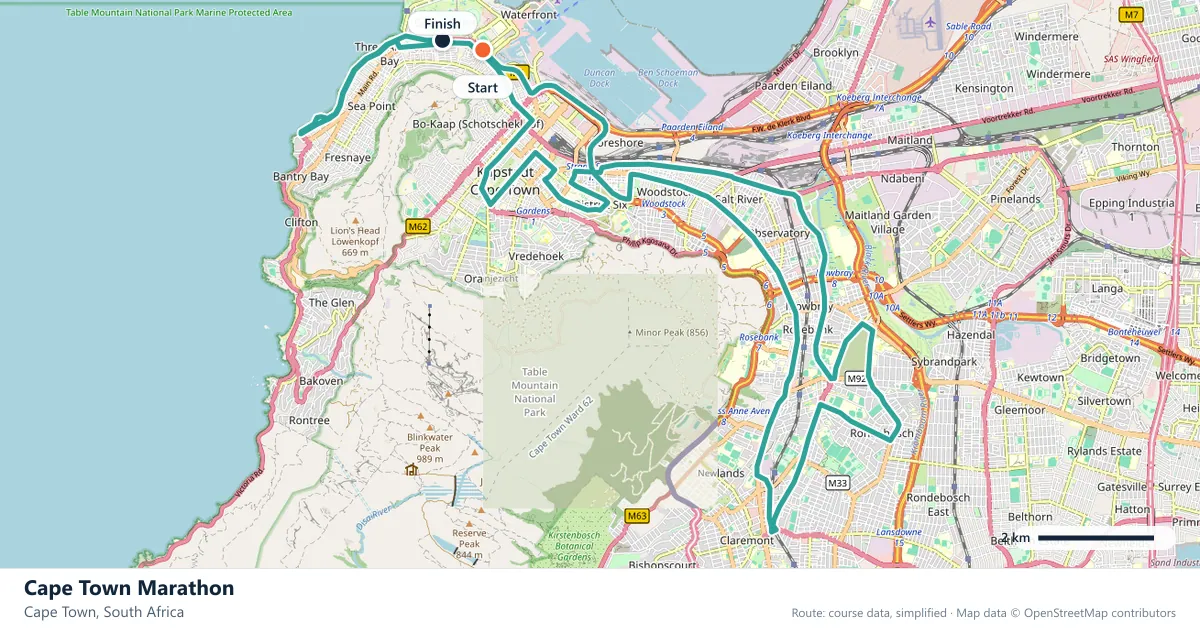
Where does the Cape Town Marathon run?
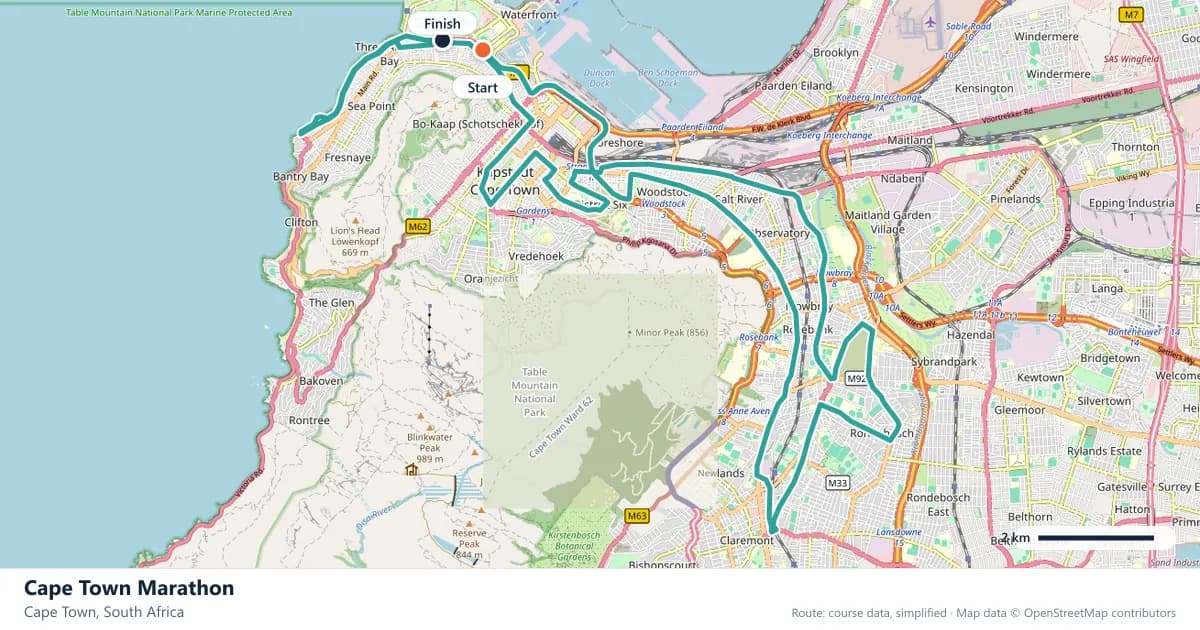
Interactive map
The trace follows the organizer's published course, simplified for the screen: the orange dot is the start, the dark dot the finish. Scroll to zoom, drag to pan.
What is the Cape Town Marathon course like?
Africa's first Abbott World Marathon Major, run in May beneath Table Mountain. The course loops through the city bowl and along the Atlantic seaboard, with the mountain as the constant backdrop.
- Next edition
- 23 May 2027
- Elevation gain
- 265 m
- Profile
- Hilly
- First run
- —
Course guide
Table Mountain is not a backdrop in Cape Town so much as a presence. It sits above the city bowl, shapes the streets that run beneath it, and follows the marathon out along the Atlantic seaboard. On race morning it is there at the start and again when runners turn for home.
The 2027 edition is set for 23 May 2027. The course is hilly, with about 265 m of climbing over a loop of roughly 42.3 km, and it holds a World Athletics Label. It is also Africa's first Abbott World Marathon Major, a status that has changed the scale of the event without changing the essential appeal: a city marathon in one of the most dramatic settings on the calendar.
It is a major, with the field and the organisation that implies, but it is also a course with real rises and a long seaside stretch. It can support a fast time and a first marathon, but only if the hills are respected.
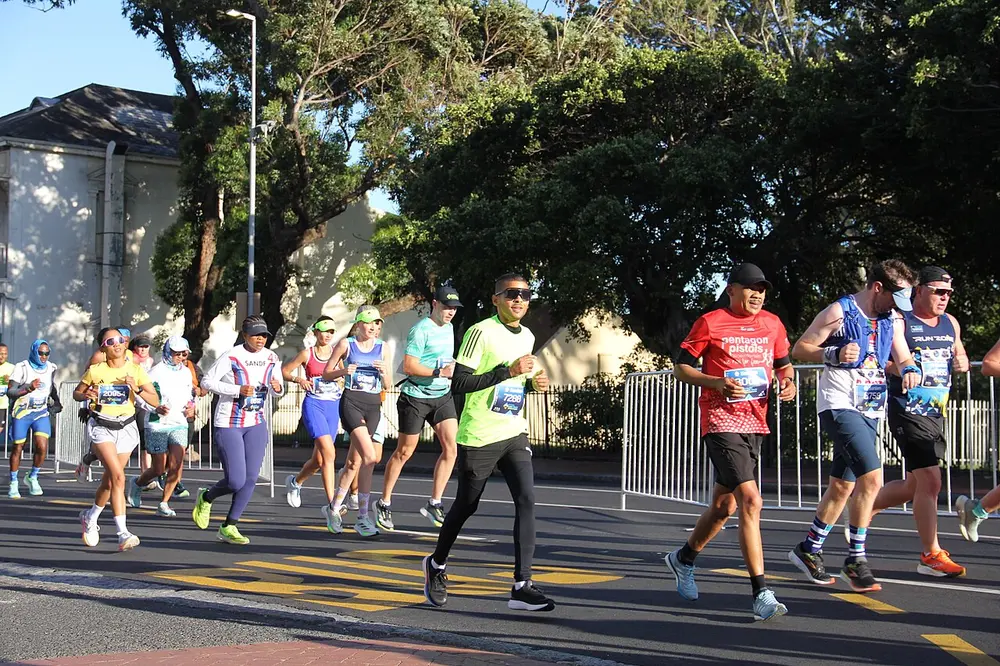
2024 Cape Town Marathon - Victoria Road 1. Photo: axxter99 / Wikimedia Commons, CC BY-SA 4.0.
The course
The marathon is a loop that uses two very different sides of the city. The city bowl supplies dense streets, constant changes of direction and the sense of running through a working urban centre. The Atlantic seaboard opens the route to longer views, sea air and a stronger sense of space.
The climbing comes in the aggregate rather than in one famous wall. About 265 m of ascent over the full loop means repeated rises, each short enough to be underestimated and long enough to cost something if the pace is too ambitious. There is no single climb that defines the race, and that is precisely what makes the course tiring: the effort accumulates without a clear moment of reckoning.

2024 Cape Town Marathon - Victoria Road 2. Photo: axxter99 / Wikimedia Commons, CC BY-SA 4.0.
The city bowl
The city bowl is Cape Town's historic and commercial heart, pressed between the mountain and the harbour. The marathon uses its streets early, and the density is a contrast to what comes later. Buildings block the view, the road turns often, and the field is still packed together.
This is where the race feels most like a big-city marathon. The crowd support is concentrated, the landmarks come thick and fast, and the pace can be influenced by the runners around you rather than by the terrain. The climbs in this section are short but frequent, and they arrive before the legs have warmed into a rhythm.
The bowl also sets up the rest of the day. The best approach is to use the early streets to settle, not to race.
The Atlantic seaboard
The Atlantic side of the loop is the part most runners remember. The road runs close to the water, the views open up, and the mountain stands behind the city. The Victoria Road section is the signature stretch, with the sea on one side and the slope on the other.
It is also exposed. Wind and weather can arrive off the Atlantic, and the road rolls rather than runs flat. The combination of scenery and exposure makes this section feel easier than it is at the start and harder than it looks later on. Runners who have paced the city bowl conservatively will be able to enjoy it; those who have not will be counting down the kilometres.
The seaboard is where the course's 265 m of climbing is most noticeable in aggregate. The rises are not long, but they keep coming, and the sea views can distract from the effort.
Africa's first major
Cape Town became Africa's first Abbott World Marathon Major, and the designation has changed the race's profile. The field is deeper, the organisation is built for an international entry, and the weekend carries more weight than a purely local event. For runners, that means a marathon with the infrastructure of a major and the setting of a coastal city.
It also means more demand. A major attracts a large field and a lot of attention, so the practical side of the weekend, from entry to accommodation, needs more planning than a smaller race. The reward is a course that feels significant without feeling manufactured.
Cape Town is hilly, and the 265 m of climbing does not disappear because the race is prestigious.

2024 Cape Town Marathon - Victoria Road 3. Photo: axxter99 / Wikimedia Commons, CC BY-SA 4.0.
What the mountain gives and takes
Table Mountain gives the race its identity and its weather. The mountain can hold cloud, channel wind and create conditions that differ from one side of the city to the other. Runners should expect the day to change as the course moves between the bowl and the seaboard.
The mountain also gives the course its climbs. Cape Town is not a mountain race in the technical sense, but the city is built on slopes, and the marathon reflects that. The 265 m of ascent is a modest total for a hilly race, yet it is enough to make the second half feel different from the first.
What the mountain takes is any illusion of a flat city marathon. Cape Town is a major, a scenic race and a hilly run at once.
Frequently asked questions
Answers to the questions runners ask before entering, drawn from this race's course guide and the directory's own data — the sources behind them are listed below.
When is the Cape Town Marathon in 2027?
The 2027 edition is set for 23 May.
Is the Cape Town Marathon a flat course?
No. The loop climbs about 265 m, with repeated rises rather than one long ascent. The city bowl and the Atlantic seaboard both contribute to the total.
Is the Cape Town Marathon good for a personal best?
The race can support a fast time, but the climbing has to be respected. It is not a flat course, and even pacing over the repeated rises is essential.
Is the Cape Town Marathon a good first marathon?
It can be. The atmosphere of a major and the scenery help, but a first-timer should train on rolling ground and start conservatively. The hills make it a more demanding debut than a flat city race.
Is the Cape Town Marathon a World Marathon Major?
Yes. It is Africa's first Abbott World Marathon Major, and the event holds a World Athletics Label.
Where does the Cape Town Marathon run?
It loops through the city bowl and along the Atlantic seaboard, with Table Mountain above the course for most of the morning. The Victoria Road section is the signature stretch.
More marathons in South Africa
More marathons in Africa
Sources for this page
What each source below is used for on this page, and where to check this race yourself.
- World Athletics — the label calendar and the road-race regulations. Used to check whether the race holds a World Athletics label, and its elite competition details.
- AIMS — the international course-measurement standard behind the 42.195 km distance, and the AIMS race calendar.
- The organizer's own publications — course maps, race handbooks and published results. The date, course character and climbing on this page are compiled from them and re-checked each season.
“A World Athletics Label denotes a full application of the Competition and Technical Rules in, at a minimum, the elite component of the competition. Labels also denote superior standards in event organisation, safety and runner experience, support from public authorities to the event and a financial commitment to anti-doping.”
Where do these facts come from?
Dates, course type, climbing and time limits are compiled from the organizer's publications and re-checked each season; elevation is an estimate of total climbing rather than a survey figure. Always confirm race-day details with the organizer before making plans.
Last reviewed 27 October 2026