
Gdańsk Marathon
Gdańsk is a city that has been rebuilt more than once, and the old town you run through is proof of it.
By Global Marathon Routes editorial team · Last reviewed 27 October 2026
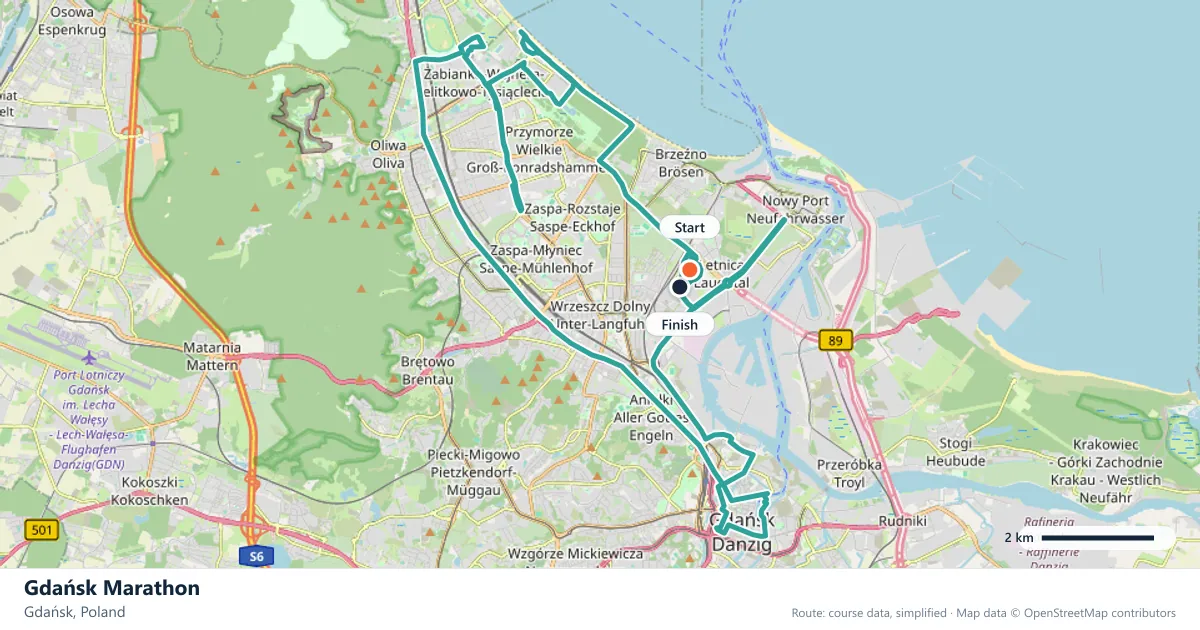
Where does the Gdańsk Marathon run?
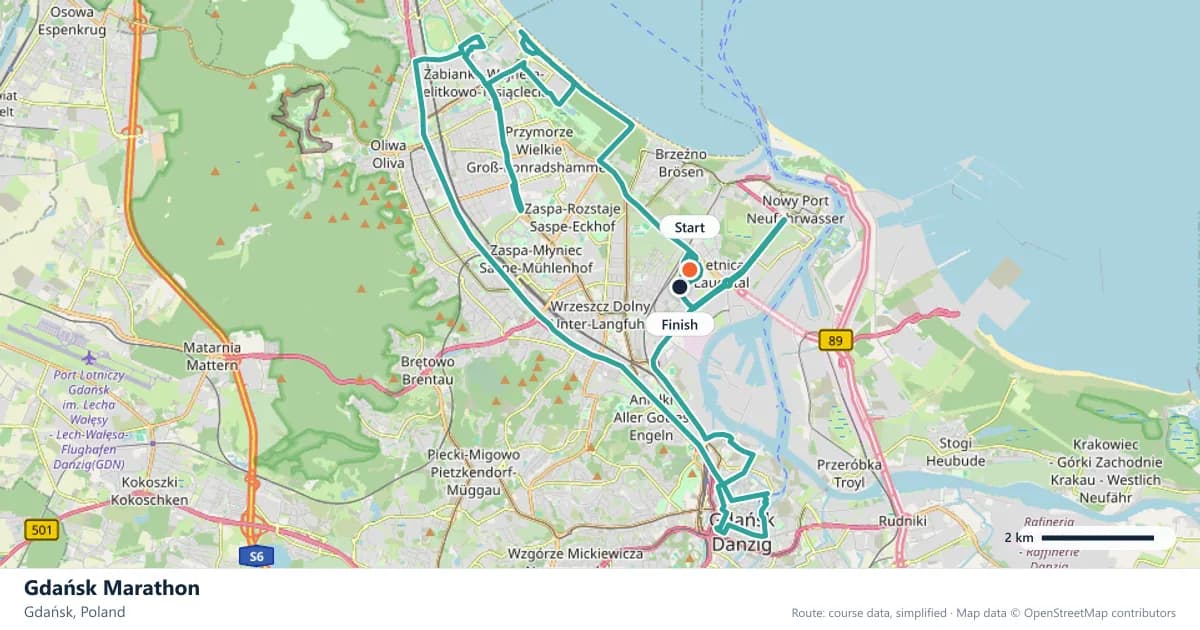
Interactive map
The trace follows the organizer's published course, simplified for the screen: the orange dot is the start, the dark dot the finish. Scroll to zoom, drag to pan.
What is the Gdańsk Marathon course like?
A flat Baltic spring race through the reconstructed old town and out along the coast. Wide roads, sea-level profile and usually cool race-day weather.
- Next edition
- April 2027 (expected)
- Elevation gain
- 72 m
- Profile
- Flat
- First run
- —
Course guide
Gdańsk is a city that has been rebuilt more than once, and the old town you run through is proof of it. Its streets and facades were reconstructed after the Second World War, so the centre looks old but carries a modern history. The marathon uses it as an opening act before heading towards the Baltic. The next edition is expected in April 2027.
The course climbs about 72 metres in total and sits at sea level. That makes it a natural spring marathon for anyone chasing a time: wide roads, a low profile and usually cool weather. It is quick enough for a personal best and gentle enough for a debut.
The old town gives the race a setting more distinctive than the average city loop. The reconstructed streets, the Motława and the waterfront make the early kilometres feel like a tour before the course turns towards the coast.
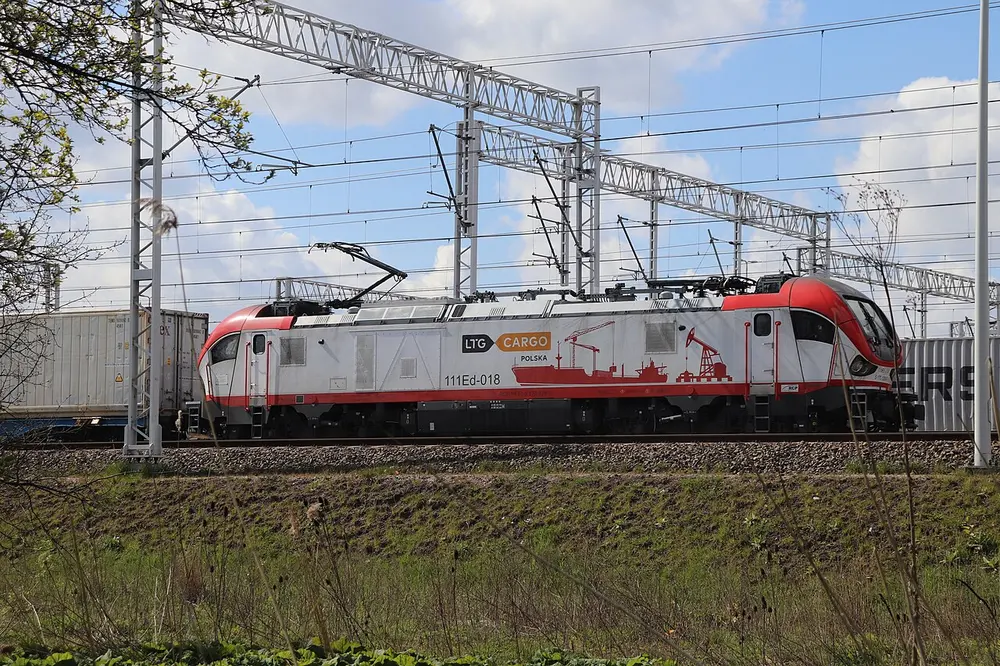
Gdansk Port Polnocny 111Ed. Photo: Andrzej Otrębski / Wikimedia Commons, CC BY-SA 4.0.
The course
The route passes through the reconstructed old town before heading out along the coast. The historic streets provide the opening character, and the coastal section opens the course towards the Baltic. That transition defines the race.
The profile is flat: about 72 metres of climbing on a sea-level base. Wide roads make it easy to settle into pace, and there is no sustained ascent to break the rhythm. The climbs that do exist are short and shallow, the sort that disappear under a well-paced marathon.
The old town is the part that demands attention. The streets are narrower than the coastal roads, the surface changes, and the turns come more often. That is not where the race is won, but an impatient start can cost you. Settle early and save faster running for the open coast.
The reconstructed centre
Gdańsk's old town is one of the most striking in Poland, precisely because it was rebuilt with such care. The Long Market, the waterfront along the Motława and the elaborate facades are part of the image most visitors carry away. The reconstruction is not a copy of a single moment; it is the rebuilding of a city shaped by centuries of trade.
That history is worth knowing before race day. Gdańsk was a Hanseatic port where Polish, German and other European influences met, and the architecture reflects that.
Out to the coast
The coastal section is the opposite of the old town: open, flat and exposed. The Baltic is close, the horizon widens, and the running becomes a matter of holding rhythm rather than navigating turns. On a clear spring day it is the best part of the course; on a windy one it is the hardest.
The coast also brings the race's main variable. A flat route beside open water offers no shelter, and the wind can make the return feel longer than it is. Use other runners when you can, keep your effort steady, and do not let the openness pull you faster than planned.
Spring on the Baltic
April on the Baltic is unpredictable. The air is usually cool, which is good for a marathon, but the coast can be windy and the weather can change quickly. The race is expected in April, and the exact date should be confirmed before travel is booked.
The date fits a spring build. An April race leaves just enough time after a winter base to add specific endurance, and it avoids the heat of summer. The risk is that spring arrives late in northern Poland; a cold race is more likely than a warm one, so pack accordingly.
A flat, sea-level race
A course with 72 metres of climbing and a sea-level base does not need a complicated pacing strategy. The terrain will not slow you down, and it will not speed you up. The race is decided by how well you judge the first half and how honestly you run the flat kilometres.
That is the appeal of Gdańsk for a personal best. The profile is quick, the roads are wide, and the spring weather usually cooperates. For a first marathon, the same qualities make the day approachable, provided you respect the distance and do not treat the flat course as an easy one.
The weekend
Gdańsk is a good place to spend a race weekend. The old town is compact and walkable, the waterfront gives the city a focus, and the coast is close enough to visit. The city is also easy to reach from elsewhere in Poland and the Baltic region.
Stay in the old town if you can. It puts the historic streets, the waterfront and the river within walking distance, and it makes the race feel part of the city. Arrive on Saturday, collect your bib, and walk the opening section before race morning.
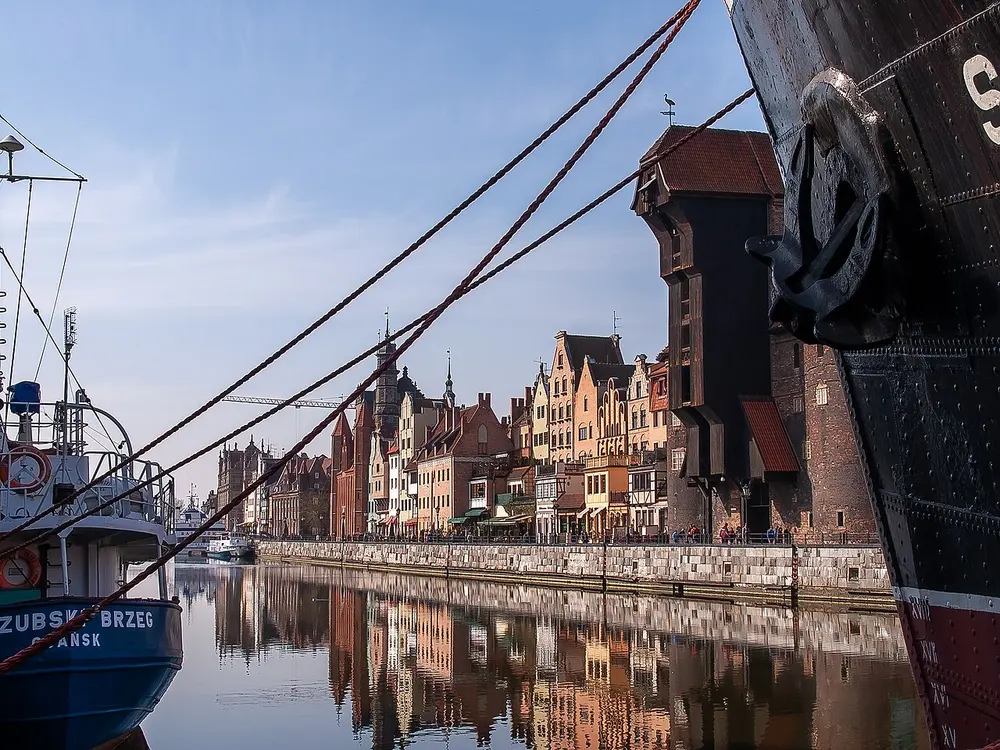
Gdańsk molo w Gdańsku-20070402-RM. Photo: Ermell / Wikimedia Commons, CC BY-SA 4.0.
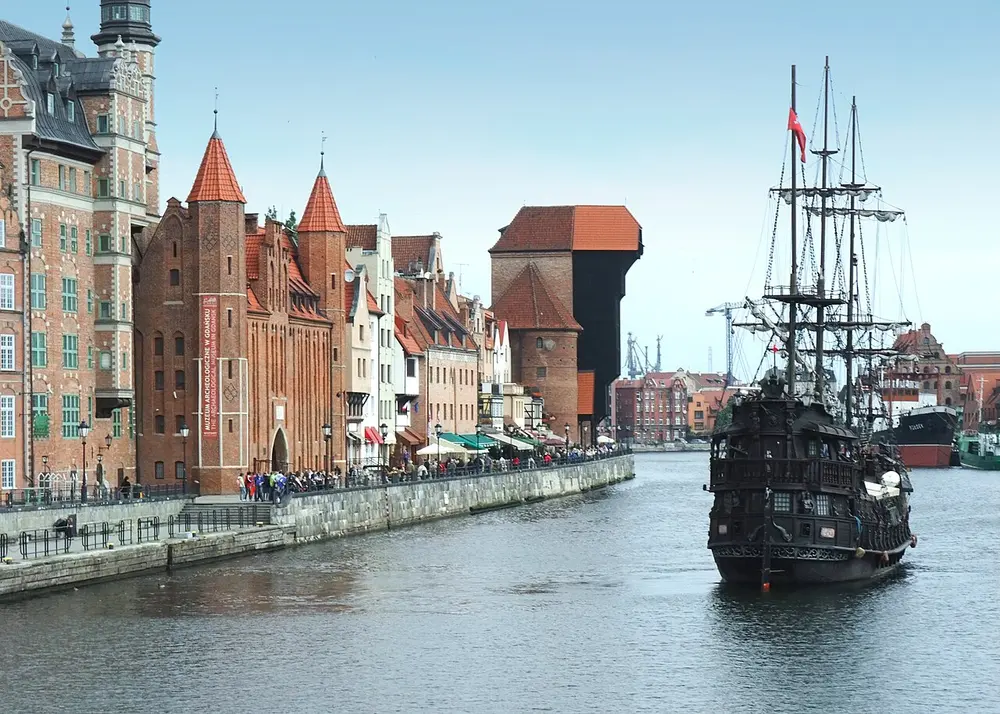
Długie Pobrzeże in Gdańsk (Motława). Photo: Nikater / Wikimedia Commons, CC BY-SA 3.0.
Frequently asked questions
Answers to the questions runners ask before entering, drawn from this race's course guide and the directory's own data — the sources behind them are listed below.
When is the Gdańsk Marathon in 2027?
The next edition is expected in April 2027. The exact date has not been confirmed, so check the organiser's calendar before making travel plans.
Is the Gdańsk Marathon a flat course?
Yes. The route climbs about 72 metres and sits at sea level, with wide roads and no sustained ascent. It is a flat spring marathon with a short coastal section.
Is the Gdańsk Marathon good for a first marathon or a personal best?
Yes, for either goal. The low climbing and wide roads give fast runners a good chance of a personal best, while the modest profile and cool spring weather make the race approachable for a first marathon.
Where is the Gdańsk Marathon run?
It runs through the reconstructed old town and out along the Baltic coast. The route is flat and close to sea level.
Has the April 2027 date been confirmed?
No. April 2027 is the expected month, not a confirmed race date. Wait for the organiser's announcement before committing to specific travel.
What is the weather like in April?
April on the Baltic is usually cool and can be windy, especially on the coastal section. Prepare for a range and do not expect summer conditions.
More marathons in Poland
More marathons in Europe
Sources for this page
What each source below is used for on this page, and where to check this race yourself.
- World Athletics — the label calendar and the road-race regulations. Used to check whether the race holds a World Athletics label, and its elite competition details.
- AIMS — the international course-measurement standard behind the 42.195 km distance, and the AIMS race calendar.
- The organizer's own publications — course maps, race handbooks and published results. The date, course character and climbing on this page are compiled from them and re-checked each season.
Where do these facts come from?
Dates, course type, climbing and time limits are compiled from the organizer's publications and re-checked each season; elevation is an estimate of total climbing rather than a survey figure. Always confirm race-day details with the organizer before making plans.
Last reviewed 27 October 2026