
Rotterdam Marathon
Rotterdam is a marathon that wears its ambition on its sleeve. The course is flat, the roads are wide, and the field is deep enough that the leaders regularly go under 2:05.
By Global Marathon Routes editorial team · Last reviewed 27 October 2026
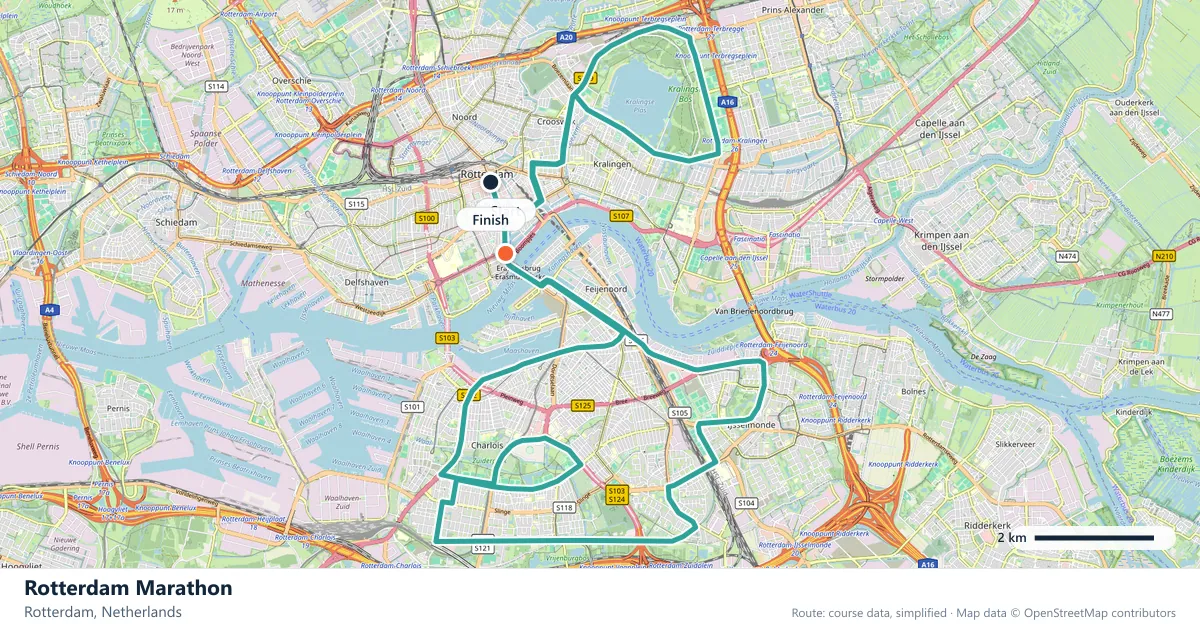
Where does the Rotterdam Marathon run?
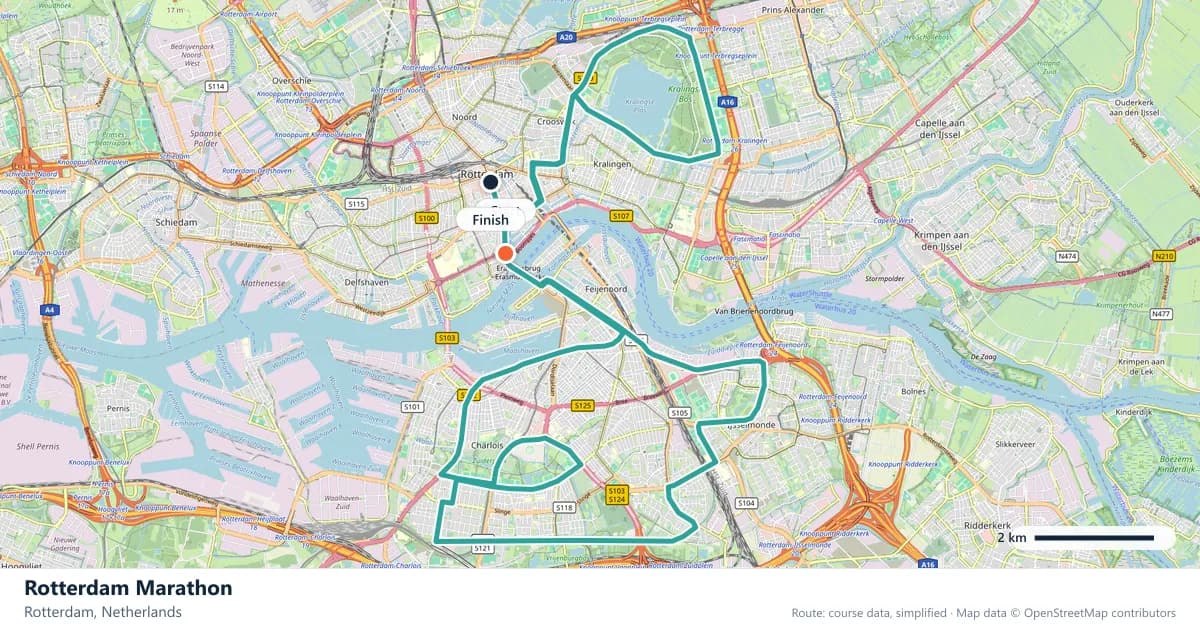
Interactive map
The trace follows the organizer's published course, simplified for the screen: the orange dot is the start, the dark dot the finish. Scroll to zoom, drag to pan.
What is the Rotterdam Marathon course like?
One of the fastest courses in the world: flat, sheltered and run on wide roads through the port city. The Rotterdam field regularly goes under 2:05.
- Next edition
- April 2027 (expected)
- Elevation gain
- 86 m
- Profile
- Flat
- First run
- —
Course guide
Rotterdam is a marathon that wears its ambition on its sleeve. The course is flat, the roads are wide, and the field is deep enough that the leaders regularly go under 2:05. The next edition is expected in April 2027, and it holds a World Athletics Gold Label.
What makes Rotterdam different from other fast courses is the setting. This is a port city that was rebuilt after the Second World War, and the wide boulevards and modern architecture are a product of that history. The marathon uses the space: wide roads, a flat profile, and a route that feels designed for rhythm rather than spectacle.
It is built for a personal best, and it is manageable for a debut. The flat, sheltered profile is forgiving, and the wide roads give runners room to settle. The risk is the company: when the field moves quickly around you, it is easy to mistake its pace for your own.
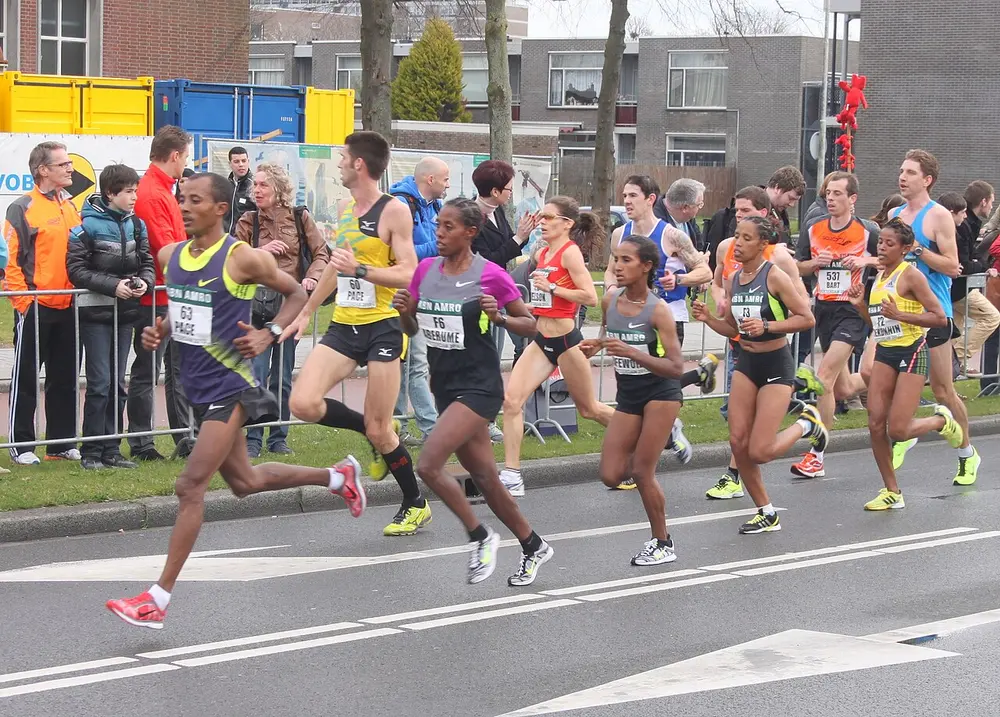
Leaders running women marathon Rotterdam. Photo: Peter van der Sluijs / Wikimedia Commons, CC BY-SA 3.0.
The course
The marathon runs on wide roads through Rotterdam, with about 86 metres of climbing across the distance. There is no sustained ascent, and much of the route is sheltered by buildings, which makes the course feel faster than the raw elevation figure alone would suggest.
The layout is built for even running. The roads are broad enough that the field spreads out early, and the route lets runners hold a pace rather than constantly adjust it.
The port is never far from the story. Rotterdam's identity is tied to the Maas and the docks that made it one of Europe's busiest ports. The wide infrastructure and modern skyline carry the same message.
The field and the clock
The depth of the Rotterdam field is part of the course's character. When the leaders are running under 2:05, the runners around them are moving quickly too, and the early kilometres can feel like a procession. That is useful if you are chasing a time and dangerous if you are not.
The mistake is to let the field set your pace. A fast marathon is a controlled start that allows a fast finish. Use the runners around you for rhythm, not validation, and check your splits against your own plan.
A city rebuilt
Rotterdam's modern centre is the result of wartime destruction and postwar reconstruction. The city lost much of its historic core in 1940, and the rebuilding produced a different kind of Dutch city: wide streets, bold architecture and a willingness to experiment. The Erasmus Bridge, with its single angled pylon, has become the symbol of that identity.
That history shapes the race. A city with broad roads and modern planning can host a marathon without the bottlenecks of an older centre, and the result is a course that feels open. It is not a pretty route in the traditional sense, but it is a distinctive one, and the skyline gives the final kilometres a sense of arrival.
Shelter and space
The course is often described as sheltered, and that matters in a city close to the North Sea. On a windy April day, the buildings along the route can take the edge off the gusts, and the wide roads give runners room to find a calmer line. It is not complete protection, but it is better than an exposed coastal route.
Shelter can hide the wind until it hits. Expect exposed sections, especially near the river. If the air is moving, do not fight it in the first half; let the course and the field carry you until the final 10 kilometres.
Debut or personal best
For a first marathon, Rotterdam offers a flat course, a big-city atmosphere and a field that makes the day feel like an event. The wide roads reduce the crowding that can make a debut stressful, and the shelter helps if the weather turns. The distance is still the distance, but the course removes some external difficulty.
For a personal best, the case is stronger. Flat, fast, sheltered and deep: those are the ingredients of a quick marathon, and Rotterdam has them all. The key is to arrive with a plan and to resist the pull of the field. A personal best here is usually the result of patience rather than a heroic first half.
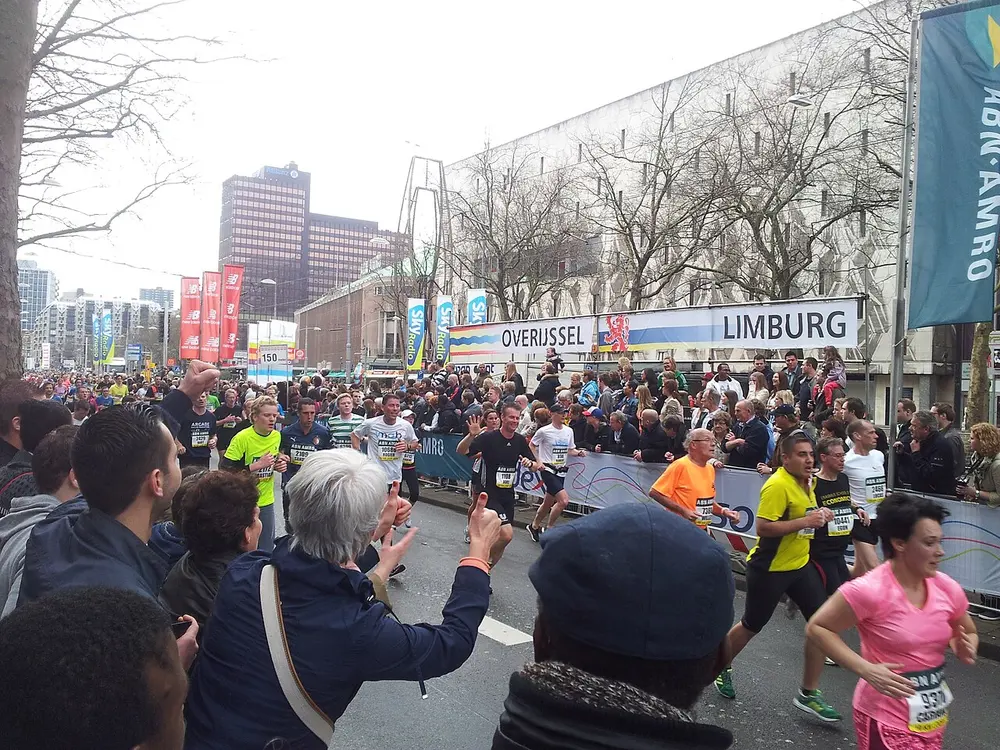
Rotterdam Marathon 2013 03. Photo: Prolete / Wikimedia Commons, CC0.
An expected April date
The next edition is expected in April 2027, so the exact date should be confirmed with the organiser before booking travel. Rotterdam is easy to reach from Amsterdam and the rest of the Netherlands, and the city has enough hotels and transport to absorb a large marathon weekend.
Spring in the Netherlands is unpredictable. April can be cool and bright or wet and windy, and the difference matters on an exposed course. Pack for a range, bring a discardable layer, and check the forecast in the final days rather than relying on a long-range guess.
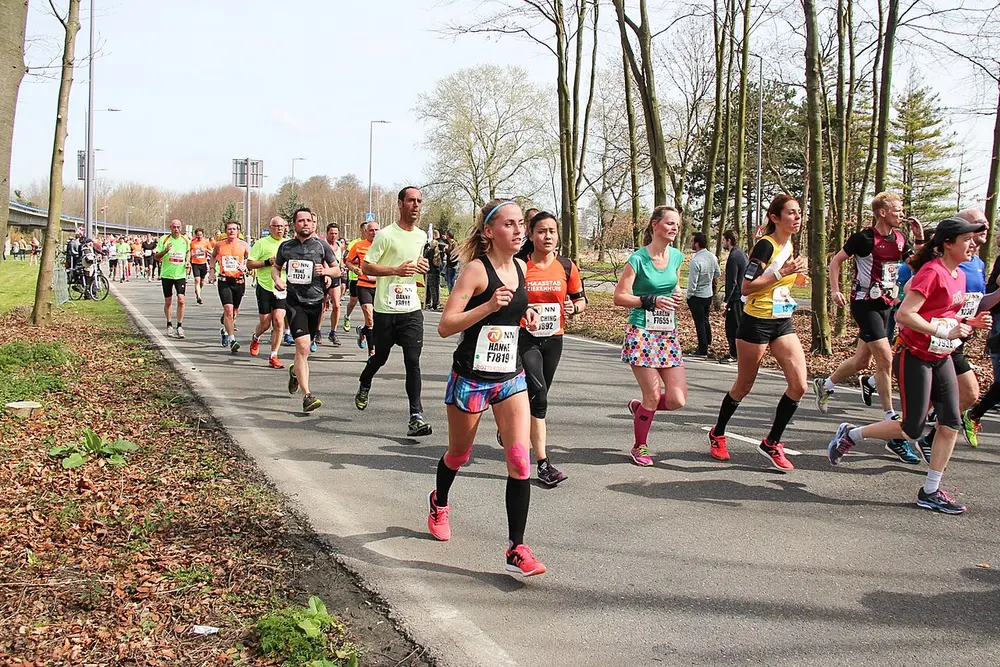
Vrouwen deden zich niet onder de mannen Marathon Rotterdam 2015. Photo: Peter van der Sluijs / Wikimedia Commons, CC BY-SA 3.0.
Frequently asked questions
Answers to the questions runners ask before entering, drawn from this race's course guide and the directory's own data — the sources behind them are listed below.
When is the Rotterdam Marathon in 2027?
The next edition is expected in April 2027. The exact date has not been confirmed, so check the organiser's schedule before booking travel.
Is the Rotterdam Marathon flat?
Yes. The course climbs only about 86 metres in total, with no sustained ascent, and much of it is sheltered by buildings. It is one of the flattest major marathon courses.
Is the Rotterdam Marathon good for a personal best?
Yes. The flat profile, wide roads and deep field make it one of the fastest courses in the world. The main risk is starting too quickly with the runners around you.
Is the Rotterdam Marathon suitable for a first marathon?
Yes. The wide roads, flat course and big-city organisation make it approachable for a first marathon. The speed of the field is the main thing to manage, not the terrain.
Does the Rotterdam Marathon hold a World Athletics label?
Yes. It holds a World Athletics Gold Label.
Where is the Rotterdam Marathon run?
It runs on wide roads through Rotterdam, the Dutch port city. The course is flat and sheltered, with about 86 metres of climbing.
More marathons in Netherlands
More marathons in Europe
Sources for this page
What each source below is used for on this page, and where to check this race yourself.
- World Athletics — the label calendar and the road-race regulations. Used to check whether the race holds a World Athletics label, and its elite competition details.
- AIMS — the international course-measurement standard behind the 42.195 km distance, and the AIMS race calendar.
- The organizer's own publications — course maps, race handbooks and published results. The date, course character and climbing on this page are compiled from them and re-checked each season.
“A World Athletics Label denotes a full application of the Competition and Technical Rules in, at a minimum, the elite component of the competition. Labels also denote superior standards in event organisation, safety and runner experience, support from public authorities to the event and a financial commitment to anti-doping.”
Where do these facts come from?
Dates, course type, climbing and time limits are compiled from the organizer's publications and re-checked each season; elevation is an estimate of total climbing rather than a survey figure. Always confirm race-day details with the organizer before making plans.
Last reviewed 27 October 2026