
Amsterdam Marathon
Amsterdam is one of Europe's oldest city marathons, and it is unusual among fast courses because the history is visible for almost the whole race.
By Global Marathon Routes editorial team · Last reviewed 27 October 2026
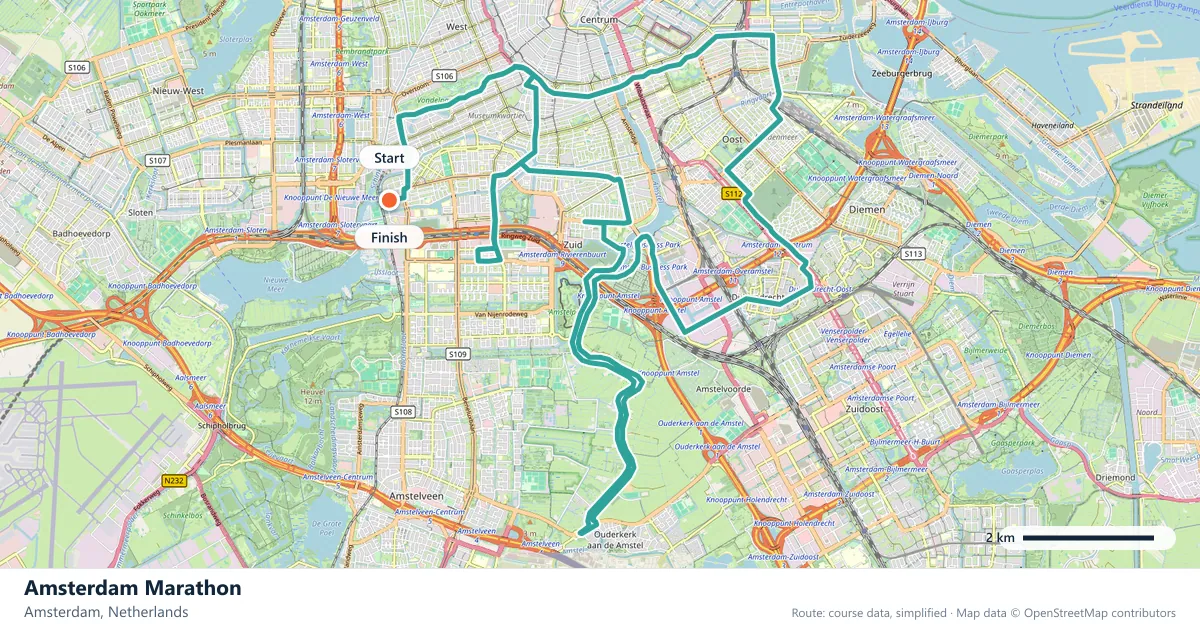
Where does the Amsterdam Marathon run?
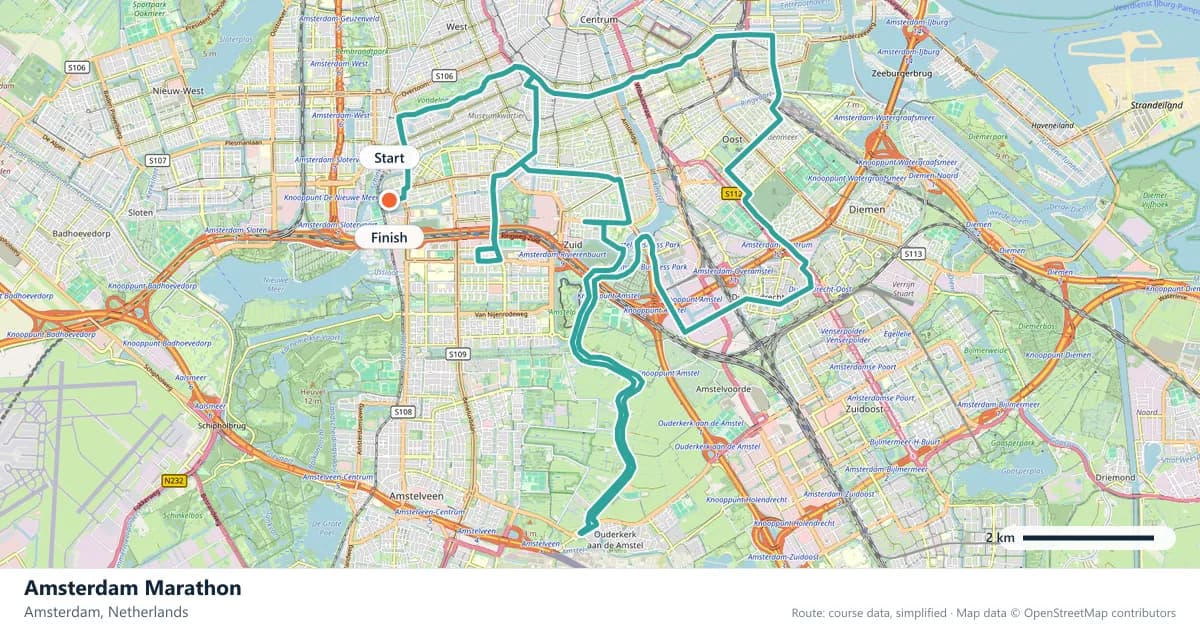
Interactive map
The trace follows the organizer's published course, simplified for the screen: the orange dot is the start, the dark dot the finish. Scroll to zoom, drag to pan.
What is the Amsterdam Marathon course like?
A flat, fast city course that starts and finishes in the Olympic Stadium, following the Amstel and looping through the canals. One of Europe's benchmark autumn races.
- Next edition
- October 2027 (expected)
- Elevation gain
- 55 m
- Profile
- Flat
- First run
- —
Course guide
Amsterdam is one of Europe's oldest city marathons, and it is unusual among fast courses because the history is visible for almost the whole race. The modern event dates from 1975, but the city's marathon story goes back much further: the 1928 Olympic marathon finished in the same stadium that hosts today's start and finish. The 2026 race is on Sunday 18 October, with waves starting between 09:00 and 09:50 and a six-hour limit.
The course is flat, fast and deliberately scenic. It passes under the Rijksmuseum, follows the Amstel River past stately houses and windmills, loops through Vondelpark and returns to the Olympic Stadium. There are only about 55 metres of climbing, the race holds a World Athletics Platinum Label, and Amsterdam is regularly ranked among the fastest marathon cities in the world. The 2025 jubilee edition produced a men's course record of 2:03:30; the women's record of 2:16:52 has stood since 2024.
That combination makes Amsterdam a rare thing: a personal-best course that does not feel like an industrial loop. The flat kilometres are real, but so are the landmarks. The race rewards runners who can stay patient through the early sights and save something for the long run along the river.
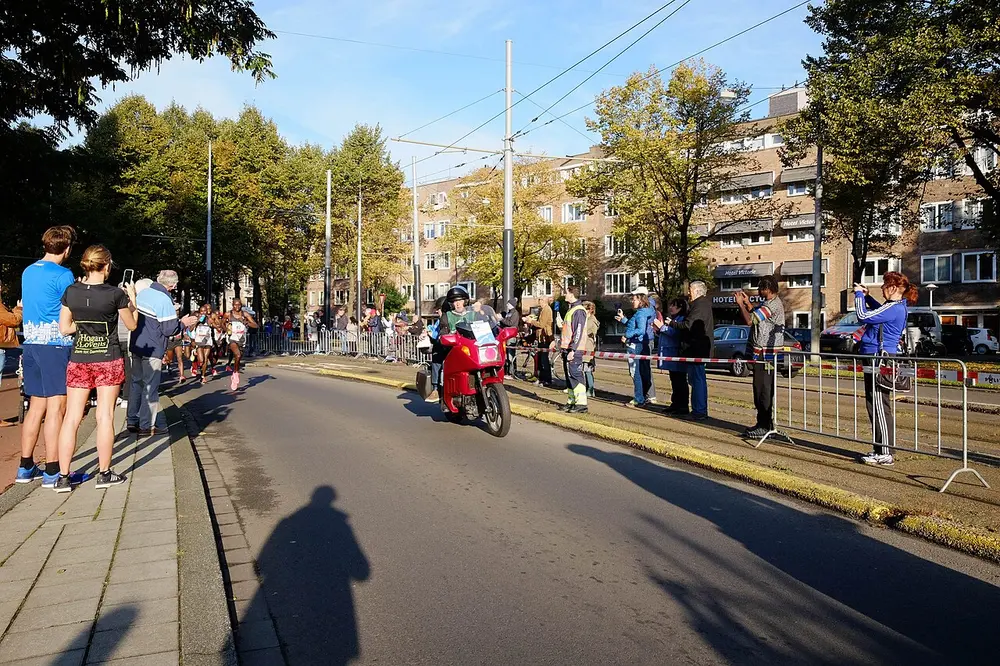
Amsterdam Marathon 2016. Photo: Franklin Heijnen / Wikimedia Commons, CC BY-SA 2.0.
The course
The race is a loop, and the first four kilometres are the most architectural. From the Olympic Stadium the route heads towards the Museumplein and passes under the Rijksmuseum, one of the signature images of the race. The opening miles are busy, so the passage is a place to hold your rhythm rather than chase the atmosphere.
From roughly 11 kilometres the course settles into the Amstel River section. This is the part the organiser calls the rural trail: stately mansions, windmills and long views across the water, with the city feeling further away than it is. It is also the most exposed part of the route. On a windy morning, the flat ground can feel considerably harder than the elevation profile suggests.
The return to the city comes late. Around 38 kilometres the route passes the Heineken Experience, then loops through Vondelpark at about 40 kilometres before the final run back to the stadium. The finish is inside the Olympic Stadium, in front of the grandstand, so the last metres are a stadium arrival rather than a city-street finish.
| Race fact | Detail |
|---|---|
| Date | October 2027 (expected) |
| Start | Olympic Stadium (Area A) and Stadionweg (Area B) |
| Finish | Olympic Stadium, in front of the grandstand |
| Field | About 32,000 marathon starters |
| Time limit | 6 hours, finish closes at 17:00 |
| Label | World Athletics Platinum Label |
| Elevation | About 55 m of climbing |
| KM | Course highlight |
|---|---|
| 0 | Start in the Olympic Stadium or on Stadionweg |
| ~4 | Passage under the Rijksmuseum |
| ~11 onwards | The long Amstel River stretch |
| ~38 | Heineken Experience |
| ~40 | Vondelpark loop |
| 42.195 | Finish inside the Olympic Stadium |
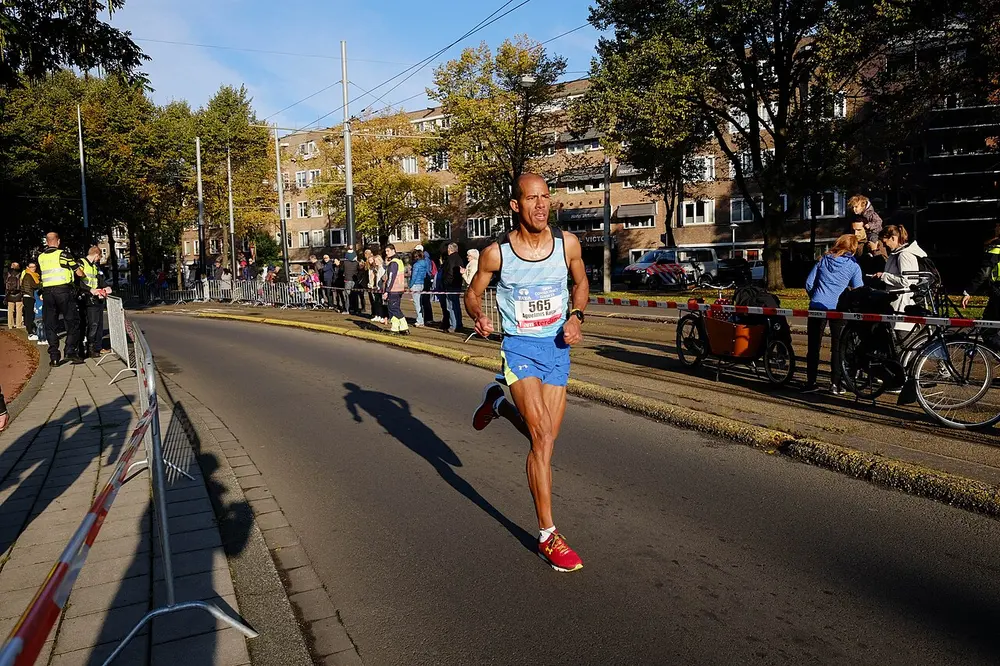
Amsterdam Marathon 2016 (photo 2). Photo: Franklin Heijnen / Wikimedia Commons, CC BY-SA 2.0.
Start, stadium and cut-offs
The full marathon starts in two places. Area A is on the field inside the Olympic Stadium, with space for around 16,000 runners; Area B is on Stadionweg outside the stadium, also for around 16,000. Your bib and expected finish time determine the area and wave. The colour on your bib matches the colour of your start wave, and Wave 1 (white) and Wave 2 (yellow) must be on the field by 08:50.
The start window runs from 09:00 to 09:50, and it can take until the later end of that window to cross the line. Starting earlier than your assigned wave is not allowed, but you may start later. That matters for warm-up and toilet plans: arrive for your own wave, not the first one.
The finish closes at 17:00, and the course has intermediate cut-offs. The official checkpoints are:
| Distance | Cut-off |
|---|---|
| 5 km | 10:31 |
| 10 km | 11:13 |
| 15 km | 11:55 |
| 20 km | 12:36 |
| 25 km | 13:18 |
| 42.195 km | 17:00 |
For most runners the six-hour limit is generous, but the early checkpoints matter if you start in a late wave or spend too long in the first ten kilometres. Treat the 5 km and 10 km times as the race's first real cut-offs.
Aid stations and fuelling
The official refreshment plan lists stations at 5, 8, 11, 16, 18, 20, 25, 27, 30, 31, 33, 35, 38 and 40.5 kilometres. Water, Maurten sports drink, bananas and sponges are available along the route. Maurten gels are only at 18 and 30 kilometres, so if you use more than two gels, carry them yourself.
Waste bins are placed at every kilometre point, and the organiser does not accept personal bottles or nutrition for delivery to the stations. Practise with the on-course products before race day rather than trying Maurten for the first time in the second half.
Records and the fast course
Amsterdam has been a record course for decades, and the 2025 jubilee edition underlined it. Geofry Kipchumba won in 2:03:30, taking 9 seconds off Tamirat Tola's previous course record of 2:03:39. Aynalem Desta won the women's race in 2:17:37, a large personal best but not a course record: Yalemzerf Yehualaw's 2:16:52 from 2024 is the women's mark to beat.
| Record | Time | Athlete | Year |
|---|---|---|---|
| Men's course record | 2:03:30 | Geofry Kipchumba | 2025 |
| Previous men's record | 2:03:39 | Tamirat Tola | 2021 |
| Women's course record | 2:16:52 | Yalemzerf Yehualaw | 2024 |
| 2025 women's winner | 2:17:37 | Aynalem Desta | 2025 |
The times are not only a product of the flat profile. The long straights along the Amstel let runners settle into a rhythm, and there is no sustained climb anywhere on the route. Amsterdam is ranked seventh among the world's fastest marathon cities by the organiser, and the Platinum Label reflects the depth of the elite field as well as the organisation.
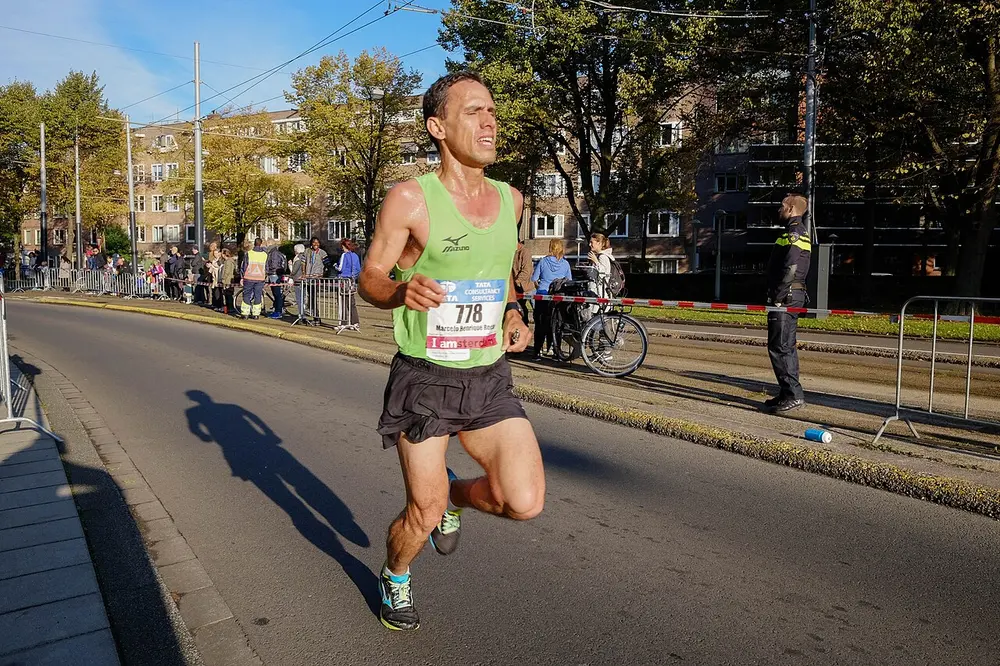
Amsterdam Marathon 2016 (photo 3). Photo: Franklin Heijnen / Wikimedia Commons, CC BY-SA 2.0.
Race weekend and registration
The marathon is the centrepiece of a full weekend. The 2026 edition runs on Saturday 17 and Sunday 18 October, with the marathon on Sunday at 09:00. The 2027 edition is already scheduled for 30 and 31 October.
Bib numbers are collected at the Marathon Expo at RAI Amsterdam: Thursday 15 October from 13:00 to 20:00, Friday 16 October from 10:00 to 20:00, and Saturday 17 October from 09:00 to 19:00. The Pasta Party is at the Olympic Stadium on Saturday from 18:00 to 21:00.
Registration for 2026 opened on 20 December 2025 at 12:00 CET and closes on 5 October 2026, unless the field sells out first. This is direct registration, not a lottery, so the practical advice is simple: enter early if you want a place. The start and finish are both at the Olympic Stadium in Amsterdam-Zuid; allow more time than you think for the walk to Area B and follow the organiser's race-day access plan.
What to watch for
- The Rijksmuseum bottleneck. The passage under the museum comes early, when the field is still dense. It is a highlight, not a place to make up time.
- Wind on the Amstel. The river section is the most exposed part of the course. On a windy day, protect your rhythm and do not fight the gusts.
- The late Vondelpark loop. The park arrives around 40 kilometres, when tired legs make its twists feel longer than they are. Stay patient and use the final city kilometres to regroup for the stadium.
- The early cut-offs. The 5 km and 10 km checkpoints are the ones to know if you start late or plan a conservative first half.
- The stadium finish. The last metres are inside the Olympic Stadium, in front of the grandstand. Leave a little energy for the arrival rather than sprinting through the city streets.
Frequently asked questions
Answers to the questions runners ask before entering, drawn from this race's course guide and the directory's own data — the sources behind them are listed below.
When is the Amsterdam Marathon in 2026?
The marathon is expected in October 2027. The full weekend runs from Saturday 17 to Sunday 18 October, with start waves between 09:00 and 09:50. The 2027 edition is scheduled for 30 and 31 October.
Is the Amsterdam Marathon a fast course?
Yes. The course climbs only about 55 metres, with long flat straights and very little climbing. The men's course record is 2:03:30 (2025) and the women's is 2:16:52 (2024), and the organiser ranks Amsterdam among the seven fastest marathon cities in the world. A personal best is never guaranteed, but the course gives you a fair chance.
Where do the Amsterdam Marathon start and finish?
The start is split between Area A on the field inside the Olympic Stadium and Area B on Stadionweg outside it. Both areas hold around 16,000 runners. The finish is inside the Olympic Stadium, in front of the grandstand.
What is the time limit at the Amsterdam Marathon?
The limit is six hours, and the finish closes at 17:00. There are intermediate cut-offs at 5 km (10:31), 10 km (11:13), 15 km (11:55), 20 km (12:36) and 25 km (13:18).
What aid stations are on the Amsterdam Marathon course?
Refreshment points are listed at 5, 8, 11, 16, 18, 20, 25, 27, 30, 31, 33, 35, 38 and 40.5 kilometres. Water, Maurten sports drink, bananas and sponges are available; Maurten gels are only at 18 and 30 kilometres. Waste bins are placed every kilometre.
How do you enter the Amsterdam Marathon?
Entry is by direct registration, not a ballot. Registration for the 2026 race opened on 20 December 2025 at 12:00 CET and closed on 5 October 2026, unless the field sells out earlier. Bib numbers are collected at the Marathon Expo at RAI Amsterdam.
Is Amsterdam a good first marathon or personal-best race?
It suits both, but for different reasons. The flat course and large field make a personal best realistic, while the generous six-hour limit and the stadium finish make it approachable for a first marathon. The main risks are going out too fast in the opening kilometres and underestimating the wind on the Amstel.
What are the highlights of the Amsterdam Marathon course?
The course passes under the Rijksmuseum at around 4 kilometres, follows the Amstel River from roughly 11 kilometres, passes the Heineken Experience around 38 kilometres and loops through Vondelpark at around 40 kilometres. The start and finish are both inside the 1928 Olympic Stadium.
More marathons in Netherlands
More marathons in Europe
Sources for this page
What each source below is used for on this page, and where to check this race yourself.
- World Athletics — the label calendar and the road-race regulations. Used to check whether the race holds a World Athletics label, and its elite competition details.
- AIMS — the international course-measurement standard behind the 42.195 km distance, and the AIMS race calendar.
- The organizer's own publications — course maps, race handbooks and published results. The date, course character and climbing on this page are compiled from them and re-checked each season.
“A World Athletics Label denotes a full application of the Competition and Technical Rules in, at a minimum, the elite component of the competition. Labels also denote superior standards in event organisation, safety and runner experience, support from public authorities to the event and a financial commitment to anti-doping.”
Where do these facts come from?
Dates, course type, climbing and time limits are compiled from the organizer's publications and re-checked each season; elevation is an estimate of total climbing rather than a survey figure. Always confirm race-day details with the organizer before making plans.
Last reviewed 27 October 2026