
Cluj-Napoca Marathon
Cluj-Napoca's marathon arrives at the end of winter, when the city is still wearing its cold-weather face.
By Global Marathon Routes editorial team · Last reviewed 27 October 2026
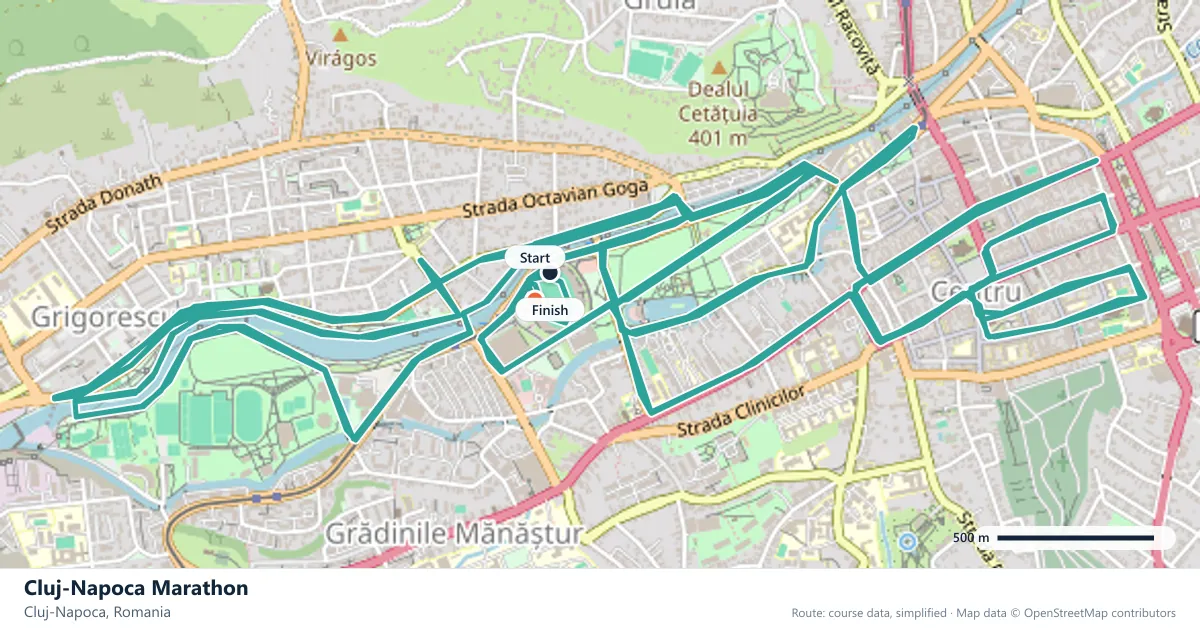
Where does the Cluj-Napoca Marathon run?
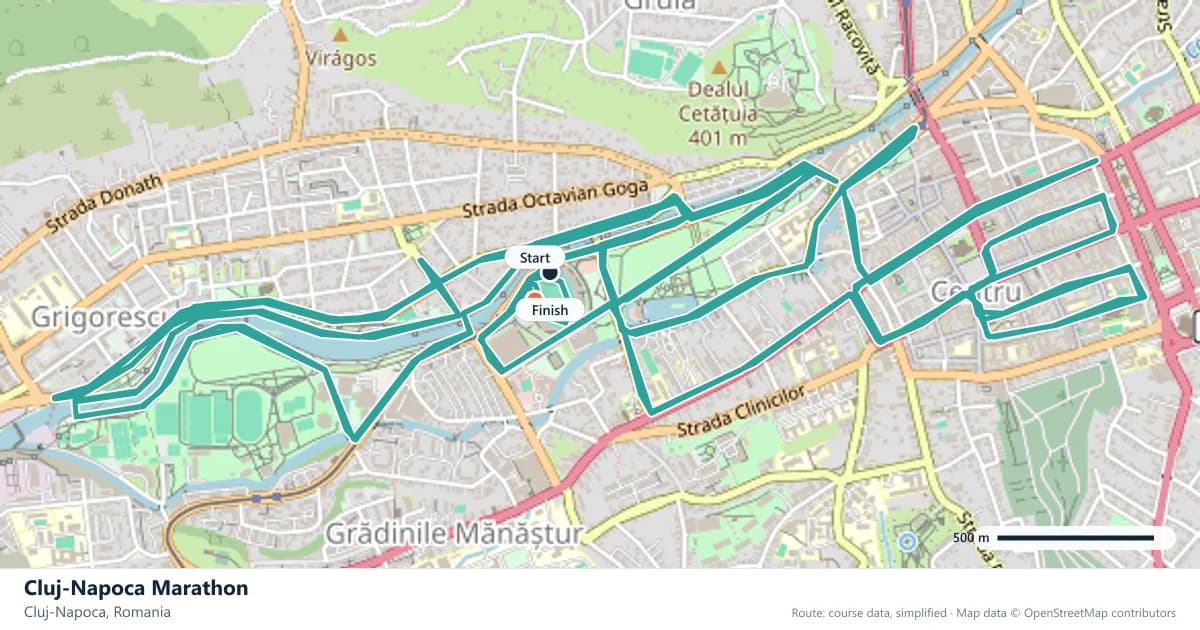
Interactive map
The trace follows the organizer's published course, simplified for the screen: the orange dot is the start, the dark dot the finish. Scroll to zoom, drag to pan.
What is the Cluj-Napoca Marathon course like?
An early-spring marathon in Transylvania, looping through Cluj's squares and out along the Someșul Mic. Rolling terrain and a marathon that shares the day with a big city running festival.
- Next edition
- March 2027 (expected)
- Elevation gain
- 106 m
- Profile
- Undulating
- First run
- —
Course guide
Cluj-Napoca's marathon arrives at the end of winter, when the city is still wearing its cold-weather face. The next edition is expected in March 2027, and the route loops through Cluj's squares before following the Someșul Mic out of the centre. The profile is undulating, with about 106 metres of climbing, and the marathon shares its day with a large city running festival.
The festival is the first thing to understand about the race. Cluj fills with runners across several distances, and the marathon is one thread in a much bigger weekend rather than the sole focus of the city. That gives the event energy, but it also means the start area and the early kilometres can feel busier than at a marathon-only race.
Cluj is a university city, and its centre has the compact, sociable feel that comes with a large student population. The course uses that centre rather than escaping into the surrounding hills. The race stays urban and rolling, with repeated changes of direction and grade instead of one signature climb.
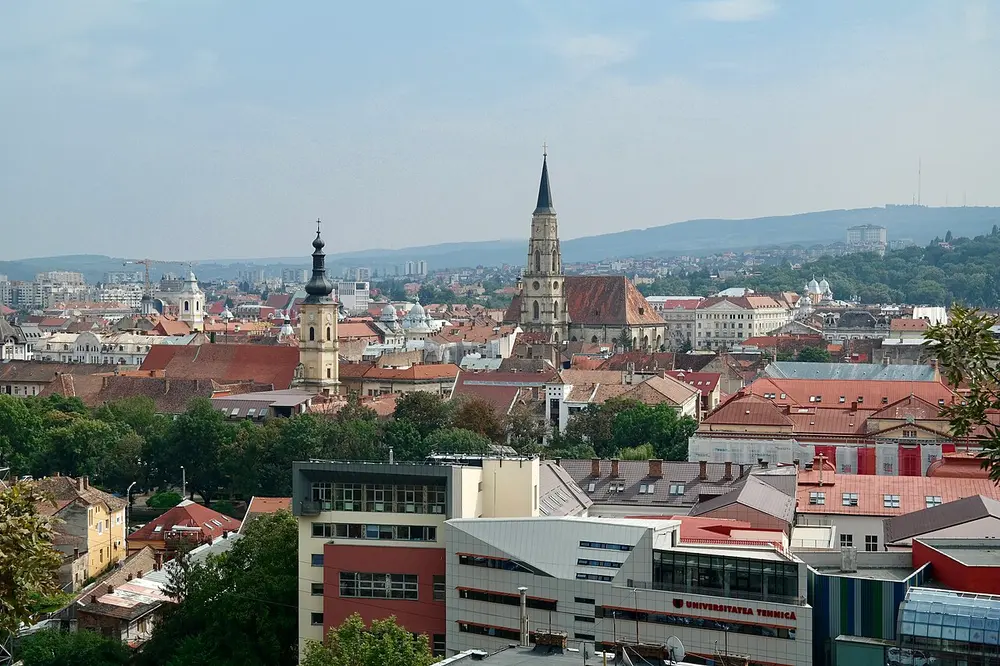
Cluj-Napoca as seen from Cetățuia Park. Photo: Choinowski / Wikimedia Commons, CC BY-SA 4.0.
The course
The route is a loop, and its shape is defined by the city's squares and the river. The opening kilometres work through the centre, where broad squares and connecting streets create a sequence of turns rather than a long straight. The middle of the race follows the Someșul Mic, giving runners a steadier stretch beside the water.
The 106 metres of climbing arrive as rolling terrain. There is no sustained ascent and no single hill that defines the day, but the course is rarely flat for long. Each rise is short, and each descent is short too, which means the race is a continuous negotiation with the gradient rather than a test of one climb.
Because the route is a loop, it returns through familiar streets before the finish. That is useful for spectators and for runners who like to know what is coming, but it also means the second half can feel repetitive. The squares that seemed lively at 5 kilometres may feel a long way from the finish at 35.
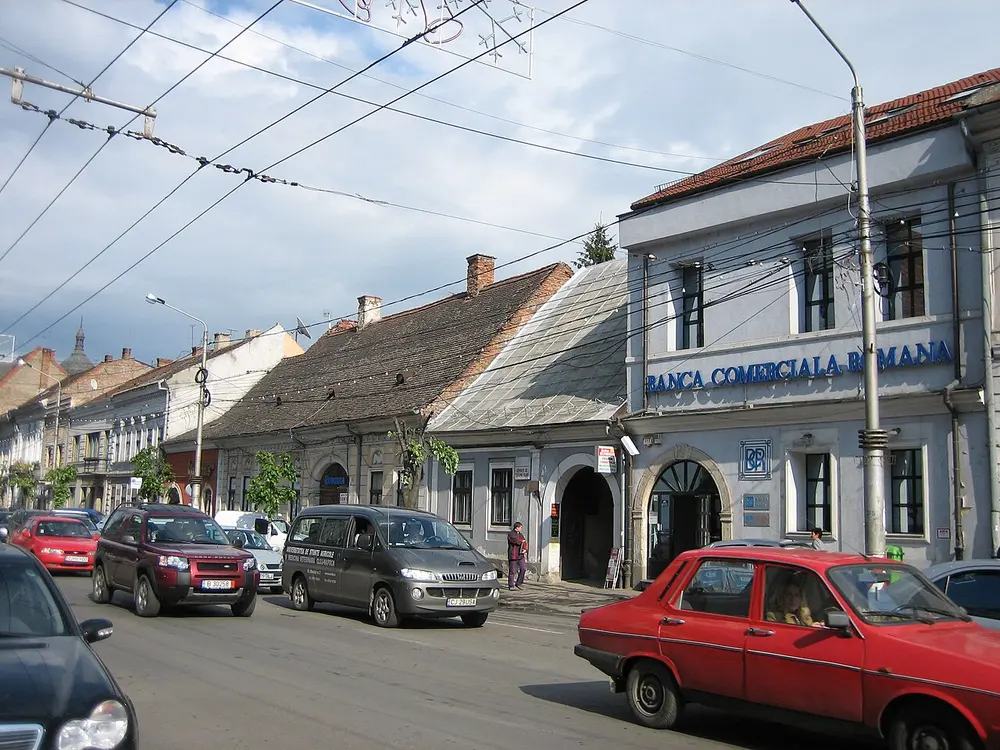
Banca Comerciala Romana, Cluj-Napoca ROM. Photo: Stefano Vigorelli / Wikimedia Commons, CC BY-SA 4.0.
A city of squares
Cluj's centre is organised around open squares, and the marathon uses them as its rhythm section. Piața Unirii, the city's main square, is the obvious landmark, with the kind of width that makes a marathon field look smaller than it is. The surrounding streets connect one open space to the next, so the course feels like a series of rooms rather than a single avenue.
Cetățuia hill rises above the centre and gives the city one of its best viewpoints. The race does not need to climb it to be affected by it: the streets below the hill are never entirely level, and the topography is part of why the profile rolls.
The Someșul Mic provides the other side of Cluj's character. The river runs along the northern edge of the centre, and the course uses its banks for the straighter, calmer part of the race. After the turns between the squares, the river feels open, even though the city is still all around.
The festival weekend
Sharing a race day with a large running festival changes the atmosphere. The marathon is not an isolated event with a single start and a quiet city; it is part of a programme that brings runners of different abilities into the same streets. The crowd is broader and noisier than a marathon field alone.
That has practical consequences. The start area is busier, the early kilometres are more crowded, and the finish area stays active for longer. Runners who prefer a calm, single-distance event may find it distracting; runners who feed off a crowd will find Cluj generous.
The festival also makes the race a good reason to spend the weekend in the city rather than arriving and leaving around the marathon. Cluj's centre is compact enough to walk, and the race's loop makes it easy for supporters to see the field more than once without learning a complicated transport plan.
Rolling ground and early-spring legs
The 106 metres are modest, but they are not the point. What matters is how often the road changes direction and grade. A course that rolls constantly asks for consistent effort, and it punishes runners who attack every rise and then coast every descent.
March adds another variable. The race comes at the end of winter, when long runs have often been done in cold, dark conditions and the first warm days can flatter. The date is expected rather than fixed, so the training calendar has to stay flexible until the organiser confirms the weekend.
None of that makes Cluj a severe course. It is a city marathon with a rolling profile, a festival crowd and a spring date. The runners who enjoy it most are usually the ones who arrive fit, pace by effort and treat the repeated changes of grade as the character of the race rather than an inconvenience.
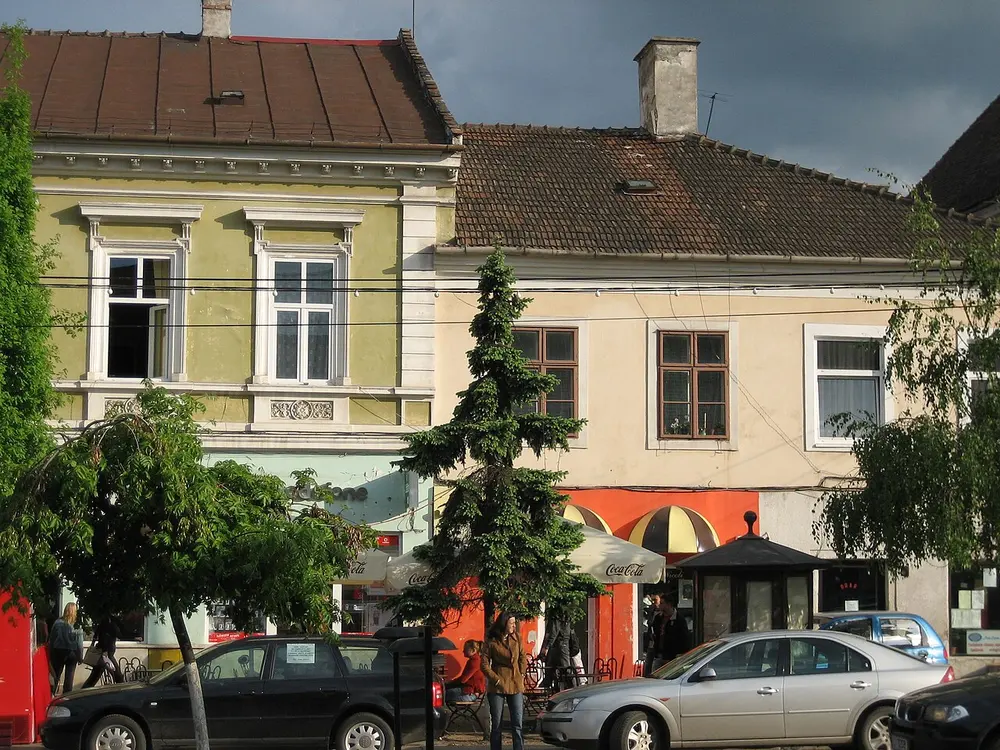
Bulevardul Eroilor, Cluj-Napoca ROM. Photo: Stefano Vigorelli / Wikimedia Commons, CC BY-SA 4.0.
Frequently asked questions
Answers to the questions runners ask before entering, drawn from this race's course guide and the directory's own data — the sources behind them are listed below.
When is the next Cluj-Napoca Marathon?
The next edition is expected in March 2027. The date has not been fixed, so confirm the weekend with the organiser before booking travel.
Is the Cluj-Napoca Marathon flat or hilly?
It is undulating, with about 106 metres of gain. The course is rarely flat for long, but the rises are rolling rather than steep, so it sits between a flat city course and a hilly one.
Does the course suit a fast time?
The repeated rises and the turns through the squares make rhythm more important than raw speed. It is not a course built around fast times, and even pacing is a better goal than chasing splits.
Where is the Cluj-Napoca Marathon run?
It is run in Cluj-Napoca on a loop through the city's squares and along the Someșul Mic. The route stays in the city rather than heading into open country.
What else happens on race day?
The marathon shares its day with a large city running festival. Expect a busy centre, a mixed field across several distances and an event that is bigger than the marathon alone.
Is the March date confirmed?
No. March 2027 is the expected date. The organiser confirms the final weekend, so keep travel plans flexible until then.
More marathons in Romania
More marathons in Europe
Sources for this page
What each source below is used for on this page, and where to check this race yourself.
- World Athletics — the label calendar and the road-race regulations. Used to check whether the race holds a World Athletics label, and its elite competition details.
- AIMS — the international course-measurement standard behind the 42.195 km distance, and the AIMS race calendar.
- The organizer's own publications — course maps, race handbooks and published results. The date, course character and climbing on this page are compiled from them and re-checked each season.
Where do these facts come from?
Dates, course type, climbing and time limits are compiled from the organizer's publications and re-checked each season; elevation is an estimate of total climbing rather than a survey figure. Always confirm race-day details with the organizer before making plans.
Last reviewed 27 October 2026