
Bucharest Marathon
The 2026 Bucharest Marathon was held on Sunday 11 October, on a course that turns the Romanian capital into a sequence of wide, straight boulevards.
By Global Marathon Routes editorial team · Last reviewed 27 October 2026
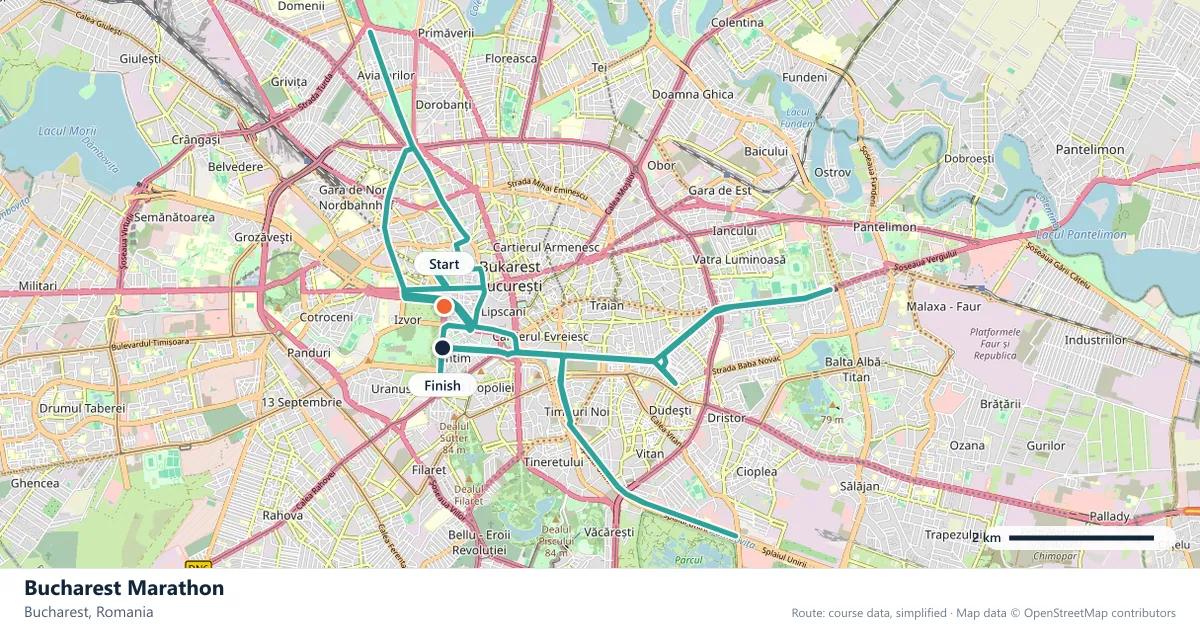
Where does the Bucharest Marathon run?
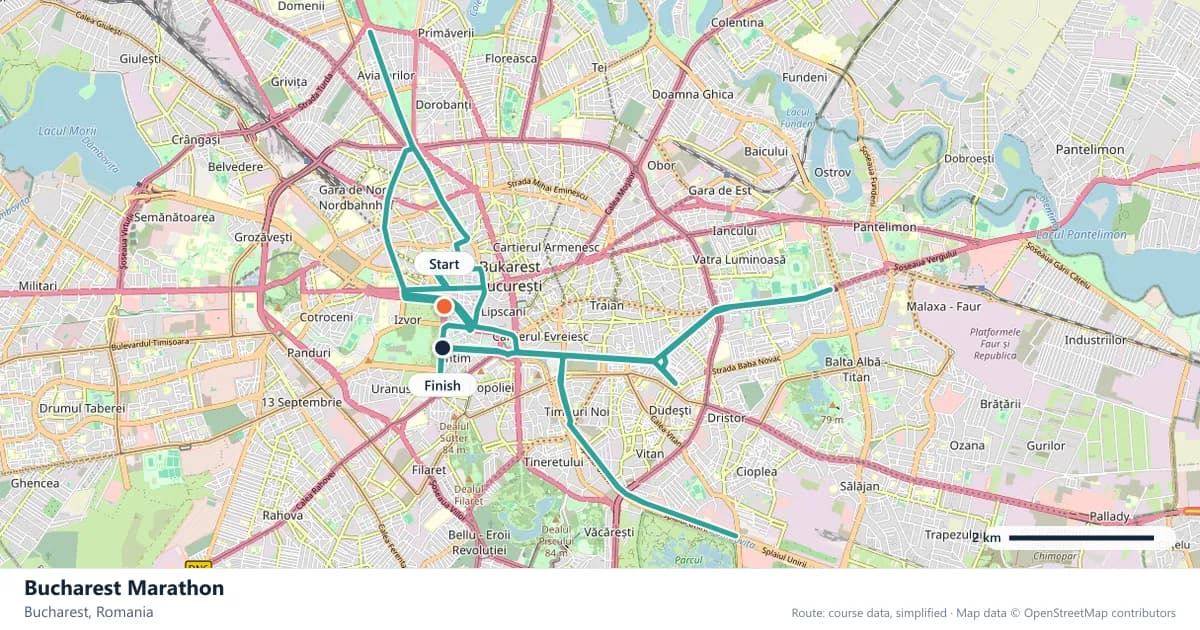
Interactive map
The trace follows the organizer's published course, simplified for the screen: the orange dot is the start, the dark dot the finish. Scroll to zoom, drag to pan.
What is the Bucharest Marathon course like?
A flat autumn race through the Romanian capital, past the Palace of the Parliament and along the Dâmbovița. Wide, straight roads and a fast profile.
- Next edition
- October 2027 (expected)
- Elevation gain
- 62 m
- Profile
- Flat
- First run
- —
Course guide
The 2026 Bucharest Marathon was held on Sunday 11 October, on a course that turns the Romanian capital into a sequence of wide, straight boulevards. The route passes the Palace of the Parliament and follows the Dâmbovița, and it climbs only about 62 metres from start to finish. That makes it one of the faster autumn races in south-eastern Europe.
Flatness is the race's identity. There is no climb to break the rhythm and no technical descent to recover on; instead the route asks runners to hold a pace on roads built on a monumental scale. The Palace of the Parliament is the landmark everyone remembers, but the boulevards are what actually shape the running.
The event holds a World Athletics Label, and its reputation rests on times rather than scenery. That is not a criticism. Bucharest is a working capital with a grand, sometimes austere centre, and the marathon uses it as a fast, open stage. For runners with a target, the appeal is obvious; for a first marathon, the same flatness can feel relentless.
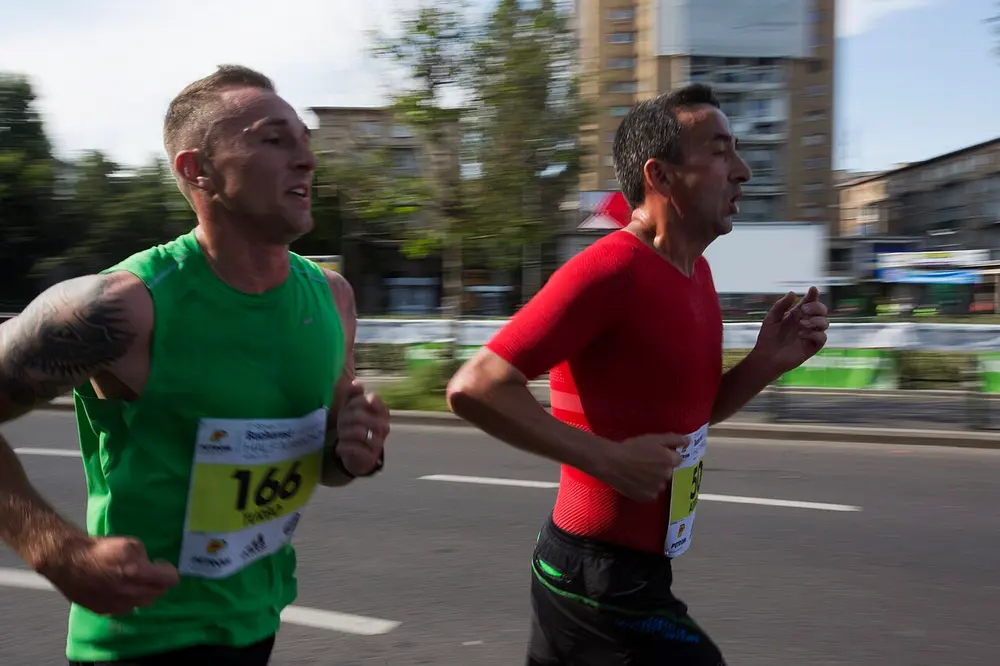
Black Sea Rotational Force Marines Compete in Petrom Bucharest International Half Marathon 140518-M-. Photo: Staff Sgt. Tanner Iskra / Wikimedia Commons, Public domain.
The course
The route is flat and direct, with long straights that let the field spread out quickly. Bucharest's central boulevards are wide enough that the race rarely feels pinched, and the 62 metres of climbing are spread so thinly that they barely register on the elevation profile.
The Palace of the Parliament is the course's fixed point, a building on a scale that makes the surrounding streets look small. The Dâmbovița provides the other anchor: the river runs through the centre in a canalised channel, and the stretches beside it give the race a different texture from the broad avenues.
Because the route is urban throughout, there is no escape into parkland or countryside. The city is the course, and the city is mostly straight lines. That suits runners who like to switch off and hold a rhythm, and it punishes anyone who needs regular changes of scenery to stay engaged.
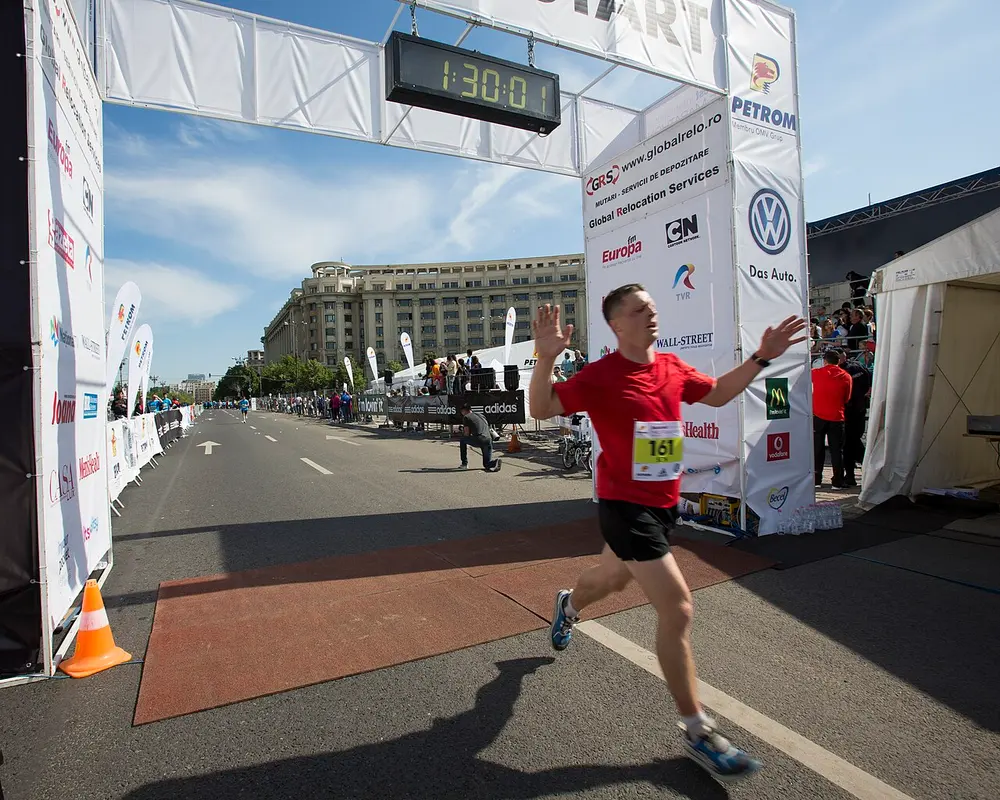
Black Sea Rotational Force Marines Compete in Petrom Bucharest International Half Marathon 140518-M- (photo 2). Photo: Staff Sgt. Tanner Iskra / Wikimedia Commons, Public domain.
The palace and the river
The Palace of the Parliament dominates the southern edge of central Bucharest. It is one of the largest administrative buildings in the world, and its sheer length changes the way the streets around it feel. Runners do not need to know its history to understand its effect on the race: it makes the kilometres around it feel exposed and oversized.
The Dâmbovița is the gentler counterpoint. The river is held in a concrete channel through the city, with embankments and bridges rather than a natural bank. On race day it offers a line to follow and a break from the boulevards, even if the gradient barely changes.
Together, the palace and the river give the marathon its two memories. One is about scale, the other about movement. The rest of the course is a study in how quickly a city can pass when the roads are wide and the turns are few.
A fast course with no hiding places
A flat marathon is often described as easy, which is only half true. The absence of hills removes one kind of difficulty and replaces it with another: there is nothing to force a change of pace, so runners create their own surges and then wonder why the last 10 kilometres hurt.
Bucharest rewards discipline. The wide roads make it possible to run exactly the pace you planned, and the long straights make it easy to check that pace without fighting the field. The runners who suffer here are usually the ones who treat the first half as a formality and discover that a straight boulevard at 35 kilometres is a stern place to be tired.
The course is also quick in a practical sense. Overtaking is rarely a problem, corners are not the defining feature, and the field has space to settle early. For a personal best, those details matter as much as the 62 metres of climbing.

Black Sea Rotational Force Marines Compete in Petrom Bucharest International Half Marathon 140518-M- (photo 3). Photo: Staff Sgt. Tanner Iskra / Wikimedia Commons, Public domain.
The October window
Mid-October places the race at the end of the European road season, after the summer championships and before the winter base begins. For runners coming off a long year, that can be either a final target or a race too far, depending on how the previous months have gone.
The date gives the marathon a particular character. It sits in the middle of the autumn, when the training block is already behind you and the result depends on what you did in August and September.
Bucharest in race mode is a straightforward city: wide roads, a compact centre and a course that asks for execution rather than local knowledge.
Frequently asked questions
Answers to the questions runners ask before entering, drawn from this race's course guide and the directory's own data — the sources behind them are listed below.
When was the Bucharest Marathon held?
The 2026 edition was held on Sunday 11 October 2026. It is an autumn race, and the course stays within the Romanian capital.
Is the Bucharest Marathon a flat course?
Yes. The route climbs about 62 metres in total, with wide, straight roads and no sustained ascent. The main challenge is controlling your pace, not managing hills.
Can Bucharest deliver a fast time?
Yes. The flat profile, wide roads and long straights give runners a genuine chance to hold an even pace. The course is built around fast times, and the 62 metres of climbing are unlikely to be the reason a target slips away.
Would Bucharest suit a first-timer?
The race is built around fast times rather than the debut experience. The flat boulevards offer little variety and reward runners who already know how to pace themselves, so the course's character is competitive rather than forgiving.
Where is the Bucharest Marathon run?
It is run in Bucharest on a flat city route that passes the Palace of the Parliament and follows the Dâmbovița. The wide, straight roads are the defining feature of the course.
What is Bucharest's World Athletics label?
It holds a World Athletics Label. The designation sits alongside a flat, fast course and a late-autumn date.
More marathons in Romania
More marathons in Europe
Sources for this page
What each source below is used for on this page, and where to check this race yourself.
- World Athletics — the label calendar and the road-race regulations. Used to check whether the race holds a World Athletics label, and its elite competition details.
- AIMS — the international course-measurement standard behind the 42.195 km distance, and the AIMS race calendar.
- The organizer's own publications — course maps, race handbooks and published results. The date, course character and climbing on this page are compiled from them and re-checked each season.
“A World Athletics Label denotes a full application of the Competition and Technical Rules in, at a minimum, the elite component of the competition. Labels also denote superior standards in event organisation, safety and runner experience, support from public authorities to the event and a financial commitment to anti-doping.”
Where do these facts come from?
Dates, course type, climbing and time limits are compiled from the organizer's publications and re-checked each season; elevation is an estimate of total climbing rather than a survey figure. Always confirm race-day details with the organizer before making plans.
Last reviewed 27 October 2026