
Lisbon Marathon
The Lisbon Marathon is a journey rather than a loop. It starts at Cascais on the Atlantic coast and runs into Lisbon, following the Tagus on the way in.
By Global Marathon Routes editorial team · Last reviewed 27 October 2026
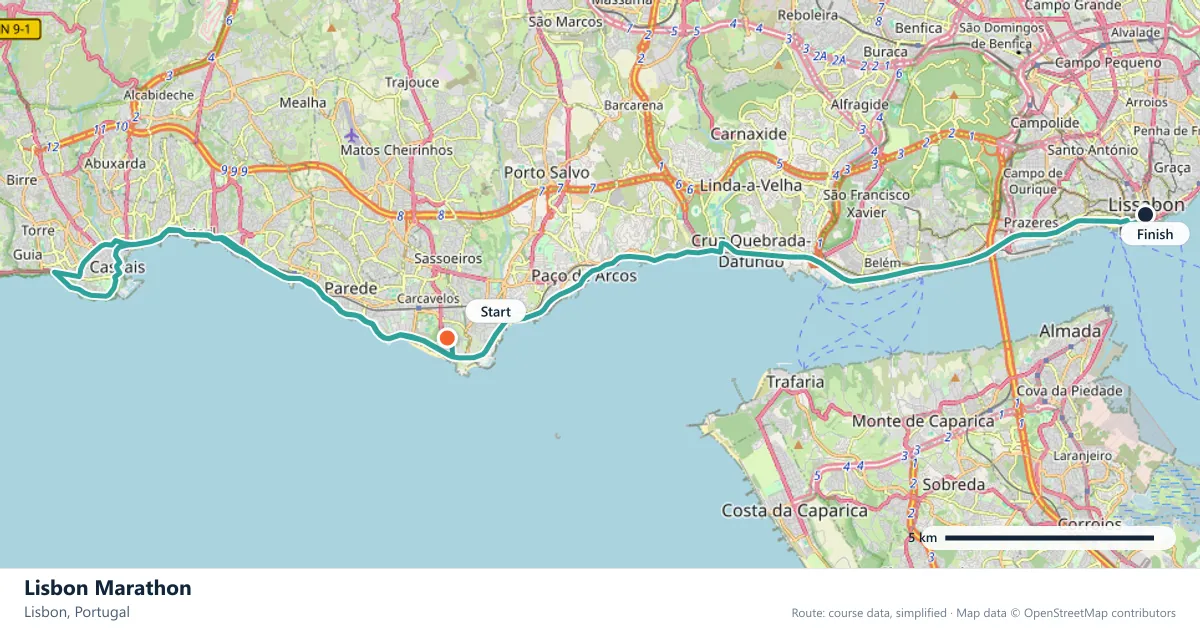
Where does the Lisbon Marathon run?
Interactive map
The trace follows the organizer's published course, simplified for the screen: the orange dot is the start, the dark dot the finish. Scroll to zoom, drag to pan.
What is the Lisbon Marathon course like?
A point-to-point from Cascais on the Atlantic coast into Lisbon, running beside the Tagus on the way in. Rolling for the first half, then quick and mostly downhill to the finish.
- Next edition
- October 2027 (expected)
- Elevation gain
- 189 m
- Profile
- Undulating
- First run
- —
Course guide
The Lisbon Marathon is a journey rather than a loop. It starts at Cascais on the Atlantic coast and runs into Lisbon, following the Tagus on the way in. The edition covered here was held on 10 October 2026, over a course with about 189 metres of climbing and a World Athletics Elite Label.
The shape of the day is unusual: the first half rolls along the coast, and the second half is quick and mostly downhill as the course approaches the city. That gives the race two moods, and the pacing plan should reflect the change. The early kilometres are for patience; the later ones are for using what you saved.
It is a course for a fast time, and a memorable place to debut. The downhill finish is a genuine help for a personal best, and the point-to-point route gives the day a sense of occasion. The risk is the descent itself: easy to enjoy, and easy to pay for.
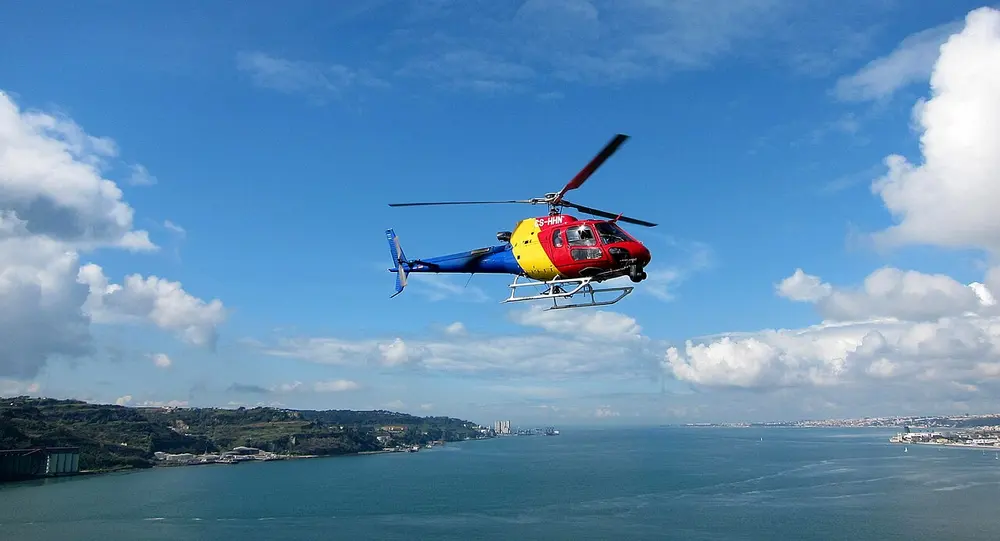
CS-HHN covering the EDP Lisbon Half-Marathon as it crosses the 25 April bridge over the Tagus river. Photo: Bosc d'Anjou from Oeiras, Portugal / Wikimedia Commons, CC BY 2.0.
The course
The route starts at Cascais and works along the coast before turning towards the Tagus and the approach to Lisbon. The first half is rolling, and the 189 metres of climbing are spread across the course. The second half is faster: quick roads and a mostly downhill run towards the city.
The coastal opening sets the tone. The Atlantic is close, the road rolls, and the views make the first few kilometres feel easy. That is the trap. The race is long, and the downhill finish is still a long way away. Settle into a rhythm before the course turns towards the river.
The final approach changes the course's character. The roads become quicker, the city comes into view, and the gradient turns in your favour. That is the reward for a controlled first half, not a substitute for one.
The Atlantic first half
Cascais is a coastal town west of Lisbon, and the race begins in that Atlantic setting. The early kilometres are exposed to the ocean, with a rolling profile that feels gentle in the moment and accumulates over time.
The coast is also where the wind matters. An Atlantic-facing route can be breezy, and the rolling roads offer little shelter. Use other runners when you can, keep your effort steady, and do not let a tailwind section convince you that the whole race will feel that easy.
Beside the Tagus
As the course turns towards Lisbon, the Tagus takes over from the Atlantic. The river is wide, the bridges are part of the skyline, and the approach to the city becomes more urban. The 25 April Bridge is one of Lisbon's defining images, and the riverfront gives the final part of the race a sense of arrival.
The Tagus section is also where the course begins to tilt downhill. The change is gradual, but enough to make the pace feel easier and the kilometres pass more quickly. That is the moment to stay disciplined: a fast last 10 kilometres is built on a patient first 30.
Downhill legs
A mostly downhill finish is a gift and a tax. It gives free speed when the legs are most tired and makes a personal best more achievable. It also loads the quads, especially if you let the descent pull you into a long, braking stride.
The technique is to stay tall, keep the feet quick and let gravity do the work without fighting it. Do not brake hard on every slope, and do not sprint through the steep sections. A controlled descent is faster than an uncontrolled one, and it leaves you able to run the final flat kilometres.
Point-to-point logistics
A race from Cascais to Lisbon means planning two places. The start is on the coast, the finish is in the city, and the journey between them is part of the race. Point-to-point races often provide transport, but check the final instructions rather than assuming.
The upside is that the finish is in Lisbon, which makes the weekend easy to plan. Stay in Lisbon, travel to the start, and return to the centre afterwards. The start needs more planning than a city-centre loop.
Debut or personal best
For a first marathon, Lisbon offers a memorable route, a downhill finish and a big-city atmosphere. The point-to-point logistics add planning, and the rolling coast can be harder than it looks, but the course is approachable for a debutant who starts conservatively.
For a personal best, the case is strong. The downhill second half, the autumn date and the quick approach to Lisbon all help. Protect the legs in the first half so that the descent is an advantage rather than a punishment.
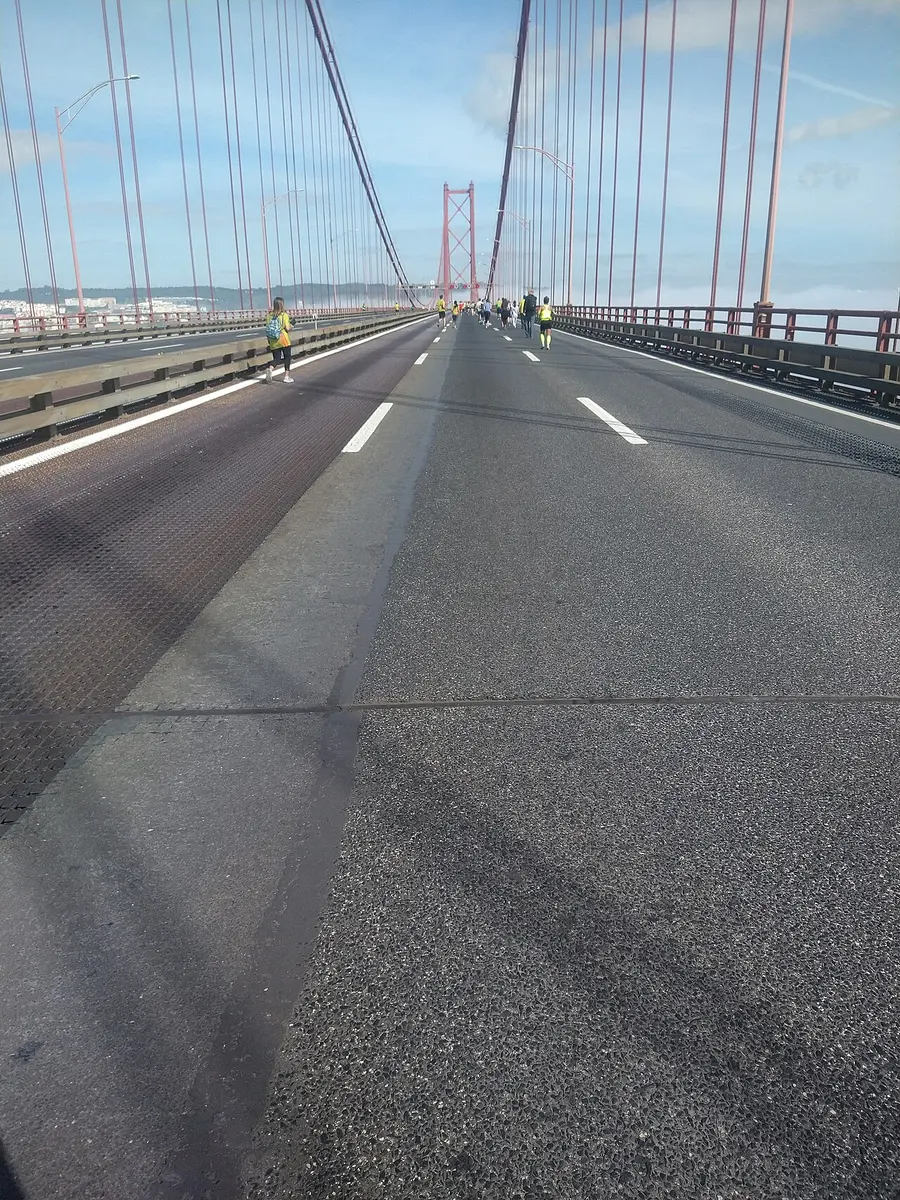
The Beginning of the Race on Ponte 25 de Abril - Lisbon Half-Marathon. Photo: Haydn Blackey from Cardiff, Wales / Wikimedia Commons, CC BY-SA 2.0.
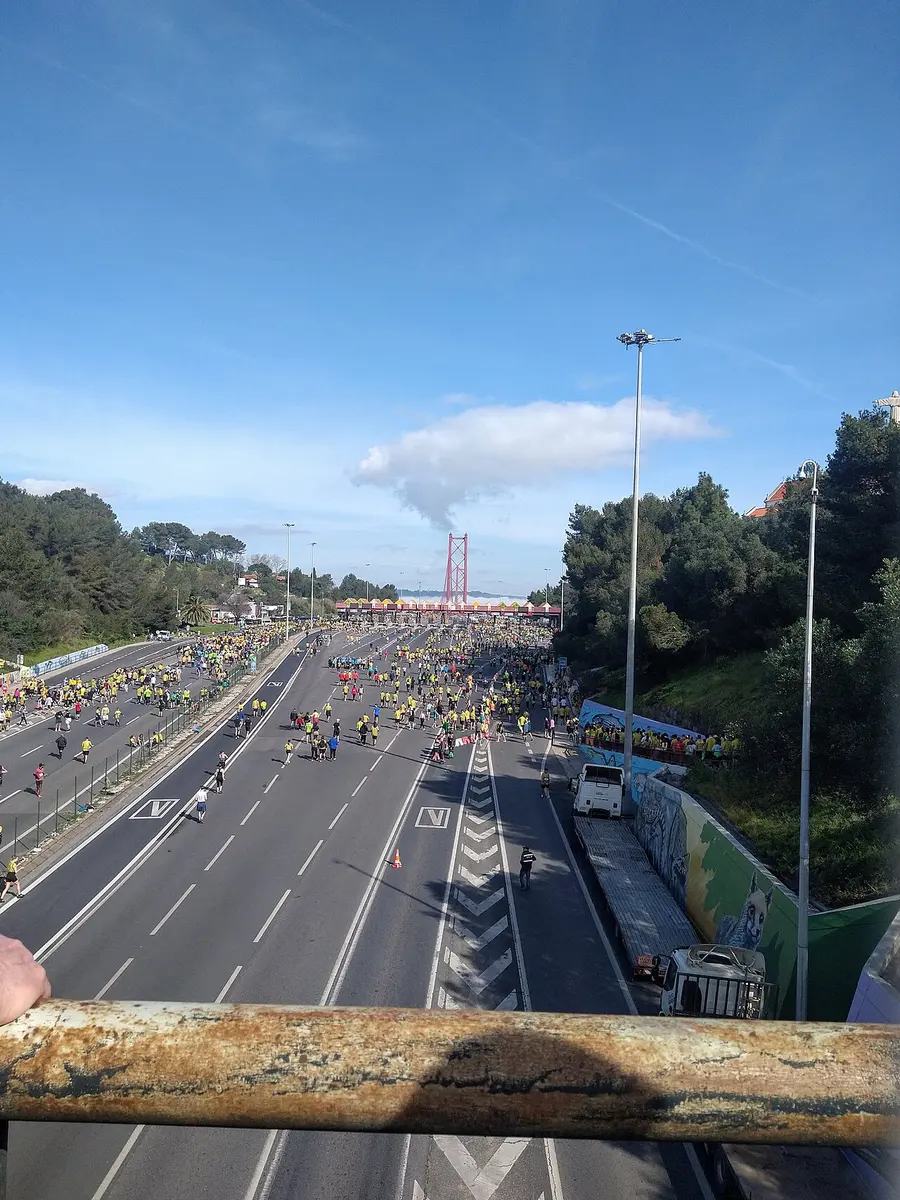
The Beginning of the Race on Ponte 25 de Abril - Lisbon Half-Marathon (photo 2). Photo: Haydn Blackey from Cardiff, Wales / Wikimedia Commons, CC BY-SA 2.0.
Frequently asked questions
Answers to the questions runners ask before entering, drawn from this race's course guide and the directory's own data — the sources behind them are listed below.
When was the Lisbon Marathon in 2026?
The edition covered here was held on 10 October 2026. It is an early-autumn race that starts on the Atlantic coast and finishes in Lisbon.
Is the Lisbon Marathon a flat course?
It is undulating: it climbs about 189 metres and rolls rather than staying flat. The first half is rolling along the coast, while the second half is quick and mostly downhill towards the finish.
Is the Lisbon Marathon good for a first marathon or a personal best?
Yes, for either goal. The downhill second half and autumn date favour fast times, while the point-to-point route and city finish make it a memorable first marathon.
Where does the Lisbon Marathon start and finish?
It starts at Cascais on the Atlantic coast and runs into Lisbon, following the Tagus on the way in. The finish is in the Portuguese capital.
Is the second half downhill?
Yes. The second half is mostly downhill and quicker than the rolling coastal first half. That makes the finish fast, but it also means the legs need to be protected early.
Does the Lisbon Marathon hold a World Athletics label?
Yes. It holds a World Athletics Elite Label.
More marathons in Portugal
More marathons in Europe
Sources for this page
What each source below is used for on this page, and where to check this race yourself.
- World Athletics — the label calendar and the road-race regulations. Used to check whether the race holds a World Athletics label, and its elite competition details.
- AIMS — the international course-measurement standard behind the 42.195 km distance, and the AIMS race calendar.
- The organizer's own publications — course maps, race handbooks and published results. The date, course character and climbing on this page are compiled from them and re-checked each season.
“A World Athletics Label denotes a full application of the Competition and Technical Rules in, at a minimum, the elite component of the competition. Labels also denote superior standards in event organisation, safety and runner experience, support from public authorities to the event and a financial commitment to anti-doping.”
Where do these facts come from?
Dates, course type, climbing and time limits are compiled from the organizer's publications and re-checked each season; elevation is an estimate of total climbing rather than a survey figure. Always confirm race-day details with the organizer before making plans.
Last reviewed 27 October 2026