
Athens Marathon
The Athens Marathon has a claim no other race can make: it follows the route of the original marathon, from the town of Marathon to the Panathenaic Stadium.
By Global Marathon Routes editorial team · Last reviewed 27 October 2026
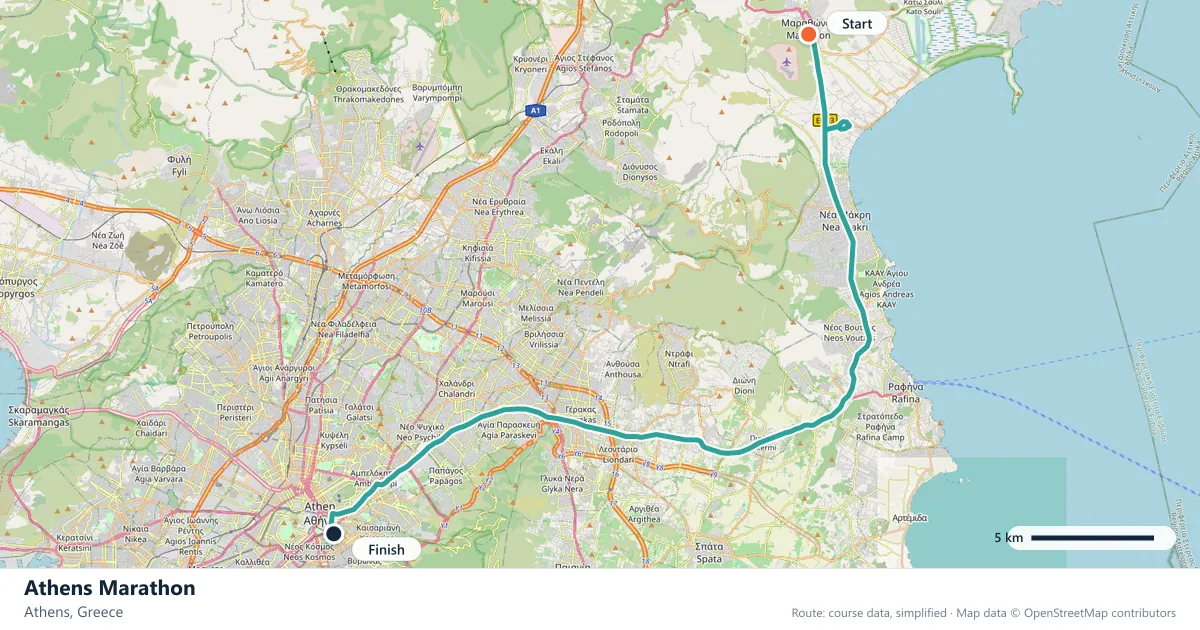
Where does the Athens Marathon run?
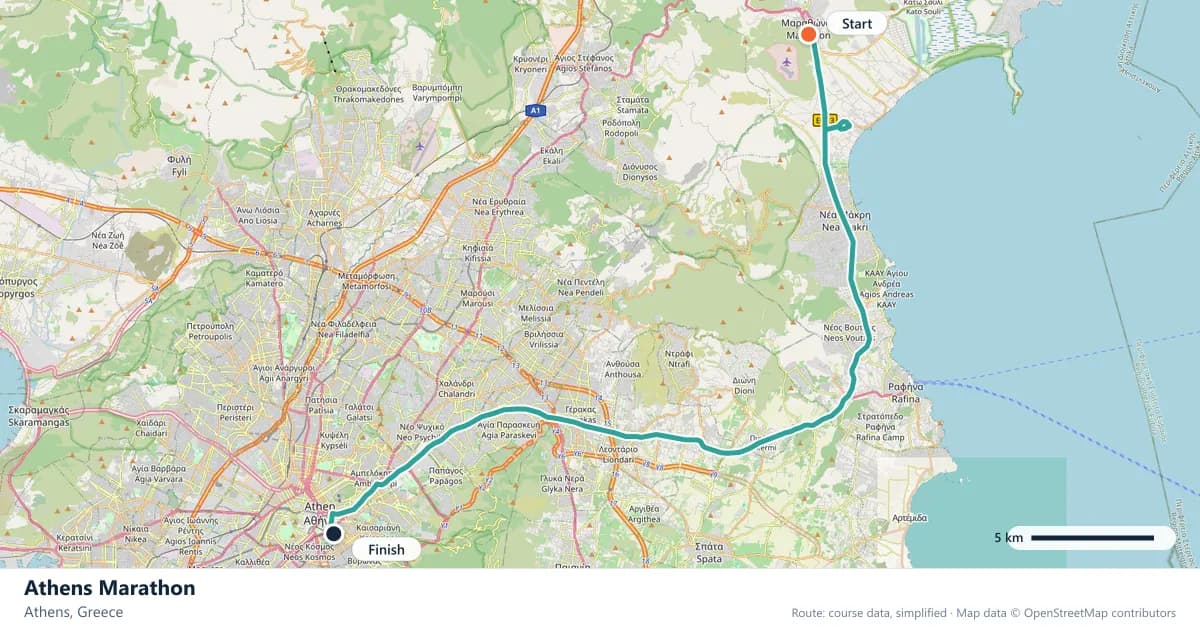
Interactive map
The trace follows the organizer's published course, simplified for the screen: the orange dot is the start, the dark dot the finish. Scroll to zoom, drag to pan.
What is the Athens Marathon course like?
The original course: point-to-point from Marathon to the Panathenaic Stadium, with the long climb out of Nea Makri in the middle. Run in November, and hard from start to finish.
- Next edition
- 08 November 2026
- Elevation gain
- 335 m
- Profile
- Hilly
- First run
- —
Course guide
The Athens Marathon has a claim no other race can make: it follows the route of the original marathon, from the town of Marathon to the Panathenaic Stadium. The next edition is on 8 November 2026, and it holds a World Athletics Elite Label. The course is hilly, with about 335 metres of climbing, and the long ascent out of Nea Makri sits in the middle of it.
The history is not a marketing overlay. The 1896 Olympic marathon finished in the same stadium, and the race still trades on the idea of the authentic route. But the modern event is a hard 42.195 km first and a history lesson second: point-to-point, exposed to the Attic weather, and demanding from the start.
For a first marathon it is an ambition rather than a gentle introduction. The distance is the same as anywhere else, but the climb and the logistics make it a race to prepare for specifically.
The course
The route begins at Marathon and runs towards Athens, with the stadium as the fixed point on the horizon. The 335 metres are not packed into one wall, but the ascent out of Nea Makri is long enough to change how the second half feels.
The 335 metres are not packed into one wall, but the ascent out of Nea Makri is long enough to change how the second half feels. It arrives in the middle of the race, and the final run into Athens is not a free ride: the legs are tired, and the stadium is still some distance away.
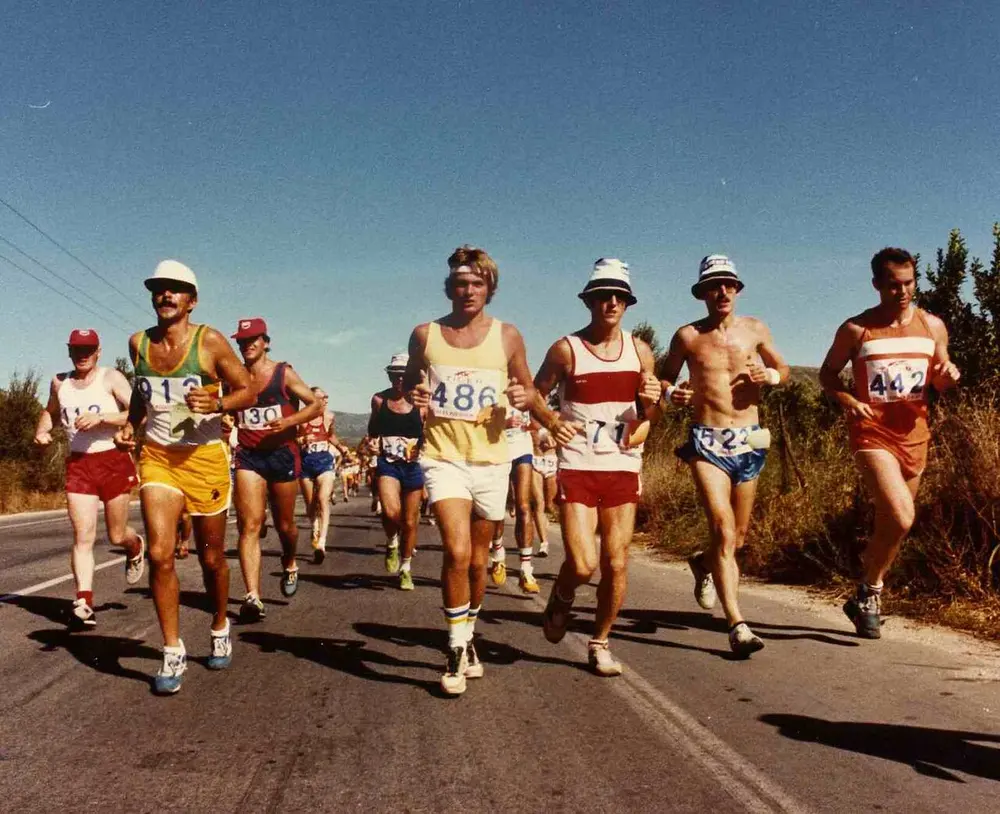
Athens Marathon 1980. Photo: Brakspear ( talk ) / Wikimedia Commons, Public domain.
The climb out of Nea Makri
Nea Makri sits on the coast, and the road out of it is the defining stretch of the Athens Marathon. The climb is not steep in the alpine sense, but it is long, and it arrives when the race is still far from over.
The mistake is to attack it. Runners who push on the lower slopes often pay for it on the upper section and then again in the final 10 km. The better approach is to settle into a rhythm that feels almost too easy, let the pace fall by 10 or 15 seconds per kilometre, and trust that the climb will end.
It is worth training on long, gradual ascents rather than short, steep ones. A 40-minute climb at marathon effort teaches the legs and the lungs what Nea Makri will ask of them, and it also rehearses the patience the race demands.
From Marathon to the stadium: the day's logistics
Because the race is point-to-point, the day involves two places. The start is in Marathon, the finish is in Athens, and the two are not within walking distance of each other. Runners need a plan for getting to the start before dawn and for meeting people after the finish.
Supporters have a different day from runners. The stadium is the natural meeting point, and the city around it is easy to navigate once the race is over. The start area is more remote, so anyone travelling out to see the opening kilometres should allow plenty of time to get back.
It is also worth treating the race as a full morning rather than a quick city dash. The point-to-point format, the early start and the climb all add up, and a calm logistics plan is part of running a good race.
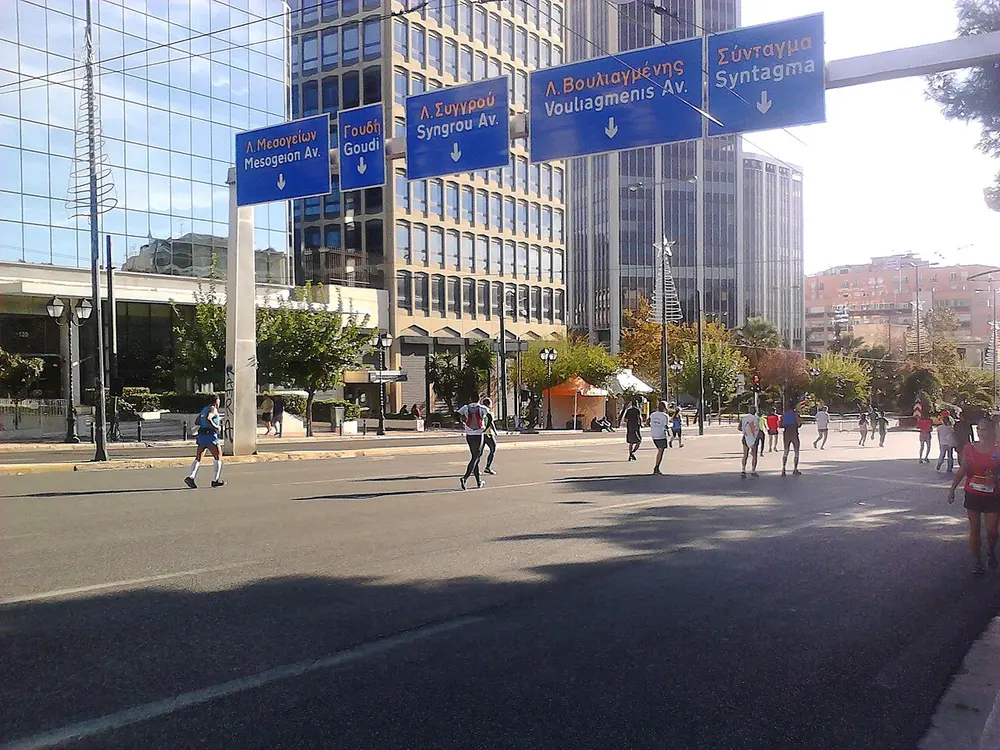
34 Athens Authentic Marathon (1). Photo: Ανώνυμος Βικιπαιδιστής / Wikimedia Commons, CC BY-SA 3.0.
November light and a marble finish
November is a good month for distance running in Attica. The summer heat has gone, the light is softer, and the morning air is more forgiving than it would be in high summer. Conditions can still vary, so check the forecast and plan layers for a long morning outside the city.
The finish inside the Panathenaic Stadium is one of the sport's great arrivals. The stadium is built of marble, it hosted the 1896 Olympics, and its long history is impossible to ignore when you run through the tunnel and onto the track. The final metres are a reminder of why this race matters beyond its elevation profile.
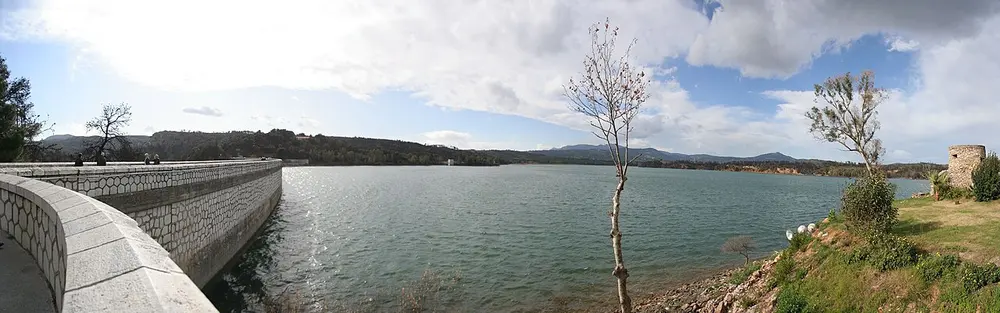
Marathon lake & dam near Athens. Photo: Alexander Baxevanis / Wikimedia Commons, CC BY 2.0.
Frequently asked questions
Answers to the questions runners ask before entering, drawn from this race's course guide and the directory's own data — the sources behind them are listed below.
When is the Athens Marathon?
The next edition is on 8 November 2026. It is a late-autumn race and holds a World Athletics Elite Label.
Is the Athens Marathon a hilly course?
Yes. The route climbs about 335 metres, with the long ascent out of Nea Makri as the hardest section. The climbing is central to the race, and hill training is essential.
Is Athens suitable for a first marathon?
Many runners make it their first marathon, and the finish in the Panathenaic Stadium is a powerful incentive. But the 335 metres of climbing and the point-to-point logistics make it a demanding debut, so the training needs to be specific.
Why is it called the original marathon?
The course follows the route from Marathon to the Panathenaic Stadium, and the race is presented as the original marathon course. The stadium finish is part of that identity, and the 1896 Olympic race used the same setting.
Where do the Athens Marathon start and finish?
The start is in the town of Marathon and the finish is in the Panathenaic Stadium in Athens. The route is point-to-point, so the two ends sit in different places.
Is Athens a fast course?
The climb out of Nea Makri and the point-to-point route make it a hard course for a fast time. It is a race to run for the experience and the finish rather than for a personal best.
How should I prepare for the Nea Makri climb?
Practice long, gradual climbs at an even effort, and rehearse holding back rather than attacking the lower slopes. The goal is to reach the top with something left for the final 10 km.
More marathons in Greece
More marathons in Europe
Sources for this page
What each source below is used for on this page, and where to check this race yourself.
- World Athletics — the label calendar and the road-race regulations. Used to check whether the race holds a World Athletics label, and its elite competition details.
- AIMS — the international course-measurement standard behind the 42.195 km distance, and the AIMS race calendar.
- The organizer's own publications — course maps, race handbooks and published results. The date, course character and climbing on this page are compiled from them and re-checked each season.
“A World Athletics Label denotes a full application of the Competition and Technical Rules in, at a minimum, the elite component of the competition. Labels also denote superior standards in event organisation, safety and runner experience, support from public authorities to the event and a financial commitment to anti-doping.”
Where do these facts come from?
Dates, course type, climbing and time limits are compiled from the organizer's publications and re-checked each season; elevation is an estimate of total climbing rather than a survey figure. Always confirm race-day details with the organizer before making plans.
Last reviewed 27 October 2026