
Vienna City Marathon
The Ringstrasse was Vienna's grand statement about itself: a wide boulevard built where the old city walls had stood, lined with the opera, the parliament, the town hall and the university.
By Global Marathon Routes editorial team · Last reviewed 27 October 2026
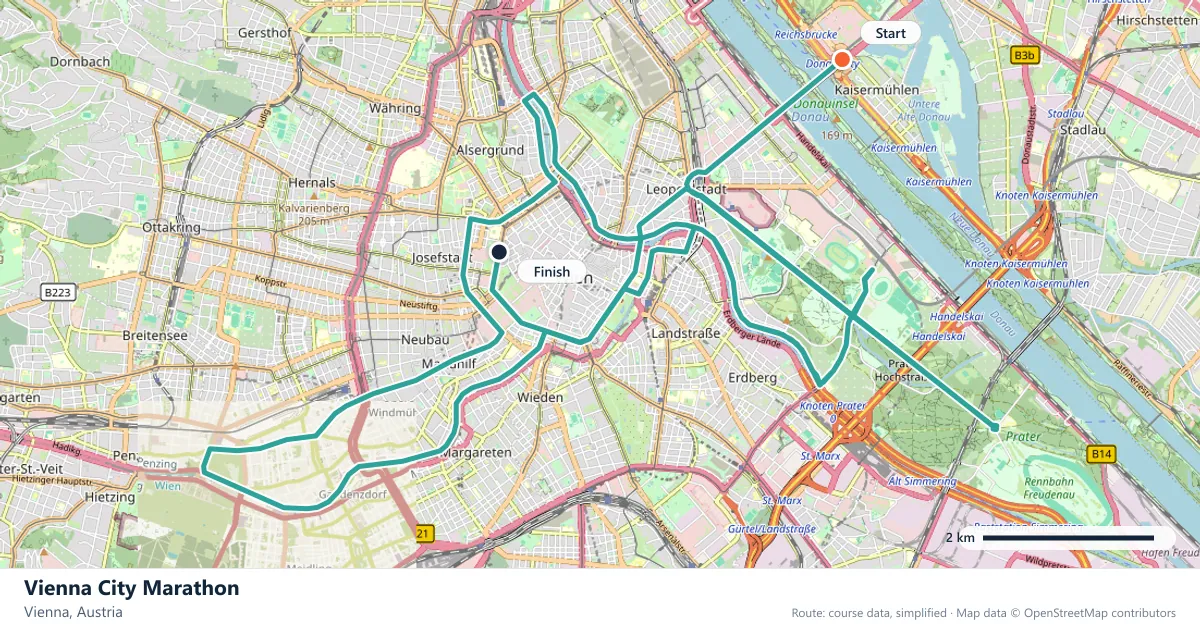
Where does the Vienna City Marathon run?
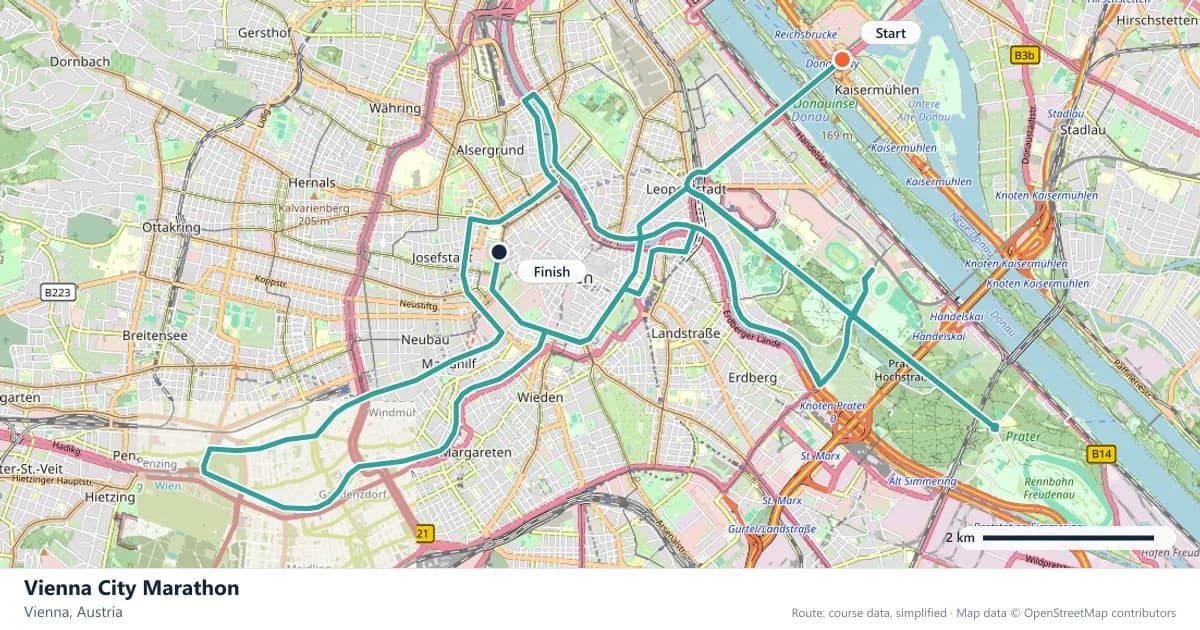
Interactive map
The trace follows the organizer's published course, simplified for the screen: the orange dot is the start, the dark dot the finish. Scroll to zoom, drag to pan.
What is the Vienna City Marathon course like?
A spring classic that crosses the Danube and passes the Ringstrasse, the Prater and Schönbrunn. Gently rolling, with a sub-3 target group that has made it a record-hunting course.
- Next edition
- 18 April 2027
- Elevation gain
- 110 m
- Profile
- Undulating
- First run
- —
Course guide
The Ringstrasse was Vienna's grand statement about itself: a wide boulevard built where the old city walls had stood, lined with the opera, the parliament, the town hall and the university. On marathon morning it becomes a running route, and the buildings that usually reward a slow walk pass by in a blur of spring light and early crowds.
The Vienna City Marathon has been a fixture of the European spring calendar for decades, and the next edition is on 18 April 2027. Its course crosses the Danube, threads through the Ringstrasse and the Prater and passes Schönbrunn, so a single morning takes in both the imperial city and its green edges. The profile is gently rolling, with about 110 metres of climbing.
That mix has given Vienna a record-hunting reputation. A sub-3 target group has helped to make the race a place for runners chasing times, while the same manageable terrain and the city's spring date have made it a popular first marathon. It holds a World Athletics Elite Label.
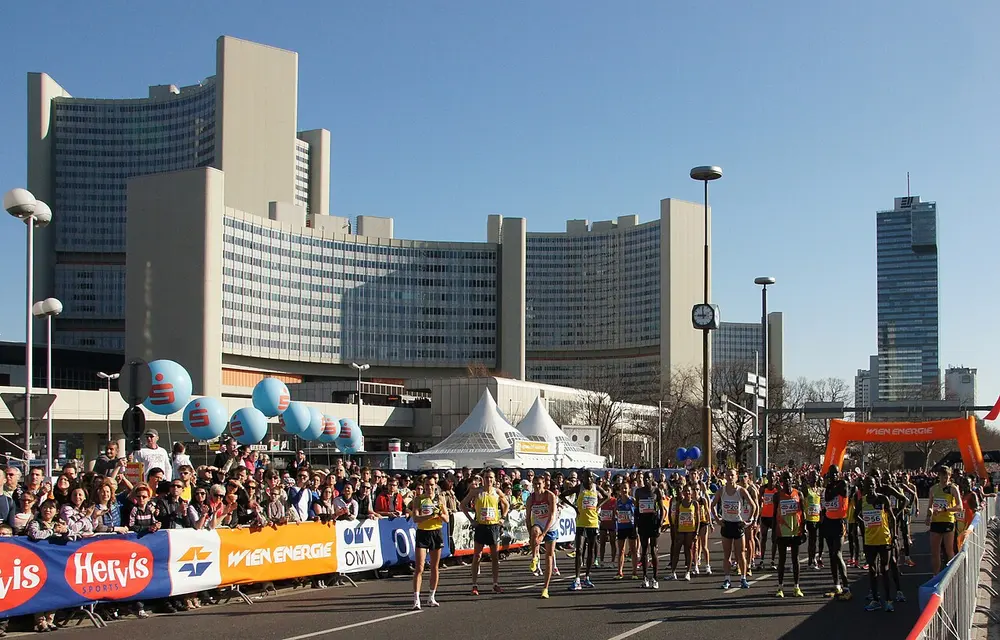
Vienna 2013-04-14 Vienna City Marathon - top athletes approaching starting line. Photo: Wolfgang H. Wögerer / Wikimedia Commons, CC BY-SA 3.0.
The course
The route is a city loop that uses Vienna's main streets and park areas rather than a single out-and-back. The Danube crossing changes the scale of the surroundings, the Ringstrasse brings the monumental buildings, the Prater gives the course its broad, green section and Schönbrunn supplies the baroque set piece.
The gently rolling profile is not a flat-course disguise. There is no long ascent, but the short rises arrive often enough to interrupt a fixed pace. The course favours runners who can hold an even effort rather than chasing a split on every open stretch.
The landmarks also function as stages. The Ringstrasse is dense and loud, the Prater is open and quiet, and the approach to Schönbrunn has a different kind of grandeur. Each one marks progress through the morning, which helps on a course where the city itself is the main distraction.
A sequence of Viennese stages
The Ringstrasse is the most architectural part of the race. The opera, the Burgtheater, the parliament and the town hall sit along the boulevard, and the route gives runners a brief tour of the Habsburg city's public face. The surface is wide and the sightlines are long, but the turns and the crowds keep the running from settling completely.
The Prater is the opposite: a large public park with the Riesenrad, Vienna's great Ferris wheel, as its best-known landmark. The course uses the park's open roads, where the field can spread out and the noise of the city falls away. Schönbrunn then brings the race back to the baroque: the palace and its gardens are a reminder that Vienna's grandeur is not confined to the Ringstrasse.
The sub-3 target group
A sub-3 target group is not a guarantee of a fast day, but it does say something about the race's ambitions. It gives runners chasing that barrier an organised pack to work with, and it signals that the course is considered quick enough to make the attempt worthwhile. The target group also shapes the atmosphere around it: a small, focused field within the larger race, all trying to hold the same pace.
Joining such a group is a decision to make before the start, not in the first kilometre. If the group's schedule matches your training, it can be useful. If it does not, the crowd and the flat stretches will make it feel easier than it is. The course rewards patience more than enthusiasm.
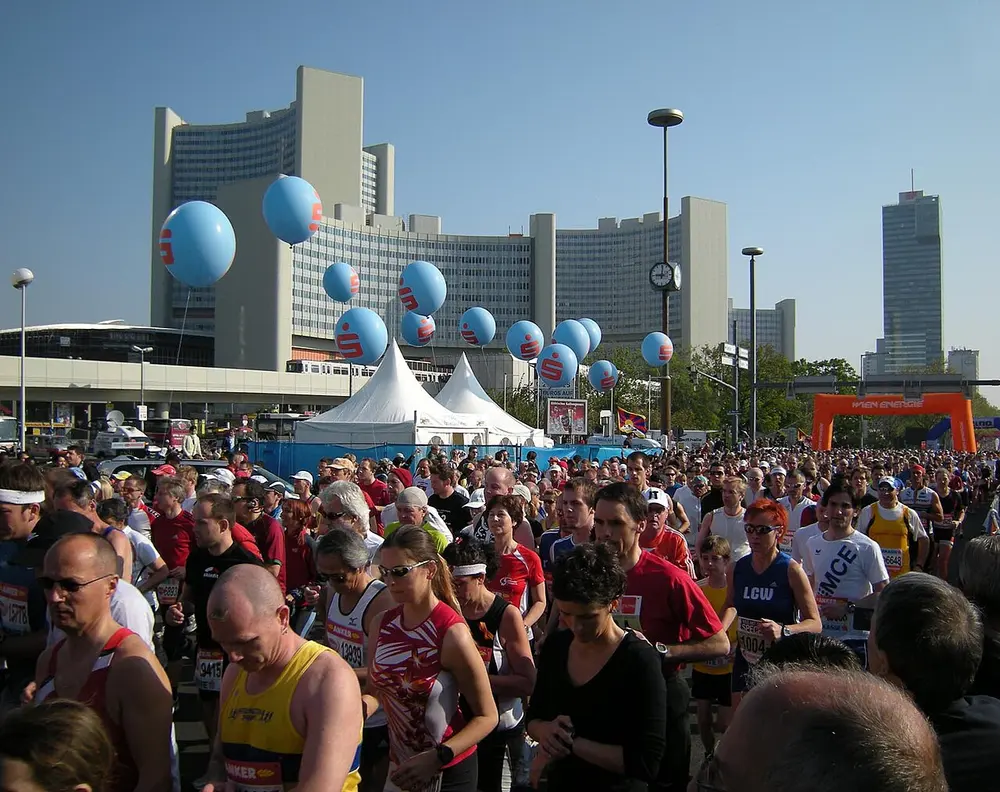
Vienna City Marathon 20080427 046 About one minute after start. Photo: Wolfgang H. Wögerer, Wien / Wikimedia Commons, CC BY 3.0.
Crossing the Danube
Vienna is a city that has always had a complicated relationship with the Danube. The regulated river now runs north-east of the old centre, with the modern districts on the far bank and the green expanse of the Danube Island in between. The marathon's crossing takes runners out of the historic core and into a different, more open Vienna.
That change of scale is useful. The river section gives the race room to breathe, and the return to the city brings the landmarks back into view. It also means the course has a natural midpoint rather than a repetitive loop through the same streets.
A spring classic for a first marathon
The same qualities that make Vienna a record-hunting course make it a generous debut: gentle terrain, a spring date and a route that keeps offering something to look at. A first marathon is still a first marathon, and the rolling kilometres can accumulate quietly. Start conservatively, use the flat sections to recover rather than to make up time, and let the landmarks mark the way home.
April in Vienna can be changeable, so plan layers for the wait and for the first few kilometres. The city is easy to navigate, and the course stays within reach of public transport for most of the day.
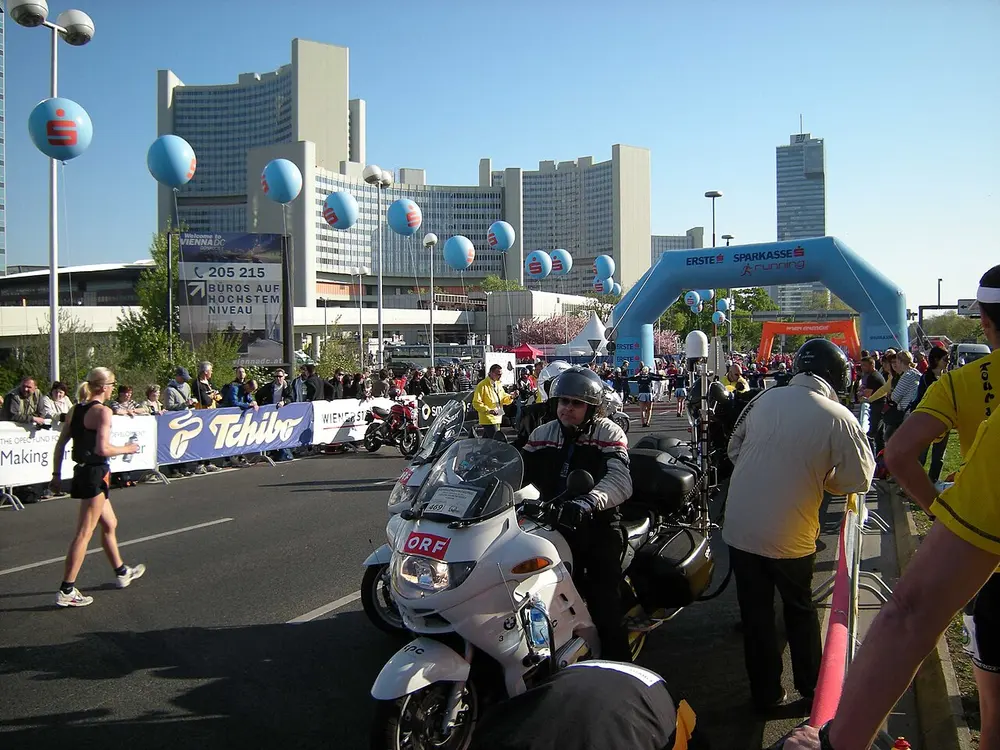
Vienna City Marathon 20090419 ORF camera team preparing. Photo: User:W. / Wikimedia Commons, CC BY-SA 3.0.
Frequently asked questions
Answers to the questions runners ask before entering, drawn from this race's course guide and the directory's own data — the sources behind them are listed below.
When is the Vienna City Marathon?
The next edition is on 18 April 2027. The date is fixed, and the race is expected to follow its usual spring programme.
Is the Vienna City Marathon flat?
It is gently rolling, with about 110 metres of climbing. There is no sustained ascent, but the short rises come often enough that the course is not flat. Train on rolling roads and run by effort.
Is Vienna good for a personal best?
Yes, it is a course that has earned a record-hunting reputation. The gentle profile and the sub-3 target group suit a fast attempt, though a personal best still depends on the day and on disciplined pacing.
Is Vienna suitable for a first marathon?
It is, provided you do not get carried away. The course is manageable and the spring date gives a long build-up, while the landmarks keep the morning interesting. Start conservatively and treat the rolling sections with respect.
Does the course cross the Danube?
Yes. The route crosses the Danube and returns to the city, taking in the Ringstrasse, the Prater and Schönbrunn along the way.
What label does the Vienna City Marathon hold?
It holds a World Athletics Elite Label, reflecting its place on the international road-running calendar.
More marathons in Austria
More marathons in Europe
Sources for this page
What each source below is used for on this page, and where to check this race yourself.
- World Athletics — the label calendar and the road-race regulations. Used to check whether the race holds a World Athletics label, and its elite competition details.
- AIMS — the international course-measurement standard behind the 42.195 km distance, and the AIMS race calendar.
- The organizer's own publications — course maps, race handbooks and published results. The date, course character and climbing on this page are compiled from them and re-checked each season.
“A World Athletics Label denotes a full application of the Competition and Technical Rules in, at a minimum, the elite component of the competition. Labels also denote superior standards in event organisation, safety and runner experience, support from public authorities to the event and a financial commitment to anti-doping.”
Where do these facts come from?
Dates, course type, climbing and time limits are compiled from the organizer's publications and re-checked each season; elevation is an estimate of total climbing rather than a survey figure. Always confirm race-day details with the organizer before making plans.
Last reviewed 27 October 2026