
Istanbul Marathon
Istanbul's marathon has one fact no other race can match: it crosses the Bosphorus and moves from Asia into Europe.
By Global Marathon Routes editorial team · Last reviewed 27 October 2026
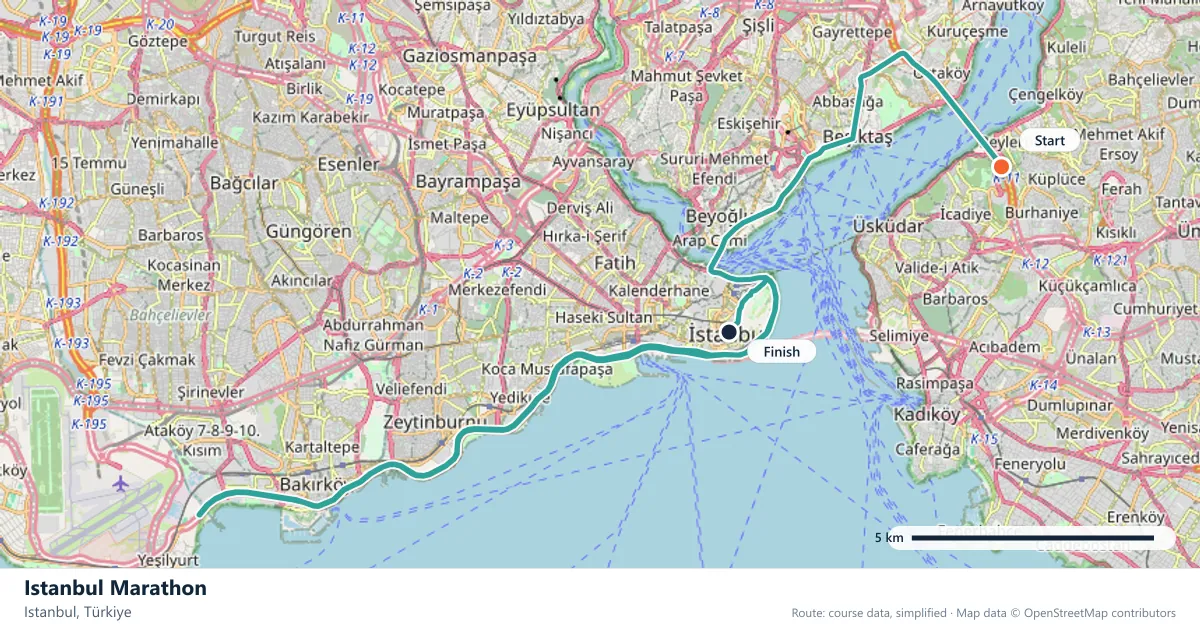
Where does the Istanbul Marathon run?
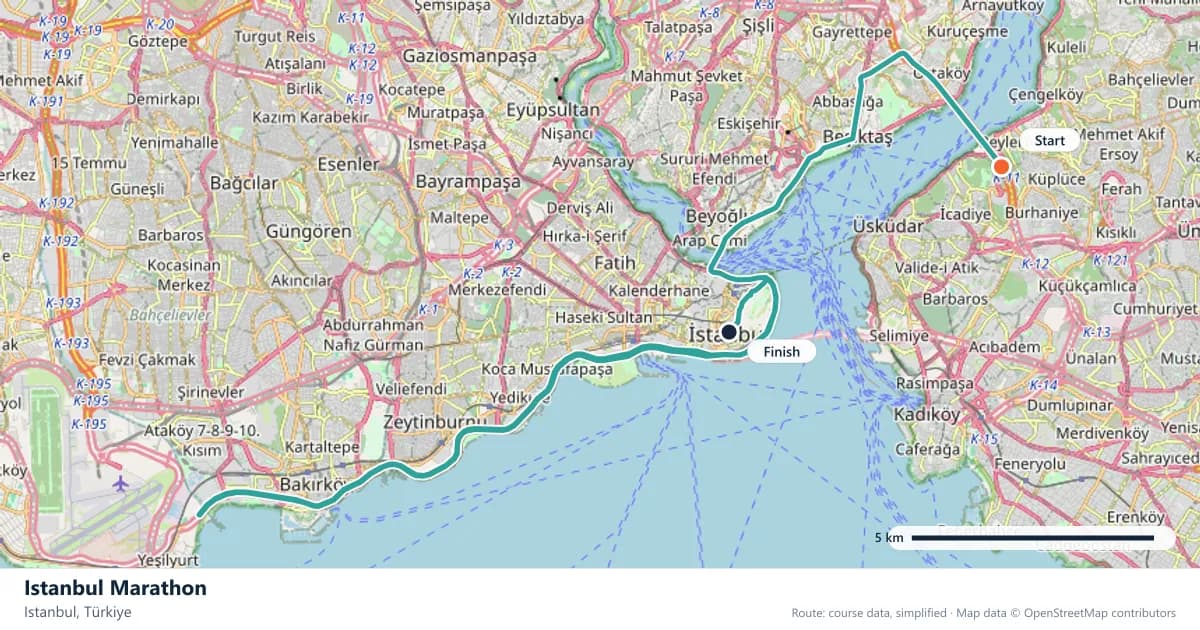
Interactive map
The trace follows the organizer's published course, simplified for the screen: the orange dot is the start, the dark dot the finish. Scroll to zoom, drag to pan.
What is the Istanbul Marathon course like?
The only marathon that crosses between two continents, running over the Bosphorus bridge from Asia into Europe and finishing near the Blue Mosque. Hilly in the second half.
- Next edition
- 01 November 2026
- Elevation gain
- 178 m
- Profile
- Undulating
- First run
- —
Course guide
Istanbul's marathon has one fact no other race can match: it crosses the Bosphorus and moves from Asia into Europe. The next edition is on 01 November 2026, over 42.195 km with about 178 metres of climbing. The crossing is the spectacle; the second half is the race.
The city does the rest. Istanbul is built on both sides of the strait, with the historic peninsula on the European shore, the Asian suburbs across the water, and ferries moving between them all day. A marathon that starts on one continent and finishes on the other uses that geography instead of ignoring it.
The finish near the Blue Mosque puts the race in the heart of Sultanahmet, among domes and minarets. That is a reward, but it comes after the hills. The 178 metres are not evenly spread; the second half is hilly, and that is where good intentions meet the course.
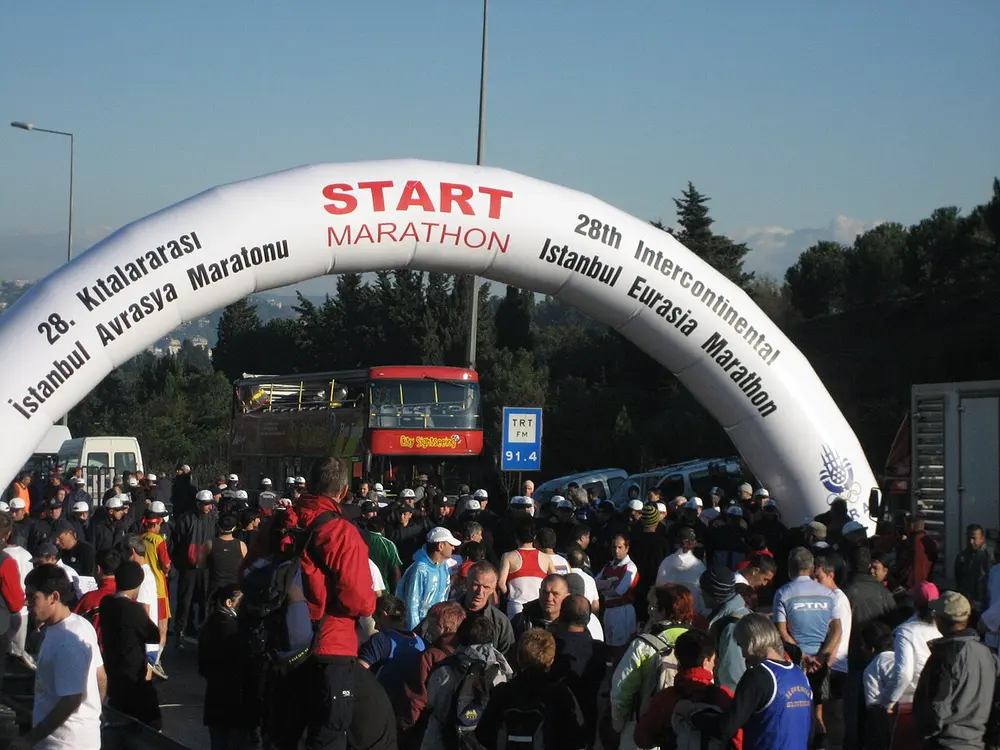
28thIntercontinentalIstanbulEurasiaMarathon. Photo: ccarlstead / Wikimedia Commons, CC BY 2.0.
The course
The race is point to point. It starts in Asia, crosses the Bosphorus bridge, continues through European Istanbul and finishes near the Blue Mosque. The bridge is the hinge: before it, the field is contained on the approach; after it, the route opens into the city's streets.
The measured profile is undulating, and the gain totals about 178 metres. On paper that is modest for a marathon; in practice the climbing clusters later. The early kilometres across the bridge and down the European side can feel controlled, even quick. The second half asks for a different kind of running.
The crossing
The Bosphorus crossing is why runners enter. The bridge is closed to traffic, the field occupies a road that normally carries cars between continents, and the water below separates Europe and Asia. The temptation is to treat it as a victory lap.
The crossing is early; the race is long. Let the novelty carry you without letting it set your pace. You will not get another moment like it on the course, and you will not need one. The memory is strong enough to survive a controlled crossing.
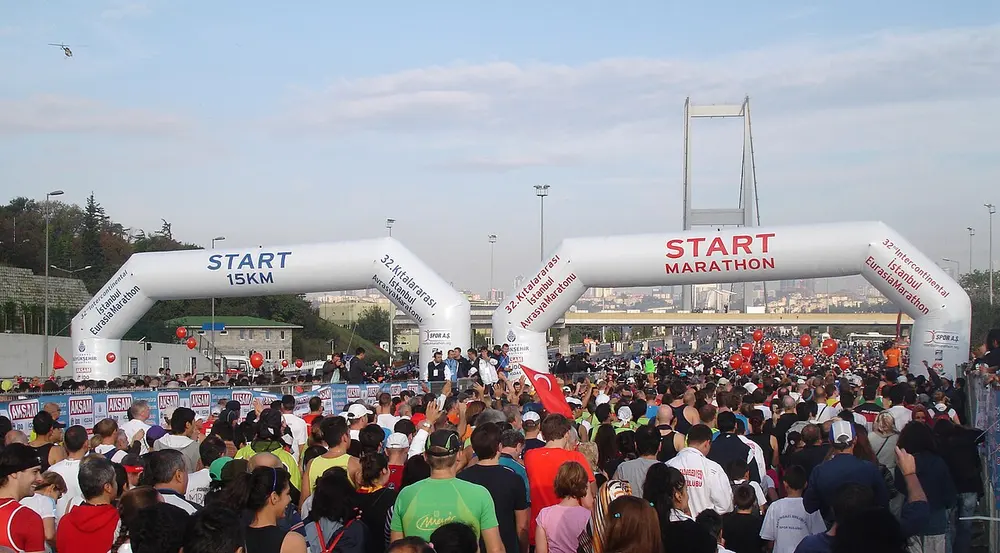
32ndIntercontinentalIstanbulEurasiaMarathon-startingpoint. Photo: Gökhan / Wikimedia Commons, CC BY-SA 3.0.
The second half
The second half is hilly. The climbs are not alpine, but they arrive when the legs are tired and the hardest part is still ahead. Runners who cross the bridge at personal-best pace often meet the return with nothing in reserve. Pace by effort on the rises, take the descents without overstriding, and accept that the closing kilometres may be slower.
The finish near the Blue Mosque is the reward. It is also a change of texture: the crowds thicken, the streets narrow, and the race ends among the monuments of the old city. Leave something for it.
A morning between two shores
The start and finish are on different continents, which makes race-day logistics more interesting than a city loop. Allow time to reach the Asian side before the start, and arrange a meeting point near the finish rather than relying on instinct in a crowded historic district. The city's ferries and rail cross the water, but race morning is not the time to improvise.
Staying near the finish is the simplest plan. The historic peninsula has hotels within easy reach of the Blue Mosque, while the Asian side is more convenient for the start. Whichever you choose, the other end will require a journey.
What the Gold Label means
The race holds a World Athletics Gold Label. That reflects the organisation and the standard of the race rather than the shape of the course. For the rest of the field it is a signal of a well-run event, not a guarantee of a fast day.
The date in November and the hilly second half still shape the result. A Gold Label tells you the race is serious; it does not flatten the Bosphorus.
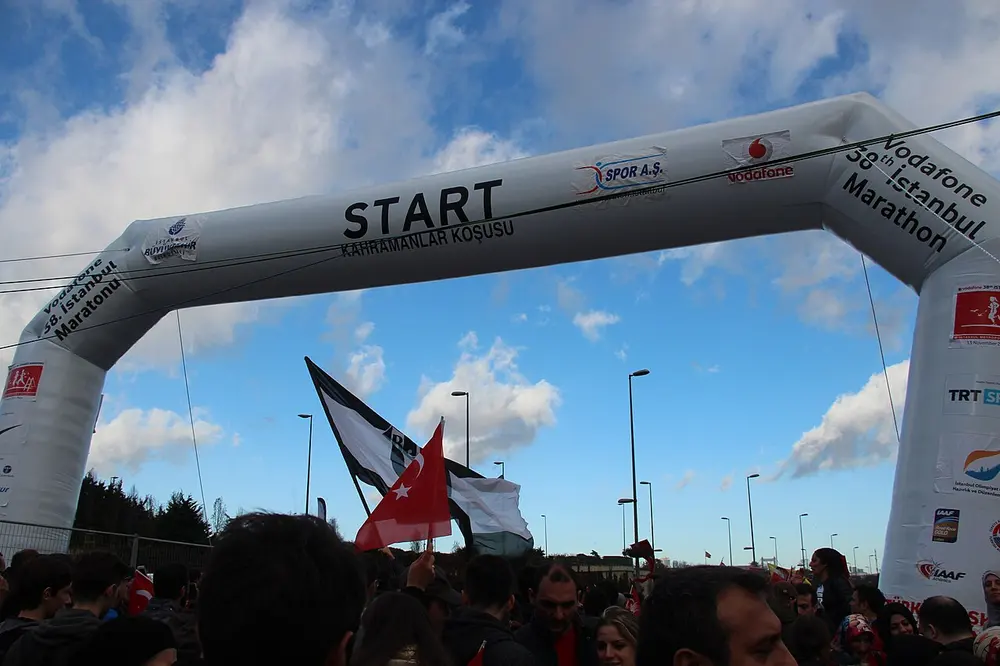
38th Istanbul Vodafone Marathon (1). Photo: Sakhalinio / Wikimedia Commons, CC BY-SA 4.0.
Frequently asked questions
Answers to the questions runners ask before entering, drawn from this race's course guide and the directory's own data — the sources behind them are listed below.
When is the Istanbul Marathon?
The next edition is on 01 November 2026. It is a late-autumn race and holds a World Athletics Gold Label.
Is the Istanbul Marathon a flat course?
No. The profile is undulating with about 178 metres of gain, and the second half is hilly. The opening miles across the bridge are relatively controlled, but the later climbs are the real test.
Is it really the only marathon between two continents?
Yes. The race starts on the Asian side, crosses the Bosphorus and finishes on the European side, which is what makes its route unique among marathons.
Is Istanbul suitable for a first marathon or a personal best?
It can serve either aim, but the hilly second half demands patience. A personal best is possible on a good day, and a first marathon is realistic for runners who start conservatively and expect the closing kilometres to be slower.
Where does the race start and finish?
It starts in Asia and finishes in Europe near the Blue Mosque, in the historic heart of Istanbul. The two ends are on opposite shores of the Bosphorus.
What is the second half like?
The second half is hilly, with the climbing falling after the bridge crossing. It is the section that decides the race, so save energy on the opening miles rather than racing across the Bosphorus.
More marathons in Türkiye
More marathons in Europe
Sources for this page
What each source below is used for on this page, and where to check this race yourself.
- World Athletics — the label calendar and the road-race regulations. Used to check whether the race holds a World Athletics label, and its elite competition details.
- AIMS — the international course-measurement standard behind the 42.195 km distance, and the AIMS race calendar.
- The organizer's own publications — course maps, race handbooks and published results. The date, course character and climbing on this page are compiled from them and re-checked each season.
“A World Athletics Label denotes a full application of the Competition and Technical Rules in, at a minimum, the elite component of the competition. Labels also denote superior standards in event organisation, safety and runner experience, support from public authorities to the event and a financial commitment to anti-doping.”
Where do these facts come from?
Dates, course type, climbing and time limits are compiled from the organizer's publications and re-checked each season; elevation is an estimate of total climbing rather than a survey figure. Always confirm race-day details with the organizer before making plans.
Last reviewed 27 October 2026