
Amazing Thailand Marathon
The Amazing Thailand Marathon takes over Bangkok in the small hours, when the streets are closed, the temples are lit and the heat is at its least punishing.
By Global Marathon Routes editorial team · Last reviewed 27 October 2026
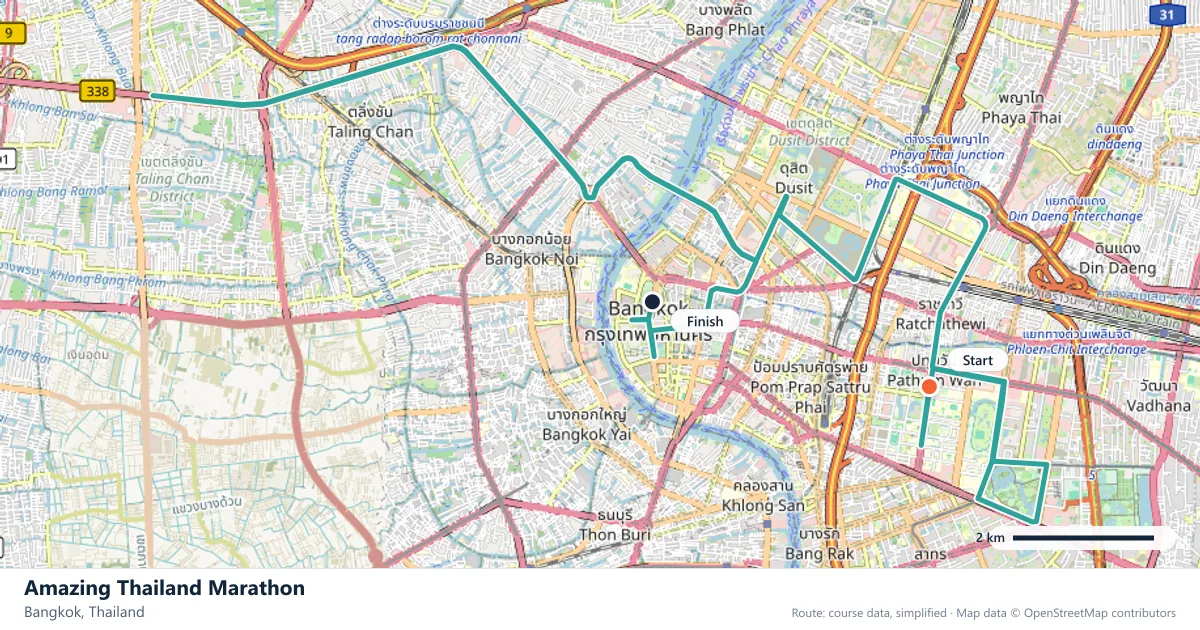
Where does the Amazing Thailand Marathon run?
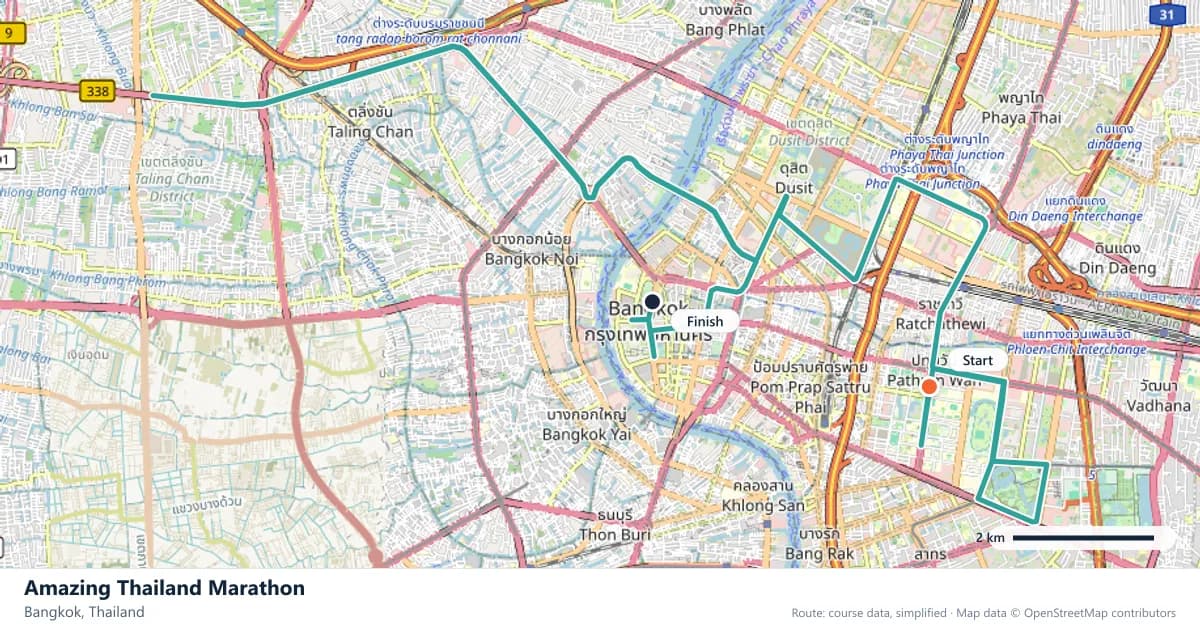
Interactive map
The trace follows the organizer's published course, simplified for the screen: the orange dot is the start, the dark dot the finish. Scroll to zoom, drag to pan.
What is the Amazing Thailand Marathon course like?
Starts in the small hours to beat the Bangkok heat, running past the temples, the Grand Palace and the expressway on closed roads. Flat, humid and enormous.
- Next edition
- 29 November 2026
- Elevation gain
- 130 m
- Profile
- Undulating
- First run
- —
Course guide
The Amazing Thailand Marathon takes over Bangkok in the small hours, when the streets are closed, the temples are lit and the heat is at its least punishing. The 2026 edition is on 29 November, and the race is as much a logistical spectacle as a sporting one: an enormous field, a city-centre route and a start that asks runners to be on the road long before sunrise.
The course is undulating, with about 130 metres of climbing, but it behaves like a flat marathon. It holds a World Athletics Label, passes temples and the Grand Palace, and uses the expressway before returning through the city. The real challenge is the tropical humidity that arrives with the sun, not the elevation.

Bangkok Skyline (MK). Photo: Mathias Krumbholz / Wikimedia Commons, CC BY-SA 3.0.
The course
Bangkok's marathon is run before dawn, when the streets are closed and the city is quieter than at any other time. The route threads past temples and the Grand Palace and uses the expressway. The roads are closed and the climbing minimal, so the course is fast in principle.
The 130 metres of ascent is spread thinly, with gentle changes of grade rather than proper hills. That makes the first half feel almost effortless in the cooler air. The second half is where humidity governs the pace and even splits matter more than speed.
| Race fact | Detail |
|---|---|
| Date | 29 November 2026 |
| Profile | Undulating |
| Elevation gain | About 130 m |
| Label | World Athletics Label |
| Setting | Closed city roads, temples, the Grand Palace and the expressway |
The small-hours start
The start time is the race's defining feature. Bangkok is hot and humid, and the only way to run a marathon through its centre is to do it while the city is still cool and quiet. The result is a start that feels surreal: closed roads, lit temples, and thousands of runners moving through a city that would normally be asleep.
The early alarm is part of the challenge. Runners have to prepare, travel and warm up at an hour when the body would rather be in bed, and the usual race-morning routines feel stranger in the dark. The reward is a course run in the best conditions of the day, with the city's landmarks emerging as the sky begins to lighten.
Temples, the Grand Palace and the expressway
The route is a tour of Bangkok's most recognisable landmarks, but it is also a tour of its infrastructure. The temples and the Grand Palace give the race its postcard moments, while the expressway gives it wide, open stretches where the field can spread out. The contrast is part of the experience: sacred architecture on one side, engineering on the other.
The expressway section is where the race can feel most abstract. The road is wide, the horizon is low, and the usual city landmarks disappear. It is a place to hold a rhythm and stay patient, especially if the humidity is already high. The temples, by contrast, are where the crowd and the atmosphere return.
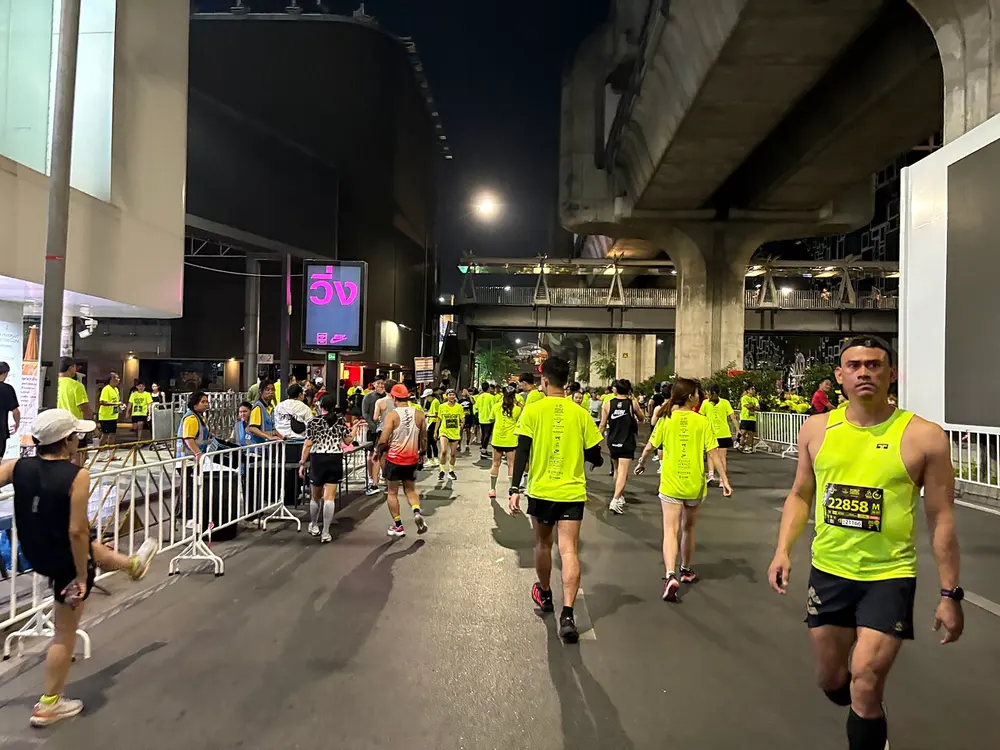
Amazing Thailand Marathon Bangkok 2025. Photo: Chainwit. / Wikimedia Commons, CC BY 4.0.
Humidity and the second half
The humidity does not wait for the sun. It is present from the start, and it is the main reason the course is harder than its profile suggests. The early kilometres may feel comfortable in the dark, but the body is already losing fluid, and the effort of running in heavy air accumulates.
Once the sun rises, the race changes. The temperature climbs, the shade disappears, and the final kilometres become a test of heat management as much as fitness. Runners who drank early, paced conservatively and dressed for the conditions have a much better chance of holding their pace than those who raced the first half as if the cool start would last.
A very large field
The Amazing Thailand Marathon is enormous. The field fills the closed roads, the start and finish areas are busy, and the race has the scale of a major city event. That scale affects the running: the opening kilometres are crowded, the pace is set by the people around you, and patience is required before the field begins to spread.
Before and after sunrise
- Humidity, not hills. The climbing is negligible, but the tropical air is not. Expect the effort to feel harder than the pace suggests.
- The small-hours start. The pre-dawn start is designed to beat the heat, so build race-day routines around a very early alarm.
- A very large field. The race is enormous, so the opening kilometres will be crowded. Stay patient and avoid weaving.
- The expressway. Closed expressway roads are part of the course. Keep your own rhythm on the wide, open stretches.
- The sunrise. The second half is run in rising heat. Protect yourself and adjust your pace when the sun appears.
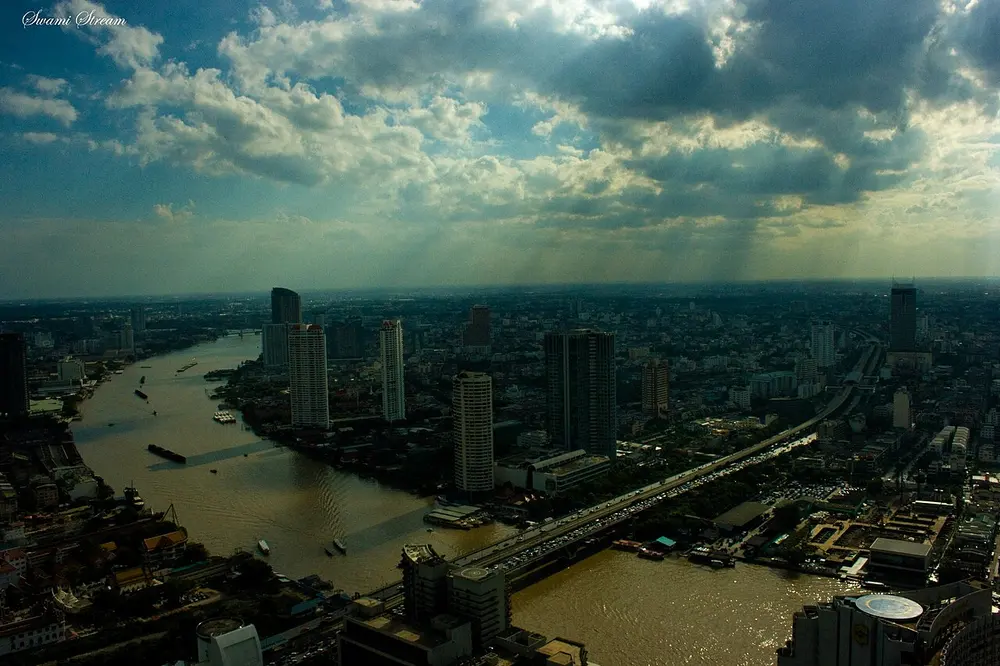
Bangkok Skyline 2 (explore) - Flickr - Swami Stream. Photo: Swaminathan from Singapore, Singapore / Wikimedia Commons, CC BY 2.0.
Frequently asked questions
Answers to the questions runners ask before entering, drawn from this race's course guide and the directory's own data — the sources behind them are listed below.
When is the Amazing Thailand Marathon in 2026?
The race is on 29 November 2026. It is a late-November event, and the start is scheduled for the small hours to take advantage of the coolest part of the day.
Is the Bangkok Marathon course flat?
Yes, in practice. The course is undulating, but the total climb is only about 130 metres, so there is no real hill. The challenge comes from humidity, not from the profile.
Is the Amazing Thailand Marathon good for a personal best?
It is well suited to fast times, and the flat course supports that. However, the heat and humidity mean a fast time depends on heat adaptation and a controlled start. The race is not a place to chase a time without respecting the conditions.
Where is the Amazing Thailand Marathon run?
It is run in Bangkok, Thailand, on closed city roads. The route passes temples, the Grand Palace and the expressway.
Why does the race start so early?
The early start is intended to beat the Bangkok heat. Running before sunrise means cooler temperatures and less sun exposure, even though the humidity remains high.
What label does the Amazing Thailand Marathon hold?
It holds a World Athletics Label.
What is the hardest part of the course?
The second half, after sunrise. The course itself is gentle, but the humidity and rising heat make the final kilometres harder than the first. The expressway stretches can also feel exposed and repetitive.
More marathons in Asia
Sources for this page
What each source below is used for on this page, and where to check this race yourself.
- World Athletics — the label calendar and the road-race regulations. Used to check whether the race holds a World Athletics label, and its elite competition details.
- AIMS — the international course-measurement standard behind the 42.195 km distance, and the AIMS race calendar.
- The organizer's own publications — course maps, race handbooks and published results. The date, course character and climbing on this page are compiled from them and re-checked each season.
“A World Athletics Label denotes a full application of the Competition and Technical Rules in, at a minimum, the elite component of the competition. Labels also denote superior standards in event organisation, safety and runner experience, support from public authorities to the event and a financial commitment to anti-doping.”
Where do these facts come from?
Dates, course type, climbing and time limits are compiled from the organizer's publications and re-checked each season; elevation is an estimate of total climbing rather than a survey figure. Always confirm race-day details with the organizer before making plans.
Last reviewed 27 October 2026