
Belgrade Marathon
Belgrade sits at the meeting of the Sava and the Danube, and its marathon uses both rivers as a map. The next edition is expected in April 2027, and the course links the old city with New Belgrade…
By Global Marathon Routes editorial team · Last reviewed 27 October 2026
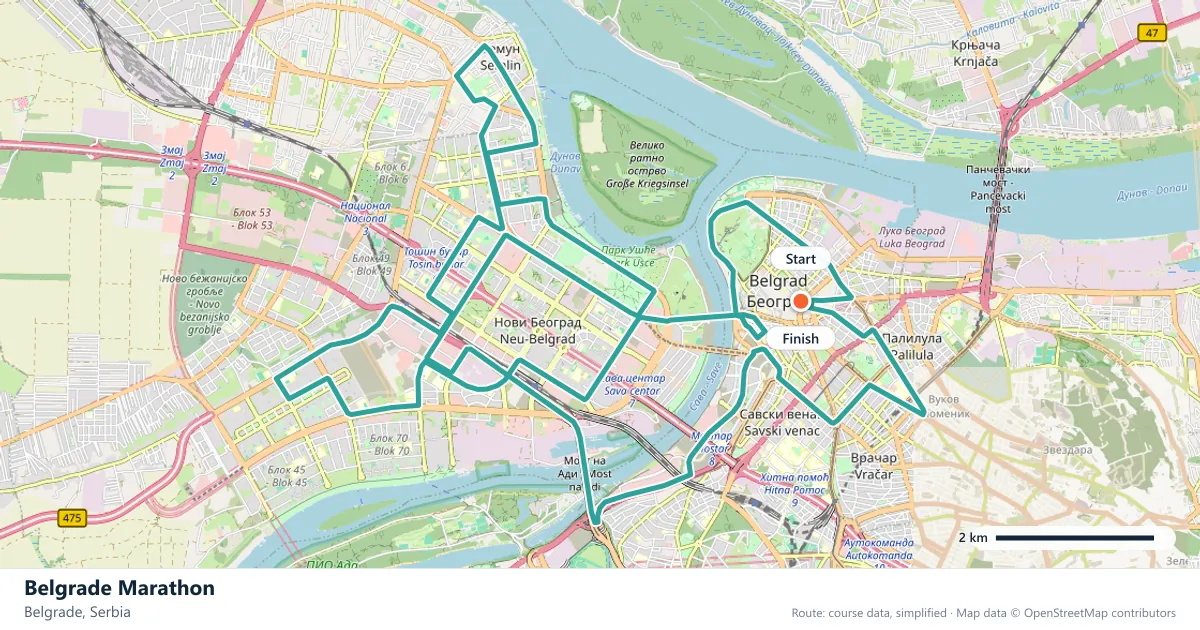
Where does the Belgrade Marathon run?
Interactive map
The trace follows the organizer's published course, simplified for the screen: the orange dot is the start, the dark dot the finish. Scroll to zoom, drag to pan.
What is the Belgrade Marathon course like?
Crosses the Sava and the Danube between the old city and New Belgrade, on a course that mixes riverfront boulevards with a long climb back to the finish.
- Next edition
- April 2027 (expected)
- Elevation gain
- 155 m
- Profile
- Undulating
- First run
- —
Course guide
Belgrade sits at the meeting of the Sava and the Danube, and its marathon uses both rivers as a map. The next edition is expected in April 2027, and the course links the old city with New Belgrade across the water. It climbs about 155 metres, mostly on the long return to the finish, and it holds a World Athletics Label.
The riverfront boulevards are the generous part of the route. They are wide, open and flat, with the water on one side and the city on the other. New Belgrade's broad blocks give the race a different scale again, with long sightlines and a sense of space that is rare in a historic European centre.
The climb back is the counterweight. Belgrade's old city sits above the rivers, and the finish has to be reached by climbing away from the water. The 155 metres are not dramatic in total, but the shape of the day is: flat running first, then a long ascent when the legs have already spent their best kilometres.
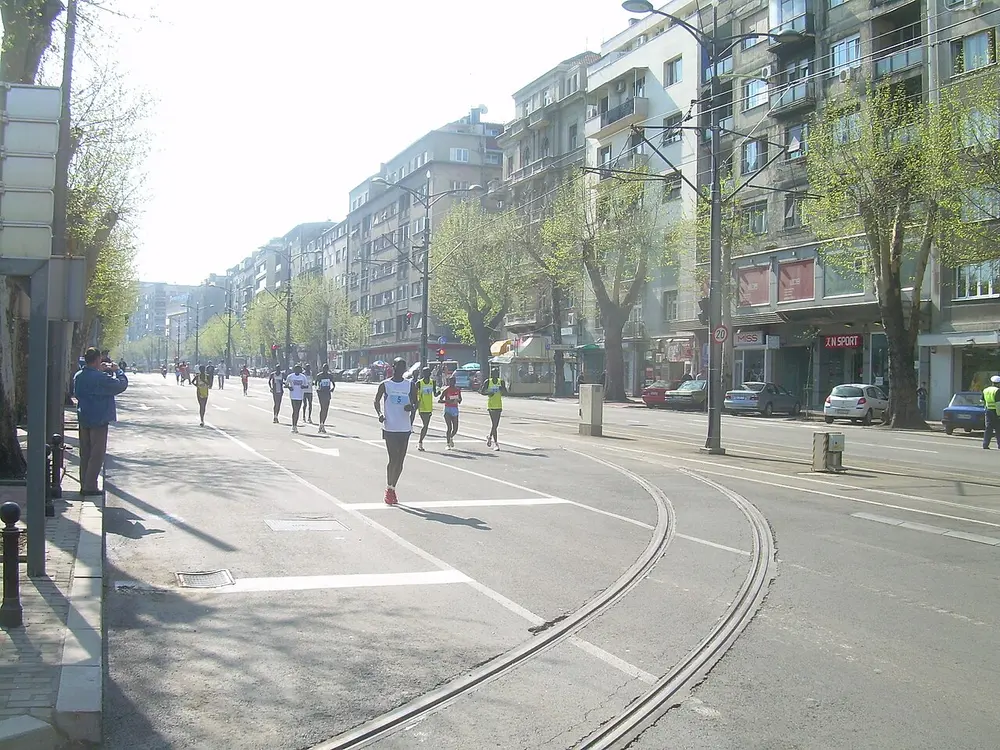
Warm up 23 Belgrade Marathon. Photo: SmirnofLeary / Wikimedia Commons, CC BY-SA 3.0.
The course
The race is built around the two rivers. It crosses the Sava and the Danube between the old city and New Belgrade, using riverfront boulevards for the flatter running and bridges to move between banks. The course feels open for long stretches and then, quite deliberately, turns uphill.
The Danube side brings the widest views. The river is broad here, and the course uses its banks to create long, even kilometres. The Sava side is narrower and more urban, with the old city's ridge never far from the road. The contrast between the two is one of the race's defining pleasures.
The climbing is concentrated rather than spread. That is good news for the first half, which can be run at a steady rhythm, and bad news for anyone who treats the flat boulevards as a free pass. The finish is earned on the return, not on the riverfront.
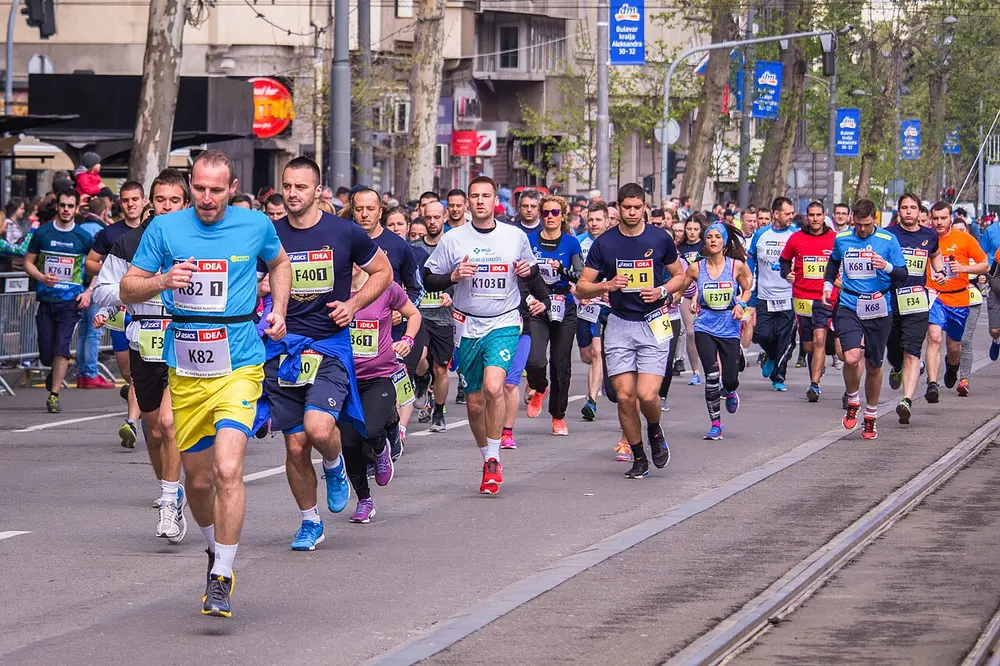
2017 Belgrade Marathon. Photo: Stefan Zubanović / Wikimedia Commons, CC BY-SA 2.0.
Two rivers, two cities
Old Belgrade occupies the ridge between the Sava and the Danube, with Kalemegdan, the fortress above the confluence, as its most famous viewpoint. The streets in the centre are tight, sloping and full of the layers of a city that has been rebuilt many times.
New Belgrade is the opposite. It was built on the left bank of the Sava as a planned modern city, with wide blocks, long avenues and a horizontal skyline. The marathon uses that difference: the old city gives it history and gradient, the new city gives it space and scale.
Crossing between them is more than a change of bank. It is a change of architecture, scale and atmosphere, and it happens twice in the race. Runners who notice it tend to enjoy the day more; runners who do not still have to run the climb at the end.
The climb back
The final climb is the race's signature difficulty. It is long rather than sharp, the kind of gradient that does not look like much on the profile but keeps asking for effort after the flat riverside kilometres are finished.
The practical response is to hold something in reserve. The boulevards are where it is tempting to bank time, and the bridges are where the race can start to feel easy. Neither is the place to spend the energy that the finish will need.
On a course like this, pacing by effort rather than pace is useful. The flat sections will feel comfortable at a pace that the climb later turns into a struggle. Runners who arrive at the base of the climb with a little patience left usually pass a lot of people who did not.
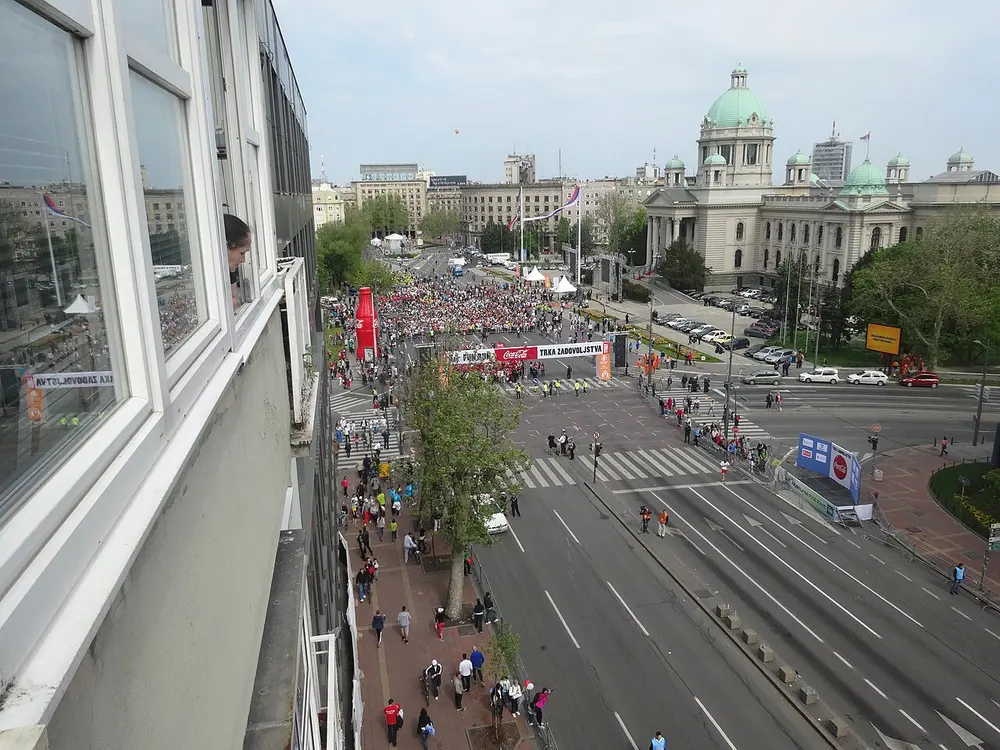
Belgrade Marathon 2014 03. Photo: MikyM / Wikimedia Commons, CC BY-SA 3.0.
April in Belgrade
The April date is expected rather than confirmed, which matters for anyone booking flights early. The race traditionally sits in the spring, and the organiser confirms the final weekend closer to the event.
Spring in Belgrade gives the city a particular energy. The waterfront comes back to life, the café terraces fill and the long winter starts to recede. For runners, the date is a useful early-season target: late enough to build some fitness, early enough to avoid the heat of summer.
The course itself does not depend on the season. It is a river city marathon with a climb at the end, and that shape holds whatever the weather does. The April date simply decides how much of the preparation has to happen indoors.
Frequently asked questions
Answers to the questions runners ask before entering, drawn from this race's course guide and the directory's own data — the sources behind them are listed below.
When is the Belgrade Marathon expected?
The next edition is expected in April 2027. The date is provisional, so confirm it with the organiser before arranging travel.
Is the Belgrade Marathon flat or hilly?
It is undulating, with about 155 metres of gain. The riverfront boulevards are flat, but the long climb back to the finish sets it apart from a pure city flat course.
Is Belgrade a course for a personal best?
It is not the obvious choice for one. The flat riverside sections are generous, but the long climb to the finish interrupts the rhythm and makes even pacing harder than on a pancake-flat course.
Is Belgrade a sensible first marathon?
The course is manageable in the first half, but the climb at the end rewards runners who already know how to save energy. The finish is a stern introduction to the distance, not a gentle one.
Where is the Belgrade Marathon run?
It is run in Belgrade, crossing the Sava and the Danube between the old city and New Belgrade. The route uses riverfront boulevards and finishes after a climb back into the city.
Is the Belgrade Marathon a labelled race?
Yes. It holds a World Athletics Label, and the race is part of the international label road-racing calendar.
More marathons in Europe
Sources for this page
What each source below is used for on this page, and where to check this race yourself.
- World Athletics — the label calendar and the road-race regulations. Used to check whether the race holds a World Athletics label, and its elite competition details.
- AIMS — the international course-measurement standard behind the 42.195 km distance, and the AIMS race calendar.
- The organizer's own publications — course maps, race handbooks and published results. The date, course character and climbing on this page are compiled from them and re-checked each season.
“A World Athletics Label denotes a full application of the Competition and Technical Rules in, at a minimum, the elite component of the competition. Labels also denote superior standards in event organisation, safety and runner experience, support from public authorities to the event and a financial commitment to anti-doping.”
Where do these facts come from?
Dates, course type, climbing and time limits are compiled from the organizer's publications and re-checked each season; elevation is an estimate of total climbing rather than a survey figure. Always confirm race-day details with the organizer before making plans.
Last reviewed 27 October 2026