
Oslo Marathon
Oslo's marathon loops around the inner Oslofjord, and the water is the constant. The route passes the Opera House and the Akershus fortress, but between those landmarks it climbs: the 2027 edition is…
By Global Marathon Routes editorial team · Last reviewed 27 October 2026
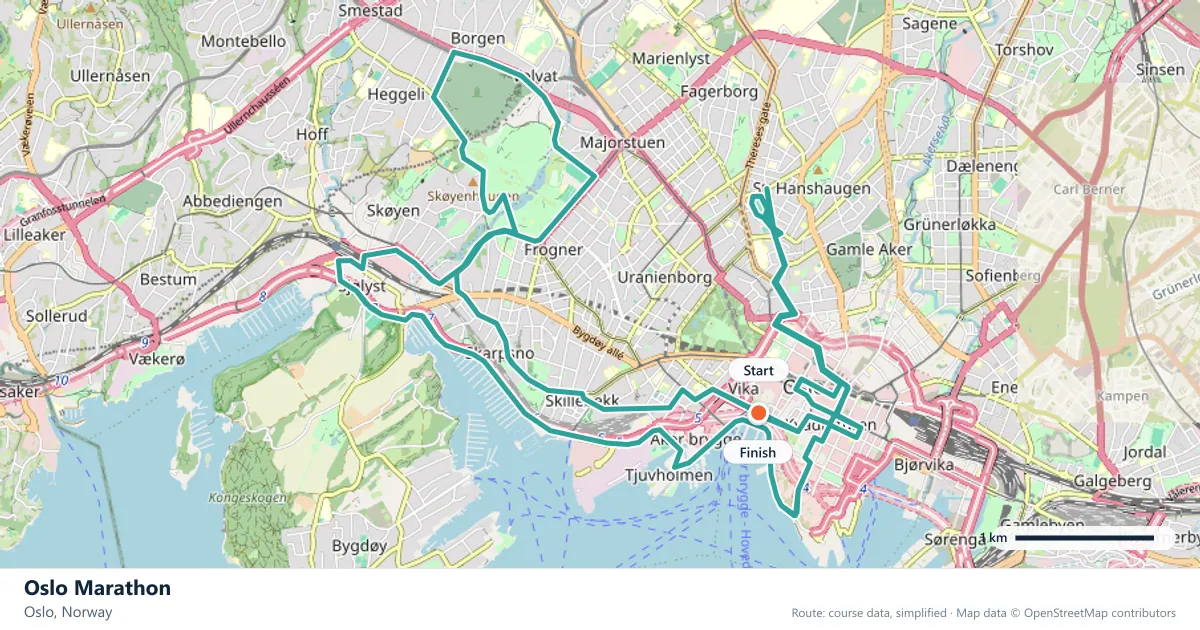
Where does the Oslo Marathon run?
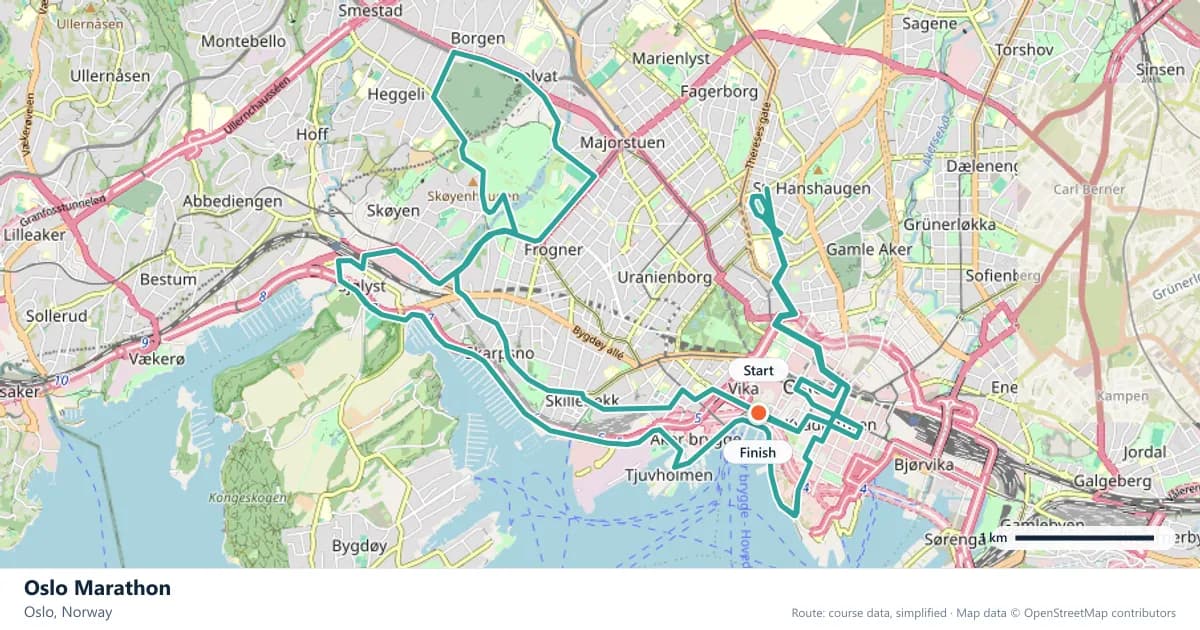
Interactive map
The trace follows the organizer's published course, simplified for the screen: the orange dot is the start, the dark dot the finish. Scroll to zoom, drag to pan.
What is the Oslo Marathon course like?
A loop around the inner Oslofjord, passing the Opera House and the Akershus fortress. Hilly in the middle sections, and the September air is usually cool and quick.
- Next edition
- 18 September 2027
- Elevation gain
- 339 m
- Profile
- Hilly
- First run
- —
Course guide
Oslo's marathon loops around the inner Oslofjord, and the water is the constant. The route passes the Opera House and the Akershus fortress, but between those landmarks it climbs: the 2027 edition is on 18 September, with about 339 metres of gain concentrated through the middle.
That makes Oslo an unusual city marathon. It has the waterfront setting and landmarks of a big European race, but the profile is not flat and processional. The hills are short and repeated, and the cool September air makes hard efforts feel sustainable. The race rewards strength and patience.
It suits a first marathon, provided the training includes hills. The loop stays in the city, and the climb is spread rather than saved for one wall. The difficulty is cumulative: the middle sections take more out of the legs than the profile suggests.
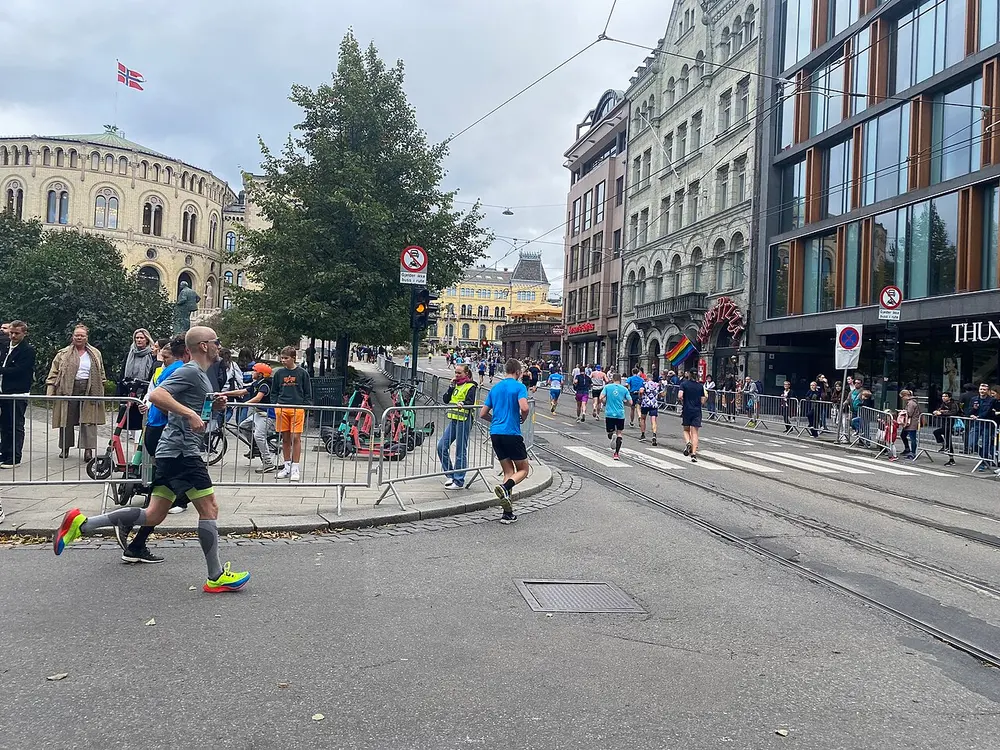
Streets of Oslo during the BMW Oslo Maraton. Photo: Jonas Tisell / Wikimedia Commons, CC BY 4.0.
The course
The route circles the inner Oslofjord, passing the Opera House and Akershus fortress. The waterfront provides the open stretches, while the middle carries most of the climbing. The 339 metres of gain make the course genuinely hilly.
The loop shape means the later kilometres return towards the start and the fjord. That helps psychologically: the second half has a direction, and the waterfront reappears as a signal that the race is coming back together.
Because the climbing is spread through the middle, the opening kilometres feel deceptively easy. The waterfront is flat, the field is fresh, and the landmarks come early. The race changes when the route turns inland and rises; that is the point to pace by effort.
The hills in the middle
The middle sections decide Oslo. The climbs are short rather than long, but repeated enough to wear down anyone who attacks them. Shorten the stride, keep the effort steady and accept a slower pace.
The descents compensate. They are fast, so use them to recover and regain rhythm, but do not let them pull you into an uncontrolled stride; braking hard costs the quads.
The total of 339 metres is not a mountain figure, but it makes hill-specific training worthwhile. Rolling long runs and a few sustained climbs will do more than guessing the exact profile.
Opera House and Akershus
The Opera House is one of modern Oslo's defining buildings. Its white marble roof slopes down to the fjord, and the building is designed to be walked on. Passing it sets contemporary architecture against the older city.
Akershus fortress is the counterweight: a medieval castle that has guarded the harbour for centuries. Together the landmarks span the city's history and give the race a sequence worth remembering.
A hilly first marathon
Oslo suits a first marathon because the difficulty is honest. The hills are visible, the route stays in the city, and there is no remote section where a bad patch becomes a logistical problem. The climb is real, but not a single obstacle.
The caveat is preparation. A debutant who trained only on flat ground will find the middle sections harder than expected, and the cumulative climbing can turn the final 10 kilometres into a grind. Build hills into the long runs and practise pacing by effort.
September on the fjord
September in Oslo is usually cool, with lower light and a hint of autumn. That helps: the air supports hard running, and the waterfront is less exposed than in summer heat. The start can feel sharp, so warm up and plan for a cool wait.
The weather can change through the day, and the fjord makes its own conditions. Check the forecast in race week and prepare for a range rather than assuming heat or rain.
Race weekend and logistics
Oslo is compact, and the loop keeps the race within reach of the centre. The waterfront, Opera House and Akershus are all part of the core, so stay central and use the fjord as your landmark.
The city is expensive but efficient. Public transport is good, the centre is walkable, and the race needs no long transfer. Arrive a day early: seeing the waterfront makes the course easier to read.
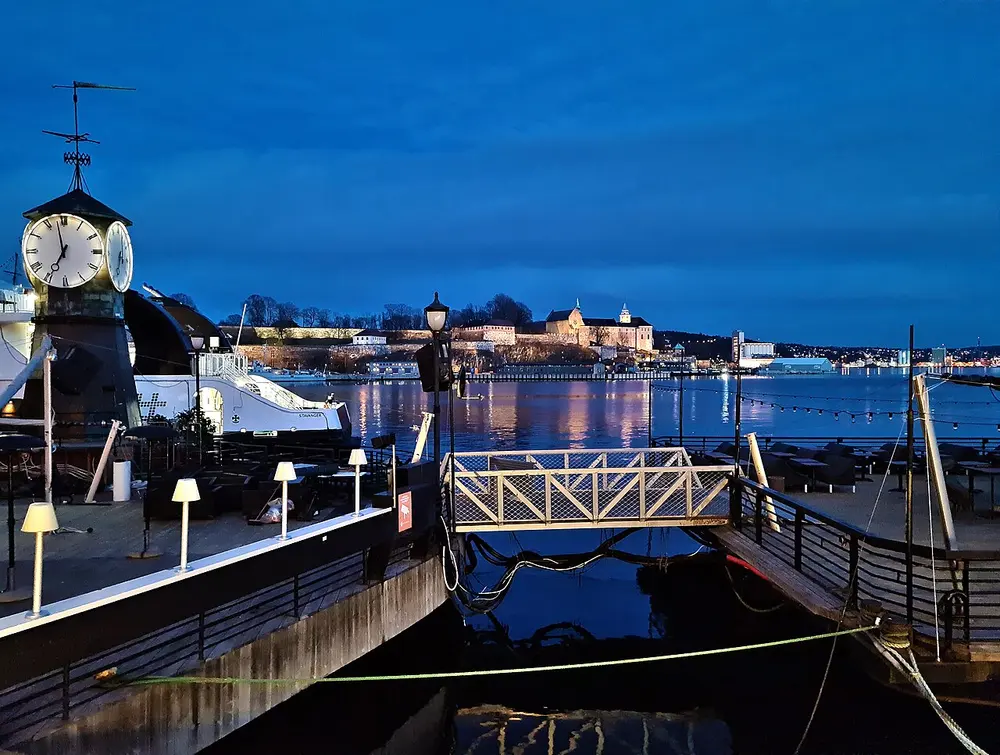
Aker Brygge Akershus Festning Pipervika Oslo Norway (2021.03.17). Photo: Geir Hval (www.MacWhale.eu) / Wikimedia Commons, CC BY-SA 4.0.
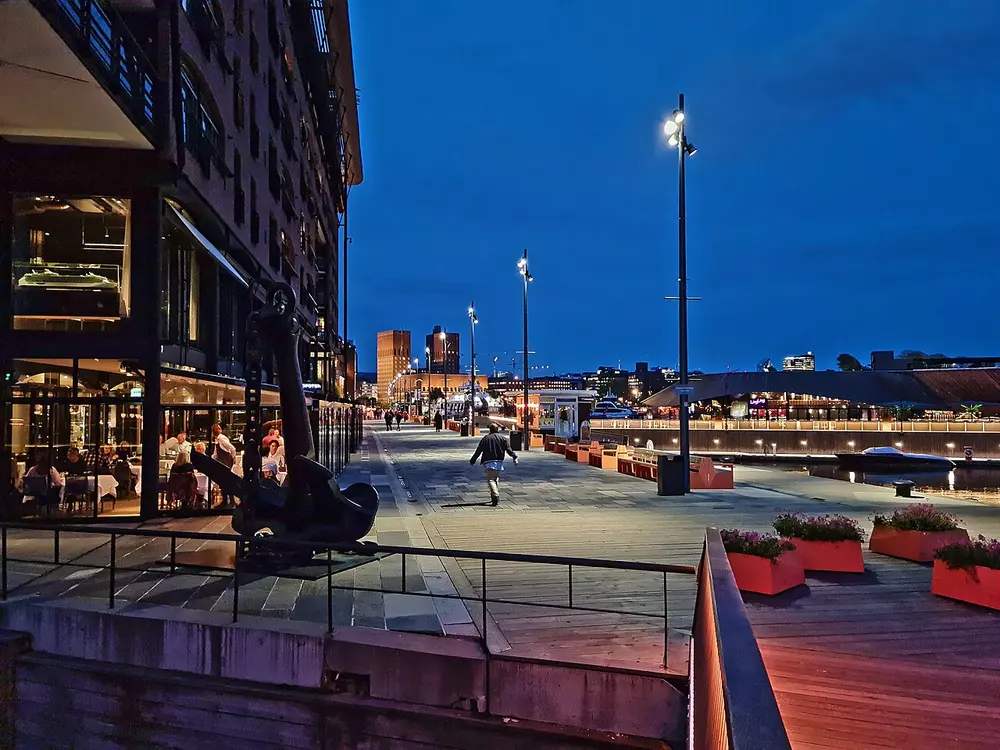
Aker Brygge Oslo Rådhus Pipervika Oslo Norway (2022.09.28). Photo: Geir Hval (www.MacWhale.eu) / Wikimedia Commons, CC BY-SA 4.0.
Frequently asked questions
Answers to the questions runners ask before entering, drawn from this race's course guide and the directory's own data — the sources behind them are listed below.
When is the Oslo Marathon in 2027?
The 2027 edition is scheduled for 18 September 2027. It is a September race, held as the city moves into autumn.
Is the Oslo Marathon hilly?
Yes. The course climbs about 339 metres, with the hills concentrated in the middle sections. It is not a mountain marathon, but the climbing is significant enough to require hill-specific preparation.
Is the Oslo Marathon suitable for a first marathon?
Yes, provided the training includes hills. The loop stays in the city, the route is easy to follow, and the climb is spread out rather than saved for one wall. The cumulative climbing is the main challenge.
Where is the Oslo Marathon run?
It circles the inner Oslofjord, passing the Opera House and the Akershus fortress. The course stays close to the waterfront and the city centre.
What are the landmarks on the course?
The Opera House and the Akershus fortress are the best-known, with the inner Oslofjord providing the constant backdrop. The waterfront sections are the most open and memorable parts of the route.
What is the weather like in September?
September in Oslo is usually cool, with lower light and a hint of autumn. It is good running weather, but the start can feel sharp, so plan for a cool morning and a range of conditions.
More marathons in Europe
Sources for this page
What each source below is used for on this page, and where to check this race yourself.
- World Athletics — the label calendar and the road-race regulations. Used to check whether the race holds a World Athletics label, and its elite competition details.
- AIMS — the international course-measurement standard behind the 42.195 km distance, and the AIMS race calendar.
- The organizer's own publications — course maps, race handbooks and published results. The date, course character and climbing on this page are compiled from them and re-checked each season.
Where do these facts come from?
Dates, course type, climbing and time limits are compiled from the organizer's publications and re-checked each season; elevation is an estimate of total climbing rather than a survey figure. Always confirm race-day details with the organizer before making plans.
Last reviewed 27 October 2026