
Kuala Lumpur Marathon
Merdeka Square is the symbolic centre of Kuala Lumpur, and the city's marathon starts there before heading out into the city's highway network.
By Global Marathon Routes editorial team · Last reviewed 27 October 2026
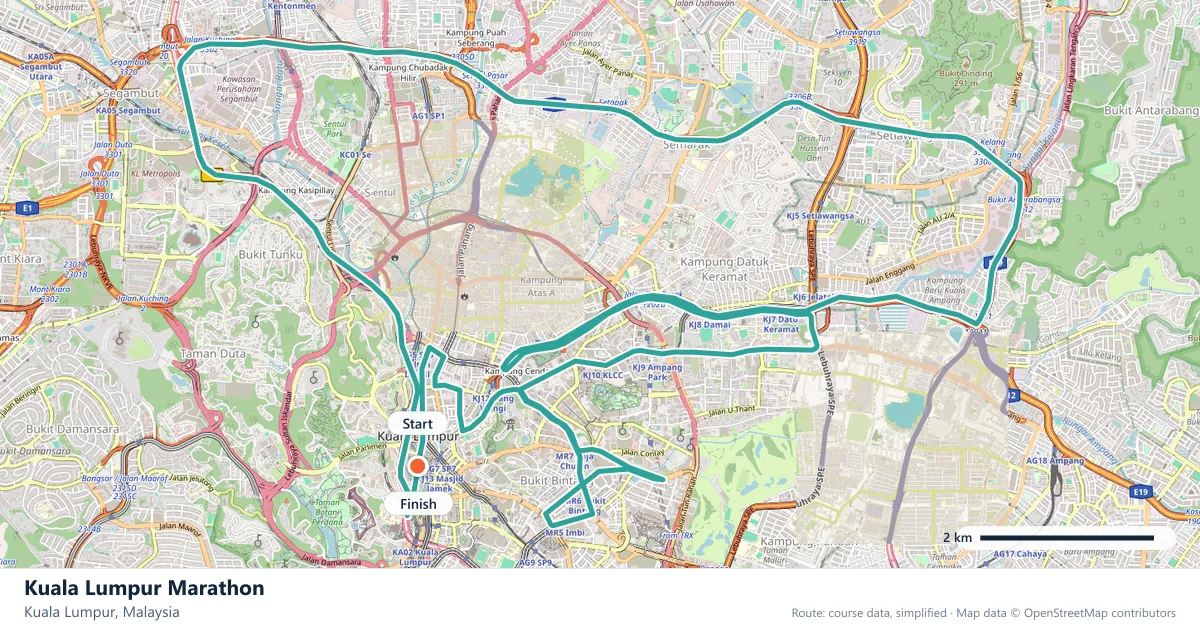
Where does the Kuala Lumpur Marathon run?
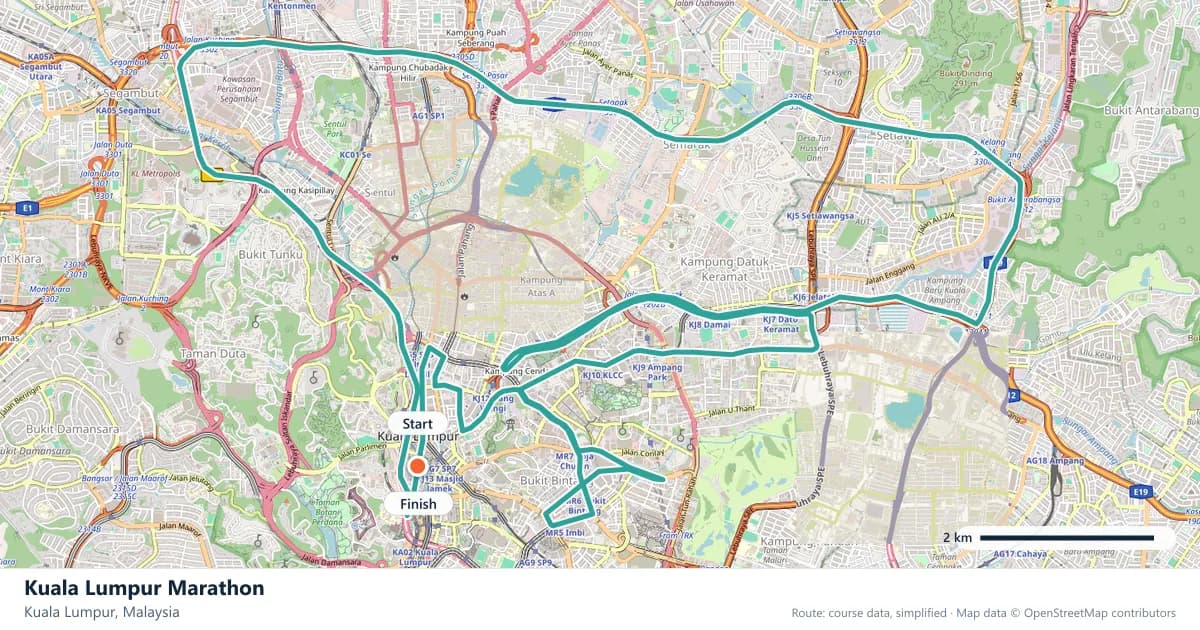
Interactive map
The trace follows the organizer's published course, simplified for the screen: the orange dot is the start, the dark dot the finish. Scroll to zoom, drag to pan.
What is the Kuala Lumpur Marathon course like?
Starts at Merdeka Square and climbs through the city's highway network before returning to the centre. Humid from the first kilometre, with real hills in the middle third.
- Next edition
- October 2027 (expected)
- Elevation gain
- 316 m
- Profile
- Hilly
- First run
- —
Course guide
Merdeka Square is the symbolic centre of Kuala Lumpur, and the city's marathon starts there before heading out into the city's highway network. The 2026 edition was run on 4 October, over a course that climbs about 316 metres and holds a World Athletics Elite Label. It is humid from the first kilometre, and the real hills sit in the middle third.
Kuala Lumpur is not a flat tropical city race. The opening around Merdeka Square is historic and relatively contained, but the route soon opens onto broad highways and begins to roll. The combination of heat, humidity and sustained climbing makes the marathon a test of preparation rather than a course that rewards a brave opening.
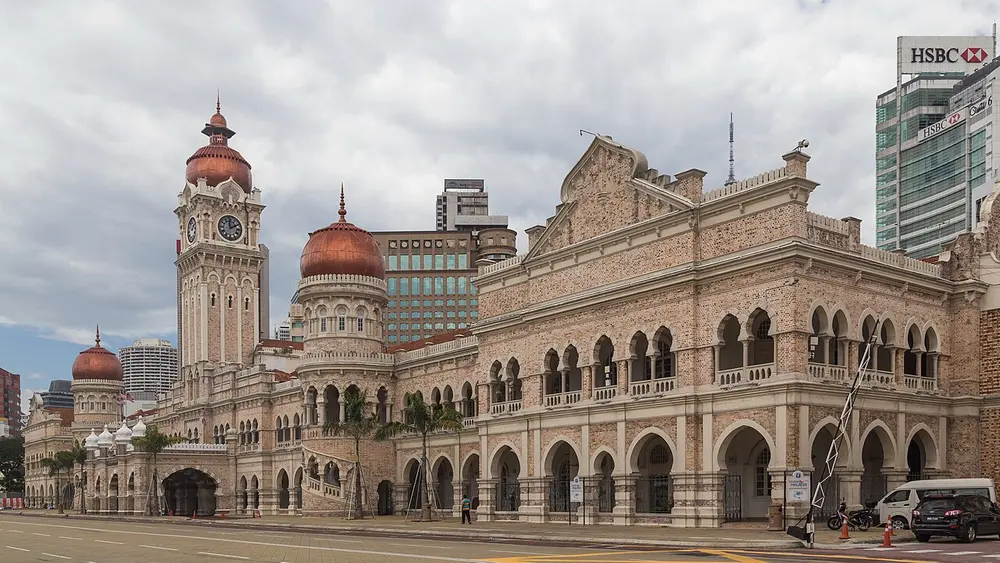
2016 Kuala Lumpur, Budynek Sułtana Abdula Samada (01). Photo: Marcin Konsek / Wikimedia Commons, CC BY-SA 4.0.
The course
The marathon begins at Merdeka Square, then climbs through Kuala Lumpur's highway network before turning back towards the centre. The course accumulates about 316 metres of climbing, and the middle third holds the real hills. Those climbs are the defining challenge, coming after the field has settled into its rhythm and while the humidity is already doing its work.
The highway network gives the route broad, fast-feeling roads, but the gradients and the moist air keep the effort honest. There are long drags as well as short rises, and the wide lanes can make the pace feel easier than it is. The return to the centre provides a change of scene and the lift of heading home, but it does not undo the climbing that came before.
| Race fact | Detail |
|---|---|
| Date | October 2027 (expected) |
| Profile | Hilly |
| Elevation gain | About 316 m |
| Label | World Athletics Elite Label |
| Start | Merdeka Square |
The middle third
The middle of the race is where Kuala Lumpur shows its teeth. The route leaves the flatter opening behind and begins to climb through the highway network, with a series of rises that are long enough to matter and steep enough to interrupt an even rhythm. This is not a course where the hills arrive at the end; they arrive when the legs are still expected to be fresh.
That placement changes the pacing plan. A runner who spends the first third feeling comfortable and then tries to attack the hills will pay for it later. The better approach is to keep the opening controlled, treat the middle climbs as steady work, and accept that the pace will be slower than on a flat course. The return to the centre is not a descent all the way, either, so the effort has to be managed to the line.
Humidity from the first kilometre
Kuala Lumpur's humidity is not a second-half problem. It is present from the start, and it shapes the race before the first hill arrives. The air is heavy, sweat loss is high, and the effort of running at a given pace is greater than it would be in a dry city.
The response is practical rather than heroic. Drink early, use every opportunity to cool down, and set a pace that reflects the conditions rather than the split you ran at home. The humidity also makes the hills harder, because the body is already working to regulate heat. A conservative first half is not caution for its own sake; it is the only sensible way to reach the middle third with something left.
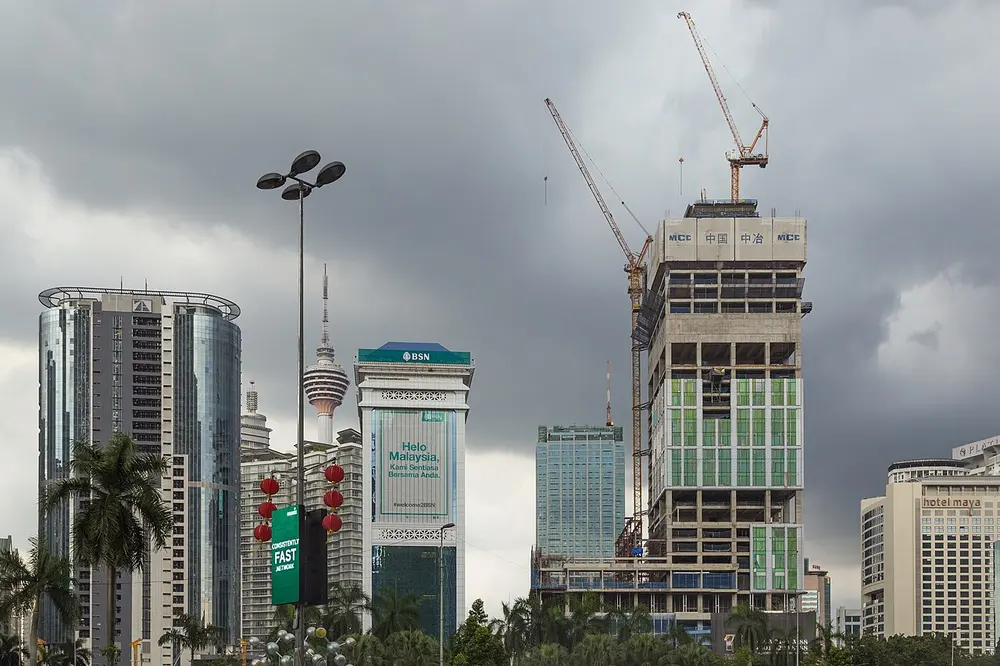
2016 Kuala Lumpur, Kuala Lumpur City Centre (01). Photo: Marcin Konsek / Wikimedia Commons, CC BY-SA 4.0.
Merdeka Square and the return
Merdeka Square gives the race a start with a sense of occasion. The square is surrounded by historic buildings and open space, and it provides a natural gathering point before the route turns onto the highways. It is a very different environment from the wide, engineered roads that follow, and that contrast is part of the race's character.
The return to the centre closes the loop. After the climbing and the exposed highway sections, the route comes back through the same urban landscape that hosted the start.
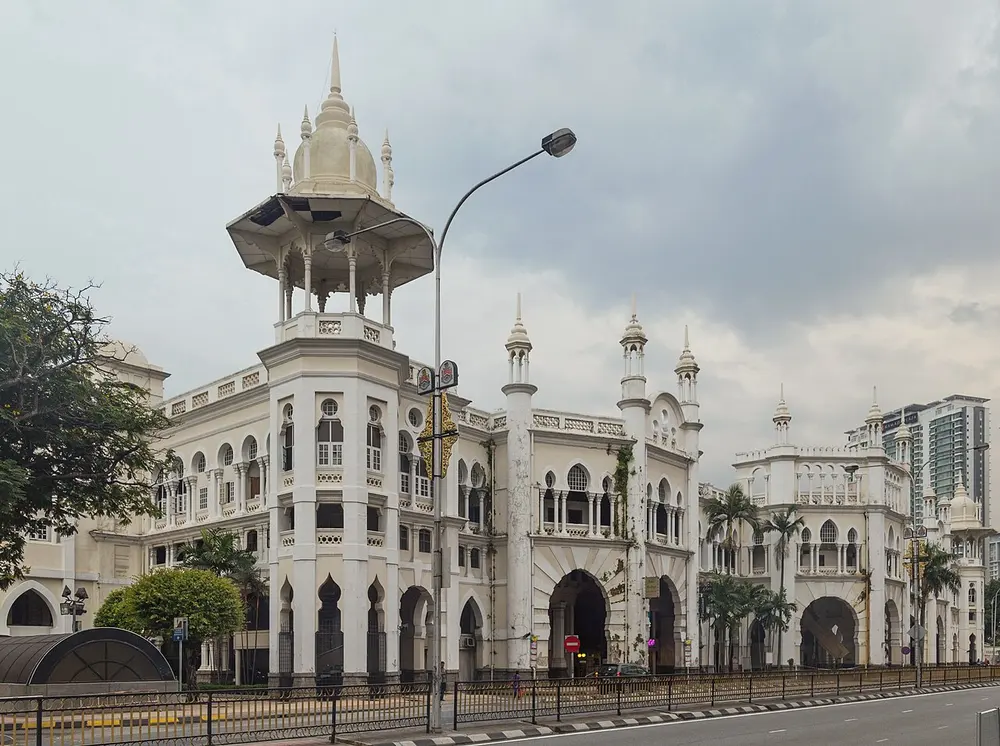
2016 Kuala Lumpur, Stacja kolejowa Kuala Lumpur (02). Photo: Marcin Konsek / Wikimedia Commons, CC BY-SA 4.0.
Heat and hills
- Hills in the middle third. The real climbing arrives after the opening. Prepare for sustained uphill work and do not expect the difficulty to be front-loaded.
- Humidity from the start. The air is heavy from the first kilometre. Adjust your target and your hydration plan accordingly.
- Highway drags. The wide roads also carry long, steady gradients that can erode pace without feeling steep.
- Pacing the return. After the hills, the run back to the centre can feel easier. Hold form rather than trying to make up time at once.
Frequently asked questions
Answers to the questions runners ask before entering, drawn from this race's course guide and the directory's own data — the sources behind them are listed below.
When was the Kuala Lumpur Marathon in 2026?
The 2026 edition was held on 4 October 2026. The race starts at Merdeka Square and returns to the city centre.
Is the Kuala Lumpur Marathon flat or hilly?
It is hilly. The course climbs about 316 metres, with real hills in the middle third. The humidity adds to the difficulty and is present from the first kilometre.
Where are the hills on the Kuala Lumpur Marathon course?
The real hills sit in the middle third, after the field has settled into its rhythm. The climbing is not concentrated at the start or finish, so runners need to be ready for it after the opening kilometres.
Is the Kuala Lumpur Marathon good for a personal best?
The course is not an obvious place to chase one. The combination of 316 metres of climbing, real middle-third hills and heavy humidity makes fast, even pacing difficult. The race rewards patience and preparation far more than speed.
Is the Kuala Lumpur Marathon suitable for a first marathon?
It is a demanding debut. The humidity and the middle-third hills ask a lot of a runner who has never covered the distance, and the highway sections offer little shelter. A first-timer should go in prepared for heat and climbing rather than for a flat tropical course.
Where does the Kuala Lumpur Marathon run?
It starts at Merdeka Square in Kuala Lumpur, Malaysia. The course climbs through the city's highway network and returns to the centre.
What label does the Kuala Lumpur Marathon hold?
It holds a World Athletics Elite Label.
More marathons in Asia
Sources for this page
What each source below is used for on this page, and where to check this race yourself.
- World Athletics — the label calendar and the road-race regulations. Used to check whether the race holds a World Athletics label, and its elite competition details.
- AIMS — the international course-measurement standard behind the 42.195 km distance, and the AIMS race calendar.
- The organizer's own publications — course maps, race handbooks and published results. The date, course character and climbing on this page are compiled from them and re-checked each season.
“A World Athletics Label denotes a full application of the Competition and Technical Rules in, at a minimum, the elite component of the competition. Labels also denote superior standards in event organisation, safety and runner experience, support from public authorities to the event and a financial commitment to anti-doping.”
Where do these facts come from?
Dates, course type, climbing and time limits are compiled from the organizer's publications and re-checked each season; elevation is an estimate of total climbing rather than a survey figure. Always confirm race-day details with the organizer before making plans.
Last reviewed 27 October 2026