
Jakarta Marathon
Jakarta's marathon is run on roads that normally belong to cars. The 2027 edition is set for 13 June 2027, and the route uses closed toll roads and boulevards to pass through the Indonesian capital's…
By Global Marathon Routes editorial team · Last reviewed 27 October 2026
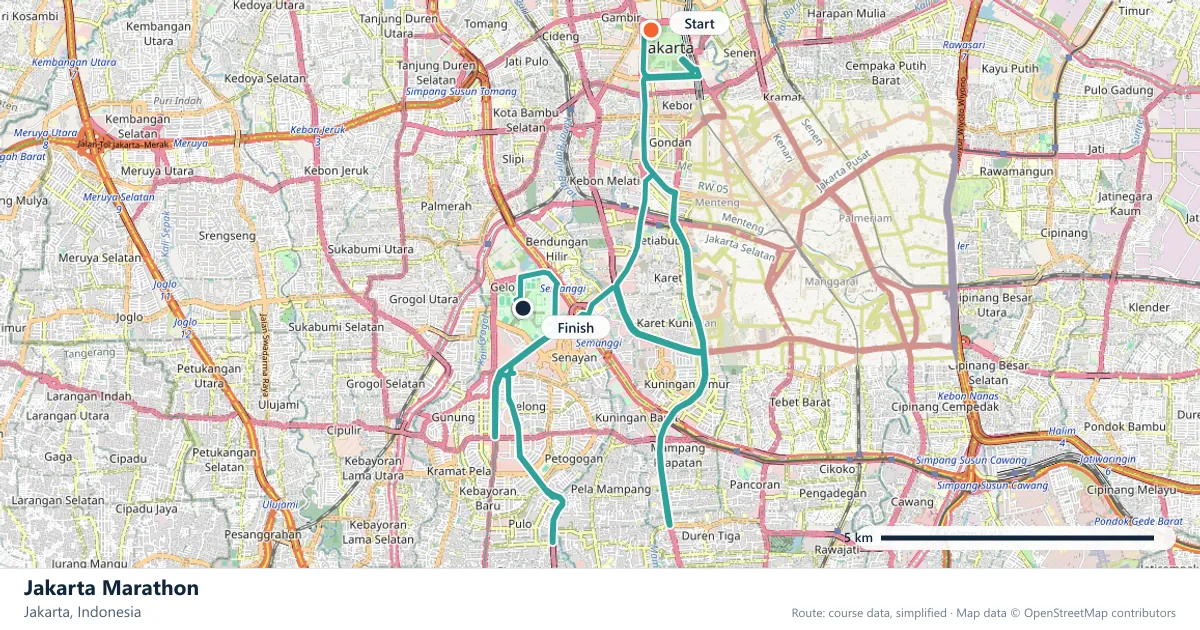
Where does the Jakarta Marathon run?
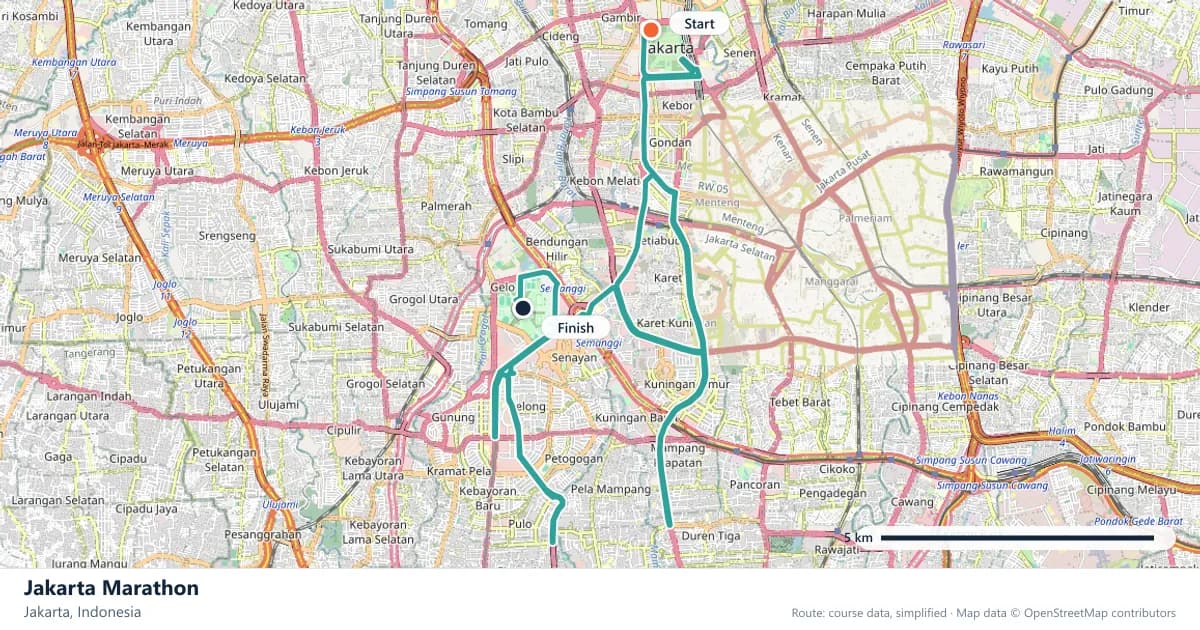
Interactive map
The trace follows the organizer's published course, simplified for the screen: the orange dot is the start, the dark dot the finish. Scroll to zoom, drag to pan.
What is the Jakarta Marathon course like?
A city marathon through Jakarta's monuments and business districts, run on closed toll roads and boulevards. Tropical heat and humidity set the pace.
- Next edition
- 13 June 2027
- Elevation gain
- 156 m
- Profile
- Undulating
- First run
- —
Course guide
Jakarta's marathon is run on roads that normally belong to cars. The 2027 edition is set for 13 June 2027, and the route uses closed toll roads and boulevards to pass through the Indonesian capital's monuments and business districts. It carries a World Athletics Label.
The profile is gently undulating, with about 156 metres of climbing, and the course is fast in principle. The tropical heat and humidity are what turn the principle into a negotiation. Jakarta is a big, dense, energetic city, and the marathon feels like a rare chance to see it from the middle of the road.

Peserta Jakarta International Marathon 2024. Photo: Infineos / Wikimedia Commons, CC BY-SA 4.0.
The course
The race runs through Jakarta's monuments and business districts on closed toll roads and boulevards. The total climb is about 156 metres, spread across the route in gentle rises rather than a single hill. The wide roads give room to settle into a rhythm, and the urban landmarks provide a changing backdrop.
The toll-road sections allow long stretches without ordinary city traffic. The business districts add a denser environment, and the monuments give the route its sense of place. With tropical heat throughout, the course rewards conservative pacing and consistent hydration.
Closed roads, open pace
Running on closed toll roads is a strange and liberating experience. The road is wide, the surface is smooth and the usual traffic is absent. For long stretches, the marathon feels like a time trial laid through a city.
That openness can be deceptive. Without junctions and traffic to break the rhythm, runners can settle into a pace that is too quick for the conditions. The wide roads invite ambition; the heat punishes it. Use the empty road to find your rhythm, not to chase a time that belongs to a cooler day.
Monuments and business districts
Jakarta's course is a tour of the city's different registers. The monuments give the race a sense of national scale, while the business districts show the capital's modern, commercial face. The contrast is part of the appeal, and it keeps the course from feeling like an industrial loop.
The urban setting also shapes the atmosphere. Runners pass through the centres of power and commerce, with the city's skyline changing around them. It is a race that feels embedded in Jakarta rather than staged on its edge.
Heat and humidity
The tropical climate is the defining condition of the Jakarta Marathon. Heat and humidity are present from the start, and they build through the morning. The course's gentle undulation does not protect the legs, and the wide roads offer little shade.
The response has to be practical: start conservatively, drink early and often, and adjust the target if the conditions demand it. Runners who have trained in heat will handle the day better than those who have prepared only in air-conditioned gyms. The course is fast, but the weather sets the limit.
Jakarta Indonesia Abandoned-motor-rickshaws-in-Kota-Jakarta. Photo: CEphoto, Uwe Aranas / Wikimedia Commons, CC BY-SA 3.0.
The profile and the pace
About 156 metres of climbing is not severe, but it is enough that the course never feels completely flat. The rises are gentle, and they arrive often enough to interrupt a rhythm that has become too rigid. The result is a course that rewards attention rather than raw speed.
For runners targeting a personal best, the equation is simple: the profile gives you a chance, and the climate takes some of it back. A strong day in Jakarta is one where the pace stays controlled through the first half and the heat is respected from the first kilometre.
A June city race
June falls in the drier part of Jakarta's year, but the tropical heat is still the defining condition. The city is busy, the days are long and the race makes the most of the morning hours. The atmosphere is big-city and local at the same time.
The label reflects the event's organisation and standing. For runners, the appeal is the chance to run through the Indonesian capital on roads that are usually closed to people. It is a race to prepare for carefully and remember for the experience.
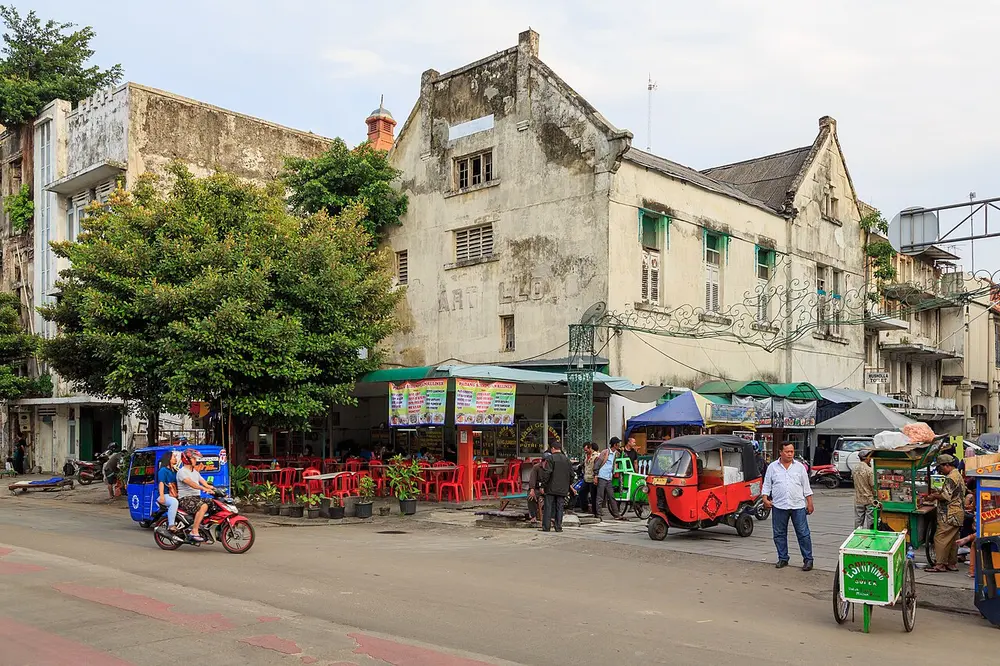
Jakarta Indonesia Colonial-houses-in-Kota-Jakarta. Photo: CEphoto, Uwe Aranas / Wikimedia Commons, CC BY-SA 3.0.
Frequently asked questions
Answers to the questions runners ask before entering, drawn from this race's course guide and the directory's own data — the sources behind them are listed below.
When is the Jakarta Marathon?
The next edition is on 13 June 2027. It is a June race, held in tropical conditions.
Is the Jakarta Marathon flat or hilly?
It is undulating rather than hilly, with about 156 metres of climbing. The rises are gentle and the roads are wide, but the total is enough that the course is not completely flat.
Where does the course run?
The race runs through Jakarta's monuments and business districts on closed toll roads and boulevards. The route uses the city's main arteries rather than a park or a coastal path.
Is Jakarta a good race for a personal best?
The course is fast in profile, but the tropical heat and humidity make a personal best conditional on a controlled start and good heat adaptation. The weather usually has the final say.
Is it suitable for a first marathon?
The race is not built around first-timers. The heat and humidity ask for experience, and anyone attempting a debut should prepare for tropical conditions and a conservative pace.
Does the race hold a World Athletics label?
Yes. The Jakarta Marathon carries a World Athletics Label.
More marathons in Asia
Sources for this page
What each source below is used for on this page, and where to check this race yourself.
- World Athletics — the label calendar and the road-race regulations. Used to check whether the race holds a World Athletics label, and its elite competition details.
- AIMS — the international course-measurement standard behind the 42.195 km distance, and the AIMS race calendar.
- The organizer's own publications — course maps, race handbooks and published results. The date, course character and climbing on this page are compiled from them and re-checked each season.
“A World Athletics Label denotes a full application of the Competition and Technical Rules in, at a minimum, the elite component of the competition. Labels also denote superior standards in event organisation, safety and runner experience, support from public authorities to the event and a financial commitment to anti-doping.”
Where do these facts come from?
Dates, course type, climbing and time limits are compiled from the organizer's publications and re-checked each season; elevation is an estimate of total climbing rather than a survey figure. Always confirm race-day details with the organizer before making plans.
Last reviewed 27 October 2026