
Reykjavik Marathon
Reykjavik's marathon starts beside one of the city's newest landmarks and runs out along one of its oldest views.
By Global Marathon Routes editorial team · Last reviewed 27 October 2026
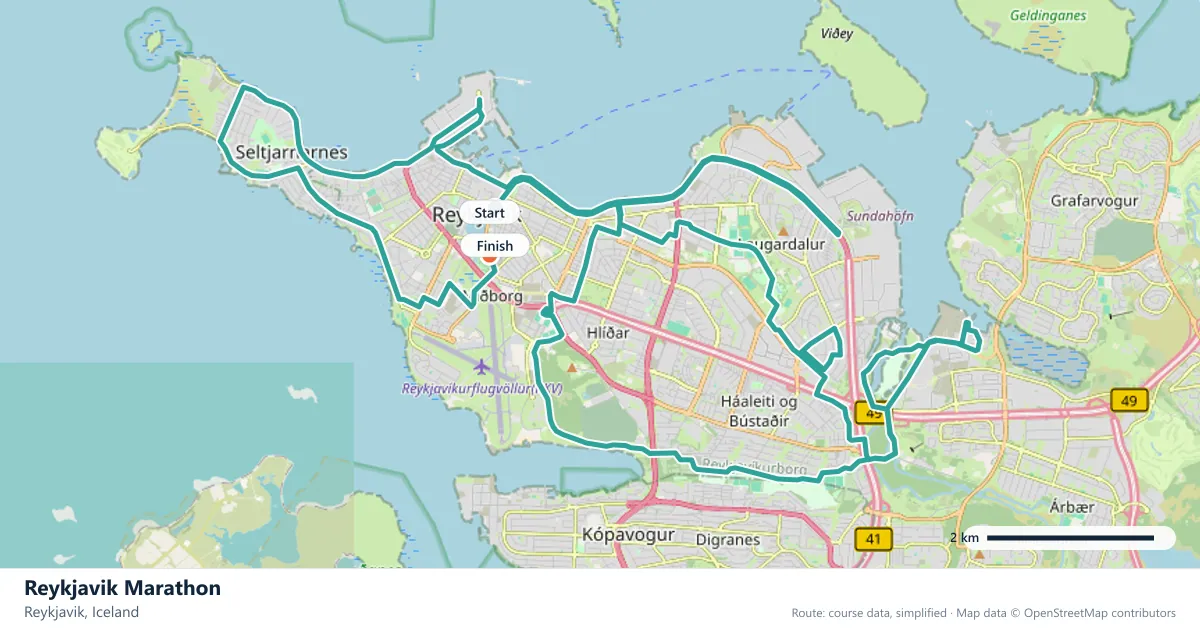
Where does the Reykjavik Marathon run?
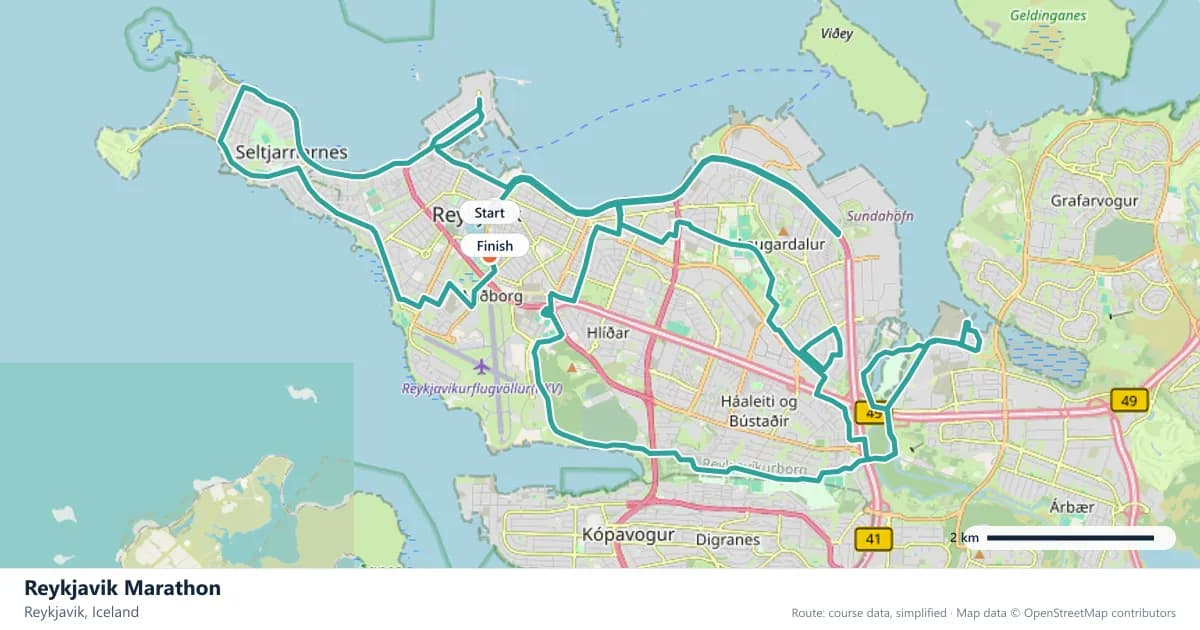
Interactive map
The trace follows the organizer's published course, simplified for the screen: the orange dot is the start, the dark dot the finish. Scroll to zoom, drag to pan.
What is the Reykjavik Marathon course like?
Runs out of Reykjavik past the Harpa concert hall and along the bay, with the mountains across the water. Rolling, breezy and held on the city's culture-night weekend.
- Next edition
- 21 August 2027
- Elevation gain
- 284 m
- Profile
- Hilly
- First run
- —
Course guide
Reykjavik's marathon starts beside one of the city's newest landmarks and runs out along one of its oldest views. The route leaves the city past the Harpa concert hall, follows the bay, and keeps the mountains across the water in sight. The next edition is on 21 August 2027, and the course is hilly, with about 284 metres of climbing.
It is a race that depends on weather and light. Reykjavik in August is still bright in the evening, and the city's culture-night weekend gives the marathon a wider audience than a standalone race would have. The breeze off the bay is part of the experience, and the rolling ground means the course never settles into a flat rhythm.
The result is a marathon that feels closer to a coastal adventure than a city circuit, even though it stays within reach of Reykjavik's centre. That balance is the appeal: wild enough to feel different, compact enough to be manageable.
The course
The route runs out of Reykjavik past the Harpa concert hall and along the bay, with the mountains on the far shore visible across the water. The profile is rolling rather than flat, and the 284 metres of climbing are spread across the distance rather than concentrated in one ascent.
The coastal sections are exposed, and the wind can change how the same kilometres feel in each direction. The course stays close to the city for much of its length, so there is always a sense of place, but the open water makes it feel less protected than a downtown loop.
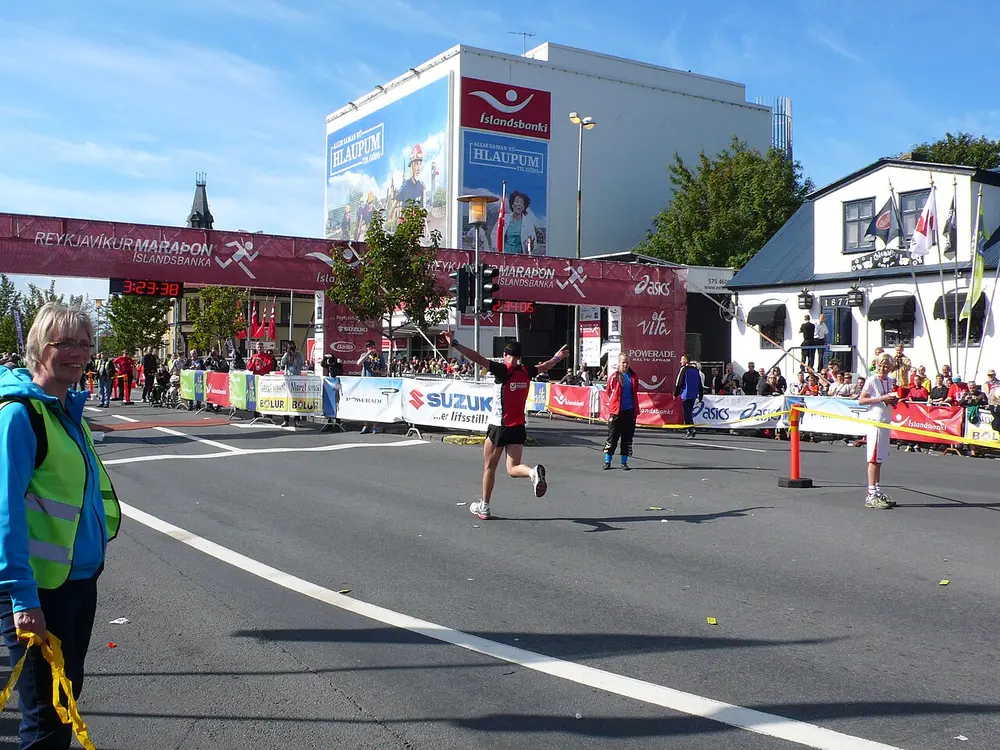
Reykjavik Marathon Finish Line. Photo: Mlc / Wikimedia Commons, CC BY-SA 3.0.
Harpa, the bay and the mountain line
Harpa is the glass concert hall on the harbour, opened in 2011 and now one of Reykjavik's defining buildings. Its facade catches the light in a way that suits a city of sea and sky, and it gives the race a strong opening image.
Beyond Harpa, the course follows the bay. The water is never far away, and the mountain line across it is the visual constant: Mount Esja and the surrounding ridges give the horizon a shape that most city marathons lack. On a clear day the view is the reason to look up; on a grey day it is the reason to keep going.
The bay also brings the wind. There is little shelter on the exposed stretches, and a headwind can make a flat kilometre feel like a climb. The course rewards runners who run by effort rather than by watch.
Wind and rolling ground
The 284 metres of climbing put the race in hilly territory, but the hills are rolling rather than steep. The harder variable is the weather. A breeze that feels refreshing at the start can become a real obstacle on the return leg, and the coastal exposure means conditions can change with the direction of travel.
The practical response is to protect your rhythm. Shorten the stride into the wind, stay relaxed, and let the pace fall rather than fighting for a target that the conditions will not allow. On the sheltered sections, settle back into an even effort and do not try to make up all the lost time at once.
It is also worth training on rolling ground and in wind. Treadmill sessions will not prepare you for the way a coastal breeze changes the effort of a marathon.
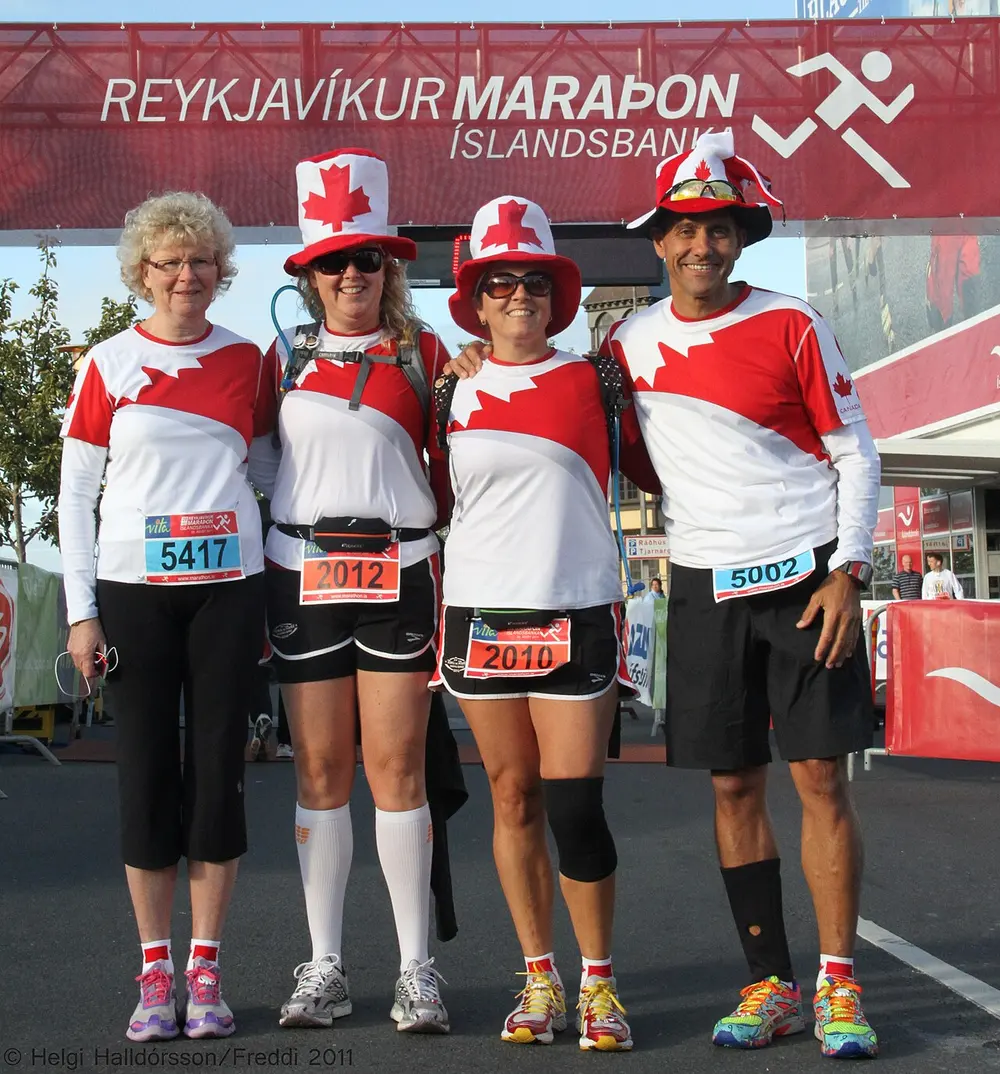
Reykjavik Marathon August 20th 2011. Photo: Helgi Halldórsson from Reykjavík, Iceland / Wikimedia Commons, CC BY-SA 2.0.
Culture night and the city weekend
The race shares the weekend with the city's culture night, when Reykjavik fills with events, open studios and street performances. That makes for a lively finish line and a busy city, but it also means accommodation can be tight. Book early and plan to stay for the evening.
August is a good month to be in Iceland. The summer crowds are still present, the days are long, and the weather is about as mild as it gets. It is not a warm-weather marathon, and runners should come prepared for wind and rain rather than assuming a dry day.
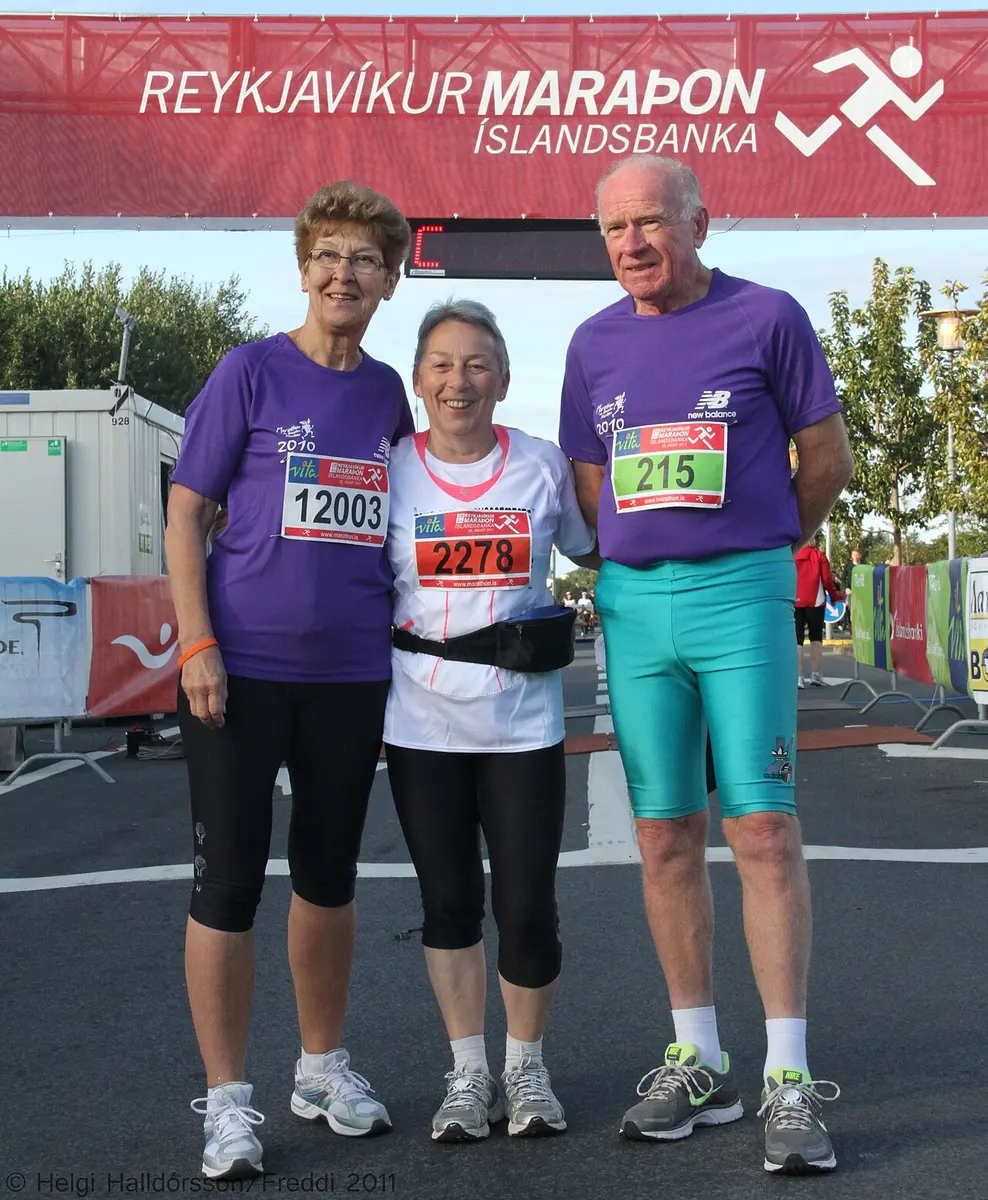
Why Reykjavik Marathon?. Photo: Helgi Halldórsson from Reykjavík, Iceland / Wikimedia Commons, CC BY-SA 2.0.
Frequently asked questions
Answers to the questions runners ask before entering, drawn from this race's course guide and the directory's own data — the sources behind them are listed below.
When is the Reykjavik Marathon?
The next edition is on 21 August 2027, on the city's culture-night weekend.
Is the Reykjavik Marathon hilly?
Yes. The course climbs about 284 metres, with a rolling profile rather than one steep ascent. The climbing requires hill preparation, especially with the coastal breeze.
Is Reykjavik a good first marathon?
It is a first-marathon option, but not an easy one. The rolling profile and the wind make it more demanding than a flat city course, so arrive with hill training and a conservative pacing plan.
Where is the Reykjavik Marathon run?
It leaves the city past the Harpa concert hall and follows the bay. The route stays close to Reykjavik, with mountains visible across the water.
Is it windy on the course?
The race is breezy, and the coastal stretches are exposed. That can make parts of the route harder than the profile suggests, so adjust your effort rather than fighting it.
What is culture night?
Reykjavik's culture night is an annual city festival, and the marathon shares its weekend. Expect a lively city and book accommodation well in advance.
More marathons in Europe
Sources for this page
What each source below is used for on this page, and where to check this race yourself.
- World Athletics — the label calendar and the road-race regulations. Used to check whether the race holds a World Athletics label, and its elite competition details.
- AIMS — the international course-measurement standard behind the 42.195 km distance, and the AIMS race calendar.
- The organizer's own publications — course maps, race handbooks and published results. The date, course character and climbing on this page are compiled from them and re-checked each season.
Where do these facts come from?
Dates, course type, climbing and time limits are compiled from the organizer's publications and re-checked each season; elevation is an estimate of total climbing rather than a survey figure. Always confirm race-day details with the organizer before making plans.
Last reviewed 27 October 2026