
Prague Marathon
Prague is a city best read from its river. The Vltava bends through the historic centre, the castle sits above the left bank, and the old town's streets press close to the water before opening onto…
By Global Marathon Routes editorial team · Last reviewed 27 October 2026
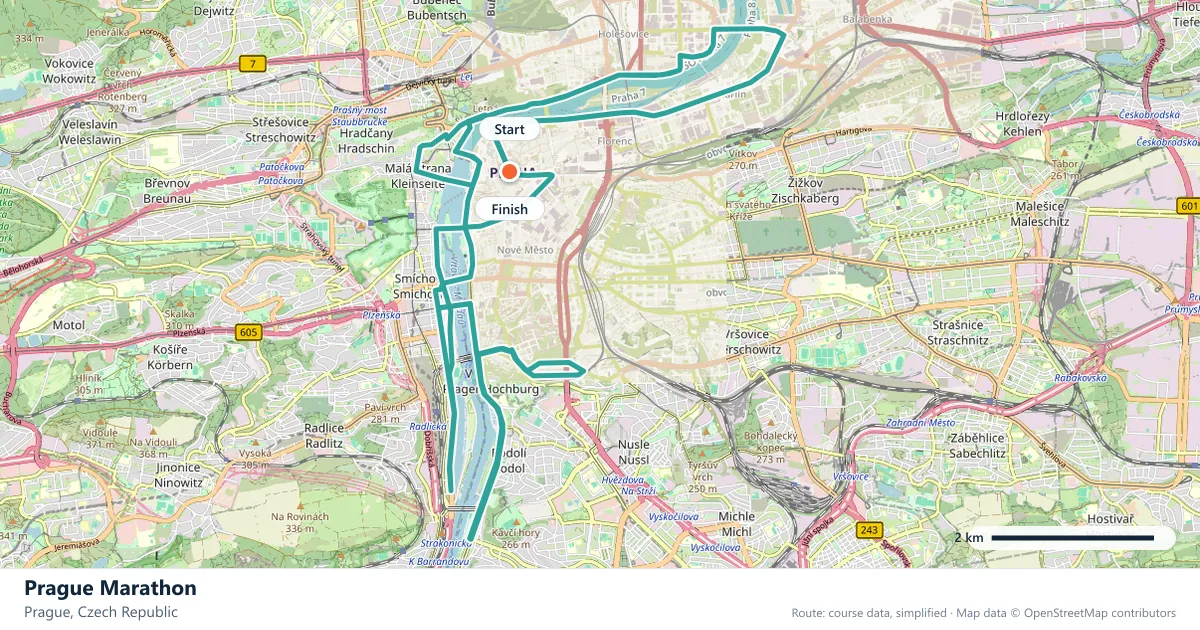
Where does the Prague Marathon run?
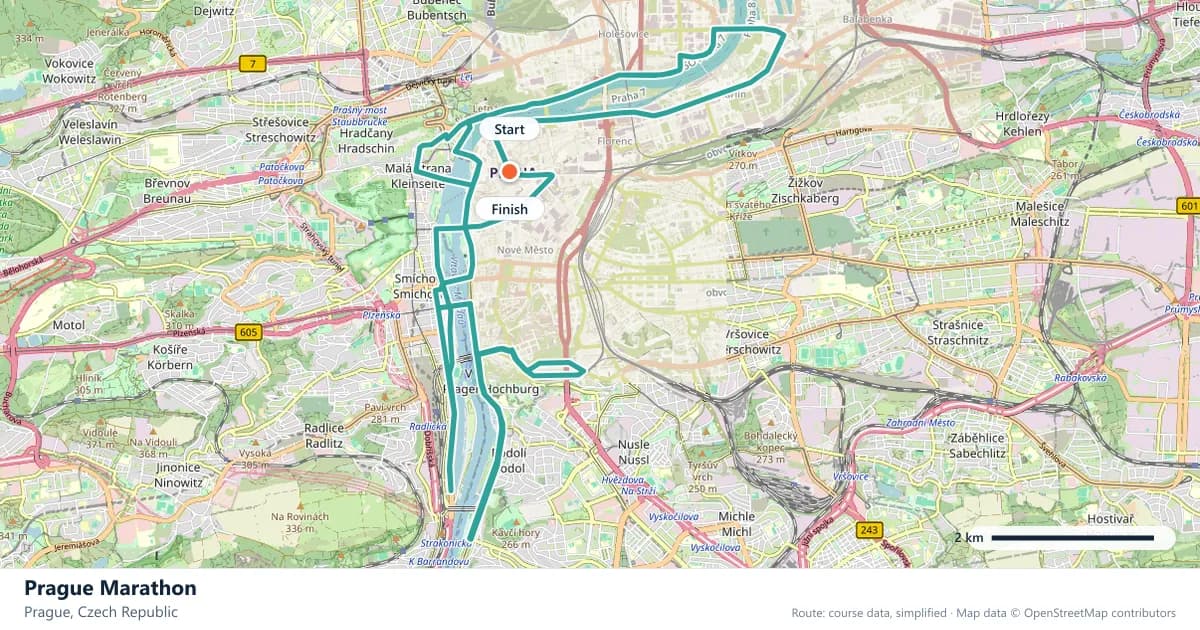
Interactive map
The trace follows the organizer's published course, simplified for the screen: the orange dot is the start, the dark dot the finish. Scroll to zoom, drag to pan.
What is the Prague Marathon course like?
A spring classic crossing the Vltava several times between the old town, the castle and the embankments. Undulating, cobbled in places and famous for its atmosphere.
- Next edition
- 02 May 2027
- Elevation gain
- 215 m
- Profile
- Undulating
- First run
- —
Course guide
Prague is a city best read from its river. The Vltava bends through the historic centre, the castle sits above the left bank, and the old town's streets press close to the water before opening onto the embankments. The marathon uses those crossings as its structure, linking the two sides of the city again and again. The next edition is on 2 May 2027.
The course is undulating, with about 215 metres of climbing, and it includes cobbled sections in places. That combination matters more than the raw numbers: the surface and the repeated changes of level make the race feel harder than a flat-city marathon, even though there is no long mountain climb. It holds a World Athletics Elite Label.
Prague is also one of the great atmospheric races. The old town, the castle and the river give the morning a theatrical quality, and the crowds add to it. The challenge is to enjoy that without letting it pull you into a pace you cannot hold.
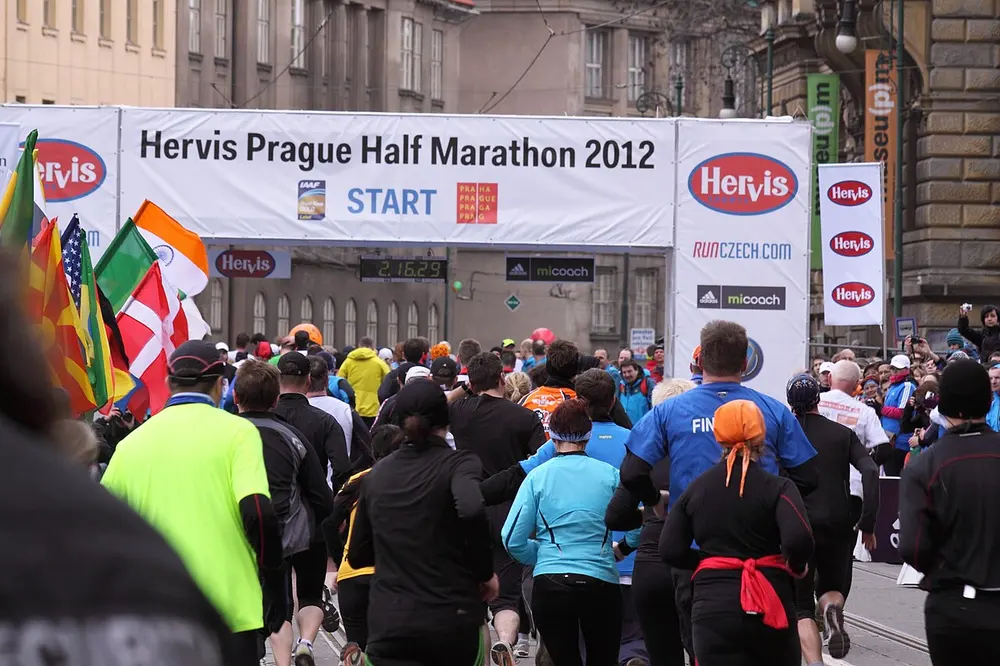
Prague Half Marathon 2012 finish. Photo: Petr Kadlec / Wikimedia Commons, CC BY-SA 3.0.
The course
The route crosses the Vltava several times, connecting the old town, the castle and the embankments. Each crossing changes the surroundings: the dense streets of the right bank give way to the rise towards the castle, then to the open riverfront. The repeated changes of level are what give the course its undulating character.
The climbing is moderate, but it is constant. Short rises and descents arrive in sequence, and the cobbles add a second kind of demand: they ask for attention, a relaxed stride and a little more energy than smooth asphalt. The course never allows a completely automatic rhythm, which is why it rewards runners who can stay flexible.
Cobbles, bridges and rhythm
Prague's historic centre is paved for pedestrians, and the marathon inherits some of that surface. The cobbled sections are part of the race's character, but they are not the place to chase a split. Keep your stride short and relaxed, watch the ground in front of you and let the smooth stretches do the work.
The bridges are the other structural feature. They provide the river views and the changes of side, and their approaches add small climbs to a course that already has plenty of them. Treat each crossing as a transition rather than a surge. The flat embankments, when they come, are where you can settle back into a rhythm.
The old town and the castle
The old town is the dense, historic heart of the right bank, with the astronomical clock and the square as its centre. Prague Castle rises above the left bank, a vast complex that has been the seat of Czech rulers for centuries. The course passes through both areas closely enough that they define the morning, and the river is the thread between them.
That geography gives the race a sequence of distinct stages. The old town is tight and loud, the castle area is higher and more open, the embankments are broad and calm. On a course with 215 metres of climbing, those changes are useful markers: they tell you where you are and how much of the morning remains.
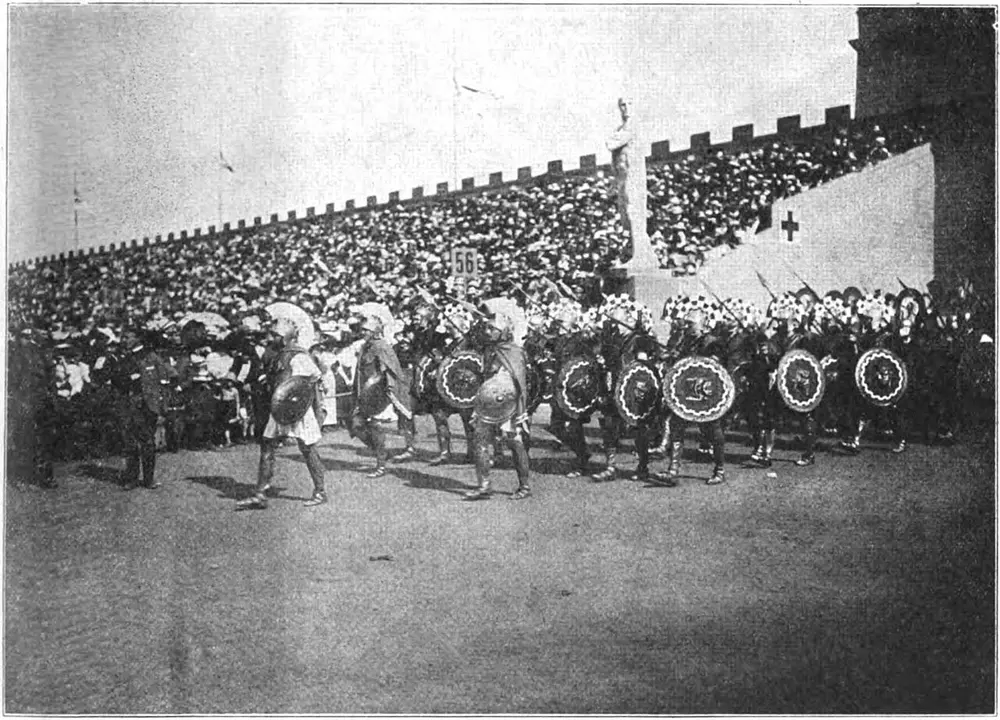
Battle of Marathon reenactment in Prague, 1912. Photo: Unknown photographer / Wikimedia Commons, Public domain.
Racing the atmosphere
The atmosphere is a real part of the course, not a marketing extra. The old town's streets concentrate sound, the river crossings open up views, and the crowds gather where the landmarks are. That can be uplifting, and it can also be misleading: the noise and the scenery make a fast pace feel easier than it is.
The remedy is to decide your effort before the gun and to check it against something other than the crowd. Use the flat embankment sections to calibrate, and do not try to match the runners around you when the course turns uphill. The cobbles will slow you anyway; let them, and save your energy for the smoother kilometres.
A debut in a historic centre
The spring date, the manageable climbing and the atmosphere make Prague an appealing first marathon. The route is varied enough to keep the mind occupied, and the city is compact enough that supporters can see you more than once. But the cobbles and the constant undulation mean a debut here is not a stroll through the postcard.
A first-time marathoner should arrive with some experience of uneven surfaces and rolling roads, and should start conservatively. The course's beauty is a distraction, not a substitute for training. Runners chasing a personal best face the same lesson: the 215 metres and the cobbles are small individually, but they add up over 42.195 kilometres.
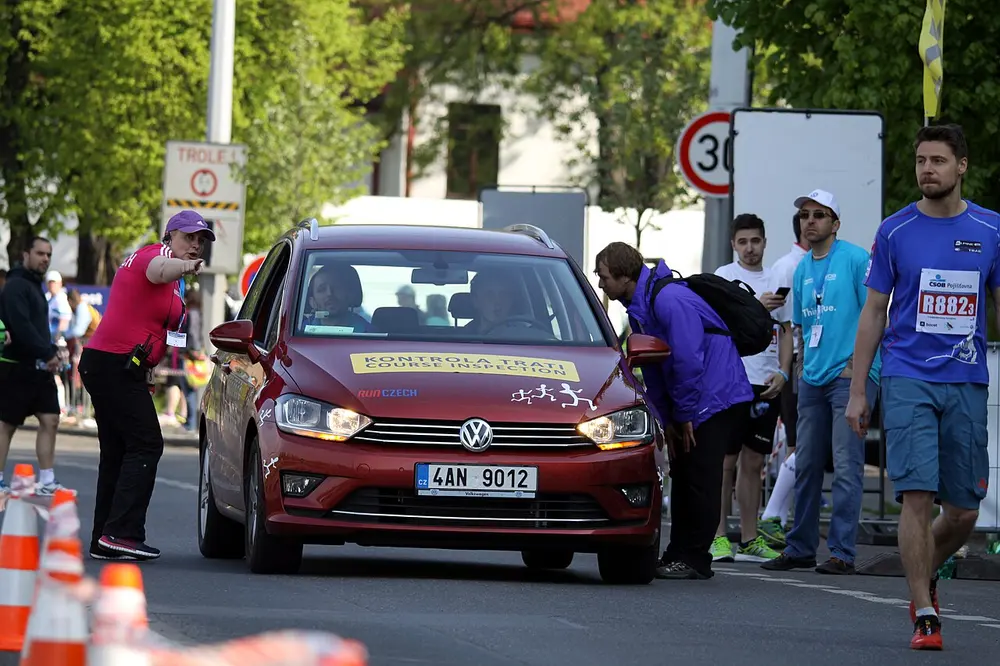
Prague International Marathon 2015 (1). Photo: Chmee2 / Wikimedia Commons, CC BY 3.0.
Frequently asked questions
Answers to the questions runners ask before entering, drawn from this race's course guide and the directory's own data — the sources behind them are listed below.
When is the Prague Marathon?
The next edition is on 2 May 2027. It is a spring race in the Czech capital.
Is the Prague Marathon hilly?
It is undulating rather than hilly, with about 215 metres of climbing and no single long ascent. The repeated rises, the river crossings and the cobbles make it feel more demanding than the raw gain suggests.
Is Prague good for a personal best?
It can be, but the course asks for discipline. The climbing is moderate and the spring date is kind, while the cobbled sections and constant changes of level can cost time if you do not pace evenly.
Is Prague suitable for a first marathon?
It is, for a runner who is prepared for the surface. The spring date, the atmosphere and the manageable climbing suit a debut, but the cobbles and the undulation mean you should train on similar ground and start conservatively.
What is the surface like?
The course uses city roads and includes cobbled sections in places, particularly through the historic centre. The cobbles ask for a relaxed stride and careful footing.
Does the course cross the Vltava?
Yes. The route crosses the river several times, linking the old town, the castle and the embankments.
What label does the Prague Marathon hold?
It holds a World Athletics Elite Label, reflecting its place among the established European spring marathons.
More marathons in Europe
Sources for this page
What each source below is used for on this page, and where to check this race yourself.
- World Athletics — the label calendar and the road-race regulations. Used to check whether the race holds a World Athletics label, and its elite competition details.
- AIMS — the international course-measurement standard behind the 42.195 km distance, and the AIMS race calendar.
- The organizer's own publications — course maps, race handbooks and published results. The date, course character and climbing on this page are compiled from them and re-checked each season.
“A World Athletics Label denotes a full application of the Competition and Technical Rules in, at a minimum, the elite component of the competition. Labels also denote superior standards in event organisation, safety and runner experience, support from public authorities to the event and a financial commitment to anti-doping.”
Where do these facts come from?
Dates, course type, climbing and time limits are compiled from the organizer's publications and re-checked each season; elevation is an estimate of total climbing rather than a survey figure. Always confirm race-day details with the organizer before making plans.
Last reviewed 27 October 2026