
Santiago Marathon
Santiago is a city with a wall at the end of its streets. The Andes rise along the eastern edge of the Chilean capital, often snow-covered, and the marathon loops through the city with that skyline…
By Global Marathon Routes editorial team · Last reviewed 27 October 2026
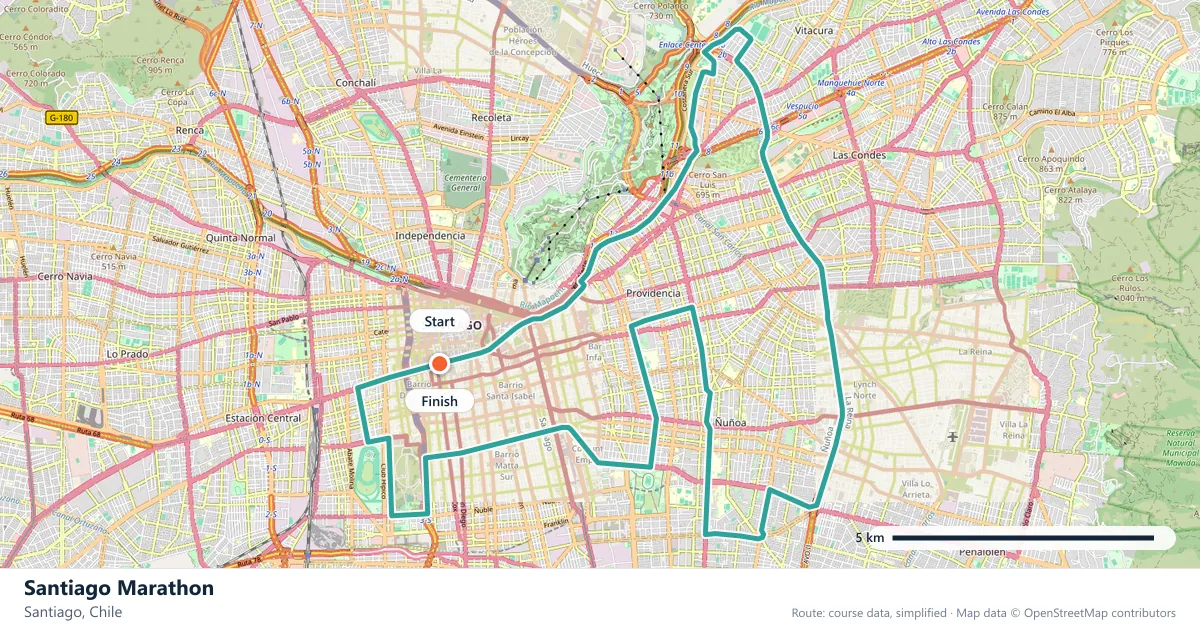
Where does the Santiago Marathon run?
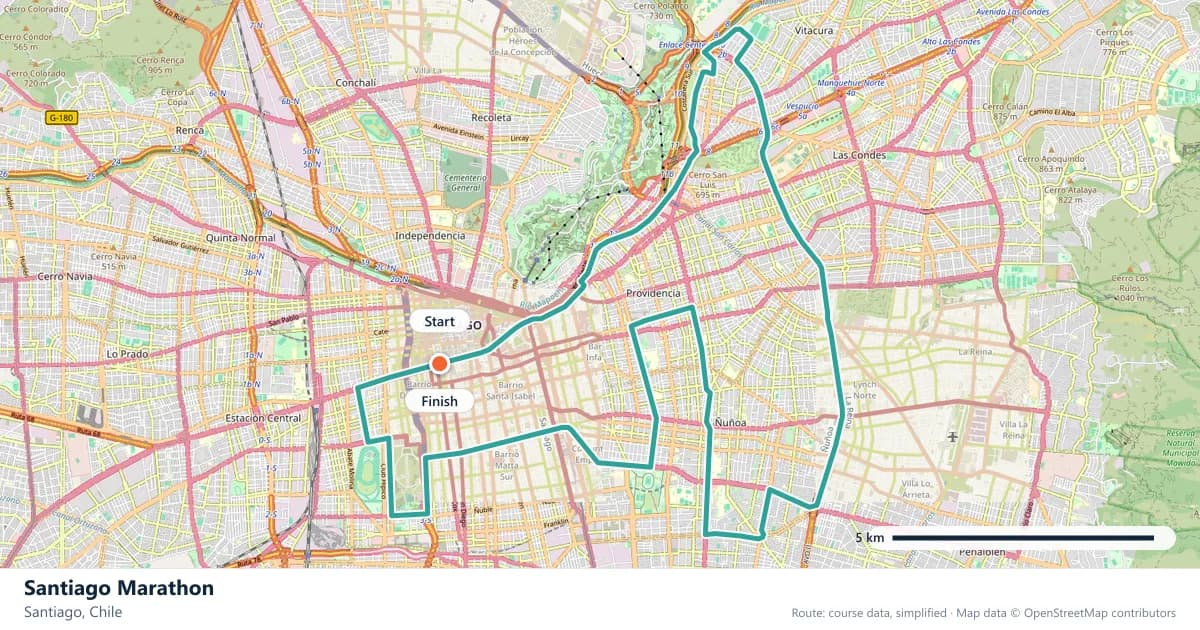
Interactive map
The trace follows the organizer's published course, simplified for the screen: the orange dot is the start, the dark dot the finish. Scroll to zoom, drag to pan.
What is the Santiago Marathon course like?
Chile's biggest marathon, looping through Santiago with the Andes on the skyline. Rolling rather than flat, and run in cool autumn air.
- Next edition
- 16 May 2027
- Elevation gain
- 202 m
- Profile
- Undulating
- First run
- —
Course guide
Santiago is a city with a wall at the end of its streets. The Andes rise along the eastern edge of the Chilean capital, often snow-covered, and the marathon loops through the city with that skyline as a constant. The 2027 edition is scheduled for 16 May.
About 202 metres of climbing is spread through a route that rolls rather than climbs. There is no single ascent to prepare for, but the repeated rises keep the pace from settling completely. May is autumn in Chile, and the race is run in cool air rather than the heat of summer.
Santiago is Chile's biggest marathon, and the combination of a capital-city loop and a mountain backdrop gives it a strong sense of place. It is also a course that suits a first marathon: the climbing is moderate, the route stays within the city and the autumn conditions are friendly.
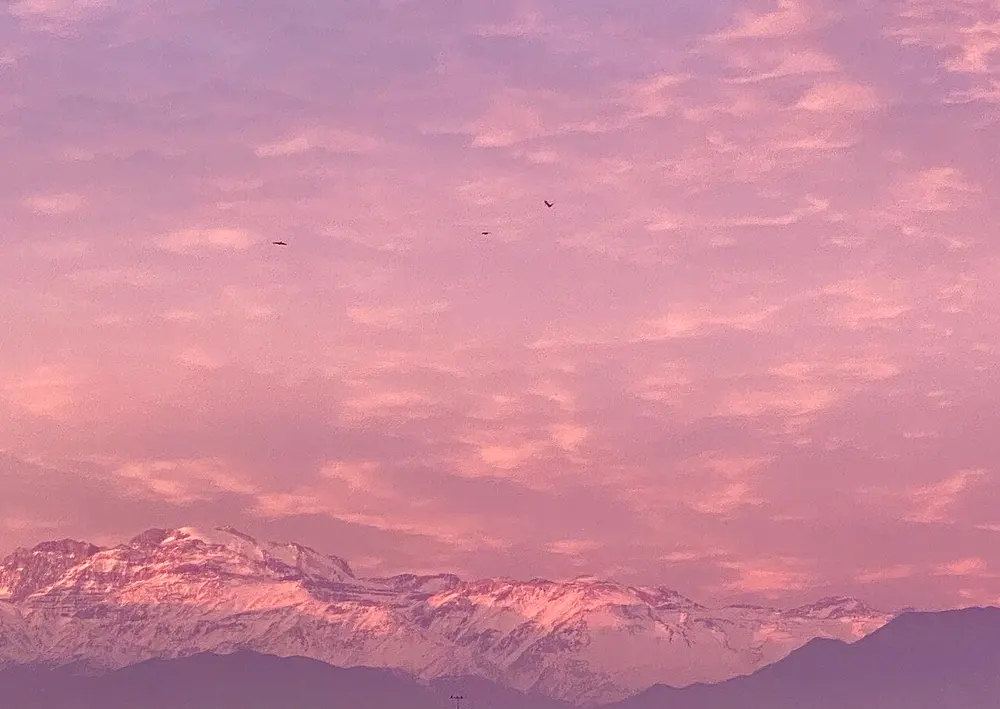
Atardecer rosado, puesta de sol en Santiago, Chile con el telón de la Cordillera de los Andes nevado. Photo: Nbendersky / Wikimedia Commons, CC BY-SA 4.0.
The course
The route loops through Santiago on city streets, gaining about 202 metres over the full distance. The loop format keeps the race inside the capital, so the Andes remain a backdrop rather than something the course climbs. The ground rolls with short rises, and the second half revisits parts of the city the runners have already seen.
That familiarity is useful. Knowing that a rise is coming, or that a straight is about to open, helps with pacing in a way that a point-to-point course does not. The loop also means the city feels progressively smaller, which can be a comfort in the final 10 km.
A basin beneath the Andes
Santiago sits in a valley surrounded by mountains, and the Andes dominate the view from almost everywhere in the city. The Mapocho River runs through the urban centre, and the wooded Cerro San Cristóbal rises inside the city limits. The result is a capital that feels closely held by its geography.
The marathon does not climb into the mountains, but their presence shapes the experience. The light changes when the sun moves across the valley, the snow line is visible above the buildings, and the air can feel cool even when the city is sheltered. Runners who look up will be reminded of where they are.

Mural en Santiago, Chile - A7400613. Photo: Rjcastillo / Wikimedia Commons, CC BY-SA 4.0.
The autumn date
May is autumn in Chile, and the race is held in cool air rather than the heat of the southern summer. That is a significant advantage for a city marathon: the same 202 metres of climbing cost less when the temperature is moderate, and the body can hold a steady effort without overheating.
The date is confirmed for 16 May 2027, so it is the next edition rather than a provisional one. The autumn conditions are part of what makes the race approachable, but they do not remove the need for a proper warm-up or a sensible pace.
Rolling rhythm
About 202 metres of climbing is spread through the loop in short rises. Individually, they are not severe; collectively, they reward a runner who can keep the effort even rather than surging on every incline. The course is a test of rhythm more than strength.
The best approach is to run by effort on the rises and let the pace recover on the flats and descents. Trying to hold exactly the same splits on rolling ground is a recipe for a fast first half and a slow second one. Santiago rewards patience more than aggression.
Debuting in the Andes capital
The race suits a first marathon. The climbing is moderate, the route is contained within the city and the autumn air is kind. The loop format also makes the day easier to manage: there are no remote sections and no point-to-point travel to worry about.
The reward is a tour of Santiago with the Andes overhead. The city's streets and landmarks provide the scenery, and the mountains provide the scale. For a debutant who wants a capital-city marathon without an extreme course, it is a sound choice.
En restauración, tranvía 757 de Santiago de Chile. Museo Ferroviario de Santiago (Chile). Photo: CARLOS TEIXIDOR CADENAS / Wikimedia Commons, CC BY-SA 4.0.
Frequently asked questions
Answers to the questions runners ask before entering, drawn from this race's course guide and the directory's own data — the sources behind them are listed below.
When is the Santiago Marathon?
The next edition is scheduled for 16 May 2027. It is held in May, in Chile's autumn.
Is the Santiago Marathon flat?
No. It is undulating, with about 202 metres of climbing. The route rolls through the city rather than staying level, and the short rises keep the pace from settling completely.
Can I run Santiago as my first marathon?
Yes, the race suits a first marathon. The climbing is moderate, the course stays within the city and the autumn conditions are cooler than summer. A conservative first half is still the best plan.
Is the Santiago Marathon a personal-best course?
The race is not set up as a personal-best course. The 202 metres of rolling climbing make even pacing harder, although the cool autumn air helps.
Where is the Santiago Marathon run?
It is a loop through Santiago, the capital of Chile, with the Andes visible on the skyline. The route stays within the city rather than climbing into the mountains.
Why is the May date an advantage?
May is autumn in Santiago, so the race is run in cool air rather than summer heat. That helps on a rolling course.
What is the Andes backdrop like?
The mountains rise along the eastern edge of the city and are visible throughout much of the loop. They give the race its scale, but the course itself stays on urban roads.
More marathons in Chile
More marathons in Americas
Sources for this page
What each source below is used for on this page, and where to check this race yourself.
- World Athletics — the label calendar and the road-race regulations. Used to check whether the race holds a World Athletics label, and its elite competition details.
- AIMS — the international course-measurement standard behind the 42.195 km distance, and the AIMS race calendar.
- The organizer's own publications — course maps, race handbooks and published results. The date, course character and climbing on this page are compiled from them and re-checked each season.
Where do these facts come from?
Dates, course type, climbing and time limits are compiled from the organizer's publications and re-checked each season; elevation is an estimate of total climbing rather than a survey figure. Always confirm race-day details with the organizer before making plans.
Last reviewed 27 October 2026