
Sofia Marathon
Sofia sits on a broad high plain with Vitosha mountain rising at its southern edge, and that geography shapes the city's marathon.
By Global Marathon Routes editorial team · Last reviewed 27 October 2026
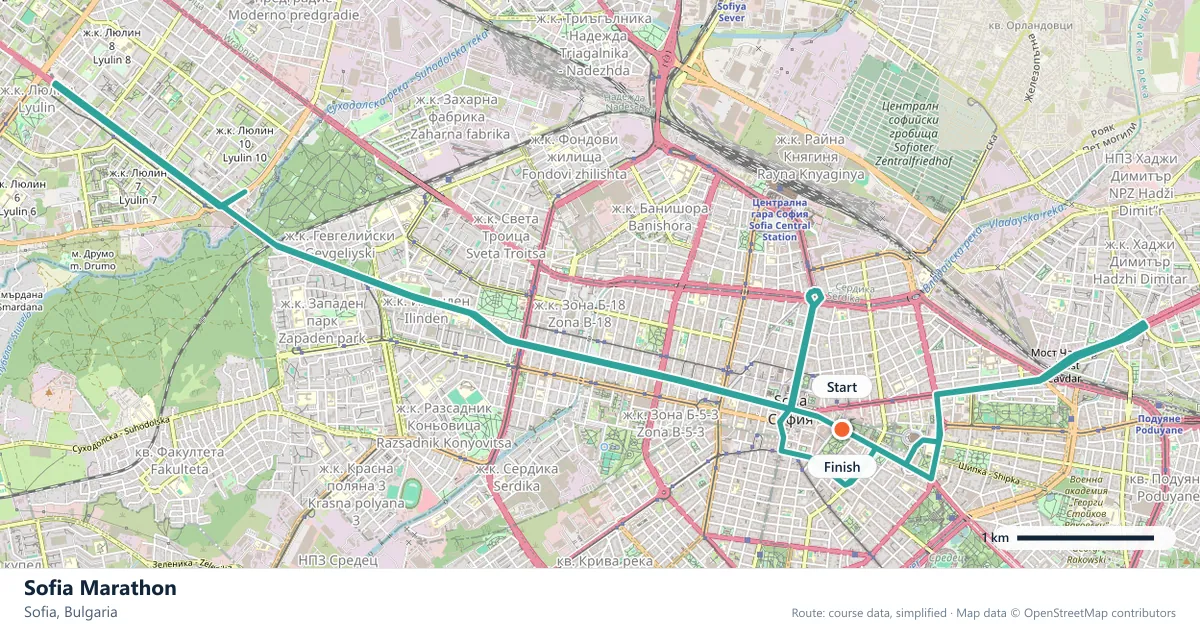
Where does the Sofia Marathon run?
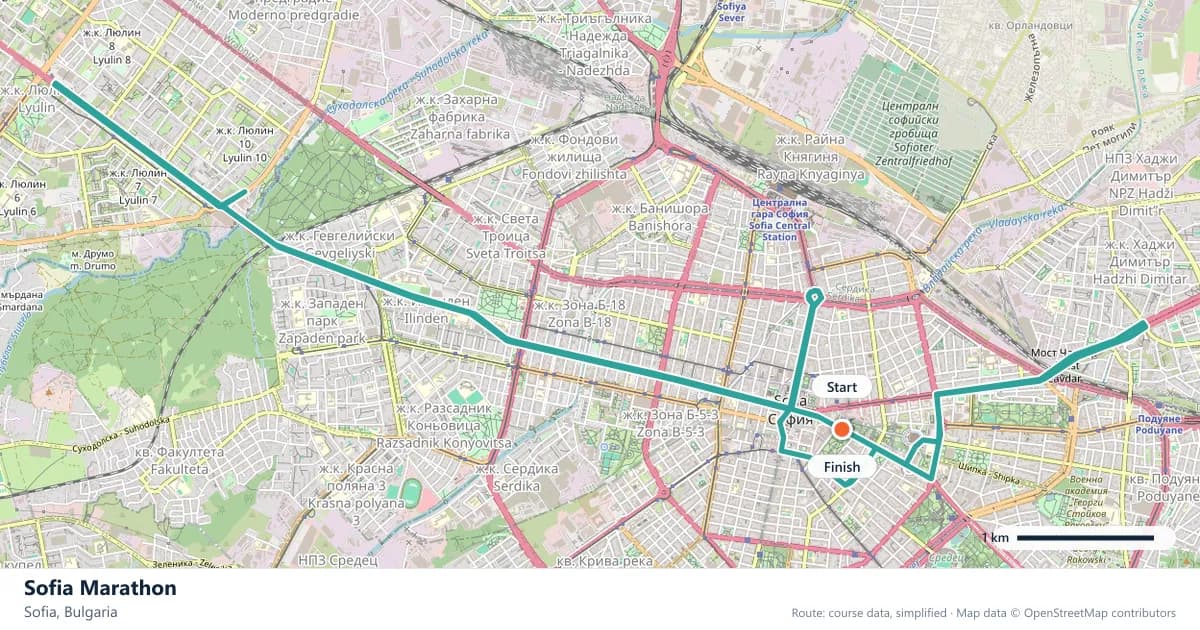
Interactive map
The trace follows the organizer's published course, simplified for the screen: the orange dot is the start, the dark dot the finish. Scroll to zoom, drag to pan.
What is the Sofia Marathon course like?
A high-altitude city marathon at the foot of Vitosha mountain, running past the Alexander Nevsky cathedral and out along the boulevards. Cool October air, rolling profile.
- Next edition
- October 2027 (expected)
- Elevation gain
- 196 m
- Profile
- Undulating
- First run
- —
Course guide
Sofia sits on a broad high plain with Vitosha mountain rising at its southern edge, and that geography shapes the city's marathon. The route stays within the capital, passing the Alexander Nevsky cathedral and following the boulevards, while the mountain remains a presence on the skyline. The edition covered here took place on 11 October 2026.
The course is undulating rather than flat, with about 196 metres of climbing spread across short rises. Sofia's elevation adds another layer: the city stands roughly 550 metres above sea level, and the altitude is part of the race's character. October brings cooler conditions, which suits distance running but can make the start feel raw.
This is a city marathon with a mountain backdrop and a rolling rhythm. It holds a World Athletics Label, and its character comes from the combination of boulevard running, the cathedral's gold domes and the Vitosha massif in the distance.
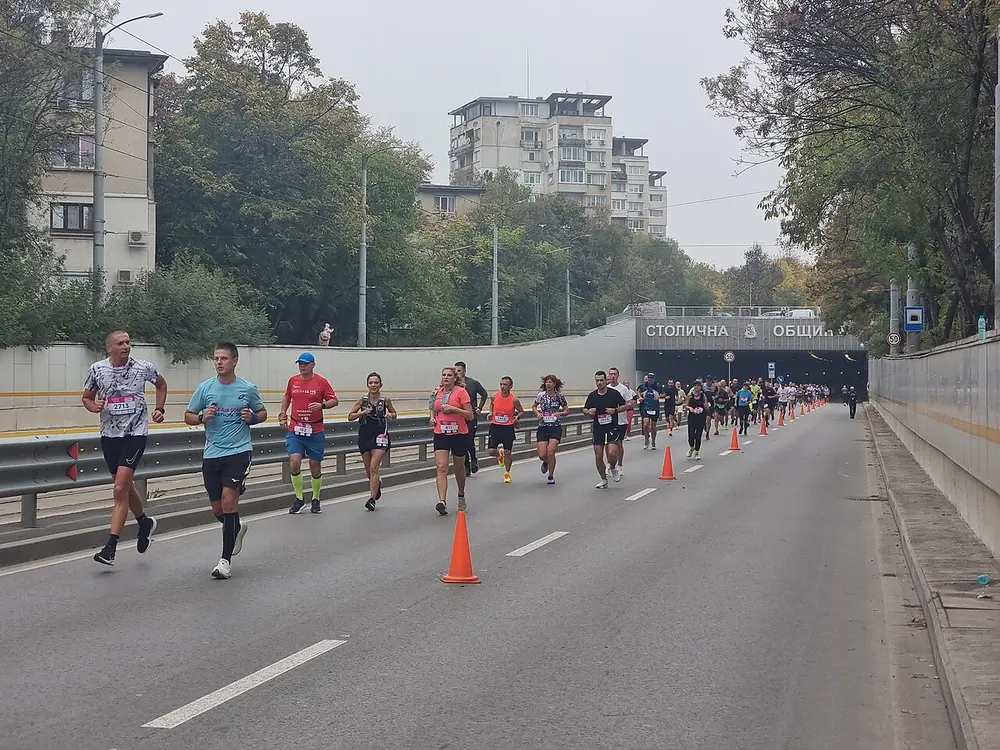
Runners exiting a road tunnel during the 2024 Sofia Marathon. Photo: DemieK07 / Wikimedia Commons, CC BY 4.0.
The course
The race works through Sofia's central streets, passing the Alexander Nevsky cathedral and using the long boulevards that give the city its spacious, ceremonial feel. The route stays urban throughout, with the mountain visible between buildings and at the end of the wider avenues. The running is on city streets from start to finish, without a detour into the surrounding hills.
At 196 metres of gain, the climbing is moderate rather than severe. The rises are short, and the descents that follow are equally brief, so the course never settles into a long climb or a long recovery. That pattern is what makes it undulating: not one mountain, but a series of changes that keep asking for small adjustments.
Vitosha and the high city
Vitosha is Sofia's defining natural feature. The mountain rises steeply from the city's southern suburbs, and its upper slopes are visible from much of the centre. The marathon does not climb it, but the mountain's presence gives the race a sense of altitude and enclosure that a flat river city cannot match.
The city's elevation does the rest. At around 550 metres, Sofia is not a mountain resort, but the air is thinner than at sea level, and runners arriving from lower ground may notice it in the first half. The effect is subtle on the flat and more pronounced on the rises, which is why an even effort matters more than a fast opening kilometre.
The Alexander Nevsky cathedral
The cathedral is Sofia's most recognisable building, a vast Orthodox church with gold domes and a silhouette that can be seen across the centre. The marathon passes it, and the building becomes a reference point in a course that otherwise moves through ordinary city streets. Its scale is a reminder that Sofia's history is layered: Roman ruins, Ottoman mosques, Soviet-era boulevards and modern glass all sit within a few minutes of each other.
For runners, the cathedral is a marker rather than a destination. It arrives, it passes, and the boulevards continue. That is the nature of a city marathon: the landmarks give shape to the morning, but the running is done on the streets between them.
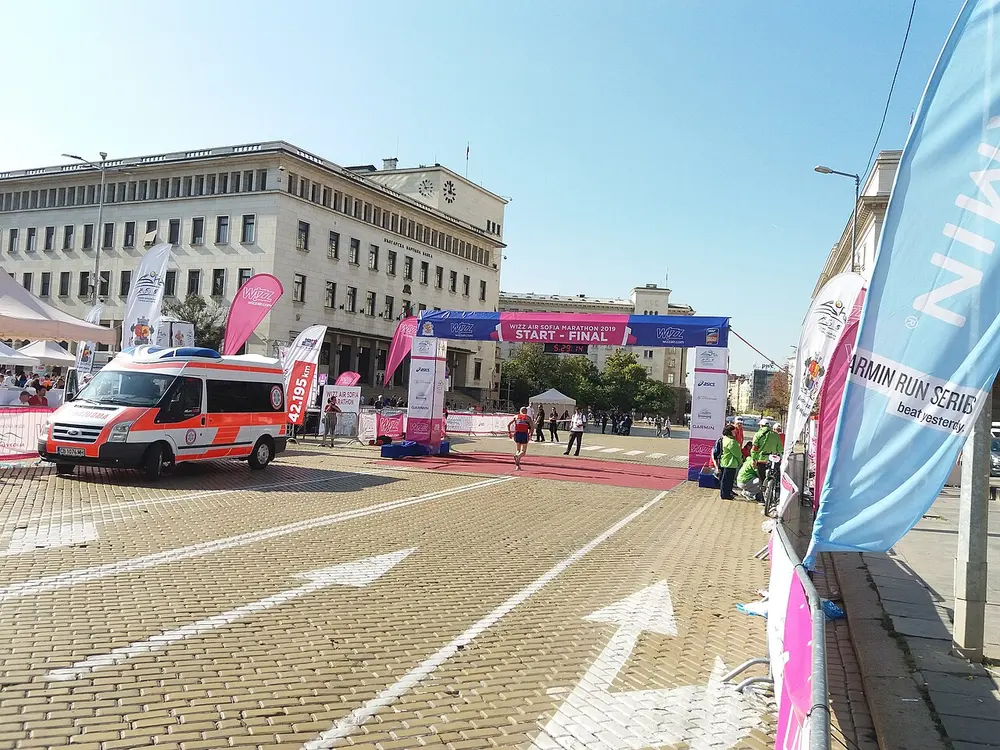
Sofia marathon, Софийски маратон, 2019 (1). Photo: TodorBelomorski / Wikimedia Commons, CC BY-SA 4.0.
What the rolling profile asks
The short climbs are easy to attack and easy to underestimate. A 196-metre total sounds modest, but the effort arrives in repeated doses, and each rise taken too hard leaves a small debt for later. The right approach is to run by effort rather than pace: let the climbs slow you slightly and let the descents bring you back without surging.
The boulevards add their own challenge. Long, straight avenues can feel monotonous, and the temptation is to drift into a pace that is either too fast or too slow. Break the morning into sections, use the cathedral and the mountain as markers, and keep the effort steady across the flat stretches.
October air and race morning
October in Sofia is a transitional month, and the morning air can feel cool before the race begins. That is good for running once you are moving, but it makes the wait before the start something to plan for. Layers you can discard are more useful than a single heavy top.
The city is compact and the course stays within the centre, so supporters have plenty of opportunities to see the race. The combination of the cathedral, the Vitosha skyline and the autumn light gives the morning a distinct character. It is a demanding course rather than a fast one, and it rewards runners who arrive prepared for both the rolling terrain and the altitude.
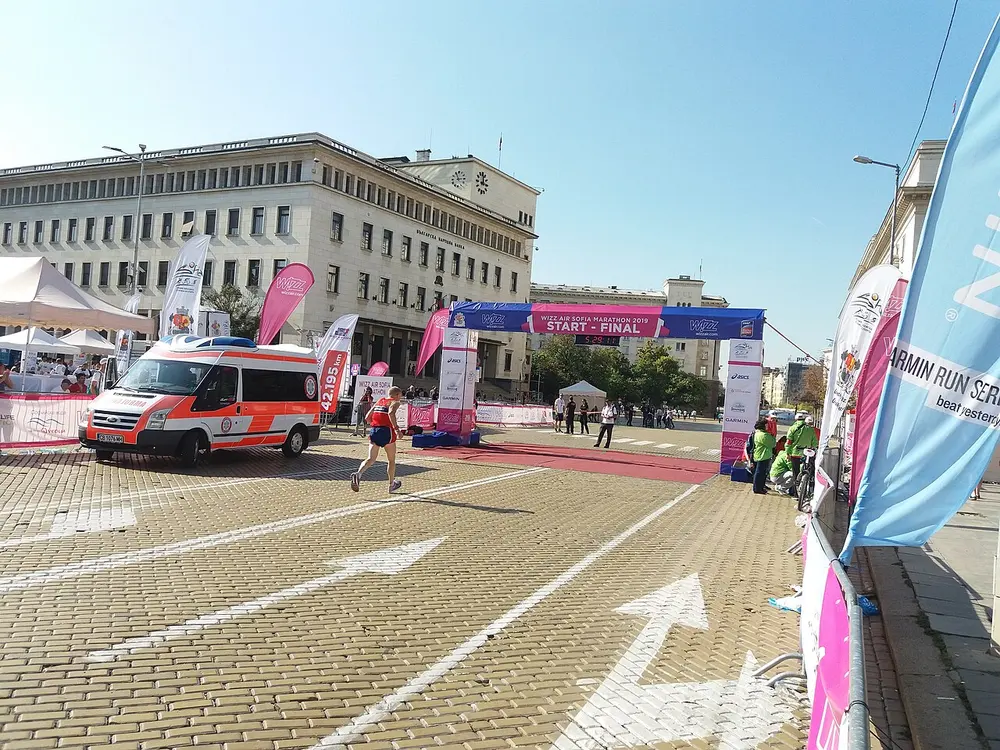
Sofia marathon, Софийски маратон, 2019 (10). Photo: TodorBelomorski / Wikimedia Commons, CC BY-SA 4.0.
Frequently asked questions
Answers to the questions runners ask before entering, drawn from this race's course guide and the directory's own data — the sources behind them are listed below.
When was the Sofia Marathon?
The edition covered here took place on 11 October 2026. Sofia's marathon is an autumn race, held after the heat of the Bulgarian summer.
Is the Sofia Marathon flat or hilly?
It is undulating, with about 196 metres of climbing. The rises are short rather than sustained, but they arrive often enough to interrupt a fixed pace.
Is Sofia a high-altitude marathon?
The city sits at roughly 550 metres above sea level, with Vitosha rising to the south. It is not a mountain race, but the altitude is part of the challenge, especially for runners arriving from lower ground.
What is the surface like?
The race uses city streets and boulevards. The surface is mostly road, and the undulation comes from short rises rather than rough ground.
Does the Sofia Marathon hold a World Athletics label?
Yes, it holds a World Athletics Label. The label reflects the race's place on the international road-running calendar.
Where does the Sofia Marathon run?
It runs through central Sofia, passing the Alexander Nevsky cathedral and following the city's boulevards, with Vitosha as the backdrop.
More marathons in Europe
Sources for this page
What each source below is used for on this page, and where to check this race yourself.
- World Athletics — the label calendar and the road-race regulations. Used to check whether the race holds a World Athletics label, and its elite competition details.
- AIMS — the international course-measurement standard behind the 42.195 km distance, and the AIMS race calendar.
- The organizer's own publications — course maps, race handbooks and published results. The date, course character and climbing on this page are compiled from them and re-checked each season.
“A World Athletics Label denotes a full application of the Competition and Technical Rules in, at a minimum, the elite component of the competition. Labels also denote superior standards in event organisation, safety and runner experience, support from public authorities to the event and a financial commitment to anti-doping.”
Where do these facts come from?
Dates, course type, climbing and time limits are compiled from the organizer's publications and re-checked each season; elevation is an estimate of total climbing rather than a survey figure. Always confirm race-day details with the organizer before making plans.
Last reviewed 27 October 2026