
Yerevan Marathon
Yerevan sits on a plateau roughly 1,000 metres above sea level, and on clear days Mount Ararat rises beyond the city's southern edge.
By Global Marathon Routes editorial team · Last reviewed 27 October 2026
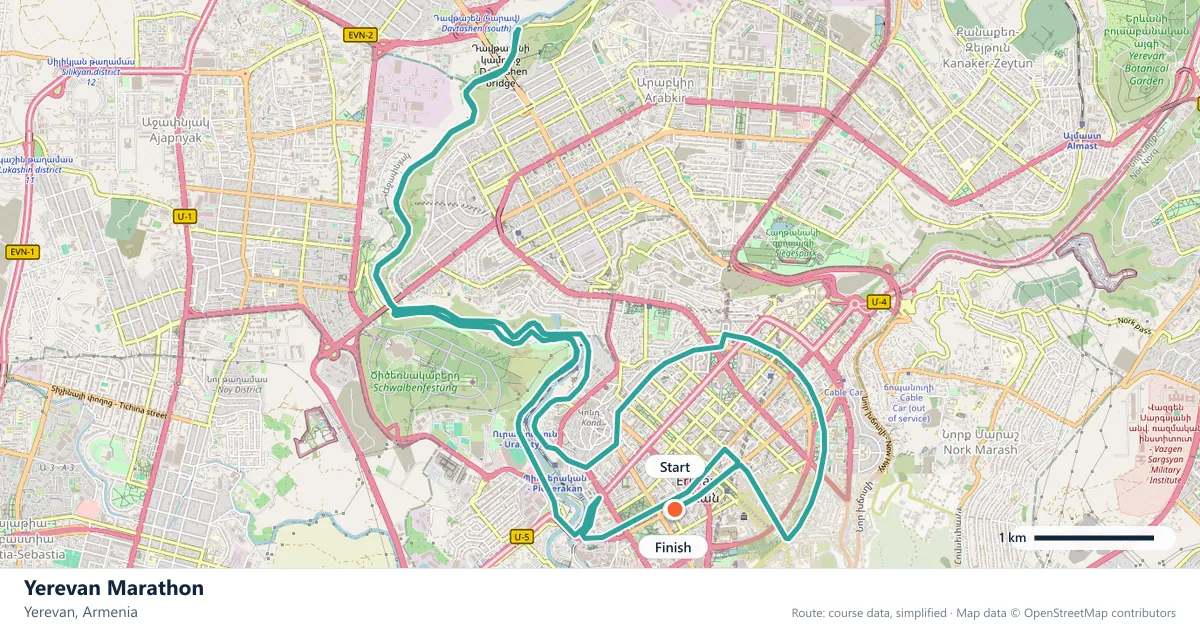
Where does the Yerevan Marathon run?
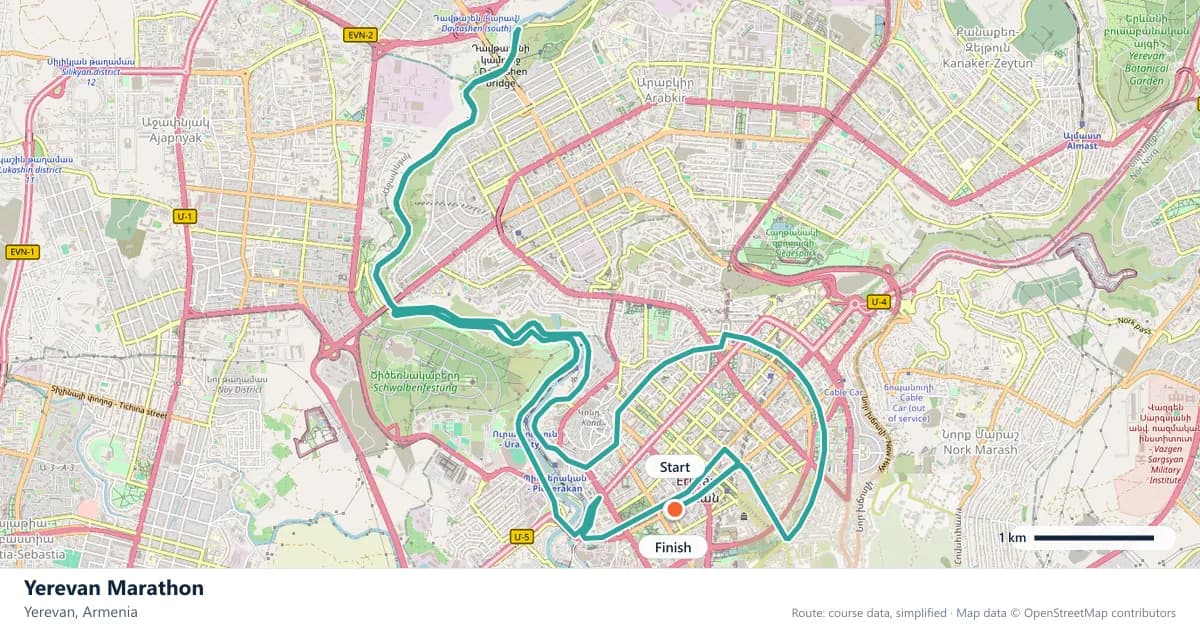
Interactive map
The trace follows the organizer's published course, simplified for the screen: the orange dot is the start, the dark dot the finish. Scroll to zoom, drag to pan.
What is the Yerevan Marathon course like?
A high-altitude city marathon in the Armenian capital, looping past Republic Square and up towards the Cascade. Around 1,000 metres of elevation at the start.
- Next edition
- October 2027 (expected)
- Elevation gain
- 347 m
- Profile
- Hilly
- First run
- —
Course guide
Yerevan sits on a plateau roughly 1,000 metres above sea level, and on clear days Mount Ararat rises beyond the city's southern edge. That setting shapes the Yerevan Marathon as much as the streets do. The 2026 edition is on 18 October, and the race is a hilly loop through the Armenian capital, climbing about 347 metres as it passes Republic Square and works its way up towards the Cascade.
This is a city marathon with a mountaineer's profile. The climbing is spread around a loop rather than saved for one summit, so the legs never get a long flat spell to settle. The altitude at the start adds a second, quieter tax. Neither feature is extreme on its own; together they make the race a test of patience rather than a place to chase a fast time.
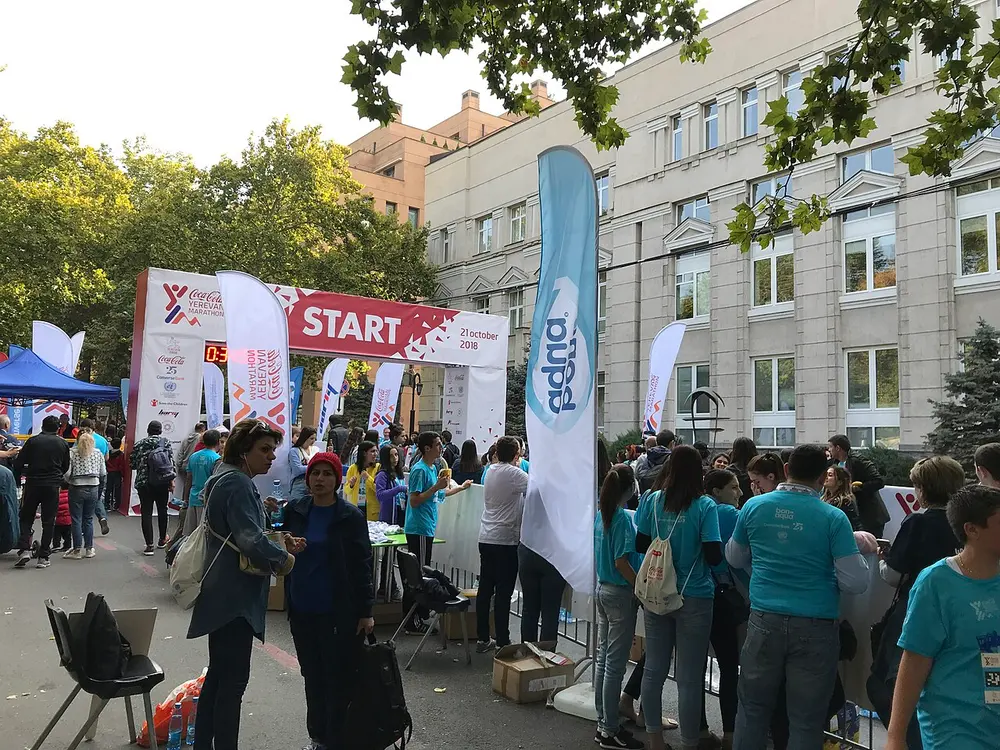
Yerevan Marathon on Yerevan 2800 anniversary. Photo: IM3847 / Wikimedia Commons, CC BY-SA 4.0.
The course
The route loops through central Yerevan, passing Republic Square and heading up towards the Cascade. Republic Square is the civic heart of the city, a long piazza framed by government buildings and fountains; the Cascade is the monumental stairway and arts complex that climbs the hillside above the centre. Between them, the marathon covers the terrain that defines the city.
The profile is hilly, with roughly 347 metres of climbing across 42.195 kilometres. That number matters less than its distribution: the route rolls, with the climb towards the Cascade as the defining ascent and smaller rises elsewhere. There is no single pass to tick off and no long descent to recover on. The loop brings runners back through the same central streets, which makes the second half a mental as well as a physical exercise.
| Race fact | Detail |
|---|---|
| Date | October 2027 (expected) |
| City | Yerevan, Armenia |
| Profile | Hilly |
| Elevation gain | About 347 m |
| Start altitude | Around 1,000 m |
| Course | A central loop past Republic Square and towards the Cascade |
The Cascade climb
The Cascade is not a single flight of steps but a long sequence of terraces, fountains and galleries rising into the hillside. The race approaches it as an ascent rather than a sightseeing stop, and the climb is where the day's effort is concentrated. Runners who push here will meet the bill on the rolling streets that follow.
Treat the climb as the middle of the race rather than its finish. Keep the effort controlled, shorten the stride and let the gradient set the pace. The descent afterwards is not free either: it loads the quads in a different way, and the loop has more work waiting after it. On a course with 347 metres of climbing, the best days belong to runners who never spend more than they have on any one rise.
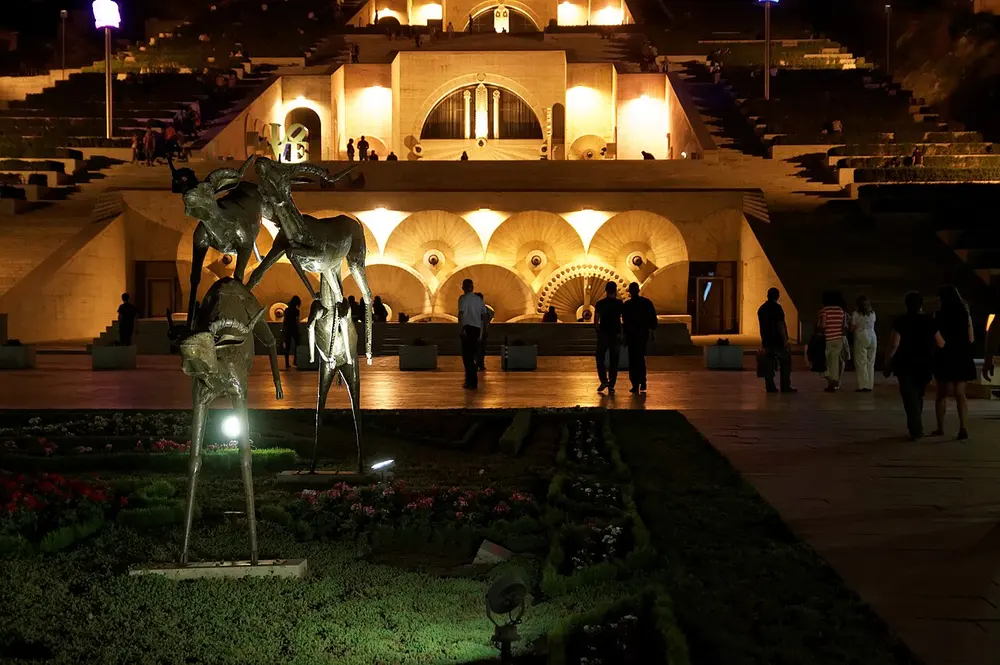
Yerevan, Art, Yerevan Cascade, Armenia. Photo: Vyacheslav Argenberg / Wikimedia Commons, CC BY 4.0.
Racing at 1,000 metres
Yerevan's start altitude is around 1,000 metres. That is not a high-altitude expedition, but it is high enough for runners arriving from sea level to notice the thinner air, particularly on the climb. Breathing feels a little more deliberate, and a pace that feels easy in training can feel ambitious on race morning.
The practical response is to arrive with a few days to spare if the schedule allows, keep the opening kilometres conservative and pay attention to effort rather than the watch. The altitude is part of why the course is demanding, but it is also part of the race's character: this is a marathon in a mountain country, above the Ararat plain.
A loop through the centre
Because the route returns through central Yerevan, the landmarks repeat. Republic Square appears early, the Cascade dominates the climbing, and the city's streets fill in the rest. That is a gift for spectators and a challenge for runners: the same buildings can make the loop feel shorter than it is, then longer when the legs tire.
Read the course by landmark rather than kilometre. Use the square as the anchor, the Cascade as the day's major effort, and the return through the centre as the place to hold form. When Mount Ararat is visible above the rooftops, it is worth a glance; the mountain is one of the reasons this race feels unlike a marathon in a flatter capital.
What the day asks
The Yerevan Marathon asks for patience twice: once on the climb, once on the long roll home. It is not a course that rewards a fast opening, and the altitude makes an honest effort feel harder than the numbers suggest. Runners chasing a fast time or a first marathon should weigh that carefully.
That does not make it a race to avoid. It makes it a race to prepare for. Hill sessions, time on undulating roads and a conservative plan will do more for the day than any target pace. The reward is a tour of one of the region's most distinctive capitals, with the Cascade as the backdrop.
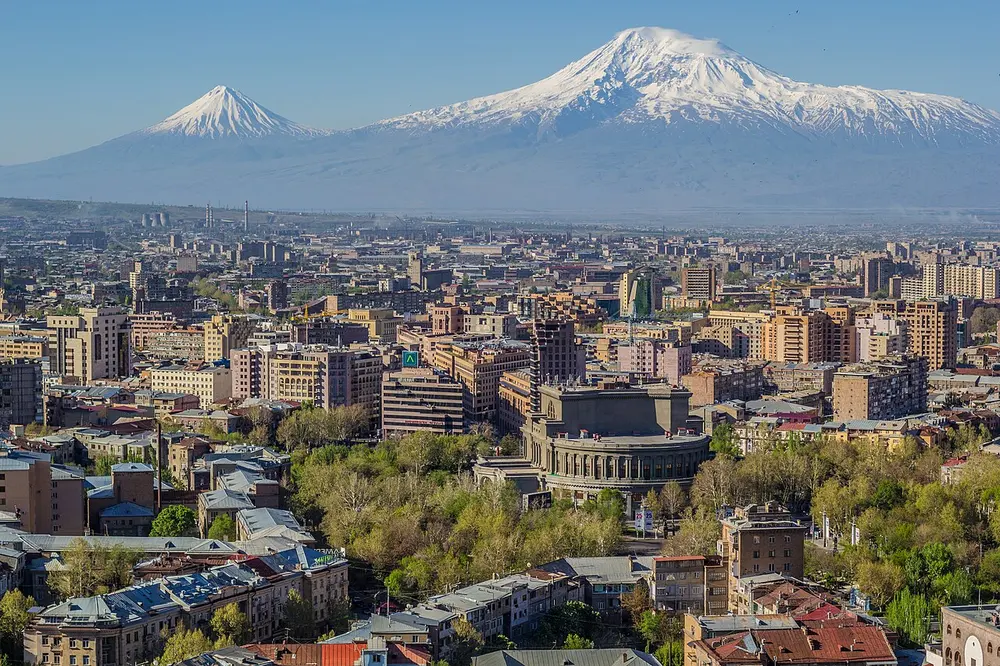
Mount Ararat and the Yerevan skyline. Photo: Սէրուժ Ուրիշեան (Serouj Ourishian) / Wikimedia Commons, CC BY-SA 3.0.
Frequently asked questions
Answers to the questions runners ask before entering, drawn from this race's course guide and the directory's own data — the sources behind them are listed below.
When is the Yerevan Marathon?
The race is expected in October 2027. It is an October marathon through the Armenian capital.
How hilly is the Yerevan Marathon?
The course climbs about 347 metres, and the climb towards the Cascade is the defining ascent. The rest of the loop rolls rather than settling flat, so there is little chance to coast.
What landmarks does the course pass?
The route loops through central Yerevan, past Republic Square and up towards the Cascade. Both sit in the heart of the city and give the race its visual identity.
How high above sea level is the start?
The city sits around 1,000 metres above sea level. That is not extreme, but runners from lower ground will notice the difference, especially while climbing.
Is Yerevan a good place for a personal best or a first marathon?
The course is hilly and the start is at altitude, so it is not the obvious venue for either. The route is better chosen for the experience than for the clock.
What exactly is the Cascade?
The Cascade is a monumental stairway and arts complex climbing the hillside above central Yerevan, with terraces, fountains and exhibition spaces. The race climbs towards it, and that ascent is the most demanding part of the route.
More marathons in Asia
Sources for this page
What each source below is used for on this page, and where to check this race yourself.
- World Athletics — the label calendar and the road-race regulations. Used to check whether the race holds a World Athletics label, and its elite competition details.
- AIMS — the international course-measurement standard behind the 42.195 km distance, and the AIMS race calendar.
- The organizer's own publications — course maps, race handbooks and published results. The date, course character and climbing on this page are compiled from them and re-checked each season.
Where do these facts come from?
Dates, course type, climbing and time limits are compiled from the organizer's publications and re-checked each season; elevation is an estimate of total climbing rather than a survey figure. Always confirm race-day details with the organizer before making plans.
Last reviewed 27 October 2026