
Melbourne Marathon
The Melbourne Marathon ends inside the Melbourne Cricket Ground, and that finish is the reason many runners remember it.
By Global Marathon Routes editorial team · Last reviewed 27 October 2026
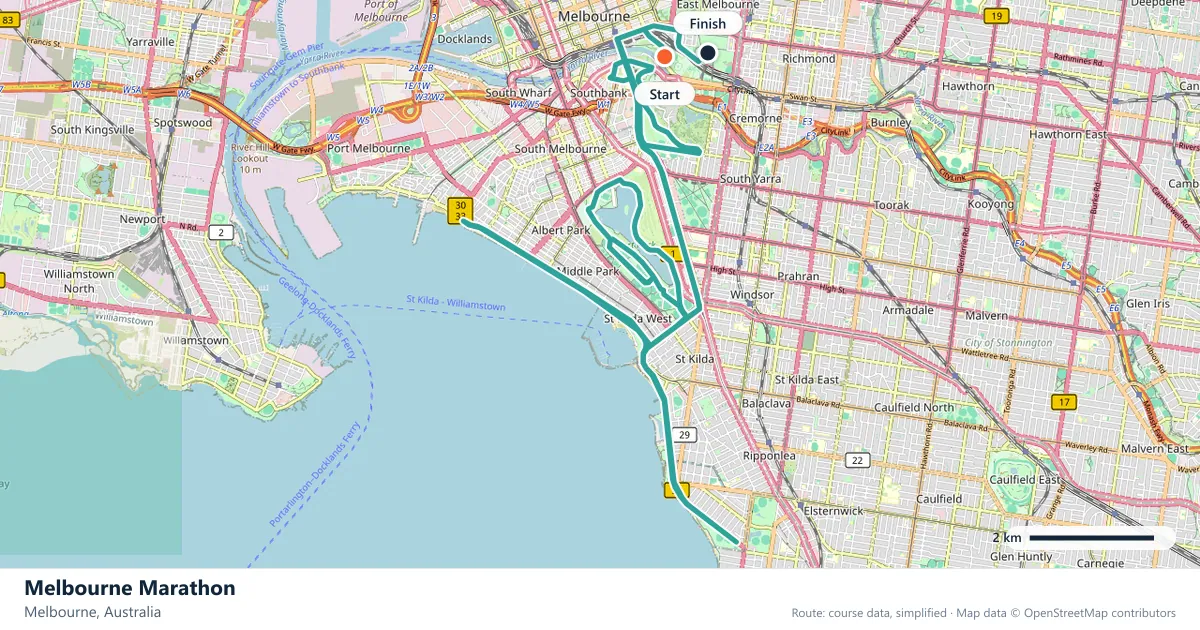
Where does the Melbourne Marathon run?
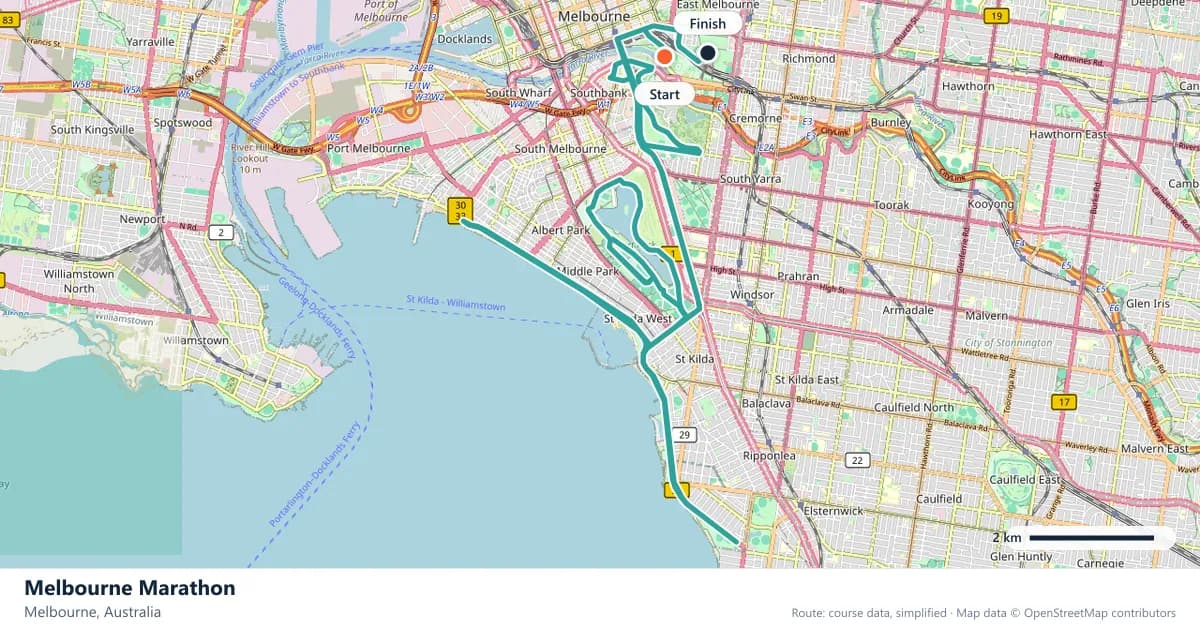
Interactive map
The trace follows the organizer's published course, simplified for the screen: the orange dot is the start, the dark dot the finish. Scroll to zoom, drag to pan.
What is the Melbourne Marathon course like?
A spring marathon that finishes inside the Melbourne Cricket Ground, running past the city's landmarks and along the bay. Flat and quick, with the stadium finish unlike any other.
- Next edition
- October 2027 (expected)
- Elevation gain
- 138 m
- Profile
- Undulating
- First run
- —
Course guide
The Melbourne Marathon ends inside the Melbourne Cricket Ground, and that finish is the reason many runners remember it. The 2026 edition was held on 11 October, and the closing lap on the MCG turf gave the race an ending that few city marathons can match.
Before the stadium, the course passes many of Melbourne's landmarks and runs along the bay. The profile is undulating rather than perfectly flat, with about 138 m of climbing, but the overall impression is of a quick city course with enough variation to keep the legs interested. The race is suited to fast times, and the stadium finish gives a fast day a memorable conclusion.
The result is a marathon that works on two levels: a serious personal-best course, and a city event with a finish that non-runners can understand.
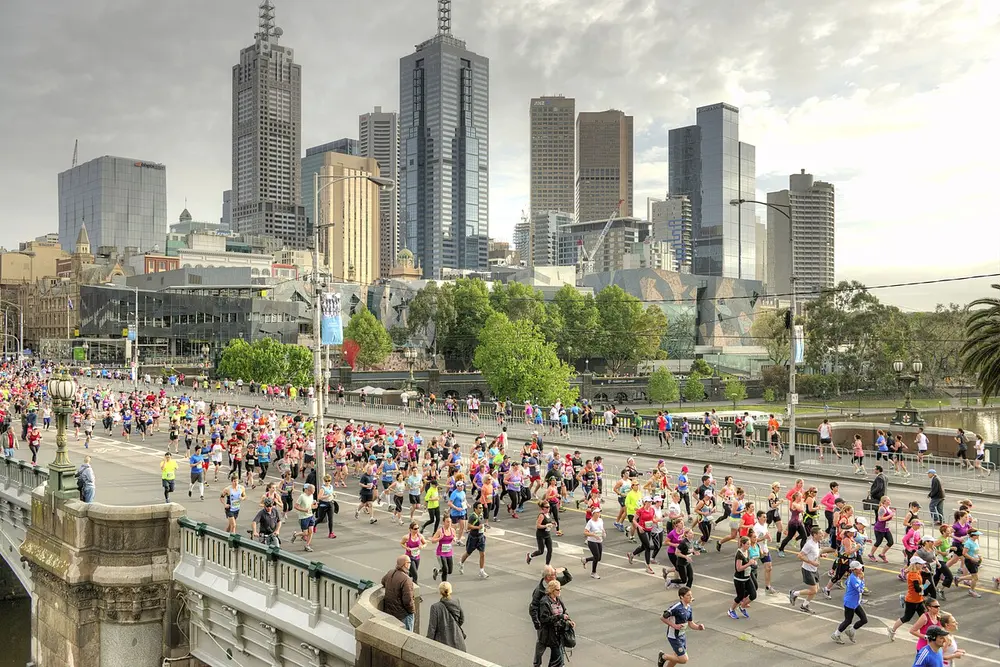
Melbourne Marathon 2013. Photo: Chris Phutully from Australia / Wikimedia Commons, CC BY 2.0.
The course
The race is a tour of Melbourne that closes with a stadium finish. The route takes in the city's landmarks and follows the bay for a stretch, so the surroundings change from dense urban streets to open water before the final approach to the Melbourne Cricket Ground.
The profile is undulating, with about 138 m of climbing spread across the marathon. There is no sustained ascent, but the small rises are enough to break the rhythm, and the closing kilometres inside the stadium approach are unlike anything else on the calendar. The stadium crowd is the reward for a well-managed race.
The course stays within the city and its bayside suburbs, so the running is urban throughout. There are no remote sections and no trail; the challenge is the distance, the undulations and the need to pace the early city miles with the finish in mind.
The stadium finish
The Melbourne Cricket Ground is one of the most famous sports venues in Australia, and finishing inside it is the defining experience of the race. Runners enter the stadium for the final lap, with the crowd in the stands and the field in front of them. It is a finish that feels like an event, not just a line on a road.
The approach to the MCG is part of the experience. The course works through the streets around the ground before turning inside, and the noise builds as the finish gets closer. Runners who have anything left can use the atmosphere to lift the last kilometre.
The stadium also changes the psychology of the race. Instead of a finish line somewhere in the city, there is a clear destination that you can picture from the start. That helps in the difficult middle miles, when the legs are tired and the stadium still feels a long way away.
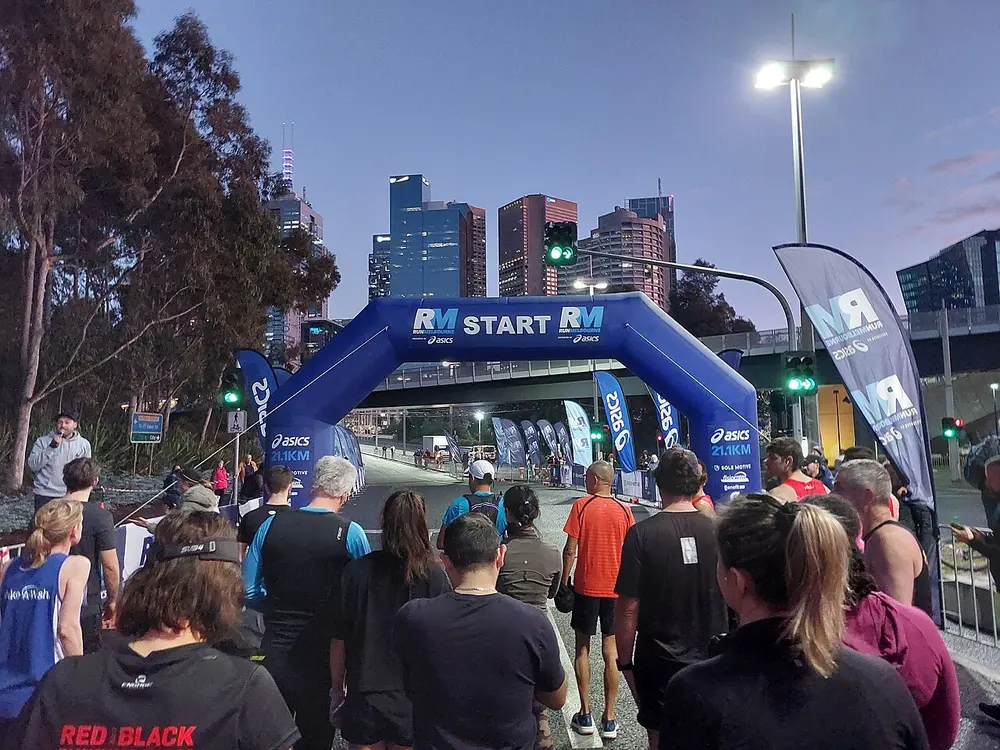
Run Melbourne Half Marathon Starting Line. Photo: KeepActive Australia from Melbourne, VIC, Australia / Wikimedia Commons, CC BY-SA 4.0.
City streets and the bay
The first part of the race is a tour of central Melbourne. The city is dense, the streets are lined with the landmarks that define the skyline, and the field is still packed together. It is a fast section in the sense that the ground is mostly level, but it is also a section where it is easy to go too quickly.
The bay section opens the race up. The water appears, the horizon widens, and the course becomes more exposed. The change of scene is welcome after the city streets, but it also brings wind and weather into play. Runners should be ready for the conditions to change as the route moves towards the coast.
The return to the city and the stadium closes the loop. By then the legs have done most of the work, and the remaining kilometres are about holding form and saving enough for the final lap. The city streets that felt busy at the start now feel like the last stretch before the finish.
Spring in Melbourne
October is spring in Melbourne, and the weather can be variable. A morning may start cool and bright, then turn windy or showery, and the bay section can be exposed to whatever the day brings. Runners should prepare for a range of conditions rather than a single forecast.
Spring also gives the race a lively setting. The city is coming out of winter, the parks and gardens are green, and the event has a festive feel that a midwinter race would lack. The date is part of the appeal, not just a scheduling detail.
The weather is one reason the course is not a guaranteed personal best. The profile is quick, but wind and rain can make the day harder than the elevation figure suggests. Runners should have a target and a backup plan.
Where the day is decided
- The stadium finish. The MCG is a unique finish, and the atmosphere can carry you through the last kilometre if you have anything left.
- The small rises. The course is undulating rather than flat, and the changes of grade are easy to miss until the legs are tired.
- Spring weather. The race is held in October, so prepare for a range of conditions rather than a single forecast.
- The bay exposure. The waterfront section can be windy, and the open ground offers little shelter.
- The early pace. The city sections and the bay are quick, and the temptation is to bank time before the undulations catch up with you.
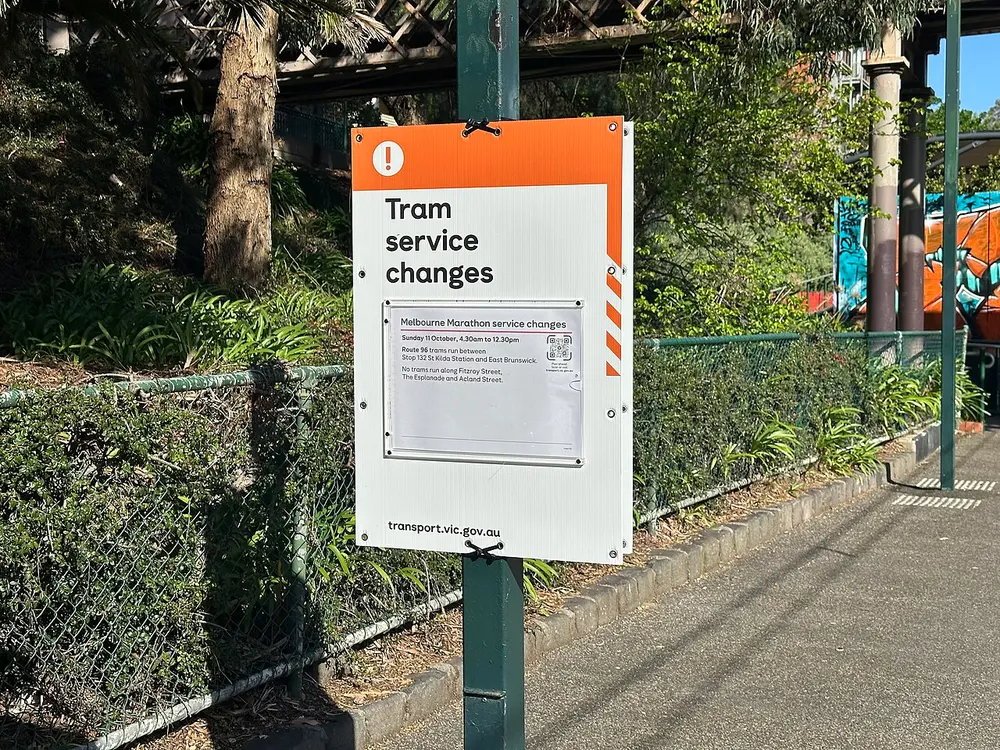
Tram service changes Melbourne Marathon 2026. Photo: Totallynotarandomalt69 / Wikimedia Commons, CC0.
Frequently asked questions
Answers to the questions runners ask before entering, drawn from this race's course guide and the directory's own data — the sources behind them are listed below.
When was the Melbourne Marathon in 2026?
The 2026 edition was held on 11 October 2026. The race finished inside the Melbourne Cricket Ground.
Is the Melbourne Marathon a flat course?
It is mostly level but not entirely. The course is undulating, with about 138 m of climbing, so there are small rises rather than a sustained ascent.
Is the Melbourne Marathon good for a personal best?
The race is suited to fast times. The largely flat route supports quick running, although the undulations and the spring weather mean the pace still has to be managed.
Is the Melbourne Marathon a good first marathon?
The race is not specifically a first-marathon course. The gentle profile and stadium finish are appealing, but the emphasis is on fast times.
Where does the Melbourne Marathon finish?
It finishes inside the Melbourne Cricket Ground, after a route that passes the city's landmarks and follows the bay. The stadium finish is the defining feature of the course.
More marathons in Australia
More marathons in Oceania
Sources for this page
What each source below is used for on this page, and where to check this race yourself.
- World Athletics — the label calendar and the road-race regulations. Used to check whether the race holds a World Athletics label, and its elite competition details.
- AIMS — the international course-measurement standard behind the 42.195 km distance, and the AIMS race calendar.
- The organizer's own publications — course maps, race handbooks and published results. The date, course character and climbing on this page are compiled from them and re-checked each season.
Where do these facts come from?
Dates, course type, climbing and time limits are compiled from the organizer's publications and re-checked each season; elevation is an estimate of total climbing rather than a survey figure. Always confirm race-day details with the organizer before making plans.
Last reviewed 27 October 2026