
Gold Coast Marathon
The Gold Coast Marathon is built for one thing above all: fast running. The course runs beside the Queensland beaches and the Broadwater, climbs about 93 m in total, and has been a record race for…
By Global Marathon Routes editorial team · Last reviewed 27 October 2026
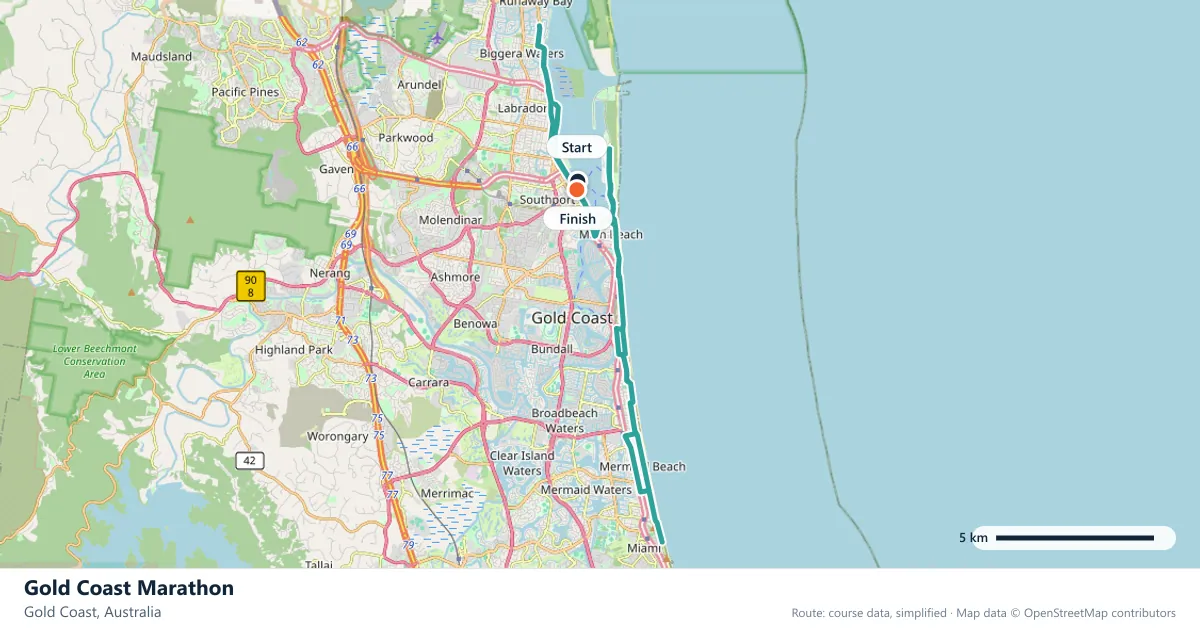
Where does the Gold Coast Marathon run?
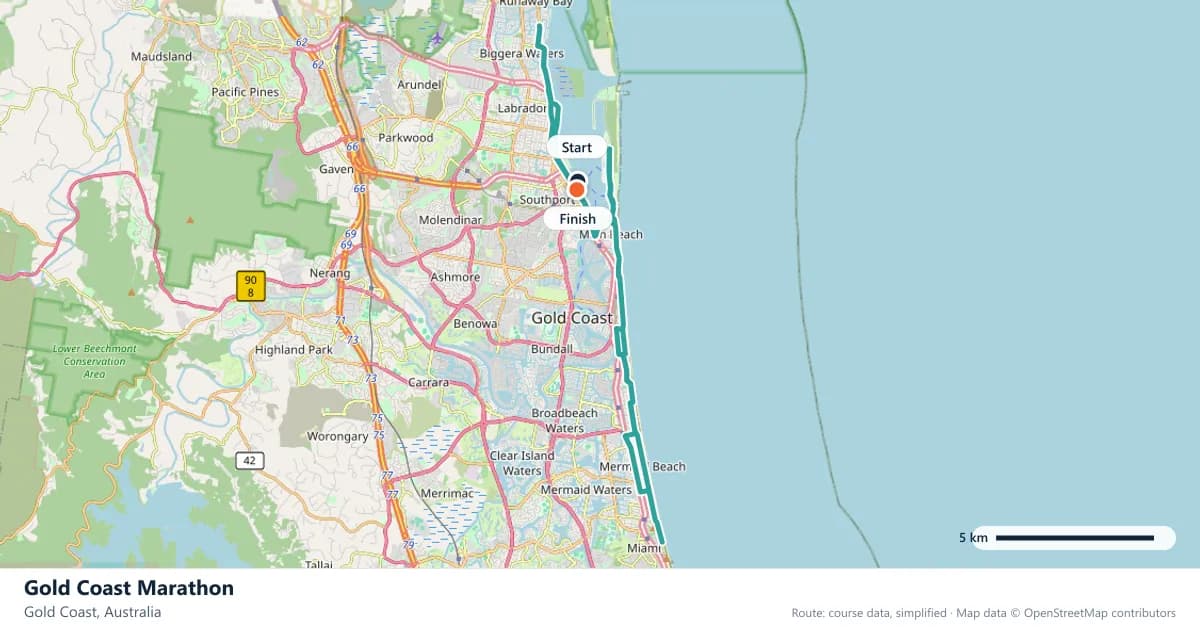
Interactive map
The trace follows the organizer's published course, simplified for the screen: the orange dot is the start, the dark dot the finish. Scroll to zoom, drag to pan.
What is the Gold Coast Marathon course like?
A flat, fast winter marathon along the Queensland coast, running beside the beaches and the Broadwater. One of Australia's quickest courses and a long-standing record race.
- Next edition
- July 2027 (expected)
- Elevation gain
- 93 m
- Profile
- Flat
- First run
- —
Course guide
The Gold Coast Marathon is built for one thing above all: fast running. The course runs beside the Queensland beaches and the Broadwater, climbs about 93 m in total, and has been a record race for long enough that its reputation now precedes it. Runners come here with a target time in mind.
The date is July 2027 (expected). July is winter on the Gold Coast, which means crisp mornings and low humidity compared with the Queensland summer, and the flat course gives that weather every chance to produce quick times. The event holds a World Athletics Label and is one of Australia's long-standing marathons.
The appeal is a long, flat run beside the water, a winter morning and a course that rewards even pacing.
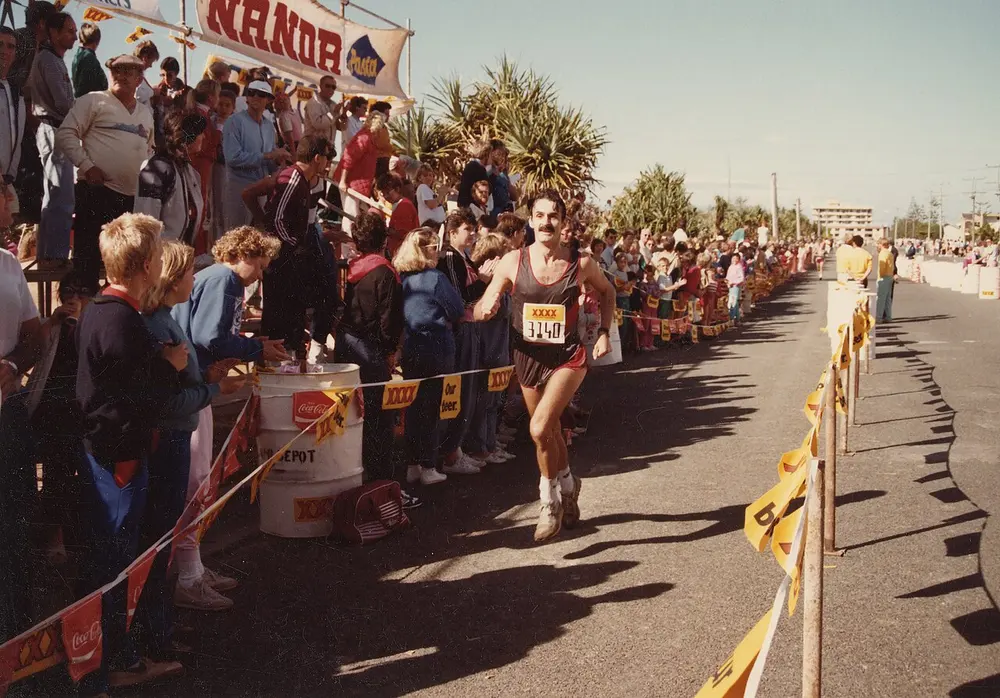
Gold Coast Marathon, 1986. Photo: Queensland State Archives from Runcorn, Queensland, Australia / Wikimedia Commons, CC BY 2.0.
The course
The route follows the coast, taking in the beaches and the Broadwater rather than heading inland. It is a straightforward course without a defining climb, and that simplicity is the point: the race is designed to let runners settle into a rhythm and hold it.
The 93 m of gain is spread so thinly that it barely registers. There are small rises and changes of direction, but no sustained ascent and no point where the course forces a change of pace. The challenge is entirely internal: holding back early, fuelling consistently and staying patient when the kilometres begin to feel repetitive.
The course stays close to the water for long stretches, so the scenery is open and the views are wide. That helps the race feel less like a loop and more like a journey along the coast, even though the route ultimately returns to its starting area.

Gold Coast Marathon, 1986 (photo 2). Photo: Queensland State Archives from Runcorn, Queensland, Australia / Wikimedia Commons, CC BY 2.0.
The beaches and the Broadwater
The Gold Coast is a long strip of coastline south of Brisbane, built around surfing beaches and the calm water of the Broadwater. The marathon uses both, so the course alternates between the sound of the surf and the quieter edge of the inland waterway.
The beaches give the race its identity. This is not a city marathon that happens to be near the sea; it is a coastal race in a place whose economy and culture are built around the water. The route reflects that, with long stretches where the ocean is the constant companion.
The Broadwater sections are calmer and more enclosed, with the water on one side and the city's towers on the other. The contrast between the two sides of the course keeps the race interesting without introducing any real difficulty. It is scenery, not terrain.
A July morning
July is winter on the Gold Coast, and the race starts in the coolest part of the day. The temperature is usually mild rather than cold, but the coast can feel fresh before the sun is fully up, especially near the water. Runners should plan for a cool start and a warmer finish.
The winter date is a large part of why the course is fast. The humidity is lower than in summer, the mornings are crisp, and the sun is less intense. Conditions can still vary, but the baseline is more favourable than at a summer race in the same city.
The weather also shapes the race strategy. A cool start makes it easy to go out quickly, and the flat course makes it easy to keep going. The result is a race where discipline matters more than fitness in the opening hour.
The record chase
The Gold Coast has a long-standing reputation as a record race, and the flat profile explains why. Runners come here specifically to chase personal bests, and the course's speed shapes the field.
That focus can be helpful or harmful. Running with a group can carry you through the middle miles, but it can also pull you into a pace that is faster than your plan. The best approach is to use the company without surrendering your own judgment.
The course's speed is not a guarantee. A flat route still has to be run, and the winter morning can bring wind or rain. The record-chasing reputation is deserved, but it is built on runners who prepare well and pace intelligently, not on the course alone.
Holding the rhythm
- The early pace. The course is fast, and the temptation is to set off at personal-best pace from the first kilometre. Patience still matters.
- Winter layers. The race is held in July, so the start can feel cool before the sun is fully up. Have a plan for extra clothing.
- The coastal stretches. The open sections beside the water are scenic, so keep an eye on pace when the view opens up.
- The flat rhythm. Without hills to break the race up, the rhythm has to come from your own pacing rather than the terrain.
Frequently asked questions
Answers to the questions runners ask before entering, drawn from this race's course guide and the directory's own data — the sources behind them are listed below.
When is the Gold Coast Marathon in 2027?
The 2027 edition is expected in July. The exact date is not yet confirmed, so check the organiser's calendar before booking.
Is the Gold Coast Marathon a flat course?
Yes. The course climbs only about 93 m over the full marathon, with no sustained ascent. It is one of the flattest marathon courses in Australia.
Is the Gold Coast Marathon good for a personal best?
Yes. The flat profile, the winter date and the long coastal stretches all support an even pace and a fast time. The race has a long-standing reputation as a record course.
Is the Gold Coast Marathon a good first marathon?
The race is not specifically a first-marathon course. The terrain is forgiving, but the event is built around fast times rather than a first finish.
Where does the Gold Coast Marathon run?
It runs along the Gold Coast in Queensland, Australia, beside the beaches and the Broadwater. The course follows the coast and stays close to the water for much of the way.
What is the weather like at the Gold Coast Marathon?
July is winter, so mornings are usually cool and less humid than in summer. Conditions can vary, but the winter date is one of the reasons the course is associated with fast times.
More marathons in Australia
More marathons in Oceania
Sources for this page
What each source below is used for on this page, and where to check this race yourself.
- World Athletics — the label calendar and the road-race regulations. Used to check whether the race holds a World Athletics label, and its elite competition details.
- AIMS — the international course-measurement standard behind the 42.195 km distance, and the AIMS race calendar.
- The organizer's own publications — course maps, race handbooks and published results. The date, course character and climbing on this page are compiled from them and re-checked each season.
“A World Athletics Label denotes a full application of the Competition and Technical Rules in, at a minimum, the elite component of the competition. Labels also denote superior standards in event organisation, safety and runner experience, support from public authorities to the event and a financial commitment to anti-doping.”
Where do these facts come from?
Dates, course type, climbing and time limits are compiled from the organizer's publications and re-checked each season; elevation is an estimate of total climbing rather than a survey figure. Always confirm race-day details with the organizer before making plans.
Last reviewed 27 October 2026