
Paris
Paris Marathon · Schneider Electric Paris Marathon
By Global Marathon Routes editorial teamPublished Last updated
Interactive course map
aid stations: 18 · landmarks: 10Official course map
Open full size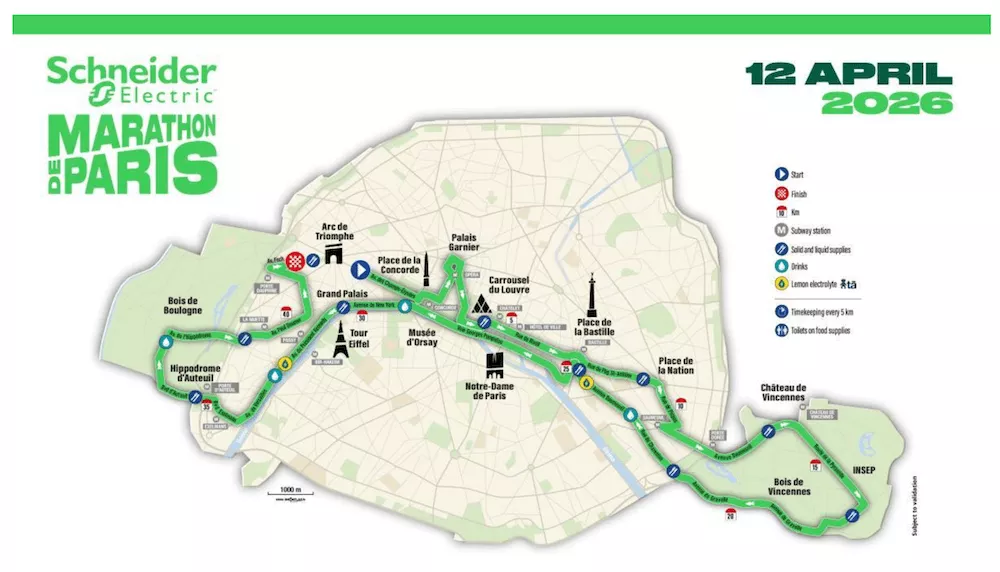
Race facts
Schneider Electric Paris MarathonLandmarks along the way
- StartChamps-Élysées
- 1 kmPlace de la Concorde
- 4 kmLouvre and Rue de Rivoli
- 13 kmChâteau de Vincennes
- 24 kmPlace de la Bastille
- 26 kmNotre-Dame
- 28 kmMusée d'Orsay
- 31 kmEiffel Tower
- 35 kmHippodrome d'Auteuil
- FinishAvenue Foch
Aid stations and timing points
Major stations modelled on the published course maps, plus the half marathon split. Real races place stations closer together, so treat the spacing as indicative.
Course guide
The Paris Marathon is one of the largest in Europe and runs through the centre of the city rather than around it. The route starts beside the Arc de Triomphe, swings east through the historic core, and finishes on Avenue Foch next to the Bois de Boulogne.
The course
The opening kilometres run down the Champs-Élysées towards Place de la Concorde, then turn east along the river. The course passes the Louvre, the Bastille and the edge of the Marais before heading out to the Bois de Vincennes, where it loops through the park in the middle third of the race.
The return leg follows the Seine westwards, passing Notre-Dame and the Eiffel Tower in the closing third, before a short climb into the Bois de Boulogne and the finish on Avenue Foch.
| Section | KM | Character |
|---|---|---|
| Champs-Élysées | 0 to 5 | Wide, fast, slight downhill |
| Right bank | 5 to 20 | Flat, historic centre, cobbled patches |
| Bois de Vincennes | 20 to 30 | Park loop, quiet, gently rolling |
| Left bank and Seine | 30 to 38 | Flat riverside, Eiffel Tower views |
| Bois de Boulogne to finish | 38 to 42.195 | Small rises, tree cover |
Aid stations and the half split
Aid stations are dense in the city sections and sparse inside the two parks, which is where the modelled map shows the larger gaps. The half marathon split falls inside the Bois de Vincennes loop. Expect water, fruit and sugar at most stations, with gels at the major points.
What to watch for
- Cobbles and paving. Parts of the city centre are paved with setts, which are harder underfoot than asphalt.
- Park sections. The Vincennes and Boulogne loops have fewer spectators and less shelter.
- Two parks, two climbs. Neither is long, but both come late in the race.
- Start logistics. The start is on the Champs-Élysées with strict access times, and bag drop is separate from the start pen.
Records
| Category | Time | Athlete | Year |
|---|---|---|---|
| Men's course record | 2:04:21 | Elisha Rotich | 2021 |
| Women's course record | 2:18:34 | Shure Demise | 2026 |
Practical notes
- Race day: early April. The next edition is scheduled for 11 April 2027.
- Entry: online registration plus a ballot for the most popular waves, with charity and tour operator places available.
- Getting there: the start near the Arc de Triomphe is served by Charles de Gaulle to Étoile, lines 1, 2 and 6. The finish is near Porte Dauphine.
- Weather: usually 6 to 16 °C, with April showers possible.
Frequently asked questions
Quick answers to what runners ask most about this race. Every figure is checked against the official sources listed below.
When is the Paris Marathon?
It is run in early April. The next edition is scheduled for 11 April 2027.
Do you need a qualifying time for the Paris Marathon?
No. General registration is open to any runner and sells out quickly, with a ballot for the most popular waves and charity or tour operator places as a fallback. There is no Boston-style qualifying standard for the mass field.
Is the Paris Marathon course flat?
It is mostly flat and fast, and the opening kilometres down the Champs-Élysées are quick. The exceptions are the cobbled and sett-paved stretches in the city centre, and the short climbs into the Bois de Vincennes and the Bois de Boulogne.
Where does the Paris Marathon start and finish?
It starts on the Champs-Élysées beside the Arc de Triomphe, served by Charles de Gaulle to Étoile on lines 1, 2 and 6, and finishes on Avenue Foch next to the Bois de Boulogne, near Porte Dauphine.
How many runners take part?
Around 54,000 runners take part, which makes Paris one of the largest marathons in Europe.
What is the weather like on race day?
Expect 6 to 16 °C with April showers possible. The city sections offer some shelter; the two park loops do not.
About this guide
Compiled by the site's editorial team from public race-organizer publications, course maps and results, then re-checked against the official race site before publishing. Course traces on the map follow the organizer's published course, simplified for the screen.
By
Global Marathon Routes editorial team
- Published
- Last updated
Checked against the official sources listed on this page.
Sources for this guide
Facts, dates and records on this page are taken from the primary sources below. Always confirm race-day details with the organizer.
Related links
Encyclopaedia entries for this race and the organizer's own site: history, records and background reading beyond this guide.